

Replacing remote blower hood
Hi,
I have a 20 year old Thermador hood with remote blower (on the roof) that is noisy and needs to be replaced because Thermador doesn't make any parts for it. My problem is nobody wants to go near it (appliance companies, electricians, etc.). Who do I get to replace this thing?? I've contacted appliance stores about replacing the whole hood along with the blower and they won't replace the blower on the roof either (told me I need an HVAC company).
What do I do? I'd like to replace it with an internal blower so it can be fixed next time it breaks. Any suggestions welcome. Thanks.
Comments (39)

Ari
Original Author7 years agoThe appliance companies, and those recommended by Thermador don't want to have anything to do with external blowers. I'll have to try an HVAC company.
 PRO7 years ago
Hi Ari,
We're sorry to hear that. Appliance companies typically stay away from range hoods that have been modified or are especially old for liability reasons. We hope you're able to secure an HVAC company that would be able to help out in your situation.
We wish you the best of luck.
Very Best,
Tai TruongElements of Design
3400 Medford Street
Los Angeles, CA 90063
tai@lusivedecor.com
Related Professionals
Dothan Kitchen & Bathroom Designers · Altoona Kitchen & Bathroom Designers · Montgomery Bathroom Remodelers · Dayton Bathroom Remodelers · Huntington Bathroom Remodelers · Chicago Bathroom Remodelers · Bend Kitchen Remodelers · Louisville Kitchen & Bathroom Designers · Lafayette Kitchen & Bathroom Designers · Worthington Kitchen & Bathroom Designers · Virginia Beach Kitchen Remodelers · Fort Wayne Kitchen Remodelers · Sebring Custom Countertops · Cambridge Custom Countertops · Platteville Custom CountertopsAri
Original Author7 years agoThanks. Is there any external blower that's compatible with the hood I have? It's a Thermador HT36HQS. Thanks!
- 7 years ago
Let's start with something simple. Does the hood have a continuous control, i.e., off to on full power switch and then lower power as one turns the control CW, or, are there several switch positions (or pushbuttons) for different amounts of fan power?
- 7 years ago
Then one might suspect an induction motor requiring two feed wires (plus ground) is in use, and the hood control is a basic diac/triac solid state controller. Many blowers from Broan and others use induction motors of this type that can be powered from such a control. You would need to know the HP or current rating of the existing motor to be sure that the motor control in the hood can handle the replacement blower (need to find the HP or current rating of the candidate replacement).
Once you have the replacement, and any sheet metal needed for interfacing the new blower with your duct, a carpenter who can work on roofs or a small business roofer should be sufficient for installation, and an electrician to hook it up in your attic (assuming it is accessible).
You may be able to find a small project contractor who maintains an electrician license who can do the entire task. But all of this commentary is a stab in the dark without a complete description of the wiring, the ducting, the manner in which the existing blower is mounted, etc. Costs may get out of hand to the point where a fresh start from requirements establishment to hood system purchase to HVAC install is price competitive.
Ari
Original Author7 years agoNot sure how to figure out the HP of the current motor as it's on the roof. Model number of the hood is HT36HQS if that helps. Which Broan motor may be suitable? I'd like to go with an in-line motor.
- 7 years ago
If Thermador doesn't provide data about their hood's preferred blower, then perhaps Broan can advise you on a substitute. Detailed suggestions are difficult at this distance.
- 7 years ago
So, what you want to do, I think, is examine Broan/Best roof blowers for compatibility. Current not to exceed 7.8 amperes, duct interface more or less (preferably the same) as what you have, and a basic induction motor. (We can discuss CFM when you have candidate(s).)
You may be able to determine all this from the candidates' blower specifications and/or their installation instructions. All of these should be at Broan's website, but you can always call for technical help. They will want to know what your duct configuration is, I expect.
Installation requires disconnecting the existing blower's power (after depowering the circuit), disconnecting the duct from the blower, and disconnecting the blower housing flange from the roof with as little disturbance of the shingles as possible. As they say, installation is the reverse of de-installation. :) If the duct interface is a different diameter, a transition piece will be needed.
Ari
Original Author7 years agoThanks. My goal is to get someone to replace it with an in-line blower. Would the fantechs be good choices as well?
- 7 years ago
This office interposes no objection to Fantech, but has only purchased silencers and duct fittings from them so far. They appear competent over the breadth of their product lines.
- 7 years agolast modified: 7 years ago
Ari, Kaseki is clearly the expert on hoods and venting. My two cents is that if you are willing to deal with a little inconvenience, you should be able to find a roofer and a handyman HVAC guy to get things back working. Right now you have a hood with controls for the fan and lights, ducting, and a blower on the roof - if you can live with the fan controls not on the hood, it should be pretty straight forward, if you want the fan control on the hood, it will be a bit more complicated. I liked https://www.hvacquick.com/products/residential/Kitchen-Exhaust/Kitchen-Exhaust-Fans for fans and silencers, I got a VTX blower, and the fantech silencer, and recommend both. As Kaseki says, you need to determine the desired CFM, considering duct losses, and MUA requirements, then get an HVAC contractor, to come over and look at the existing ducting. Hopefully there is enough space in the attic to install the blower and the silencer, and he can run power to the blower and install a speed controller in a convenient location in the kitchen, though unfortunately, it probably won't be on the exhaust hood itself. Then you need a roofer to remove the roof mounted blower, and install a roof vent, with a flap, that can connect to the ducting in the attic. Alternatively, you can try to find an inline blower with a rating under 7.4 amps, and see if your contractor can wire the inline blower to be controlled by the speed controller on your vent hood. I am no expert electrician, but the wiring diagram confirms the speed control is continuous, and so it should? work with any speed controllable fan under 7.4 amps- though there is no guarantee, and the contractor may not want to try it for liability reasons . Unfortunately, it will take at least two trips, since the contractor will have to confirm there is space to fit the blower and silencer, and the duct sizing that is needed. You may also need some transition pieces get the blower and the vent to fit the ducting.
- 7 years ago
Also, if wiring is changed, I would check to see if someone actually used 16 AWG conductors to feed the blower. Better would be to use 14 AWG in that conduit unless there is separate fusing in the hood. While there are various exceptions in the NEC (NFPA 70) for motor controls and connections to motors, a conduit to the roof is a bit of a stretch for a motor whip. If the hood is fused at the breaker at 15A, then all the wiring should be consistent at 14 AWG or thicker. It is best to not temp 'fate' with low but not insignificant probability fire risks.
Ari
Original Author7 years agoThanks both. There’s certainly space in the attic for an inline fan. The duct just goes straight up from the hood through the attic and through the roof. There’s space to put in a blower. I was going to skip the silencer. I’m already having my roof redone in a few weeks anyway so they roofer is removing the external blower, capping the wires, and putting on a Broan roof cap with damper. I was going to go with the fan tech 6XL (which fantech said only needs 5 amps). I just need someone to mount that, hook up ducting and connect the wiring. Hopefully the hood controls will work if not I may need to get a separate controller. I’lol have to find a handyman or general contractor since the hvac folks say they don’t do it (I called a lot of them).
With regard to the wiring, I wasn’t following a lot of that Kaseki. I know the manual said 16 AWG but I have no clue what they used. Is there a way to tell by looking? I know I saw in my breaker box that the hood has its own breaker.Ari
Original Author7 years agoHere’s a photo of whats in the attic. Don’t blame me for any of this, I inherited it from the previous owner. It looks like (correct me if I’m wrong) a 6” duct transitioning to a 10” duct to accommodate the remote blower they wanted. My thought is since it’s a 6” duct from the hood (and Im not trying to do a big remodel and just want to get the hood working), stick with 6” round duct the whole way. Get rid of the 10” duct, get a fan like the fantech FG 6XL that is for a 6” duct, add in 6” duct above the blower to the roof cap, and have the roofer replace that wood, make a 6” round hole and put on a roof cap for a 6” round duct. Roofer will do his part first and then i’ll get someone to do the rest. Am I thinking about this right?
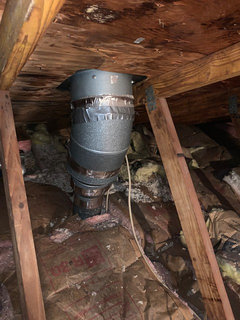
- 7 years ago
What Kaseki was saying is that the wiring diagram called for 14 gauge, which will handle higher loads than 16 gauge, but no one knows exactly what was used without checking. Yes, you can check gauge size by the diameter of the wire - it would be great if you had a caliper to measure the bare wire, though if you go to the local home improvement center and look at the wire they sell ( not extension cords, just wire cable in a jacket) it is not that hard to tell the difference in thickness between 16 gauge and 14 gauge. Again, you are looking at the bare wire size, not the part that is insulated. It is sort of like looking at a nickle versus a dime , you can see the difference in thickness pretty easily when you hold them up to each other. https://www.whimsie.com/gauge%20wire.html
Since none of the HVAC guys will look at it, check your local Nextdoor for handyman. I did my own, so any decent handyman should be able to do the job. As to ducting, while I defer to Kaseki, if it would me, I would make the ducting as large as possible , it will be easier on the motor and may be better for sound issues. For example, if you found an 8 inch fan, I would transition to 8 inches at the ceiling, and stay that way all the way through the roof. - 7 years ago
Ari: Now you are getting to what the hood should have for a blower, and this is a more complicated question. There are many questions to answer that I don't have time right now to ask, although they may be implied by other threads on this forum. To start, can you replace the 6-inch duct with a larger diameter? What is the hood entry aperture size? What is the cooktop size? Does your Thermador literature list a nominal CFM value?
- 5 years ago
In case anyone else is reading this, we pulled our Thermador remote blower from the roof because it was noisy. Turns out the fan blades were hitting the housing. Had someone pull them away, straighten them, and it was quiet for about a month. They said with the roof slope over the 20 years that ours was installed, it had just sagged. Wondering if a brace to hold it would work. Worked fine for that month. Just needs to not hit the housing...
- 5 years ago
I interpret this report to suggest that the blower has desk fan or attic exhaust fan like blades that have perhaps fatigued at the blade root and tend to bend when loaded until they hit something.
Modern(ish) down roof hood blowers such as made by Broan (also used by Wolf) and Abakka have a flat disk with substantial vertical riser type blades. These will probably never fatigue in that manner.
I also wonder what flow rate you are pulling w.r.t. the size of the hood you have. That 6-inch duct section strikes me as a flow gag zone. When you are in the mood for a hood upgrade, maybe we can assure that the parts are matched for the application.
- 5 years ago
kaseki, in case you read these older threads occasionally....
I, too, have a Thermador HT36HQS, about 22-23 years old at this point. The fan switch has just stopped working - no fan operation, and no distinct On/Off click anymore.
After turning the power off at the circuit breaker, and then doing some "sitting-on-the-stove" shenanigans, I was able to figure out how to drop down the control panel to get to the switch and remove it.
(FYI for others, in this model Thermador hood, remove the 3 spring-loaded metal grease mesh filters and then look for 3 screws holding the control section metal panel (the one with the cut-outs for the lights) to another flat metal flange above it. Then be very careful and pull down on the control secton panel - be careful, the edges are thin and sharp! It's a very tight friction fit and so you must exert controlled force pulling it down. Be aware that the front edge of the metal piece, which is at the front of the hood if you're standing in front of your stove, has a 90-degree vertical lip, and can kind of act as a "hinge" as you pull the metal panel down from the middle of the hood where you took out the 3 screws. It's such a tight friction fit, you may think other fasteners are still in place, but it's nothing but a very tight fit side-to-side. So be very careful when pulling down on the control section - you don't want it to fall and pull out some of the wiring. Have something about 2 ft high on the stove you can rest the control section on since the wiring isn't long enough to allow you to set it down on your stove once you remove it from the hood. I found that two upturned 5-gallon buckets (like paint comes in, or empty ones you can buy at Home Depot or Lowes worked just fine for me.)
Anyway, kaseki, that fan switch (part # 00486762) is no longer available Anywhere! It controls an internal hood fan and a remote blowe via a 3 wire pigtail. The back of the plastic switch housing says its made by "Trivar Canada" and their part ID is "LR-46842." Googling for that also turns up nothing.
The back of the switch itself says it's "cTs, Type GC (or maybe"CC"), 8 A, 125 V.A.C." I see a lot of generic fan/furnace/hood solid state controllers rated at 8 amps or higher, but they all seem to just have 2 wires. Do you know if I could use such a 2-wire switch and somehow adapt it to the original 3-wire pigtail going to the remote blower?
(I am even willing to just settle for a simple On/Off generic replacement switch and forgo the continuously variable fan speed control just to get the hood exhaust working again.)
Thanks! - 5 years agolast modified: 5 years ago
You will need to determine whether one of those wires connects to ground, defined as whatever is connected to the green wire in the cable from the breaker panel, or to the white wire from the breaker panel. Use the wiring diagram provided with the motor control switch to determine how each of the circuit "colors" are to be used. Functionally, the switch should be in series with the black conductors, but the neutral may be part of the circuit. The other motor wire should be connected to the white conductor (neutral) from the breaker box. You should be able to test this with the control guts hanging from the hood.
N.B. Remote electrical analysis from here is fraught with potential error.
If your switch is actually a control for a triac diac control scheme somewhere in the pulled panel, then you need a potentiomer type device with its three terminals properly connected to the circuit under control, interconnected with whatever switch was integrated with the pot. That would be a more complex undertaking to wring out. To exclude this, check that your control is wired to the motor and hood power and not some mysterious circuit.
- 5 years ago
Thanks for the quick response, kaseki.
I think my particularly Thermador hood is the latter type since it has an Off/On rotary switch with the continuously variable fan speed. Plus when I finally got the control panel loose and pulled the switch module out, it had a Blue and Black wire coming out of the module and into a pigtail with a third Red wire coming from a wire-nut junction with Black power wires.
So yes, I have a failed potentiometer switch going (presumably) to the remotely-located exhaust blower in the attic. I was wondering that since I cannot find that Thermador (Bosch) replacement part Anywhere, nor a direct replacement fit substiute part, if I could either just leave that pigtail disconnected and out of the control circuit.
Would any operational damage occur if the remote blower fan motor got no signal from this disconnected pigtail and just got direct power from its connected Black and White power wires? I would just put a simple inexpensive Off/On switch where the rotary fan control switch now resides. I just don't know if the remote blower fan motor requires some additional "Control" signal in order to run at all.
I've attached a photo (and close-up) of the rolled-up wiring diagram that fell out of the control panel once I figured how to dislodge the panel.
Thanks in advance for any additional operational light you can shed on this problem. I'd hate to have to repace an entire kitchen hood and remote blower system for lack of a simple switch remedy.
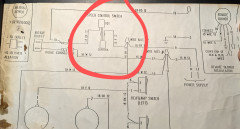
(The schematic icon labeled "CONTROL" is the pigtail connector to the remote blower fan motor.)
- 5 years agolast modified: 5 years ago
Sho' 'nuf. You can see from the schematic that they use a regular receptacle / plug to connect the motor to the control. The motor side of the circuit plug can be plugged into an extension cord to demonstrate blower action; the interior side can be connected to an on/off switch for temporary control (bypassing both "pot" and "control" devices; or, the present control components can be replaced by a variable motor control. These are likely available at big-box hardware stores or electrical distributors and are usually configured to mount in a wall switch box. You would want one that uses the same attachment means as your present defective control.
On your schematic, there are "pot" and "control" blocks. Do you have a fan switch and a fan speed control as separate items? If not, which one of these is actually exposed to the user? If only the "pot" part, that might be replaceable from Digikey, Allied, or some other source. However, in general I would replace the pair of them with a wall switch type motor control if I could find one that could be mounted in place of the existing circuit modules.
I wrote this without noticing your comment after the photos. It looks like the "pot" function is what you need to replace with the motor controller.
What I have in mind is this type, but there are myriad others. This type might not fit, but could be used for testing. Just be sure that the current rating is at least the current requirement of your blower (or at least the OP's blower).
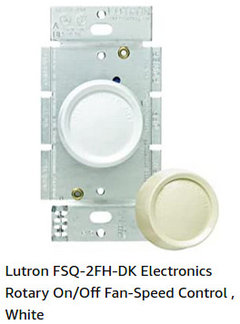
- 5 years ago
Thanks again for the input, kaseki.
Yes, when "inside the hood" when I was trying to remove the control access panel, I noticed the plug/receptacle for the under-hood motor which was really easy to unplug. I was a little surprised to see such an arrangement but I guess it makes sense - easy to disconnect for panel access and/or motor replacement; no hardwiring or wirenutting.
I guess I've always assumed my hood had a second blower up in the attic since this thread was started by the original poster discussing such a blower. I can't swear that I have one since I wasn't around when this house was built, and have never looked for it even though I have been in the attic a number of times (it's dirty and difficult to get to that part of the attice easily, otherwise I would just go check quickly).
From being under the hood the other day, and also looking at the wiring diagram, the under-hood blower is the "Internal Blower" with the plug, and there is a "Remote Blower" powered by a separate Red wire feeding off of a separate Brown wire coming out of the pot. That Brown wire thus feeds both the power leads for the Internal as well as the External Blowers.
However, the wiring diagram does not show what the 3 wire pigtail (identified as "CONTROL" on the wiring diagram) connects to, although it must be the speed control part of the set-up. I just don't know how to eliminate/replace that part of the wiring set-up without possible negative effects on the blower(s).
Otherwise, I'm guessing then that I can just put either a simple On/Off replacement control switch where the Pot/Control switch is now, or maybe even a Rotary Fan Speed controller like you suggested. Yes, the current little pot says "8A" on it, so I know to look for something rated at least to 8 amps.
I had already looked at some common ceiling fan or lighting controllers but I think most of them were rated around 3 amps or less because of the lower load needs, but I have seen some heavier duty industrial fan/motor controllers in about the $60-$70 range.
The original combination Pot/Control unit for my Thermador is tiny; maybe an inch in diameter, inside a plastic module box measuring about 2" x 1" x 1", which is affixed to the back of the control panel.
A similar Thermador hood control switch (but apparently not specified as a direct replacement for my hood model) goes for about $130-$140 online. I would probably be willing to pay that high premium if I could find an OEM replacement "new Old Stock" switch exactly like mine. But I am also perfectly okay with mounting a little external fan control box on the nearby kitchen cabinetry to get the hood working again, and leave it up to the next buyer of the house in 5-10 years to replace the whole hood if they wanted to in a kitchen refreshening. - 5 years ago
Oh, BTW, yes the original fan control switch is a one-piece On/Off with fan speed control. It is one of those rotary click-to-turn On/Off and then readjust for fan speed. It has always been confusing to me because there is always a 20 or second delay before the blowers even start and so you can't tell if the switch is working or not. Never liked it - would be more intuitive if it was just click to turn On, and then continue to turn to increase the fan speed linearly.
- 5 years ago
Modern fan control switches operate backwards from light dimmers; turning OFF to ON get one to full power, and then turning the control CW gets the motor to lower speeds. This scheme not only gets a motor reaction more quickly, but applies maximum torque to get the motor started. Minimum speed power might not start the motor. If you can integrate a wall switch easily (or at least practicably), then that might be a good solution.
- 5 years ago
Your schematic's wording leads me to believe that the choice was internal OR external, not both, but the schematic doesn't exclude a "both" configuration so long as the maximum current of the control is not exceeded.
- 5 years ago
We are dealing with a related issue. We have a 25-year-old Thermador Hood with remote blower (1400 cfm). It’s aging but still working okay (not great). We are in the process of replacing our kitchen appliances. We are replacing this hood with a new Thermador Hood (similar model) but with an internal 1000cfm blower. We are going to replace the remote blower on the roof of our garage with a roof cap with internal damper (10” round duct). Would appreciate recommendations on high quality roof cap with damper (sloped roof). We could find no appliance dealer that would sell and/or install a remote blower because of newer hvac regulations (Massachusetts) regarding fresh airflow in the home. Shifting from remote blower to internal blower with roof cap seemed like a workable solution to us.
- 5 years ago
??? Somehow MA regulations differentiate between internal blower and roof blower? Are you sure the issue isn't rated CFM above which make-up air (MUA) is needed. This threshold is most widely set at 400 CFM. Blower flow rates are determined by the blower's fan curve and the pressure losses in the hood system, where 'system' includes the path from cooktop to outside and back to the cooktop via whatever MUA path(s) exist. These pressure losses do not depend on whether the blower in internal or external.
- 5 years ago
Just wanted to follow up and bring my Thermador hood exhaust fan switch story to a close, for anyone else who might be reading this thread and in the same situation.
First of all, a BIG shout-out to kaseki because everything he/she has advised and pointed out has been correct.
For instance, a couple of weeks ago, I posted this photo of the schematic wiring diagram I found tucked up inside the hood. I thought the icon labeled "CONTROL" was the 3-wire connector I was thinking was connected to an external fan. kaseki was correct that my hood did not have Both an internal and remote blower, but the diagram was just showing how either internal or remote blower fan would be connected.
Then when I got further up into the hood and looked closer, it turned out that there was a physical "CONTROL" module that the "POT" (potentiometer) rotating fan switch was connected to. In other words, the icon "CONTROL" in the wiring diagram represents another little electronic physical module that is connected to the fan switch potentiometer by the 3-wire connector. It is not some connector to an external blower as I thought. The power wire "18 RD 12" at the top of the schematic is the only connection going to a remote blower, and you can see how the Potentiometer and Solid State Fan CONTROL module controls the amount of power going to a remote blower powered by "18 RD 12" as well as the internal blower powered by the "MOTOR OUTLET" plug.
- 5 years agolast modified: 5 years ago
I also considered kaseki's advice about wiring in a fan control switch and mounting it in its own little box nearby (say on the side of the kitchen cabinet next to the hood) but decided against it. We really don't need a lot of variable speeds for the exhaust, and would rather settle for just a simple On/Off switch that could be mounted on the hood control panel instead of opting for a big fan control mounted in its own receptacle box mounted externally nearby - very much a visible kludgy affair.
So I searched around and found, in of all places at Home Depot!, a simple well-known brand On/Off control lever switch - it is Gardner Bender GSW-18, an 8 amp, 125 volt SPST ("Single Pole, Single Throw" = simple "On/Off" switch) with 6-inch wire leads, and fitted for a 1/2" hole. All for less than $4!
One note to the wise - the existing hole in the Thermador control panel must be something like 7/16" because the Gardner Bender switch would not fit into the hole as-is. I didn't have a 1/2" drill bit nor a step drill bit to enlarge the existing hole, but then I remembered I had an old tap-and-die set. I pulled out one of the 1/2" diameter taps and after a few minutes of forcefully screwing that tap through the original hole, I was able to actually screw the Gardner switch into the hole.
Although it isn't black, and isn't the same type of switch as the existing hood light switches, the new lever switch does what it is supposed to and has made the hood exhaust functional again. There is only one speed now - either on or off. It was relatively simple to wire in -- you just put it in place of the original POTentiometer in the wiring schematic, and the Solid State Fan CONTROL module is just left unconnected under the hood - not used anymore with the simple Gardner On/Off switch.
Bottom line - thanks kaseki for all of the advice and imput, couldnt have done it without your expertise and help! Plus, got a 22-23 year-old Thermador hood exhaust fan running again for $4 -- a lot less than the $130 replacement fan switch (of which none are available), or the replacement cost for a new hood!
This is what it looks like now, rather purposeful and industrially high-tech in its own way ;-D:
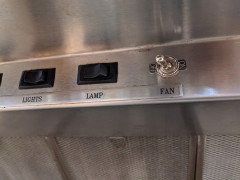
- 5 years ago
Hmm, odd... I made two postings yesterday, the second one with the resolution and a picture of the finished repair. Yet this second post did not appear before your post today.
I logged into my Houzz account and did see the second post there, so I'm not sure why it wasn't in the public thread. But now that I did that, when I return to the public thread, I see my second post from "11 hours ago" has now "magically" appeared! Can you see it now?
(And BTW, I think you were right - I think I have only the internal, in-the-hood exhaust blower fan. At least I don't think I can hear another one up in the attic.)
Thanks again for all your help, kaseki! - 5 years ago
I see a post with a schematic image with red circle, but the post only addresses resolution of what the parts are; I don't see anything related to you actually fixing your problem.



AriOriginal Author