Software
Houzz Logo Print
ali_burgess65

Encourage branching FLF

7 years ago
last modified: 7 years ago

Help! I cut my FLF to encourage it to grow two branches instead of one super long one.. but one of the new buds seems to have stunted isn’t growing. Any tips or suggestions?


Comments (7)

  • 7 years ago

    Nothing in your post to go on, other than the tree species. Image and timeline, please? It sounds like something very easy to diagnose if there was some information. Are you fertilizing? with what? how often? How long has it been since the last repot? Did you repot (includes bare-rooting, root pruning, and a change of soil) or pot up (simply bump the plant up to the next size larger pot). How long have you had the plant? How often do you water? How do you determine when it's time to water? Is it in full sun? Where do you live?

    Al

  • 7 years ago

    Yes I’m fertilizing, with Schultz 10-15-10 plant food. Once a month.

    I have never repotted it, it’s currently in soil with perlite & Indoor potting mix. I haven’t potted up or repot it because it seemed to fit the container it’s in. I water it once The soil is dry, I check by putting my finger in the soil and feeling. i water it until it drains through, wait about 10 and water again. I make sure it’s completely drained too. It’s in full sun and was regularly putting out 3 leaves at a time even through winter. I live in Vancouver BC canada. I tried to include a picture but it didn’t post so i will try again!

  • 7 years ago


    Ali's ideas · More Info


  • 7 years ago


    Ali's ideas · More Info


  • 7 years ago


    Ali's ideas · More Info

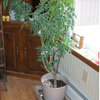
    This one is the successful branch

  • 7 years ago

    This one is the stunted branch

    Ali's ideas · More Info


  • 7 years ago

    Yes I’m fertilizing, with Schultz 10-15-10 plant food. Once a month. No one can give you fertilizing advice specific to your situation w/o a pretty good understanding of how you water and the type of soil you use. It sounds like your soil would be quite water-retentive, so I suspect you have some significant loss of potential going on due to soil in the bottom of the pot remaining saturated for extended periods. I could be wrong, but there's an easy way to find out. Skip the digital device (your finger) and start using a piece of wood dowel rod stuck deep into the pot (as in all the way to the bottom). After you remove the "tell", examine the tip. It will "tell" you how moist the soil is in the pot. Withhold water until the tell comes out nearly dry, then water as you have been, making sure at least 15-20% of the total volume of water applied exits the drain hole. Never allow your pot to sit in the effluent that drains from the pot after watering. To make sure it doesn't, you can rig up a system that raises the pot in the collection saucer such that the water that drains never has a pathway back into the pot. The reasons we flush the soil when we water are A) to rid the soil of salts contained in tapwater and fertilizer solutions that accumulate if you don't flush. Over time, poor watering practices (not flushing) can allow salts to accumulate to such a degree that water moves backward, reversing the osmotic process. Normally, water moves toward the higher concentrations of salts in cells until a state of isotonicity is reached (equal level of solutes inside & outside of cells). When the concentration of solutes in the the soil solution is higher than in cells, it actually PULLS water from cells - tearing plasma from cell walls. This is called plasmolysis - commonly - fertilizer burn. 2) flushing the soil is like hitting the fertilizer "reset" button. Plants function best when the ratio of fertilizer in the soil solution closely mimics the ratio at which plants actually use the nutrients. For example, plants use about 6X as much Nitrogen as Phosphorous. Your 10-15-10 supplies about 4X as much P as the plant can/will use. W/o flushing, the unused portion remains in the soil and accumulates. It doesn't take long before the level of P would be so high it unnecessarily inhibits water (and nutrient) uptake and/or inhibits the plant's ability to take up other nutrients. When you flush, and there is no pathway by which the effluent can make its way back into the soil, you reset the nutrient levels in the soil by flushing them out. One way of preventing salts from getting back into the soil:


    I have never repotted it, it’s currently in soil with perlite & Indoor potting mix. Please expand on what's meant by ""soil" with perlite and indoor potting soil". Are we talking about mineral soil, as you might find in the garden, or topsoil? If so, soil compaction is almost certainly levying a very stiff tax on your plant's potential. Even if you're not referring to topsoil or garden soil as a fraction of your medium, the description you offered makes me wonder if soil saturation and/or compaction aren't limiting your plant. I haven’t potted up or repot it because it seemed to fit the container it’s in. Once a plant reaches the point in time where the root/soil mass can be lifted from the pot intact, it affects the vitality (health) of the plant, it's ability to extend (branches/stems growing longer), the frequency with which back-budding occurs, and it causes loss of foliage except in the immediate vicinity of branch apices (growing tips of branches/stems). If the plant is potted up, the limitations of root congestion largely stay with the plant, though there is usually a notable improvement in growth, vitality, and appearance. Fully repotting on a timely basis, which includes root pruning and a change of soil, completely eliminates the limitations imposed by root congestion. Repotting has a rejuvenating effect on the plant, and there is a distinctly notable difference in the growth, vitality, and appearance of trees regularly repotted and trees potted up or left to languish in a too small pot for extended periods. I water it once The soil is dry, I check by putting my finger in the soil and feeling. Covered above. i water it until it drains through, wait about 10 and water again. Perfect practice. Keep in mind that a good practice is to make sure that what you guess to be 15-20% of the water used when you water exits the pot.

    Plants need a certain amount of energy to maintain the status quo and keep their systems orderly. When they are able to convert the sun's energy into more food (sugar, carbohydrates, ...) than they need for their 'normal maintenance', they grow. Stalled growth means the plant is barely making enough food or is not making enough food to take care of routine maintenance. Liebig's Law of the Minimum states that growth + other factors cannot improve unless the most limiting factor is eliminated or its impact reduced. Then, what was the second most limiting factor gets the promoted to taking the place of the former most limiting factor limiting growth +. If all factors are asking the plant to tolerate conditions near, at, or beyond what it's programmed to tolerate, fixing the most limiting factor might not prove to be all that helpful; however, if only one factor is out of alignment with the plant's well being, it can make a notable difference.

    I'm sure I've written enough to leave you with questions, and I hope a minimum amount of confusion, so I'll watch to see what input you have.


    Al