Software
Houzz Logo Print
atmoscat

Help me choose a specimen tree

7 years ago

I am trying to choose a specimen tree for my yard in Maine (zone 5a). I have plenty of space, and this will be in front of a wooded area (far enough in front to stand on its own). I would like a large tree (>30 ft) rather than a smaller ornamental. My requirements are:


-it should be highly ornamental during one or more seasons, particularly either summer flowering or fall foliage or both. I'm not sure which of these to prioritize more highly. Right now I'm drawn to things with flowers, but I can also get flowers from smaller trees, shrubs, and perennials. There are fewer things with great fall foliage, so maybe it's better to prioritize that?


-it should be >30 ft and hardy in zone 5a


-it should be possible to plant within 15 ft of it, as I am planning shrubs to the sides and perennials in front. So, nothing too densely rooted (such as maple - fortunately I have several mature red maples and other places in my yard for sugar maples).


-it doesn't have to be native, but I would prefer something that is indigenous to the eastern US, or at least not invasive or too exotic looking.


Here are some trees I am considering that I would appreciate input on (either pros or cons), and I would welcome other suggestions as well (though I also need help choosing!):


-Black gum - great fall color, native, fruits for wildlife, but no flowers.


-Red horse chestnut - red flowers in early summer, not sure about fall color, not native but a cross with a native buckeye, I think?, or 'Autumn Splendor' horse chestnut, which has both flowers and fall color(!) but not native. It's on the smaller side, 25-35 ft.


-Tulip tree - cool tree, but gets really big, and some say you can't really see the flowers. There's a smaller-growing cultivar, but it seems hard to find. Native to New England. Yellow fall color okay but not great.


-Catalpa - great flowers, not much fall color. Not native here but it is further south.

I'd love to hear your thoughts or additional suggestions. In particular it would be good to know if some of these are hard to plant under because it's hard to find information on that.


Comments (25)

  • 7 years ago

    Have you considered a conifer? Winter interest and nest spot for birds.


    atmoscat thanked gracie01 zone5 SW of Chicago
  • 7 years ago

    And many conifers turn color in winter and have very showy cones and new foliage.

    atmoscat thanked Sara Malone Zone 9b
  • 7 years ago
    last modified: 7 years ago

    if you are interested in Buckeyes, take a look at Aesculus flava, Yellow Buckeye.


    atmoscat thanked indianagardengirl
  • 7 years ago
    last modified: 7 years ago

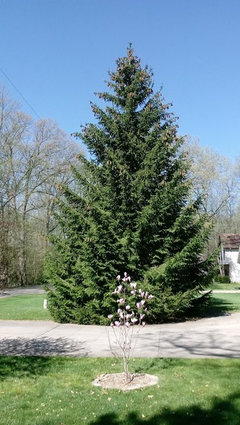
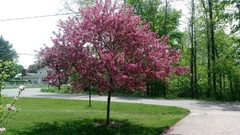
    Flowering crab with red leaves. Interest in spring and fall. My favorite is Japanese maple. Flowers not showy but gorgeous color when leaves come out in spring and then again in fall. Kousa dogwood--nice flowers and good fall color and somewhat nice bark. If you find a 3-trunked version, all the better. Red buckeye has gorgeous spring flowers but otherwise nice but nothing special in the other seasons. A lot of folks around me go for something weeping, like a cherry or larch or spruce . . . they tend to be weak plants though. Nothing beats a truly awesome evergreen IMHO. Here's mine, it's a Norway Spruce that has not been butchered . . . I mean limbed up. The baby in front of it is a star magnolia. It has one big show in spring but is nice enough in form the rest of the year.

    PrairieFire Crab in spring


    atmoscat thanked l pinkmountain
  • 7 years ago
    last modified: 7 years ago

    Correctly 'Purpurea Tricolor' the beech isn't small growing, reaches instead over 60' tall in time. And the variegation is not consistent, with highly colored young specimens often toning it down later. So that what is ended up with is a rather dull looking copper beech with small random pink highlights, producing a somewhat curious - even eerie - effect.

    atmoscat thanked Embothrium
  • 7 years ago

    Having seen Metasequoia glyptostroboides 'Ogon' at the Coastal Maine Botanical Gardens a few years ago, it’s the first tree I thought of after reading your post. They had a small grouping of them that were fantastic. Are you near Booth Bay?

    atmoscat thanked maackia
  • 7 years ago

    Thank you all so much for your wonderful suggestions! Now I have even more to choose from :). Good point about conifers, gracie01. Fortunately, I have a very big yard (3 acres) so I already have some mature conifers, including white pines, cedar, spruce, and a mature Norway Spruce (unfortunately not as beautiful as yours, ipinkmountain, because it suffered a bittersweet infestation before we bought the property. We have freed it, and hopefully it will recover somewhat.) I also plan to add some more cedar, hemlock, and balsam firs.


    But for this spot, I think a deciduous tree would be better. At least that's what I thought until I saw that metasequoia, maackia. Wow, what a gorgeous tree (deciduous and a conifer!) I am putting that one on the list. I've only lived in Maine a short time, and just learned of the existence of the Coastal Maine Botanical Gardens about 2 weeks ago. I am excited to go sometime soon. We are not on the coast, but near Augusta, so not too far from Booth Bay.


    I'm looking for a medium to large tree, not a smaller ornamental (but some that you mentioned are on my list for other places, pinkmountain). 60' is fine. Something like tulip tree that gets to 100' is a little daunting though, also because it would be tough to grow anything close to it. Good to know the pros and cons of the beech. Thanks for the suggestion, niccidhg, and yours as well, Doug. Yellow buckeye looks great, indianagardengirl - both flowers and some fall color. Thank you! I'll definitely consider it. I guess the Autumn Splendor buckeye that I mentioned is a cross between aesculus flava, aesculus pavia, AND aesculus glabra. Seems like it might be smaller, so flava might be a better choice. In the end, some of the decision might depend on what I can find locally. But it is great to have so many good options! Thank you all again for your input. If anyone has any additional suggestions, thoughts, or preferences among those mentioned, please let me know - particularly if any of them are difficult to garden near.

  • 7 years ago

    One nice thing to do would be to visit some local botanical gardens and just "window shop" for trees you like. The gardens might even be able to help you figure out where to get some of the trees.

    Another somewhat overlooked specimen trees is Carolina silverbell, and if not that one Mountain silverbell which is a little smaller. They really only have one spectacular bloom but they are not terrible looking otherwise. If I was interested in buckeyes, I'd pick the red. I've worked in two places that had them and they got a lot of compliments when in bloom. Otherwise nice trees but kind of blended into the background.

    atmoscat thanked l pinkmountain
  • 7 years ago

    A great many deciduous magnolias would fit your requirements.

    atmoscat thanked laceyvail 6A, WV
  • 7 years ago
    last modified: 7 years ago

    I am going to second Metasequoia Ogon. It is deciduous also btw.


    Edit: here they grow pretty fast so no need to buy a larger one. They also prefer wetter to drier if your area is as absolute rocky cliff or somethibg extreme for Maine.

    atmoscat thanked Toronado3800 Zone 6 St Louis
  • 7 years ago

    It only gets to be 35 feet tall, but Redbud is my favorite native tree.

    atmoscat thanked suzabanana (6b Boston/N. Shore)
  • 7 years ago

    I live in zone 5a & lost a catalpa after a cold winter. Just food for thought on that one.

    I also have two suggestions to add. The first one is a serviceberry tree. A single trunk or multistem specimen are both nice. I have two Robin Hill Serviceberry trees. It provides 3 really good seasons of interest here. Spring has pink buds, turning into white flowers. Fall colour is a lovely orange red, like tomato soup. It may not be as large as you want though, 25 x 15 feet at maturity.

    The second tree is Schubert Chokecherry. It has seasonal interest as well. It starts out with green leaves and blooms fragrant white flowers. Which I can smell throughout the yard, and it smells sweet. Then the leaves turn dark purple from July until fall. Then the leaves are red for fall. It is known to sucker at the base, I just rip them off once or twice a season.

    atmoscat thanked HalloBlondie (zone5a) Ontario, Canada
  • 7 years ago

    Thanks everyone for more great ideas. pinkmountain, I had a carolina silverbell at my last house and loved it. Beautiful tree. I do plan to plant one here, also. And I also love redbuds, suzabanana. I actually just got two of them for a different spot and am planting them this weekend. So, a good choice! I'd also like to find a spot for a serviceberry. But yes, HalloBlondie, I think all of these are smaller than I had in mind for this particular spot. But they will all go on my small tree list for elsewhere in the yard. laceyvail, thanks for reminding me about magnolias. I had been thinking the ones that are hardy here would also be smaller (<30 ft). Are there any species or cultivars you would recommend that get larger than that?


    HalloBlondie, thanks for sharing your experience with catalpa. I haven't seen a lot of them around here, so maybe it's not a good choice. I'm not familiar with the chokecherry, but I'll look into it. Glad to hear another recommendation for the metasequoia. They are incredibly beautiful trees. I'm strongly considering it. The problem is it's so hard to choose. I think I actually have 3 spots I can put large trees - I originally posted about the most prominent of the 3, but I might have so many good options I can fill all of them (eventually!). I am going to try to make a trip to the Coastal Maine Botanical Garden and check out as many as I can in person before I decide. Thanks everyone for your great input!

  • 7 years ago
    last modified: 7 years ago

    Shubert Chokecherry is not common in ye olde big box stores but a good tree nursery should be able to find one for you.

    Sweetbay magnolia blooms a little later and might work in your zone. I'm not sure, I'm on the border between 5 and 6 so I don't know much about zone 5a/4b interface. Sweetbay magnolia can get big but it can be a slow grower. I read 20 ft. mature height but we have two in our arboretum that top that, maybe 25 ft. But they are 90 years old.

    If you've got shade, stewartia is gorgeous in flower and fall color. Another is parrotia, with spectacular fall foliage but not much of a flower show. A favorite of mine is Cornelian cherry/Cornelian dogwood, yellow flowers. Scientific name Cornus mas. They are breeding sweetgums with some gorgeous fall colors and even at other seasons, but the seeds bug some people and not much of a flower show. It's pushing your zone but we have several that survive in 5b. I'm not sure about Maine.

  • 7 years ago

    Ohio buckeye

  • 7 years ago

    I don't know for sure if it would be a problem in your area, but here in zone 6b Catalpa is very invasive. They pop up all over the place. Same for the "Princess" tree, Paulownia tomentosa. Nice purplish-pink flowers, but can also be invasive. Maybe in your zone the seedlings wouldn't become a nuisance. I'd ask local garden clubs, etc.

  • 7 years ago

    Since both northern and southern catalpa species are native plants, it's difficult to consider them invasive (unlike the exotic Paulownia). They may reseed freely but that doesn't make them invasive :-)

  • 7 years ago
    last modified: 7 years ago

    Catalpa is not an exotic around me; so I guess that is the reason I am not so crazy about them (people tend to be attracted to the exotic). I know nothing about Zone 5a Maine, but there are a few trees that I have always tried to plant once moving into a new property. Every yard I gardened in HAD to have the following...

    a Magnolia of some kind (deciduous and/or evergreen one)

    Metasequoia (Dawn Redwood)

    Bald Cypress (Taxodium)

    Japanese Maple (mine are 'Bloodgood', a larger variety)

    Ginkgo biloba

    any species of Oak tree

    a true Cedar/Cedrus (I currently have Atlas Cedars)


  • 7 years ago

    gardengal, the Catalpa, while it is native to parts of the U. S., it is NOT native here in New England, and is considered an introduced species. In any case, they show up everywhere and anywhere, and are often weed trees here. I don't doubt that the panicles of showy, orchid-like blooms are attractive, as well as the large, tropicalesque leaves. Just a caveat about the self-seeding,

  • 7 years ago

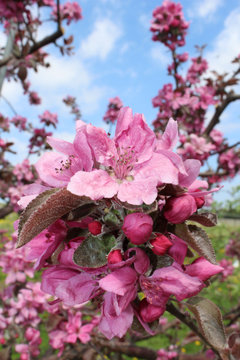
    Redfield apple or Roberts Crab.

    Both are red fleshed apples with striking red blossoms. Both are available at the link above. They are not native, but I think the blossoms might compete with Japanese Cherry. I have the Redfield which bloomed at year one. One blossom. The Redfield is said to make a great red apple cider, or apple sauce or would be great in a pie. The crab will also make cider. Either will be cleaned up by deer if they fall to the ground.

    The Redfield apple is about 3 inches diameter, the Roberts is about 2 1/4" diameter.You'll get the blossoms in spring and the striking deep black red apples in late summer/fall.

    Picture is Roberts Crab


  • 7 years ago

    Thanks everyone for the great suggestions and input. Sorry for my slow follow up. I've been thinking about this question over the past few weeks. It's nice to have so many great choices, but that also made it hard to decide! Fortunately, I have a big yard, so I don't have to choose just one. Some of the things I already have are apples (regular and crab), eastern white cedar (not true cedar, though), norway spruce, many oaks and maples, birch, ash, dogwood, bloodgood japanese maple, staghorn sumac, two redbuds that I just planted. There are many spots I can put smaller ornamental trees, and I am adding many of the suggestions here to my list, including serviceberry, stewartia, magnolia and silverbell. I also like the chokecherry for its contrasting foliage color.


    As for the original spot, based on some of the comments here I decided against the catalpa. So, my final top two candidates were black gum and either yellow or 'autumn splendor' buckeye. Then a couple of weeks ago I went to the Coastal Maine Botanical Gardens. First of all, thank you maackia for that suggestion - the place is truly fantastic. Let me add my recommendation to anyone living in or visiting the area to go check it out. So beautiful, and so much garden inspiration. I'll be going again soon and regularly. I saw the metasequoias, and they are wonderful. Though I love them, they're just not what I had in mind for the particular spot I originally asked about, where I think a tree with a spreading canopy will work better. I am still going to work on finding another spot for a metasequoia in the yard. If we end up taking out the existing damaged norway spruce, it would be a great replacement.


    But while at the Botanical Gardens, I found the perfect solution. On a back hillside there is a planting of sourwood. I'd read about these trees but never seen one in person. They are so beautiful - delicate and graceful but also (eventually) large enough to have big-tree presence (I know it's a slow grower so will take a while to get there). Plus, multiple seasons of interest with the summer flowers and great fall color. They check all the boxes. Then, in a great stroke of luck, I found one at a garden center this weekend. It's about 7-8 ft, but the guy said they had come in undersized (were supposed to be 2" caliper but only 1.5) and hadn't sold, so he let me have it for 50 BUCKS!!!!!! I've read they can be kind of hard to establish, but for $50, I think it's worth the risk. I'm so excited about this beautiful tree and I hope it does well.


    Sorry for the epic post, but I thought all the folks who generously shared their thoughts might like to hear how it worked out in the end. Wish me luck with the sourwood! Thanks again for all the great ideas! I'll try to come back and post pictures once I have some of these things in the ground.

  • 7 years ago
    last modified: 7 years ago

    Be aware that many of the plants mentioned are at the extreme northern bounds of their hardiness and since you are away from the coast, you may see damage in bad winters. For instance, where I work in Durham, NH, near the coast and so with temperature extremes mitigated somewhat, regular redbuds are damaged, but where I live inland near Concord, NH, my Minnesota strain redbud (selected specifically for hardiness) has done well and is well over 10 years in my garden. So source of the original genetic material is important. And siting is significant as well. I have two seed grown kousa dogwoods and two genetically identical Halesia ‘Wedding Bells’. For each species, one is planted in an exposed field situation and one surrounded by woods. For each, the one nestled into other plants has remained undamaged in harsh weather, while the one that is more exposed has had a large amount of winter dieback every few years. One Magnolia that you might want to consider is Leonard Messel. It blooms late enough that blooms are almost never damaged, it has lovely yellow fall foliage that changes to chestnut after frost, and the large, silvery winter buds are ornamental enough that a friend thought they were pussy willows, so a three season plant.

    From experience I can say that seeing half or more of a woody plant die back followed by a wild Medusa of stems as the plant tries to regain lost ground in succeeding years is a sad situation, and I now try to add woodies that are fully hardy into zone 4, even though I am well into zone 5 according to the USDA. I know that in bad winters my yard can reach -23, so I plant for that. So I would check local weather station for extreme lows over the last 10 to 20 years since zones are more geared to typical coldest temperatures. Woody plants have to be able to survive the coldest temperatures over their life times.

    Check to see if there are examples of the plants you are considering locally to help judge survivability in your area, and think about microclimates. For instance my rural area is often 5 or more degrees colder than Concord (likely the source for the USDA zone maps), even though I am only about 10 miles from this small urban heat island. One other place to check would be the arboretum at the U. of Maine Orono, just north of Bangor. If something is hardy there, it should be rock solid for you.

  • 7 years ago
    last modified: 7 years ago

    Ah, the native Sourwood is a fantastic choice! Would you mind taking a picture of it the next time you are at the Botanical Gardens? I'd love to see a "live" pic of one from "real life!" B)

    And another great addition would be the native American Persimmon. It easily fulfills your entire checklist...and then some! Just be sure to plant a few for best fruiting pollination!

    "The botanical name for persimmons, Diospyros, means “fruit of the Gods.” If you haven’t had the privilege of tasting the American persimmon in particular, imagine that you can stand under a tree, and dessert will fall from its branches right into your hands. In this case, dessert is in the form of a bite-sized, succulent, honey-sweet burst of flavor that is healthy for you.

    The appearance of the American persimmon tree is pleasing to the eye. It boasts bluish-green leaves in spring and summer, and fall leaf colors range from yellow to blazing red depending on variety and climate. Its branches and leaves droop giving an overall relaxed appearance to the tree. The ripe fruit provides a burst of golden color and adds to the languid look. It can grow to be a very tall, long living tree reaching up to fifty feet and higher. A young American persimmon tree will grow rapidly, but its growth will taper as the tree matures and begins to bear fruit."