Software
Houzz Logo Print
therhythmman

St. Augustine Sod Issues

7 years ago
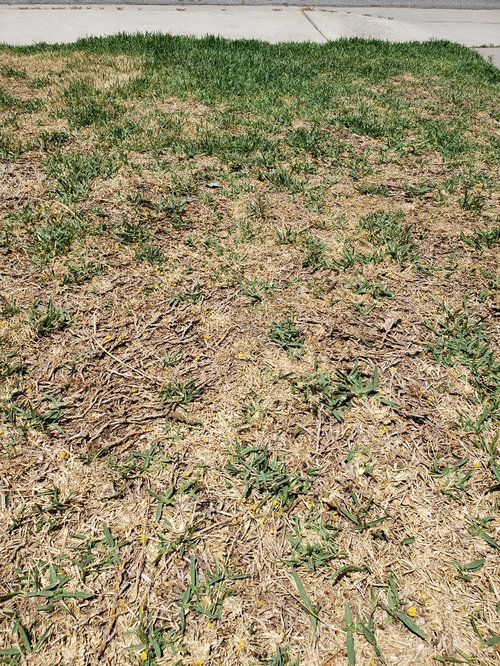
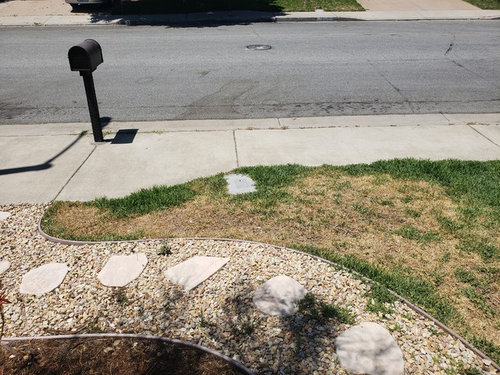
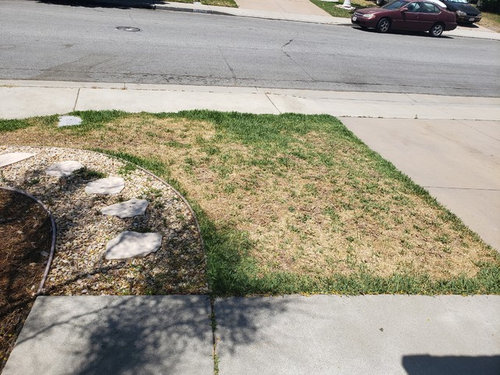
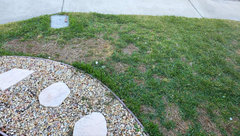
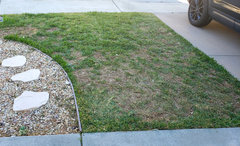
We live in Zone 9b, near Rancho Cucamonga/Fontana and have had nothing but trouble with this tiny patch of grass.

First, our landscaper put in Marathon III Fescue sod, which didn't last long before drying out and succumbing to the infestation of weeds. Of course at the time, we were assured it was the correct type of grass for our climate/zone. I learned otherwise in this forum shortly after the issue with fescue in this area.

Then, last fall my father in law, who is an outspoken advocate for St. Augustine v. Fesue, paid some unknown gardener to "redo" the lawn. Which entailed digging up of all weeds and remaining fescue, treat the soil, then lay St. Augustine sod. Which was in late fall, in November, which I thought was odd.

Not even a month later we noticed discoloration and drying, but I figured it was standard St. Augustine dormancy. But we're in July now, and it's still looking pretty bad. Compared to our backyard St. Augustine, which is green and thriving.

I've done the tuna can test to make sure its getting enough water, and watering once every 2-3 days.

Any suggestions?

Comments (15)

  • 7 years ago

    This is recoverable, so don't even think about redoing the yard.

    Let's rule out insects first. Chinch bugs attack first at the sidewalk and driveway edges. Your edges are, if anything, greener, so you don't even need to check for chinch bugs. Now carefully dig up 1 square foot of the dead stuff. Look right under the root zone for grubs. If you see fewer than a dozen grubs, then you're golden. If you find an uncountable mass of grubs, then treat for grubs (when the temps cool down). I doubt this is an insect problem, but if it is, then treating for anything else won't improve it.

    It looks like an extreme drought issue; however, since you are watering so freakin frequently, it cannot be drought. But still the water is not getting through the soil to the roots to the plant. I'm thinking your roots are dead from a disease caused by...over watering. Root rot. Can you pluck the dead grass out of the ground fairly easily? If so then the roots are shot.

    I have been extremely successful treating St Augustine disease with ordinary corn meal. I get mine in 50-pound bags at the feed store, but grocery store corn meal or corn masa is fine. the application rate is 2 pounds per 100 square feet. That's 10 feet by 10 feet which is not much bigger than your yard, so 50 pounds might be overkill. Apply the corn meal and wet it at the surface only. Then let that sit for at least 3 days. Keep an eye on the living grass for signs of drought stress. If it seems to be dry in the late afternoon but not the next morning, let it go another day. If it still dry the next morning, then water a little, but not a full tuna can's worth.

    In your area with the highest 'normal' temps being in the 90s, you should only be watering once a week. During Santa Ana Wind events, you might water every 5 days instead of 7 days. But there is no set of natural conditions that would require watering every 2 or even 3 days. It might take some time to bring your grass back, but I've done it. The corn meal should show results in 2-3 weeks for this. I think what you will see is the grass coming back all over at the same time.

    The first thing that needs to happen is the disease has to clear from the soil. That's what happens from the corn meal. You might want to reapply corn meal after 3 weeks as both fertilizer and as an additional dose of disease prevention. Once the disease is gone from the soil then the plants need to reestablish a root system. It will need very light watering once a day or so at first only. Keep an eye on it trying to stretch out the watering frequency and increase the watering time. In the summer heat the goal would be one inch all at one time, once per week. As the temps cool off, then go to every other week, every 3rd week, and with temps below 70, once per month.

    I live in the Texas Hill Country with a climate similar to yours (I used to live in Riverside and Pomona). We have been getting temps in the 90s for many weeks now along with the occasional thunderstorm, so I have not watered my front yard yet this year. The back yard slopes to the south and has needed water twice when it was looking a little stressed. The idea is to water the grass when it needs it and to make it so it needs it less frequently. Deep and infrequent watering is the way to do that.

  • 7 years ago

    Thanks dchall_san_antonio - Always appreciate your input! I will check for grubs. And yes! We have had some pretty hot days here recently, plenty more to come.

    We noticed the gardener who laid the St. Augustine sod did not use a roller, and thus there were square, raised patches of grass all Fall/Winter/Spring.

    Is it possible the roots may have never properly established themselves in those dead areas because the sod was laid improperly?

    I also noticed the sprinkler heads spray too high, missing some of the areas that are yellow/dryish. And it's on a slope, so much of the water runs-off. We started watering more because it was getting so dry and crunchy when walking on it. But based on what I've researched, seems like Root Rot it the culprit here. We'll give the corn meal a go.

    Thanks!


  • 7 years ago

    If you have a runoff problem on the slope, you could spray with shampoo at a rate of 3 ounces per 1,000 square feet. That will soften the soil and allow more moisture in and at a faster acceptance rate. It also seems to allow you to water less frequently.

  • 6 years ago
    last modified: 6 years ago

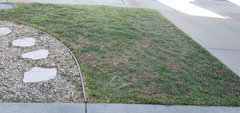
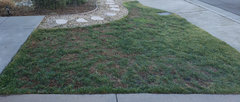
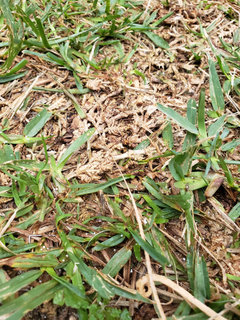
    Here are some updated photos following the 'corn meal treatment' and watering adjustments as recommended:


    Still patchy but definite improvement! Thanks again dchall_san_antonio!

  • 6 years ago
    last modified: 6 years ago

    Any advice for over-seeding to keep the green through dormancy during what we call "Winter/Fall" in Zone 9b, near Rancho Cucamonga/Fontana? I've seen Rye grass used around here, but not sure which variety, or when to apply.

  • 6 years ago

    Looks a lot better.

    I recommend NOT to overseed a southern grass with rye. Why? Because the tall ryegrass in the spring provides too much shade to the dormant grass underneath. The shade delays the turf from awakening for weeks and sometimes months. You might be able to get more sunlight to the St Aug by mowing the rye grass down lower and lower starting in late Feb, but I haven't seen that done. The professionals spray a special herbicide in the early spring which kills the rye and does not harm the bermuda or St Aug. I believe that herbicide is unavailable except to professionals.

    My neighbor in San Antonio used to overseed with rye. It usually looked sparse all winter. One year he got it right and it looked like a lawn, but then in the spring my lawn was way ahead of his by the end of March.

  • 6 years ago
    last modified: 6 years ago

    Thanks! Still not the lush St. Augustine I envisioned when putting in this new St. Aug sod - especially such a small patch! But we're getting there.

    Will take your advice with the overseeding - I've also heard that it can also deplete any resources that would have been used by the St. Aug.

    So because the sod was laid in late, late Fall last year, then over-watered (because we were instructed to water frequently as it was new sod), then consequently stricken with the Take-all/Root Rot - I'm guessing we should hardly water during Fall/Winter this year during dormancy?

    I've read here & there that you can keep St. Aug green(ish) during dormancy by watering once a week. But I'd really like to not deal with Root Rot again.

    Also - should we do another corn meal treatment at any time?

  • 6 years ago

    You can apply corn meal any time, day or night, rain or shine. Once you see it work like that, it's easy to get excited about using more. It works both as a fertilizer and the anti fungal. As a fertilizer there are better organic fertilizers; however, if you use any of them more frequently, everything seems to get better. Morpeuspa has tried to overdo organic fertilizer and was not able to do it. He fertilized with two organics every weekend all season long. No problems. I did something similar by using corn gluten meal once a month all season. No problems - other than lots of grass to mow.

    As for watering, use temperature as your guide. With temps in 70s water no more frequently than once every 3 weeks. I stretch it out longer, but I always water deeply when I do water. Ideally you'll get enough rain in the fall and spring that you won't have to water again until June or July.

  • 6 years ago
    last modified: 6 years ago

    Thanks for checking-in!

    I decided against over-seeding. Since the temps here have been starting to cool-down (at least at night), I have only been watering once a week or less. Also seeing some discoloring, which I assume is the slow onset of dormancy.

    As for all the root-rot damaged thatches with the long dead runners & stolons that never seemed to take: Would you suggest digging/cutting out the dead growth in those areas and fill-in with turf builder and/or corn meal? If so, should I wait until a certain time to do that? (i.e. late Winter, Spring, etc).


  • 6 years ago

    While that is considerably better looking now (Nov) it's not what I would expect after this length of time. Is the grass not growing tall or are you mowing it short? It should be mowed at your mower's HIGHEST setting all the time. Mowing high helps in several ways, including growing deeper roots and helping to shade out competing grasses and weeds. But if the grass is simply not growing any taller than that, something's wrong.

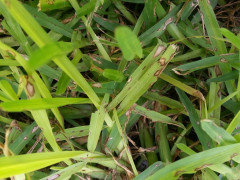
    Have you fertilized with anything besides the corn meal? If you have used corn meal (twice??), then it would be time to bring in a chemical fungicide. Can you take a close up picture from about 6 inches. I'm looking for lesions on the blades that look like the brown spots in this picture...

  • 6 years ago

    Guilty as charged. I have been mowing in the lowest/shortest setting, as my father-in-law swears that St. Augustine preffers it super-short (in addition to suggesting that SA must be cut with a rotary mower, which I do not have).

    I fertilized twice with cornmeal this year. Once in spring, and once in summer.

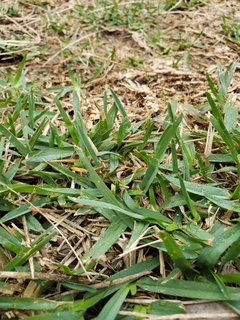
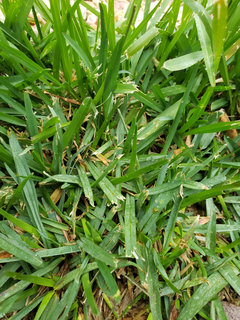
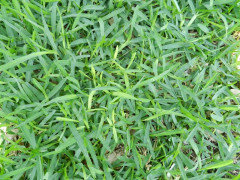
    Attached are some close-ups from both the thicker sections of the lawn, as well as some of the thinned-out areas.

    Many thanks as always!

  • 6 years ago

    Riddled with disease. St Aug should be completely free of any blemishes on the blades. Here's a pic I took several years ago. The area was in complete shade all day under a huge oak tree, so it is not very dense, but it is green.


    Okay it is not perfectly green. I have this labeled as chlorosis in St Augustine. The very center is not what I like to see, but there's no spots. What is interesting is the reason I picked this spot was that a month earlier it looked just like yours - spots on the bladed. I treated it with corn meal and it looked like a success, except for the center chlorotic spot.

  • 6 years ago

    Thanks. So any recommendations on which chemical fungicide to use? And when?

  • 6 years ago

    I don't have a recommendation for a chemical fungicide. I have always had success with cornmeal. But I can say that most fungicides have a temperature limit which means you should use it in the spring or fall in your area.