

Redoing my favorite garden
MA, Zone 6a
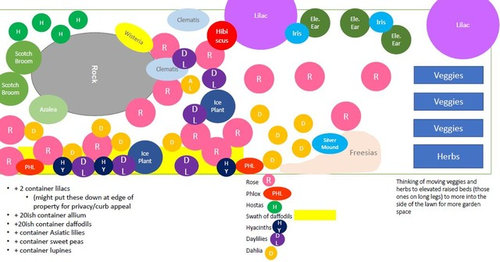
Hi, I recently expanded my garden which I am very happy about. Things aren't really in the place I want them to be in and now the proportions are off anyways. In addition it really needs some evergreens. I made a mock up of what it looks like now and what I would like it to look like next spring. Any layout advice would be super helpful if people have it.
Current (not to scale and might be forgetting some things):
This is what I am thinking of doing:
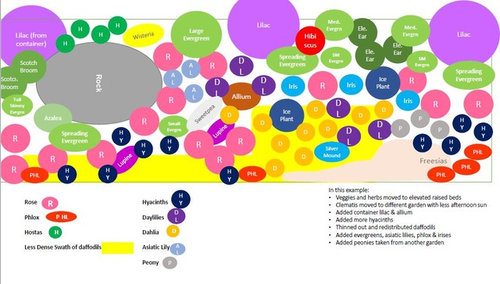
Thoughts?
Comments (29)
 7 years ago
Very cool diagram. How big is the rock and the bed? Would it make sense to create a pathway among the plants? The reason I ask is that you have a lot of plants and it might be difficult to reach some of them for deadheading etc.
Related Professionals
Greenfield Landscape Contractors · Orlando Landscape Architects & Landscape Designers · Chicago Landscape Architects & Landscape Designers · Laconia Landscape Architects & Landscape Designers · Santa Maria Landscape Architects & Landscape Designers · Watertown Home Builders · Clearlake Home Builders · Bismarck Home Builders · Scottsbluff Home Builders · Gulfport Landscape Architects & Landscape Designers · Kenosha Landscape Architects & Landscape Designers · Decatur Landscape Contractors · Lewiston Landscape Contractors · San Bernardino Landscape Contractors · Jackson Tile and Stone ContractorsKali C
Original Author7 years agoprairiemoon - good point about the dying foliage of the bulbs, maybe ill move the day lilies in front of them a bit (I have a surplus of DL's since I have these gorgeous wild Euorpa ones that grow in the woods on my property. There are dozens just waiting to be used haha). Oh no sorry to hear that about your Sky pencil and your lilies, this is the life of gardening I suppose. The changes never end!
ctgardenguy - the rock is approximatly 9 ft long, 5 feet wide (at it's widest, the left is thicker than the right), and four feet tall at it's tallest. I would love to have a path walking through, maybe flagstone or something, I'm not super creative haha so I am having a smidge of difficulty picturing where I should put it 7 years agolast modified: 7 years ago
Kali - I am used to the moving. I accept that my placement judgment will always be less than needed. [g]. And really, is having too many lilies a bad thing? lol I should have added, that I do really like having a tall thin evergreen and I still have hope it will work out in the end. And maybe there is a better choice than 'Sky Pencil'. I haven't researched that lately.
As for pathways, I never planned a pathway in my 20x15 ft bed, but it is bordered on three sides, with pavement - the walkway, the street and the driveway. Once I started planting, I just added stepping stones where I need them. It works for me. I never plotted it out on paper, I find it more helpful to stay fluid and visually see where I need somthing as I plant. About the only thing I do on paper is to think thru where the sun/shade will be and for how long, how large the bed will be and where and a list of plants I really want. Positioning plants according to height and impact I do as I begin to plant.
I also used berms in my bed, to try to retain as much rain as possible when it rains instead of running off into the street. When I increased the size of the bed, I started in the fall and used the lasagna method of layering organic matter which also worked out really well for me.
 PRO7 years ago
Naturally, I am the one who will be the downer relative to other comments. I think the diagram is busy and hard to read ... requiring too much time to analyze in order to give highly specific feedback. But a general observation is that plants are very jumbled up, with like plants being separated by other plants. I think it would be a better looking garden, with more impact, if like plants were grouped into a single lot, or possibly no more than two groups of the same thing.
A second thing I noticed is that it seems some short, spreading plants are surrounded by tall plants. If that is the case, it would be better to reorganize them so that the height generally descended starting with the tallest plants at the back of the bed, as seen from the predominant view. There might be an occasional place where this "rule" is broken for creating "punctuation." If there is more than one predominant view, then the arranging must accommodate the height hierarchy from that direction as well.
Just a tip ... I think it would be much easier to create a garden plan if instead of noting the location of every individual plant, one grouped them and showed an outline for the perimeter of each group. This would make it easier to think through as the impact of the plants would be more obvious, and easier to read.
- 7 years ago
I don't agree or disagree with your viewpoint Yardvaark, just for me personally, I found that planning a garden on paper, seemed like what would work best and be the most logical and I tried that to begin with, with graph paper and the whole nine yards. Started threads looking for input on GW, and in the end, I found it just dragging on and on and bogging down and became no fun for me at all. It became fun again, when I realized that some people are good at planning on paper and it helps them and for me, it just wasn't helpful. I really benefited from input from others in the form of guiding principles to keep in mind. Personal experience with successes and failures with their own garden planning and with individual plants.
So, either way works, I think we all have to figure out which way works for us. - PRO7 years agolast modified: 7 years ago
I think you misunderstand my point. It is not about planning on paper .... or NOT paper. In spite of the fact that you are using a computer program to draw (in the pictures you submitted above) the exact same thing could be done on paper (though it would be much more time consuming!) And I'm not talking about not-getting-input from others. I'm encouraging it and giving you an idea of how it could more easily be done.
All I'm talking about is when you show the 6 same plants on the plan, don't draw each one individually. When they are next to each other, draw them as a collected group .... the same way you'd see them in real life. And by "draw" I mean make their circles overlap and become one outline, if you are using a computer drawing program, as above.
First below, is the scheme you've shown in your second picture. I am not altering the planting scheme/arrangement whatsoever. But I am linking the like plants that you have grouped together, which makes it instantly more understandable where plantings are contiguous. It also makes it easier to see and understand what plant patterns you are creating. (You have to overlook that my "painting" is not gorgeously smooth!) Here, instead of trying to interpret that there are x-number of individual plants at the lower right corner, I see one group that is colored red. That's the footprint pattern that one would see in the garden ... not three separate things.


In fact, what might be causing you trouble in creating a plan, is that you are, kind of, trying to reverse engineer it. You're starting with the actual plants themselves and trying to end up with pattern shapes on the ground which would show up as three-dimensional volumes in the yard. Instead, you should be starting with the pattern shapes on the ground, ignoring what plants might be used. After the 2-D pattern is created, you would explore how you wanted it to read in volume. (How tall is that shape and what form does it take ... a cone, dome, cube, mat, etc.) There would be some back and forth between the ground pattern shape, and its volume and form. Maybe where there was a cone at the foreground, you decided it should be moved further back and a mat shape would be better at the foreground ... or similar such changes.AFTER, you have got the ground pattern fairly well established on paper, and the form and volume established (possibly in your mind only .... or on separate little sketches), then you would begin to explore what exact plants might best makes those shapes, volumes and forms. In that process, there might be 5 different options that could do one of the jobs. At that point you'd be comparing foliage colors & textures, plant habits, bloom "flavors", etc. in order to fine tune your selection to what you believe will be the perfect, or near perfect plant for that particular spot. I guaranty that if you were to do the planning in the correct order, you'd end up with a different result, and likely it would be one that had a far better chance of standing the test of time. To plan in the reverse order usually achieves a result in which the gardener is moving a lot of plants around over a period of time, trying to fix their mistakes.
- 7 years agolast modified: 7 years ago
First of all, I'm not the original poster, I responded to you because in your post you described yourself as the 'downer relative to other comments.'
And the way you suggest doing it, I'm happy is helpful for you. And I'm sure that in my own process, I consider size and texture and color and everything else, I just do that when I am developing a plant list. And from my experience the reason I end up moving plants is often that I've not given enough room to each plant, but not the only reason. I don't want to wait for it to fill in, I have too little space and too many plants I fall in love with. Sometimes it's just a poorly performing plant for one reason or another.
I wouldn't say, I'm trying to 'fix my mistakes', except when it comes to distance between plants. As a matter of fact, the one bed that I move things around in the most, is the only place on my property that I have full sun, and most of the plants I enjoy are full sun plants. I have gone through phases, once I wanted a prairie look, then there was the year I planted a lot of sunflowers, etc. I've enjoyed just about every season. Another reason I've replaced or moved a lot of plants, is due to having so many tree roots in the back in more shade, that I've had to experiment a lot with what will grow.
I think I understand that you are able to do it a different way and it works well for you. I hope you understand it's not the only way.
And with that - I certainly don't want this thread to be about me, or about how to plan a garden, but about Kali hoping for help and ideas - and I've offered the suggestions that I thought would be helpful and glad you've offered yours.
 7 years agolast modified: 7 years ago
Like PM2, I would place bulbs behind perennials so that the sprouting perennial hides the dying bulb foliage. I didn’t do that in some places and it is a mess out there right now with patches of old bulb foliage dominating the front of some beds.
I can’t evaluate the bed as drawn. It isn’t to scale and you don’t have specific varieties. So something like the rose label leaves me wondering . . . Is it a 4’x4’ shrub rose or a rambler? Is the Hosta a huge Sum and Substance or a midget Mouse Ears? Will they be hidden by what is growing in front of them? Size matters. Is the phlox creeping or midsized Phlox divaricata or tall garden phlox?
As Yardvaark suggested, with perennials, often a swath/patch/grouping is most effective, and drawing them as one mass in the general shape you anticipate is helpful.
I would not use a lilac as a foundation planting. Like forsythia, it is a one shot wonder, gorgeous for 2-3 weeks and then truly boring for the rest of the year. Often they get powdering mildew, and most are large enough to block windows if used near a house. Instead of placing them in a bed that gets a lot of attention, put them where they can be enjoyed when in bloom, but when they aren’t lovely, they aren’t taking center stage.
And that leads me to . . . Where is this? A foundation bed or the first bed one sees approaching the house or at the back of the yard where it is mostly viewed from a distant patio or windows or . . . ? Context matters. For instance, most lilacs are too large for most foundation plantings.
- 7 years ago
One shrub to consider as a substitute for a standard lilac, is Syringa palibin. It remains small - 4-5ft? Does not have the full panicles of bloom, but smaller blossoms, but does have a good amount of fragrance. Also not the mildew problems and some fall color.
 7 years ago
Roses don't like to be crowded and they need a fair amount of water. My phlox gets mildew so I would make sure it has plenty of air circulation around it and not put it next to something that is also prone to mildew. I love phlox and have inherited a large patch from my mother. I've never grown them before, and I have to say, from a landscape perspective, they need a lot of space to do their thing and look best grouped. One phlox here or there is just an odd shoot out in the garden. They need to be mixed with something that can hold it's own against them, and roses aren't it, IMHO. But if you're talking about the low, creeping phlox, then that would be fine.
Kali C
Original Author7 years agoHi all - quite a lot happened since I last checked in haha, so apologies if I miss something.
Everyone brings up a good point about the diagram and the groupings. In addition, I think part of why I tried to mix up my plants so much is to assure something is always in bloom. So for example, if all the roses were clumped together then early spring in MA it would just be green sticks lol. But I do see people's points and think of how to better distribute things. At the very least some of the other perennials, dahlias and the irises for example should probably be grouped with themselves.
ctgardenguy - apologies I thought I responded but it looks like it didn't save. The rock itself is an irregular shape. At its widest about 6 feet, about 4 feet tall at the very top, and about 8 or 9 feet long. So it's quite large. I would love to make a path, I think if I move the plants to groupings like people have suggested I can just drop some flagstone in and have an "informal path" that kind of gently goes through.
pm2 - happy to hear about your new roses! You'll have to post photos of what ends up happening with them, sorry to hear you've already had to rearrange though. I suppose that's the constant struggle of gardening.
I can't seem to find who said what but here the rest goes lol - For the phlox it is the creeping variety not the taller kind, I do realize I was not specific. For some reason every time I hear 'phlox' I just think creeping first. For the accessibility, this garden is at the base of the driveway, driveway runs along the bottom edge of the garden. (So if you were to drive up the driveway, the garden would be on the left and running upwards). It is far away from the house and really on its own. Gets full sub (save for a couple shaded spots due to a tree on the street - where the hostas are). For sizing - most of the roses for ex ample will be the standard 4x4 or 5x5, a few that are near the rock and towards the back are large climber varieties (Don Juan, CL Blaze, and even though Abe Darby isn't a climber it still gets larger).
I really appreciate all of the help people have given so far and love getting the feedback. I'm always hoping to learn more and become a better gardener, so even when things don't go according to my initial plan I still get to learn something.- PRO7 years ago
sorry Prairiemoon. I guess I confused your comments with OP and in my reply ended up lumping you together. But per your comments. I understand that people attack design different ways, but there is design process that professionals use, and for a reason. Doing it in the reverse manner might work for someone, but they would be stumbling through the process at a disadvantage. A typical homeowner might achieve a decent end result in any DIY project, but if they don't as much as possible emulate the method the pros use, chances are they will be taking a lot longer and gambling a lot more on the turnout.
- 7 years ago
Well Kali I have the opposite problem as you, I'm now constantly dealing with my late mom's tall phlox so I tend to automatically think of those . . . and their mildew problems which I am dealing with. I have mine mixed with roses, but in a separate area. My perennial garden is evolving and it's mostly done to deal with some plants my mom had planted under a dogwood tree which is not a good idea so I'm moving them to create a perennial garden. So I'm mixing what I got from her with some of my own additions, plus trying to keep costs down and "use what I have."
At first I kind of did what you suggest, jumbled up individual plants so there would always be something blooming. But it ended up not looking all that good. Plants need to be grouped at least in threes to have any visual effect. Unless it is one really large specimen plant.
Only will add I'm not in love with iris mixed with roses, the foliage contrasts too much for my taste. I have some iris mixed with small perennial sunflowers which looks good. In the bed I have low creeping dianthus in front, iris behind and then the taller sunflowers in the back. Oh, plus some sedum. There are roses too, in the bed, but they are on the corners and not really surrounded by anything. In your plan, I'd clump the iris more together and then move the ice plant to a place where its foliage could be better seen and appreciated.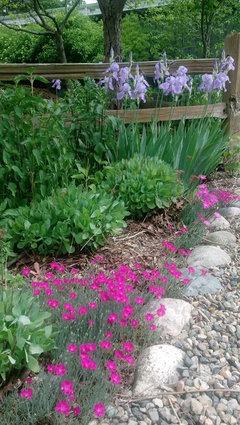
- 7 years ago
pink -- a suggestion for you, concerning tall phlox mildew: I have had much success spraying them with homemade milk&water solution. 9 parts water to 1 part milk (I use skim). It works for me very nicely, both as a preventative and for already-present mildew. Not 100% but close. I do have to re-apply after drenching rains. Give it a try!
I, also, love tall phlox and those are what I think of first, as you do. It would not be summer without them!
- 7 years ago
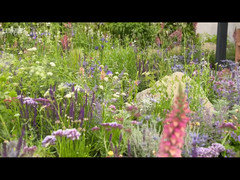
The traditional approach of massing and arrangement by height has been the prevailing wisdom for many years and has produced some wonderful gardens. It has been interesting to see the changes in design in recent years to more mixing of plants. This does allow for waves of color throughout beds rather than a burst here and then a burst there. This kind of mixing does seem to work very well in smaller beds. To do massing effectively it helps to have a very large area so you can repeat groupings. I don’t have great pictures but the Royal Horticultural Society shows (Chelsea and others) have demonstrated these mixed plantings to great effect in recent years.
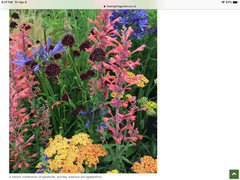
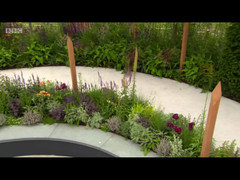
- 7 years agolast modified: 7 years ago
Thanks for the tip on the phlox. I have been trying with neem oil which seems at this point to have gotten me to "not spreading" but I spotted it too late for prevention and I gave up on curing what was already gone. No harm in trying the milk idea!
I have been doing the "burst" type of garden arrangement mostly because of the tight space and tight wallet, I can only afford a burst at a time. In those cases though, the groupings do have to look nice together when not in bloom, and play nice above and under ground as far as plant health.Edited to add that with the "burst" method, it still doesn't pay to tuck a small plant behind a large one unless the large one has either not come up or died back when the small one does its show. With ice plant, the cool thing is not just the flowers but the leaves, so I'd put them closer to the front. It takes some time to design a garden that looks good spring through fall.
Here's my "work in progress," which is totally smaller than Kali's. We doubled it in size this year but we still don't have enough room for all the phloxes. Right now the remaining ones are under a dogwood tree and that tree is not doing well with all the underplanting. We're fixing both beds a bit at a time due to time and space constraints. The phlox aren't doing as good this year, the soil is marginal and the mildew is taking it's toll.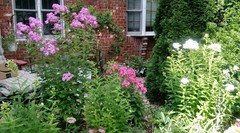
- 7 years ago
@ Yardvaark - No problem at all! I agree with you, design professionals, thankfully have a process that is different than mine. Lol. What I do, works for me, and I enjoy my garden. If I wanted a display landscape, I’d get a professional involved, for sure. But I want a working garden, that is all me and that’s what I have. I have my priorities and the limitations of my property and whether I end up with something I’m thrilled with the end result of, or something that needs a little more work, I’m loving the whole process and just the act of gardening.
I’m sure your input is helpful to anyone trying to landscape their property. - 7 years ago
Not to hog the post, but I tried the milk spray today, but then I wondered if the lactose-free milk we use would work. I ended up adding some yogurt and an acidopholous pill for good measure. I don't see how it could hurt. Looked online and I couldn't find any definitive science on what the active compound in the milk was, but it could be free radicals, raising the pH, or some of the milk compounds themselves being toxic to the spores. Some people just use the whey.
Back to the OP, even with a mixed perennial garden with a little bit of this plant or that plant, you still have to pay attention to of the plants relative to each other, otherwise the smaller ones will just get crowded out by the others. That's why I would caution about overplanting with some species of roses. I can't imagine hybrid teas or knockouts flourishing in a wild garden, but some wild species roses can't hardly be killed . . . Another example is grasses. Some plants can hold their own with them, others will be overwhelmed by their aggressive roots. Plants have to get along below ground as well as above. Nothing in your garden really stands out as being a problem other than the aforementioned ice plant but that was minor. The only other thing is I have found that in addition to roses, lilacs don't play very well with others either, they are very particular about soil and growing conditions. Too much nitrogen and they won't bloom. I have to treat mine with phosphorous in the form of bone meal worked into the soil around them, to get them to bloom. Don't know how that would affect the elephant's ears and other plants around the lilacs. Roses on the other hand, don't like phosphorous. - PRO7 years ago
"I’m sure your input is helpful to anyone trying to landscape their property." I'm sure it is, too. It's just that sometimes THEY are not sure of it! .... Haha .... LOL :-) and hardee-har-har.
Kali C
Original Author7 years agopink & maisie - your garden photos are beautiful! You've certainly done a really great job, I think the colors are just gorgeous.
pink - you could never hog the post :) I enjoy when people are able to get answers and have mini convos within the threads haha. You bring up a good point. The ice plants are only two years old and they got MASSIVE quick, after the flowered I aggressively pruned them since I wanted to keep them a bit smaller. I swear a month later they were huge again so I pruned even more aggressively and they seemed to have simmered down haha - I will certainly have to move them somewhere where they won't overtake other plants. Maybe they can hold their own near the lilac. Speaking of which, people bring up a good point about the lilacs, I think I'll remove all but one (they're still babies so it'll be easy), and I'll keep the one lilac in the corner and just see how it goes, maybe I really will put the ice plants around it and move the elephant ears elsewhere. For the roses in this garden most of them are HTs and Floribundas, and a few climbers.
here are the photos people have asked for - please keep in mind that it is very much a work in progress that has slowly been taking form over the past couple years. I expanded it length-wise this year so there's a big empty space that I intentionally haven't put things into until I decide what to do, and the veggies are just shoved at the far end of the extension since they'll die off in winter.
view from on top of rock (haha the things we do for photos). I know a lot of this is really just shoved in there)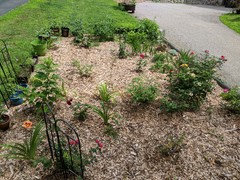
From on top of rock looking down at majority of roses ( I think I'll move out the DLs and more evenly space the roses to hang out in this general area)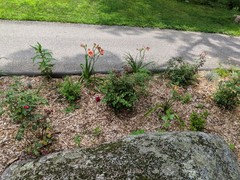
from on top of rock - Little hosta village behind the rock - only have four but planning on adding several more, sine my shade garden is getting a bit too full (has like 20 hostas). Don't mind all the weeds, that's this weekend's project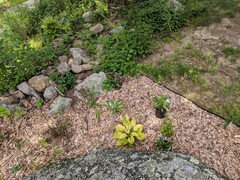
You all have been SO helpful, I have a much better idea of what I want it to look like nowKali C
Original Author7 years agoand here are the head on views (wouldn't let me put them all in one post)
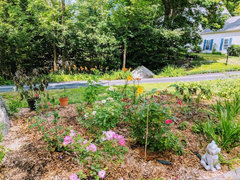
the entrance of the driveway is on the left, much further up and then to the right (L - shaped driveway) is the garage and house. This is probably the best view of it. You can see the big ole rock on the left side, the right side from the grass up to the little statue is brand new. Behind the big rock/kinda to the leftish, is where the hostas are, since as you can see that big trees blocks a lot of sun in that corner specifically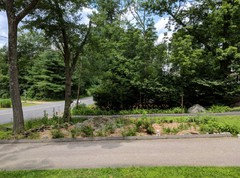
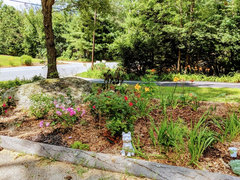
This is the angle I see most often coming down from the house ( I know my little pots are a bit ghetto-fabulous lol)
- 7 years ago
Well maybe it is your zone, they might grow differently where you live. I can't get ice plant to overwinter and live. This is what I am calling ice plant, Delosperma cooperi (scientific name).
https://www.monrovia.com/plant-catalog/plants/1130/hardy-ice-plant/
The reason i know about the problem with lilacs is I have some planted on the edge of my yard and I fertilize the grass in the yard, and they are in the perfect spot as far as sun goes, but are just not blooming. Grass fertilizer is about the exact opposite of what you want for lilacs. They are on the edge of a new perennial garden I am planting with all the leftovers from my other gardens. Luckily I think I will be able to work some bone meal into the soil around them and that might help. I had a problem at my last house with a Ms. Kim lilac not blooming and the bone meal did the trick. - 7 years ago
I see two issues, one is the trees roots. Too much planting under will impede the health of the tree, and two, possible shade issues. Shade prevents many perennials from blooming well, particularly lilacs which is why folks tend to put them in big rows out on the edge of their property around here. A nice alternative that can take a bit of shade is clethera.
Kali C
Original Author7 years agopink - thanks for the suggestions :)
shockingly the tree roots have not proven to be very problematic. I think it's because the tree is slowly dying. I think whomever put the garden in originally may have destroyed a lot of its roots. Unfortunately the tree is on town property. I've called many times about it but they seem to say it's ok (the dead branches falling off it would say otherwise). Because of its poor health it surprisingly doesn't block much sun, the majority of the garden gets full sun, save for the back left part. During the afternoon it provides a nice dappled shade tooKali C
Original Author7 years agolast modified: 7 years agoThank you everyone so much for your help!
I've taken your advice and redone things a bit. No more one off plants or scattered designs. I moved all the roses into one area, that gently curves around the rock, put all the daylilies together, and moved all the dahlias together in front of the DLs (believe it or not the DLs are taller). Grouped the irises together, put all 3 elephant ears in the same area, carefully dug up and relocated the cosmos, sweetpea, and echinacea seedling to all be near themselves. Removed the lilacs and put them on the border of my property. Still needs a bit of finessing and of course time to fill out (the rose area is a bit skimpy since many are first years). Thanks again everyone!! My next step is to add the evergreens for some "bones", and relocate the herbs and veggies to separate raised beds, maybe even through in some flagstone for a walkway.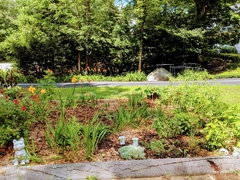
- 7 years agolast modified: 7 years ago
Looking great, kali! I wish I had your energy right now as I do need to do a lot of dividing and edging and weeding and...and...and... Your gardens will just keep getting better and better! I look forward to more photos in the future. =)
Kali C
Original Author7 years agothanks Roxanna! your lovely daylilies have brightened up the garden quite a bit! I wish you luck it gets exhausting!









prairiemoon2 z6b MA