Software
Houzz Logo Print
micmac1970

Crepe Myrtle Help

7 years ago
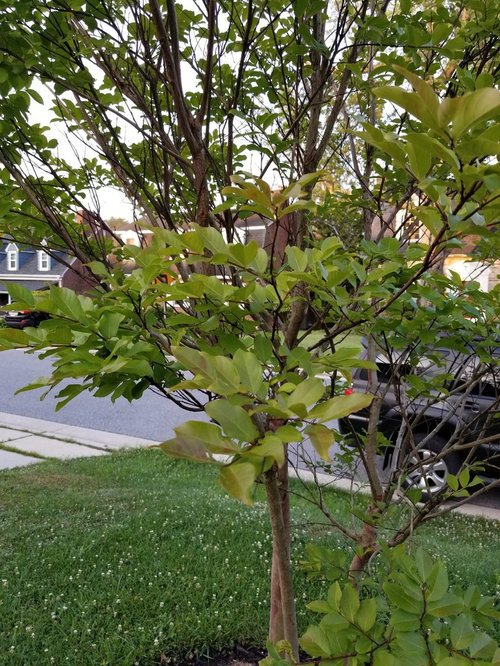
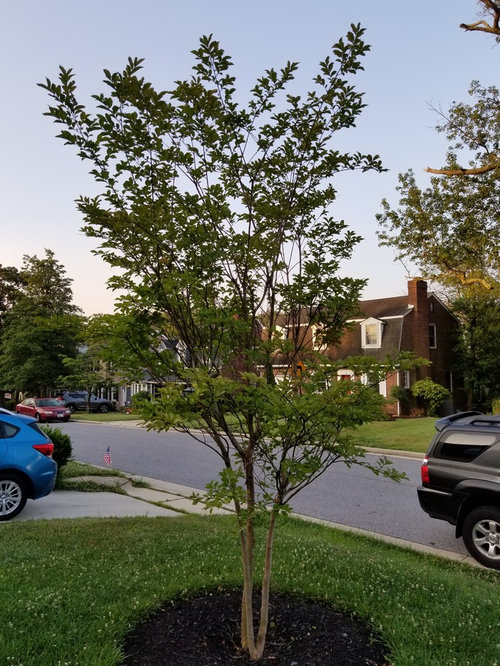
can anyone tell me what type of crepe myrtle this is? I was told that it would have white blooms; however, this doesn't look like a Nachez Myrtle.

Comments (12)

  • 7 years ago

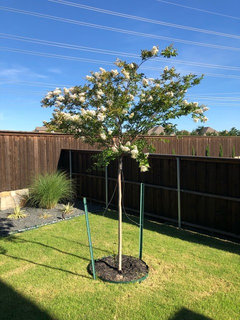
    What state do you live in? I have a white myrtle and it has already started to bloom here in north Texas. Below is a photo. The leaves don’t look to be the same. (Also, mine is a single trunk, but normally they come looking like yours.)

  • 7 years ago

    I live in Maryland. Last year I had two trees planted. I asked for Nachez white bloom crepe myrtle. All the white myrtles in my neighborhood like yours are already in bloom. I asked the landscaper about this and he told me they will eventually bloom. The leaves on my tree don't even look like a Nachez myrtle. So I was wondering if there are another type of myrtle that produces white blooms. Your tree is beautiful by the way. That's what I wanted.

  • 7 years ago

    No I haven't but will do. Thanks for the advice.

  • 7 years ago

    Last year I had two trees planted.


    ===>>>


    those are pretty huge transplants ... i wouldnt be surprised if they were late on a bloom cycle .. or skip it all together for a year ...


    personally.. i dont see fert as a panacea ....solving all issues ...

    https://duckduckgo.com/?q=panacea&t=ffcm&ia=web


    and if you fert your lawn.. it will get all the fert it ever needs ....


    these trees/shrubs .. based on size ... will be under stress for at least this year.. and maybe even next year ... just water it properly ... and it should stabilize ... right now.. they are regrowing all the roots that were cut off ... if they were field grown ... could a plant that size.. been potted all its life????


    and you might not be able to ID it.. until it flowers.. whenever that is ...


    i dont know what to suggest.. if the seller did not give you the plant you requested ...


    ken


  • PRO
    7 years ago

    Fertilizer is not a panacea, per se, but it is a necessary component of plant life. All the plants growing in pots, while at the nurseries, are fertilized on a regular basis. Anyone who has worked in a garden center knows that these plants start showing signs of running out of fertilizer after just two or three weeks of watering-only. Thus, the nearly universal use of Osmocote fertilizer beads to extend the fertilizing throughout the garden-center-sale-period. The planting instructions almost always include that fertilizer be added at planting time. Newly planted plants do not necessarily get their roots quickly or deeply enough into the native soil to start tapping on to any nutrients that exist. It might take them two or three years to get to that point. My personal experience has it that many newly installed plants will yellow out or languish if they are not given supplemental fertilizer (and water) in their first months and years at their new home. If the fertilizer directions are followed, there is virtually no downside to adding it. In the unusual case where no fertilizer at all is needed, the downside will usually amount to no more than a little extra trimming for a short time ... until the nitrogen has washed on to lower soil levels. I can't see any reason to withhold it from a newly installed plant.

  • 7 years ago

    Tammy, since you asked for Natchez specifically, you should be provided proof of purchase by your landscaper. He or she should have receipts from where it was purchased.

    I would never accept a crape that was not labled and here's why: ordinary seedling crape myrtles are typically a great deal cheaper and without the stunning bark exfoliation and color, the beautiful fall foliage color, and stunning structure. A seedling crape myrtle will never have those gorgeous bones of a hybrid. A seedling specimen won't have the resistance to the dreaded powdery mildew that can be such a problem for these plants, nor to the persistant Crape Myrtle aphid (Tinocallis kahawaluokalani ). That's the pest that is responsible for the black sooty mold which is so unsightly and disfiguring.

    If your landscaper cannot prove that your tree is a bonafide Natchez, then you have every right to refuse it. A seedling will always be a poor imitation.

    Your tree may or may not be the named hybrid, I cannot tell from the image, but I'm leaning to its not being a Natchez. Your landscaper can obtain the appropriate documentation from wherever it was purchased. Don't let him or her get away with it.


  • 7 years ago
    last modified: 7 years ago

    Fertilizing new plantings is contrary to all accepted horticultural advice. Plants are already stressed due to the planting process and are unable to assimilate or process additional applications of fertilizers. In fact, the effect may actually be damaging.

    If the tree/shrub has been well cared for at the nursery, there are plenty of stored nutrients in the root system to keep it happy until its starts root elongation. Which happens in late summer or early fall for the vast majority of woody plants. Any application of fertilizer should be in its second or third year and then only after a soil test.

    btw, "bloom boosting" fertilizers are just a fertilizing marketing hoax. Plants only take up the nutrients they require and typically in a very predictable 3:1:2 formula. Providing excess amounts of phosphorus, what is normally the focus of so-called "bloom boosters", can impede or prevent the uptake of other essential plant nutrients.

  • 7 years ago

    I completely forgot to address the fertilizer issue! That practice has not been recommended for at least a generation! Holding off on fertilization is a part of standard good planting practices accepted by the professional industry for many years.

  • PRO
    7 years ago
    last modified: 7 years ago

    "Fertilizing new plantings is contrary to all accepted horticultural advice." That is ridiculous and positively not so. A plant is either sufficiently fertilized, or it is not ... or it is somewhere in between these two states. It is common for any plant that has is in a container, or has been dug and is balled and burlapped, and is sitting for a time in a sale yard, to run out of fertilizer (within a few weeks at most). I have worked in a variety of such places early on in my horticultural career and know that there is little if any effort made to fertilize plants at the retail level. Usually, if it is done, it is the result of desperation as some expensive plants did not get sold. But it is haphazard at best. So plants sit around the garden center being depleted of fertilizer, then are taken home and planted by the homeowner. It will be some time before they root into the surrounding soil and tap into any nutrients, which may or may not be adequate at that site at that time. The first sign of nitrogen depletion is yellowing. Take a look at any plant yard and see how much of that is evident. It is often substantial among plants that have been there over one month's time.

    This idea that fertilizing a normal amount -- according to fertilizer manufacturer's directions -- is some hardship on the plants, it a fantasy claim. In the first place, the amounts are not the specified at the EXTREME MAXIMUM. There is safe-space cushion, so that a single proper fertilizing does not cause harm. There is probably enough safety cushion that a double fertilizing will not cause harm to the plant. If it did, it would likely amount to no more than a little singing along leaf margins of some of the plants. But it would be temporary as the plant grows and cause no lasting damage. By pointing this out, I'm not arguing for over-fertilizing! I'm saying there is cushion ... so stop the panic claims!

    Plant nutrients are not a luxury. They are a necessity. Expecting a newly purchased plant, nearly depleted of nitrogen to go much longer (two or three years!!!!) without nutrition is ridiculous in the extreme. It is like expecting a person who has crawled through the desert without water for three days, not to drink as soon as they have been saved .... because someone in some book said that "drinking too much water suddenly is harmful to humans." Through the ages, there are plenty of popular policies that are discovered to be bad, once enough time has passed and they can be properly evaluated. I'd far rather depend on first-hand experience and common sense than what someone, somewhere, sometime said. A lot of what is claimed to be "said," too, turns out to be 'old wive's tales that just get passed around in the industry. Let common sense have some credibility.

    '... "bloom boosting" fertilizers are just a fertilizing marketing hoax. Plants only take up the nutrients they require ..." Here, again, disagreement. A lot of plants REQUIRE additional phosphorus in order to bloom well. This can so easily be determined by anyone. Get a pair of blooming annuals and give one only the 3:2:1 ratio of fertilizer. Give the other the high phosphorus fertilizer. In most cases, the difference will be readily apparent. (Note: it often does not do much good to give a plant extra fertilizer at the last moment, when you expect it should bloom. It must be given ahead of time for many plants, in order to improve the bloom.)

  • 7 years ago

    Feel free to disagree all you want but it is not me you are disagreeing with. This is a reflection of a large body of current scientific work compiled and published by some of the strongest and most respected horticultural authorities out there. And extremely well documented......most .edu websites will confirm the same. There are countless articles available outlining the fallacy of high P ferts/bloom boosters and from sources with a lot more substance behind them than just someone's anecdotal experience. To be perfectly honest, what you are claiming is really the result of old wives' tales or gardening myths that have been summarily disproven. Common sense and 'first hand experience' really have little to no bearing unless you yourself have gone through lengthy field trials and scientific studies that can conclusively support your contentions. And why in the world would you assume that a new plant is going to be depleted of nitrogen for 2 or 3 years without additional fertilization? Sorry but it just does not work that way.


    I am not going to argue with you.....you have made that a pointless effort numerous times and it is really not worth the bother. If you like to put yourself forth as an authority on matters that it is clear to those with an indepth education of botany and horticulture know to be other than what you state, go ahead.......... But I will continue to offer what I know to be differing and well substantiated viewpoints and let the readers here make their own choices.

  • 7 years ago

    Yardvaark, I have to ask.....are you a member of any national, regional, or state organizations that support the landscaping and nursery industries? If so, you should take advantage of the many educational opportunities afforded to you, either in the way of annual conferences or regional workshops, or informative articles written by the greatest experts in the field.

    I know that I've had to adjust my thinking as we learn more about soil science and plant biology and physiology. It's important to keep up, stay educated, be informed. You don't want to be the guy who is still giving outdated advice to your customers or here.