Software
Houzz Logo Print
mike_romain

Teragren Xcora solid bamboo vs solid acacia

7 years ago
last modified: 7 years ago
Hello all,

Any comments on the color choices, recent experiences with stranded solid or engineered bamboo, costs, are all appreciated! I have to make a decision within about a week, and I love the Java color Xcora solid bamboo but I'm concerned about durability and cupping - though Seattle where I live has somewhat consistent humidity throughout the year.


I know that some have had bad experiences with bamboo in the past. I've also heard the newer stranded bamboo flooring is much harder and resistant to dents and dings. My flooring installer has told me he's had trouble with cupping of bamboo, but it was a floated floor and I will be side nailing mine.


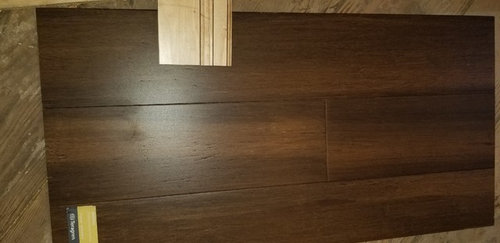
My house is a 100 year old craftsman and the cabinets are already ordered and are clearcoat maple shaker style, I included a clear maple sample in the photos.


Any comments on 1) Teragren solid or engineered strand woven bamboo flooring - quality, durability, appearance 2) The colors in the below photos as far as how they match the maple? Which do you like most? And runner up? 3) prices I have listed? 4) any words of wisdom or other comments?


In addition to the options I'm trying to decide on from below, there is 5" wide engineered acacia also in a natural clearcoat.


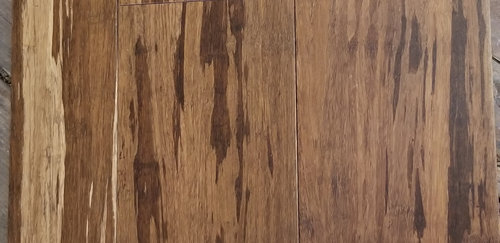
above: Teragren Xcora Portfolio Naturals solid bamboo strand woven Java color 5" wide, $5.99/ft2


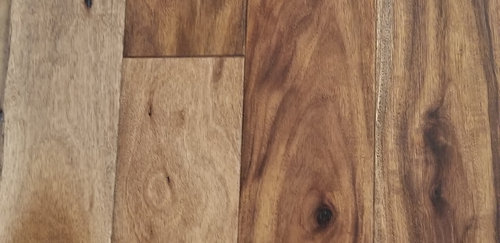
Above: solid acacia natural color, 3-1/4" wide, random lengths (shorter than most flooring), $6.99/ft2


above: Teragren Xcora engineered stranded bamboo Sherman color 5" wide, distressed, $5.99/ft2


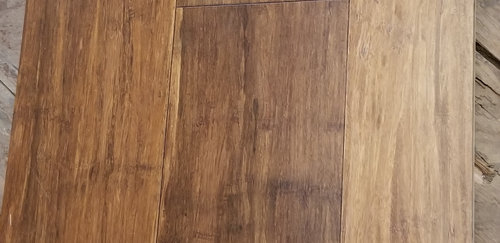
Above: Teragren XCora Portfolio Naturals solid stranded bamboo Chestnut color, $5.99/ft2

Comments (3)

  • 7 years ago

    No matter your choice, you MUST HAVE whole home humidity control for bamboo or solid hardwood. A 100 year old home in Seattle does not speak to a home with humidity control (it might...I don't know your upgrades). I live in Vancouver BC (2 hrs north of you) and the climates are very similar (Seattle gets more rain = HIGHER humidity).


    Bamboo is STUPID-TRICKY. Bamboo has the SMALLEST window of 'happy' in the entire flooring business. It MUST BE maintained between 35% - 55% humidity. Sounds reasonable doesn't it? Oh...wait there's more...Bamboo MUST BE stable INSIDE that range. That is to say it cannot swing more than 10% in either direction!!! That means if it is installed at 43% humidity...it can NEVER be allowed to live outside the range of 38% - 48%...ever.


    Solid hardwood is a bit more forgiving. Most can be happy in a range between 35%-65%. Again this doesn't sound too difficult but it is a MUCH wider range. And a solid 5" hardwood will receive nail+glue assist install = FAR MORE stable.


    If your installer has said there are issues with bamboo in your climate, then PLEASE listen to him/her. A floating bamboo doesn't react any differently than a nail-in-place. Grass glued together (aka bamboo) still is grass glued together. The REACTION to humidity is still going to happen. A few hundred nails/staples isn't going to change the laws of physics and hydrodynamics.


    Please listen to your installer AND check your HVAC system for whole home humidity control at the tough of a button! You will need it for either choice...bamboo just more so.

  • 7 years ago
    last modified: 7 years ago
    Thanks SJ! I don't have humidity control upgrades on my house (Edit: I do have aircon that was installed 2 years ago and I'm reading most A/C systems have dehumification systems and I think mine does also. I occasionally have to pump out a container of water). Looking at average relative humidity in Seattle, it ranges from about 65% in summer to 82% in winter. Wouldn't that mean all solid wood floors could have problems in my house? I have original fir floors right now that have not shown any issues, but they are old and need replacing. (Edit: I realize now we are talking relative humidity, which would be affected / lowered by heating outside damp air, so high outside humidity should'nt present an issue.)


    Teragren is appears to be manufactured in Southern Cali but originated near Seattle on Bainbridge Island and I believe invented bamboo flooring. Most local flooring stores sell some Bamboo lines.

  • 7 years ago

    The best thing to do is get some indoor humidity measurements. Preferably over a 6-12 month time period. You would begin your documents in winter to find the winter range and then follow through to summer to find that range as well. At that point, you would need to find out if your indoor climate is good enough for bamboo. Most homes in your situation are not.


    A/C isn't always enough for humidity control in summer. A container of water from time to time is very little in the grand scheme of things. A system that needs emptying every 4 hours (because the water reservoir is full) is more likely to have better humidity control.


    For the next few days (or weeks...because floors go in last) you will want to measure your humidity. You can purchase a hygrometer (or 3...you will want a few if you are installing in more than one room) at Home Depot for $35. You then place them around your home and begin documenting the humidity. For bamboo, you need a TIGHT range. Nothing less than 35% and nothing higher than 55%. But it is best to see a range that swings a total of 10%.