Software
Houzz Logo Print
timtsb

Soil Sample from Logan Labs

7 years ago
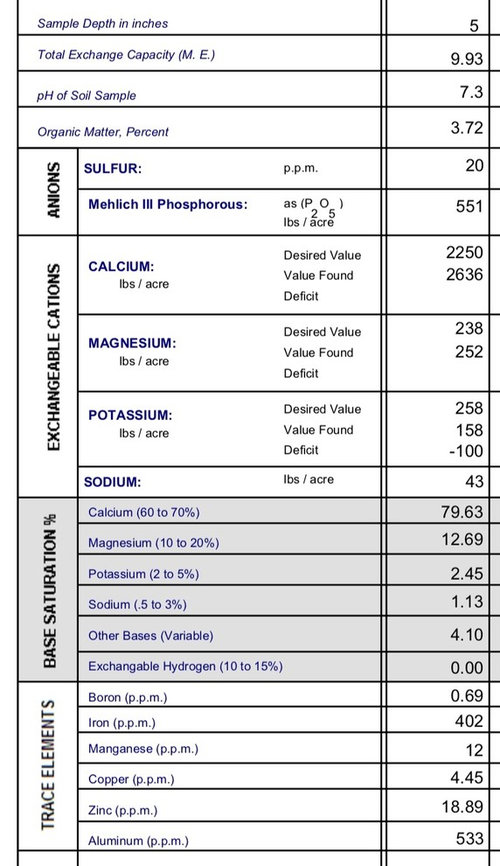
So I was convinced I had acidic soil based on the thin, short, yellowed patches in my lawn filled with weeds...turns out it’s actually a hair alkaline and my main problem is a potassium deficiency. MorpheusPA - I’m ready for your diagnosis!

Comments (6)

  • 7 years ago

    Btw, I should note that this is my first soil sample on a new property after building a new house, so this shouldn’t be compared to past samples I’ve posted here

  • 7 years ago

    Yellowed patches are more often a resource shortage of some kind. In this case? I don't see it, so I'd check for shallow topsoil with rock underneath, clay underneath, areas where trash has been discarded from the building of the house, and so on. Something isn't right there.


    The overall read is that you're in a very good starting place. There are no extreme shortages, nor anything that says "Fix This Now" to me. The soil's of pretty good quality. Because it's a new soil, I'll give it The Full Monty. Pardon while I get my pants off. Proverbially.


    ME 9.9: Midrange, most likely a silty soil, could be clay-ish if it's very light low ME clay, could be sandy if any clay fraction is absent or of heavier types.

    OM 3.7: A nice starting point in the Fair range, borderline Good. I wouldn't mind seeing it go up.

    pH 7.3: Fine, you're a bit high on calcium, but that's certainly not a problem. We can compensate by adjusting other resources accordingly and will. Grass color might suffer just the tiniest bit, but I doubt anybody will ever notice.

    Sulfur 20: Normal.

    Phosphorus 551: Sky high. There's no need for P sources in the forseeable future and even flower gardens won't require them. If you grow vegetables and find things like broccoli tough, bitter, and chewy, this is why. Raised beds with imported, lower-P soil might be your answer in that case, although the higher pH will help you out here by binding some of this P in unusable forms.

    Calcium 80%: High, but not a problem. Certainly don't bother adding calcium.

    Magnesium 12.7%: Normal, pretty close to exactly optimal for your soil.

    Potassium 2.5%: Holding its own, but a tad on the low side and yep, probably about to drop. You know the drill about potassium sulfate here--recommendations below. This is not a major rush.


    Sodium 1.13%: Higher than I would like to see, but not a problem. Let's see if this drops over the next year or so as the soil settles into place--and also some of the source of your higher pH. I suspect this, and your pH, will settle a bit. If not, we'll take care of it next year by dispelling it with some gypsum--but it's not worth doing right now.


    Minor Elements: All absolutely optimal, including boron and iron. But, as always, if you want to pour on the iron in Milorganite or iron sulfate for color, I have no objection. Iron isn't toxic until ridiculous levels and, at your pH, ridiculous levels mean 50,000 PPM still isn't toxic. You'll never get anywhere close.


    Recommendations:


    September: Apply 2 pounds per thousand of potassium sulfate.


    October: Apply 2 pounds per thousand of potassium sulfate.


    April 2020: Apply 2 pounds per thousand of potassium sulfate.


    May 2020: Apply 2 pounds per thousand of potassium sulfate.


  • 7 years ago

    First of all, thank you very much for always taking the time to interpret this data for me. I appreciate your help.

    I’m shocked this test came back as good as it did. I thought for sure levels were going to be all over the place due to the disturbance of construction, not to mention the previous property owner’s complete neglect of the lawn (it was a rental, can’t say that I blame them).

    “Yellowed patches are more often a resource shortage of some kind.”
    The only thing I can think of is we had some trees removed... I can’t remember their exact locations because they were only standing for a matter of days after we purchased the property. We didn’t grind the stumps, they were actually ripped out of the ground with an excavator. All that to say, I never suspected those old trees would affect my lawn, but perhaps there are still enough old decaying roots down there sucking up nitrogen?

    “OM 3.7: A nice starting point in the Fair range, borderline Good. I wouldn't mind seeing it go up.”
    Besides the obvious (mulch mowing lawn & leaves, organic fertilizer) anything else I should be doing?

    “Phosphorus 551: Sky high.”
    The only thing I have in the native ground this year are tomatoes. I do also have a raised bed I filled with garden soil. The tomatoes in both locations are very healthy. Would this high phosphorus negatively impact hydrangea by any chance? The plants look perfectly healthy but I didn’t get as many blooms as I’d like.

    “Sodium 1.13%: Higher than I would like to see, but not a problem. Let's see if this drops over the next year or so as the soil settles into place”
    The house was actually completed about 2.5 years ago. I imagine soil is pretty well settled...do gypsum now, or still wait?

    “Minor Elements: All absolutely optimal, including boron and iron. But, as always, if you want to pour on the iron in Milorganite or iron sulfate for color, I have no objection.”
    You have no idea how happy I am to hear that boron is optimal...the whole borax application process is not one I care to repeat!
    I will continue to thrown down the iron.

    One other thing I should have mentioned is I plan to do a bit of a renovation in Sept. I have largely neglected the lawn since moving in for several reasons I won’t bore you with, but I’m ready to get back in the game. I’m not nuking it because what is there was started from decent seed, but it definitely needs work. Any tips there as far as timing of seeding around the potassium sulfate application?

  • 7 years ago

    " We didn’t grind the stumps, they were actually ripped out of the ground with an excavator. All that to say, I never suspected those old trees would affect my lawn, but perhaps there are still enough old decaying roots down there sucking up nitrogen? "


    Possibly, but I wouldn't think they'd be making wide patches or causing huge problems. Sawdust dug in, sure. Wood chips, probably. Larger chunks, maybe. Roots, probably not.

    If you want, feed one of those areas at about half rate with any high nitrogen food you happen to have on-hand (Miracle-Gro would be just fine, too). See if it greens up. If it does, you have your answer and you can compensate appropriately.


    " “OM 3.7: A nice starting point in the Fair range, borderline Good. I wouldn't mind seeing it go up.”
    Besides the obvious (mulch mowing lawn & leaves, organic fertilizer) anything else I should be doing? "


    That covers it. 3.7% is nothing I'm worried about when combined with a 10 ME. If you absolutely feel you must, sawdust, importing leaves, and so on to transform the soil is also fine but it's also absolutely unnecessary. We can never tell the OM balances from the raw number (fresh, middling, old), but I'm betting most of this is pretty old. You'll be adding the fresh stuff that will rot and become the middling, slowly-decaying stuff over time. And that...just takes time.


    " Would this high phosphorus negatively impact hydrangea by any chance? The plants look perfectly healthy but I didn’t get as many blooms as I’d like. "


    The opposite! My hydrangea are in a bed with a P around 1,000 and bloom like crazy. High P levels will force hydrangea to the pink side, however, unless you add large amounts of iron sulfate (which I prefer over the standard aluminum sulfate as aluminum is toxic to the plant).

    Inspect for aphids, check that you didn't give them too much nitrogen (which suppresses bloom in hydrangea), and keep water levels consistent and at the modestly damp level. Hydrangea can be really touchy...


    " The house was actually completed about 2.5 years ago. I imagine soil is pretty well settled...do gypsum now, or still wait? "

    Ignore it this year. The potassium will bind out some as the sulfate grabs sodium as sodium sulfate and knocks it out of the soil.


    " Any tips there as far as timing of seeding around the potassium sulfate application? "

    Potassium certainly isn't at any critical level, so ignore it for September and pick it up in October instead. K goes into the soil quickly and well, so if soil freeze won't be until December, you can apply it in November to make up for the September application.

    If you're not comfortable with that, or if ground freeze might be in December sometime, then simply hold an app and forget about it until after your next soil test. We'll do it anyway if the amount in the bag allows--a dash of extra K certainly isn't a problem.

  • 7 years ago

    Just a small comment (which I am somewhat reluctant to make, since I will undoubtedly get jumped on by the self appointed monitor of this forum).

    Aluminum is not toxic to bigleaf hydrangeas (H. macrophylla). In fact, is the amount of available aluminum in the soil that produces the blue flower coloration. In inadequately acidic soils, aluminum ions combine with hydroxide ions (OH-) to form immobile aluminum hydroxide, Al(OH)3. If the plant is unable to access the Al, the flowers will never be blue. That is why aluminum sulfate is sold as hydrangea "bluing" - it both acidifies the soil (slightly) as well as provides suffcient levels of accessible Al. Even in acidic soils, if the Al levels are not sufficient (which admittedly is rare), the flowers will not be blue.

    This is seldom a requirement with a pH less than 5.5 and applying Al in that case could cause toxicity, if not for the hydrangea then certainly for ericaceous plants that are Al adverse (blueberries, rhododendrons and azaleas, etc.). But with a pH of 7.3, I wouldn't hesitate to use aluminum sulfate to develop bluer flowers. Or just use agricultural sulfur to amend the hydrangea planting area to lower pH to around 6.0 to 6.5, since your current Al levels are probably sufficient, if not currently accessible. Or live with pink flowers :-)

    The Chemistry of Hydrangea Flower Coloring

  • 7 years ago

    " Just a small comment (which I am somewhat reluctant to make, since I will undoubtedly get jumped on by the self appointed monitor of this forum). "


    Sorry, but being insulting and belittling isn't going to stop me from pointing out that you're also telling half the story just to be a total...well, I can't use that word on this forum. But I can sure think it. I might suggest getting that histrionic personality disorder treated, however.


    You can get the same results by directly lowering pH with iron sulfate, green the plant, and iron toxicity really is practically unheard-of since it'll take less to adjust the area pH, iron isn't nearly as toxic as aluminum as the pH falls, and the pH has to fall much further for iron to become toxic in the first place.


    P and Al are going to have some interesting antagonistic interactions, making even a pH of 5.9--as I set my hydrangea location--generate bright pink flowers with Al levels of 550 PPM when competing with "natural" phosphorus levels of 1,000+. Because phosphorus inhibits aluminum uptake.


    Aluminum is toxic to (the extreme vast majority of) plants, including bigleaf hydrangea, as pH falls. Because aluminum is a heavy metal that competes with phosphorus and other nutrients. While not at that pH, it will if concentrated in one spot...like one plant...at too high a level, as when dumped on. And added aluminum sulfate lowers pH while simultaneously--and very obviously--raising aluminum levels.


    It's one reason why I never suggest aluminum sulfate for lowering pH, or for changing hydrangea color. I've never met a soil that didn't have sufficient aluminum ions to produce a very nice blue, if somewhat pale when competing with high levels of P.


    It's not going to save the life of a hydrangea (or any other successive plant you try to raise) in soil with a very low pH, but nothing would.


    Suggesting adding aluminum at any pH when pH can and will change over time--and we don't know the previous treatment of the land, current location, or natural pH of the soil at this point--is pretty irresponsible. While my current pH is 6.2, the pH here wants to head for, and will head for, around 5.0 as Pennsylvania's 55 inches a year of acid rain leaches out everything. I started at a pH of 4.8. Raised aluminum levels would also raise area toxicity and, as noted, at less than 5.5 (and absolutely at 4.8) availability of aluminum is extremely high.