Software
Houzz Logo Print
spencer_hanson97

Fiddle Leaf Fig Diagnosis?

7 years ago
last modified: 7 years ago
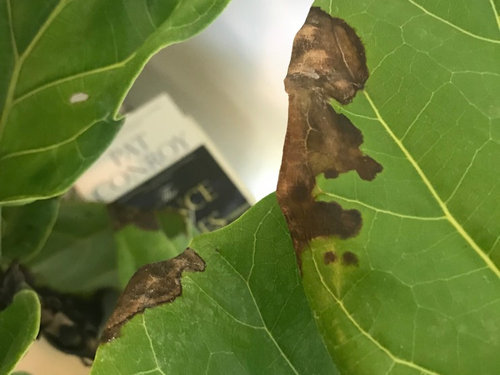

Help! I got a fiddle leaf fig tree about a month ago.

It has been slowly developing brown spots on the edges of leaves. I water about 1 cup/week and soli feels dry. He gets great light and great, warm humid temperatures. Hasn't dropped any leaves yet, and the top leaves look green, vibrant and healthy. I THINK he needs more water, but the blogs are confusing and pictures have given me no help. Can someone help diagnose?


Comment (1)

  • 7 years ago

    Too much water, not enough water, and a high level of dissolved solids (salts) in the soil solution can all cause necrosis of leaf margins as seen in the image of your plant's leaf. Though not as common as the 3 potential causes already mentioned, a change in light (reduction) can also cause that symptom under certain conditions. A healthy plant in a very high light position (like outdoors in full sun) can be fertilized at very high (luxury) levels (for that species). Plants in lower light levels will not tolerate the same level of fertility; so, the move from high light to your home where photo exposures are likely to be half or less of what the plant was receiving outdoors (at the nursery/greenhouse) can passively cause fertilizer burn.

    1 cup per week doesn't sound like much, so let's get your watering back on track and see if we can eliminate a high level of salts in the soil as a looming worry. May I suggest you buy a 1/4 or 5/16" dowel rod from the hardware or from a home imp. store. They come 48" long and you can cut it in half so you have 2. Sharpen all 4 ends in a pencil sharpener, stick them deep into the soil, if they come out clean/dry or almost so, it's time to water. If they come out moist, wait until they come out nearly dry. Your plant will tolerate being dry, but you can't leave it completely dry for days, or it will start to shed it's leaves.

    Your pot has a drain hole? Is your plant's pot in a separate cache pot? Are you fertilizing? with what? how often? You don't have an ionic exchange water softener (uses salt) for your home, do you?

    When it next requires water, flush the soil. I'll leave a tutorial I wrote at the end of my post. Regular flushing eliminates, or nearly eliminates the potential for salts to accumulate and for the ratio of nutrients in the soil solution from becoming badly skewed over time. This causes several issues and should be avoided.

    Flushing Soils

    When you water, you should be able to flush planting's soil to eliminate the potentiality of salts from fertilizers and tapwater accumulating in the soil, thereby limiting the plant's ability to take up water and the nutrients dissolved in the water. If you think you shouldn't flush the soil during
    your regular water applications for fear the soil will remain saturated for a lengthy period, limiting root function or worse, you should consider a different soil or take steps to reduce the amount of excess water your soil can hold. By whatever means necessary, getting to the point you can water correctly is going to make a very big difference in the opportunity to realize as much of it's genetic potential as possible. Once you can water correctly, you no longer have to do battle with a water-retentive medium over control of your plant's vitality. There are several methods of limiting how much water your planting can hold, all but 1 or 2 are completely passive, requiring no effort on your part other than set-up, which is monkey easy. I can help if you have interest in that, I'm continually improving my proficiency at monkey easy tasks.

    To flush
    the soil of a planting: Water with room temperature water until the
    soil is completely saturated. Allow the planting to rest for 15
    minutes to an hour to allow as much of the salt accumulation as
    possible to go into solution, then pour a volume of room temp water
    equal to at least 10X the volume of the pot the plant is in slowly
    through the soil. This will remove most of any accumulation of
    offending salts and resolve any skewing of nutrient ratios.

    It's a good idea, no matter what time of year, to fertilize most
    plants immediately after flushing the soil. Try to be sure you're
    using a fertilizer that has a ratio as close as possible to the ratio
    at which the plant uses nutrients. The NPK % listed on fertilizer
    packaging is not its ratio. 7-7-7 and 14-14-14 are 1:1:1 ratios.
    9-3-6, 12-4-8, and 24-8-16, are all 3:1:3 ratios. Container growers
    should try very hard to avoid use of fertilizers advertised as
    'bloom-boosters', or any number with a middle number (Phosphorous)
    higher than either the first or third numbers (Nitrogen or
    Potassium). These fertilizers can badly skew nutrient ratios with
    even the first application). On average, plants use about 6x as much
    N as P, so there is NO potential for a positive outcome when
    supplying many times as much P as the plant requires. I, and a large
    number of other members, use Dyna-Gro's Foliage Pro 9-3-6. It's
    designed to closely mimic the uptake ratio of the average plant, and
    has many other attributes not commonly found in other fertilizers. It
    also has ALL of the nutrients essential to normal growth. Summarized,
    it makes fertilizing as easy as it can be, and from 1 container.


    This might be helpful.


    It's a basic overview of good growing habits, will help you avoid all of the common pitfalls that confront nearly every container gardener at some point on the journey toward green thumb status.

    This should be, too. It's about caring for Ficus in pots over the long term.


    Al

Sponsored