Software
Houzz Logo Print
winnepj

Incorrectly installed drain line?

7 years ago
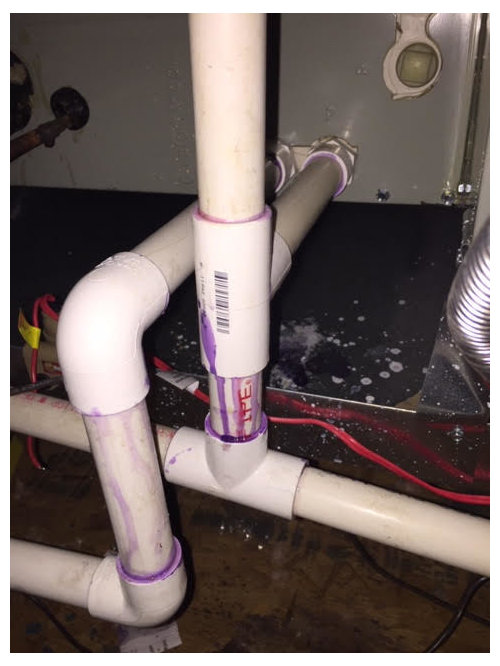
I recently had two new HVAC systems installed. The first system has a J trap connected to the condensate line. The 2nd system (pictured below) is connected to the same drain line with a T connection. Water from this system is pouring out of the overflow pipe to the outside of the house. I've had two plumbers come out and both said the lines are free of any clogs. I'm thinking this was installed incorrectly and water is backing up into the system. Thoughts?


Comments (21)

  • 7 years ago

    Is that water on the floor? If it is then condensation water is leaking. Have you called back the installer? What is the red wire and why is laying on the floor?

    A condensate line should have a trap so it blocks air flow from coil. I like the clear EZ Trap type. Easy to clean and you can visually check if there is a clog.

  • 7 years ago

    Some high efficiency furnaces have an internal trap. What furnace do you have?

  • 7 years ago

    The stain on the floor is from the PVC glue they used. The red wire is from the water alarm sitting in the drain pan. Its connected back into the system. It looks like it's on the floor but runs across the outside of the pan. My other unit has a trap but this one doesn't --both installed by the same company. They are sending someone out tomorrow. This is an American Standard 4.0 ton 16 SEER

  • 7 years ago

    Heatpump or furnace? is the condensate coming from AC use or furnace use?

  • 7 years ago

    Coming from A/C usage

  • 7 years ago

    Ah, OK, then it should have a P-trap.

  • 7 years ago

    P traps aren't required everywhere for AC condensate.

  • 7 years ago

    When you say, "overflow pipe", what do you mean?

  • 7 years ago
    last modified: 7 years ago

    "Elmer J Fudd

    P traps aren't required everywhere for AC condensate."


    Can you be more specific?

  • 7 years ago
    last modified: 7 years ago

    My understanding is that traps are not required by code everywhere. On addition to that, I've also read on an HVAC site that only industry credentialed folks can comment on (in response to homeowner questions) that not all think using traps is a good idea.


    This info could be wrong, that's what I've read.

  • 7 years ago

    Here is a good video explaining Why you need a P trap.

  • 7 years ago
    last modified: 7 years ago

    That's interesting. I think my coil drain lines (at the one house where I can access them because they drain at the bottom of the siding just above the foundation top) have no P traps, have positive pressure and a slight amount of air blows out the end.

    I wonder which is right and which is which?

  • 7 years ago

    If you have negative pressure, then you must have a P trap. If you don't condensate doesn't drain properly and will lead to problems.

    If you have positive pressure, the water will drain out. However conditioned air is being lost. It's the equivalent of having an open hole in the main supply vent.

  • 7 years ago

    I don't know enough about the physical layout of a coil to be certain but let me describe how I thought (maybe incorrectly) it physically is and you can tell me what's wrong.


    The coolant runs through a serpentine of pipes with fins attached, like a car's radiator. Warm air is blown through the coil and fins, loses heat, and while doing so water vapor condenses on the cold surfaces. .Water drips down the coil into some kind of collection pan and then is piped out to drain.


    If that's right, then the air is moving through the coil under positive pressure and the drain hole (and connected pipe)would similarly be under positive pressure. No?


    I just had a thought - maybe does it depend on the layout of the blower and coil? Mine are downflow arrangements. The furnace sits on top of the coil and blows air downward through it. It must be positive pressure in the coil.


    Would an upflow be different, with the coil beneath the furnace but the furnace sucking air up through it and so creating a negative pressure? I think that might be the explanation at least for this discussion?

  • PRO
    7 years ago
    last modified: 7 years ago

    As far as blower suction and condensate drainage is concerned it greatly depends on configuration of the equipment.

    The old blanket statement doesn't work in HVAC. (you know as in always do this or else, regardless of the circumstances.)

    In a air handler set up the blower is pulling air thru the evaporator coil, where as a furnace is pushing air thru the coil.

    In addition to that if you put a trap in (improperly) you know because you don't know how equipment is supposed to operate you can also cause drainage problems that way.

    Like putting two or more traps on a condensate line. Over time this can cause a lot of problems.

    So if you improperly add a trap you seal off and create a suction within the drain system the blower running could effectively cause draining issues because the trap fills up with water and the blower running can create a suction and thus prevent the condensate from draining properly. Obviously the blower shuts off and the drain is then allowed to drain because the suction is gone.

    Because of this you could think the system drainage is proper when in fact it is not. Then 3 years, 4 years later you get a big repair bill in the form of maintenance. There is no warranty on system maintenance, you pay for dumb mistakes in more ways until Sunday.

    Go ahead, ask me how I know this.

    In a less humid climate like New Jersey it probably won't matter that much. But we all know the air conditioning market does not revolve around New Jersey.

    Also just because you don't visually see a trap, doesn't mean one doesn't exist. You have to know buildings and know codes, plus changes to that code over the years.

  • 7 years ago
    last modified: 7 years ago

    Ray,

    Have you ever been to New Jersey? If have haven't then you should visit in the summer. You will be able to experience days like we had two weeks ago when the humidity was above 90%. It happens when there a several days of temperatures above 90 degrees, and then the thunder storms come and dump a lot of water on hot concrete and asphalt. It is interesting to watch the steam come rise off the hot surfaces after the rain stops.

    When we get these conditions the humidity in underground basements gets very high and stays high for the whole summer. You can get condensation dripping off cold water pipes if you don't control the humidity. The condensate from my AC coils and condensing furnaces is draining all year round.

    I have EZ traps on my furnaces. The clear tube allows me to see the debris in the trap. They are easily cleaned with the included brush. They are inexpensive and easier to install than a trap made out of PVC piping. I recommend this device whenever someone reports their trap is clogged and they have to disassemble the piping to clean it.

    I agree many HVAC installers don't understand when and how to install a trap. This seems to come up for debate by professionals on the HVAC Talk forum. My intention was to show why a trap is required. And you are right that it is possible to screw up the installation of a simple device like a trap.

  • 7 years ago

    " My intention was to show why a trap is required. "


    And my comment (once I got my thoughts organized) explained why what you showed wasn't relevant in my case nor in similar setups. Unless I'm missing something.

  • 7 years ago

    If you have positive air flow then you can probably get away without having a P trap. I think many installers avoid the cost of putting a trap in t his situation. They have learned not installing one means it can never clog up and it saves them time and money. But I think what may happen the first 90 degree elbow will eventually clog up and there is no way to easily clean it.

  • PRO
    7 years ago
    last modified: 7 years ago

    Mike, it's humid where I live all year long. There's nothing New Jersey could show me that I don't already know. Your air conditioning season is short, mine is as much as 10 months most years. A few weeks of high humidity is nothing compared to if you deal with it all year long. That's my point.

    Also I've told you many times that blanket statements do not work for things in relation to HVAC. You have to know what you are doing --- all the time. Otherwise it will eventually cost you, in more ways than one.

    I've had AC calls in December and February. It requires heat & humidity to generate that. What is the normal temperature of New Jersey in December & February time periods?

    I service the Katy, Texas area in case someone has a case of amnesia or something. LOL.

  • 7 years ago

    What is the normal temperature of New Jersey in December & February time periods?

    The average temperatures in December is 44, in February it is 42. January is actually the coldest month at 39 degrees. During a very cold day in the single digits, I think more condensate is produced by the furnace than in the summer when temperatures are in 90s with 90 degree humidity. The condensate traps in NJ need to be clear all year round.

    I agree blanket statements can cause more harm than good.

  • PRO
    7 years ago
    last modified: 7 years ago

    Well condensate from a furnace is an entirely different cause and effect, because the furnace is creating the condensate by mode of operation, not from the humidity content of the structure.

    Furnaces do not removed humidity from a structure without the assistance of an air conditioner.

    As an example an 80% efficient furnace does not create any condensate waste water at all. This demonstrates the furnace produces it as a function or mode of operation of the particular furnace. In order for a furnace to be considered condensing it must be 90% or higher efficiency.

    The condensate it produces is due to using the excess heat to heat the structure as opposed to letting it go up the flue. Because dew points are reached during this process, the result is condensate water vapor. This has nothing to do with the humidity content of a structure.