Software
Houzz Logo Print
hartcm08

Large yard landscaping ideas and solution.

7 years ago

Hi-

We have recent purchased a home on roughly half an acre of land. The home has some nice mature shady trees and a few areas that need to be brought together to give the space some definition. Under the trees quite a bit of mud gathers during heavy rain or snow. This side of the property is met with a gate that belongs to our neighbor. This area gets little to no light due to the trees above. Any ideas for how to visually improve this space and eliminate some of the mud? I am in zone 7a in the Greensboro triad area. Thank you for any help.

Comments (22)

  • 7 years ago

    Post some photos


  • 7 years ago

    My apologies, I see the photos did not properly load.

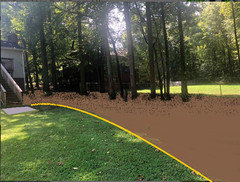
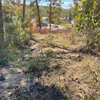
    this is the back of the home. The area I am referencing in below photos are to the right in the wooded area.


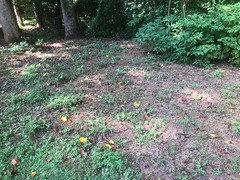
    This area directly beneath the trees in the area I was mentioning.


    close up

  • PRO
    7 years ago

    The way to give it definition is to define beds, distinctly separating the wooded area from the lawn. One would do this within the context of designing the whole back yard, not just one portion at a time. After locating the bed lines, one would kill all the weeds in the wooded area, and then mulch it. There is no point trying to grow grass where there is not enough light to grow it.

    That would work fine for a quick solution, but doesn't work well as the only long term solution as mulch needs to be replenished every year. You'd get tired of the recurring expense and work. But while it was mulch-only, it would allow you to keep weeds out easily since it could be sprayed as needed without damaging other plants. Over time, though, you'd want to convert to a groundcover so you could end needing to mulch and so you'd be looking at nice green plants instead of flat, dry, brown mulch.

    To take care of a 1/2 acre property, you'll need a good backpack sprayer. It would be impossible to spray large areas with a hand carry type sprayer. Eventually, you'll probably want to plant some shade tolerant shrubs along the border for view and possibly for some privacy ... or at least a sense of it.

    At minimum, even if it goes nowhere, there should be a landing at the base of the steps.


    hartcm08 thanked Yardvaark
  • 7 years ago

    I saw a few photos of what appeared to be hydrangeas lirope and hostas making somewhat of a landscaped border.. is that a realistic planting Idea? I am unsure how much privacy hydrangeas will provide..

    the step situation is interestin. There are two logs there now. A landing is an absolute must.

  • 7 years ago
    last modified: 7 years ago

    If you want to keep the larger shade trees, don't damage the roots w/too much digging and definitely don't put dirt against the bark. Thin out the trees so you leave only those you want to keep. Then see if it is possible to create a pair of shallow scooped areas in the grass covered ground -- front yard to back spaces you can mow -- to have the water flow where you want/need it to avoid creating those muddy places.


    If not gravel filled drainage ditches may be needed.


    With homes to the left and right (and behind?), unless you can fence the side and back yards for privacy, you might begin by outlining the sides and back of the lot with an evergreen shrub -- begin at a point on one side even with the front wall of the home and plant around the back yard until you get to that point on the other side of the lot even with the front wall of the home.

    hartcm08 thanked suezbell
  • PRO
    7 years ago

    Some, not all, hydrangeas can provide some seasonal privacy, but there is no way to gauge your needs, or how those plants would satisfy them, based on what little we know about the backyard. I think you could benefit from creating, or having someone create, a master plan, so you have a guide to what improvements you will make to the property over the long haul. Even if you take 15 years to implement the plan, or never fully achieve it, going only as far as you wish, the PLANNING still needs to be done at one time.

    hartcm08 thanked Yardvaark
  • 7 years ago

    Good morning everyone-

    Thank you for all the wonderful ideas and important points.

    There is no neighbor to the back or right of us. We had a home inspection done, I’m assuming that is not what you mean by master plan correct Yardvaark? Went by the home again today after a heavy rain and walked around the back. It seemed the water was only muddy in areas under the trees. Also under the deck it’s just weeds and mud as well. We are considering creating a concrete patio under the deck, expanding to the back door to create an additional sitting area & better utilize that space. Along the right side of the home more mud under the trees but very little erosion. I drove around the neighborhood and some neighbors had underplanted their trees with either small shrubs or a a ground cover (Ivy). They had mostly shaded lots which they had turned into very pretty yards. The grass is mature and mostly full in the front and back but looks like it could use a seed and fertilizer. Most of the trees are in good condition, I just would prefer more light. I may just need to Limb them up. Is there a place where I can find more information on creating a landscaping plan myself? We have other pressing issues to resolve & if there is a possibility we could conserve funds that would be wonderful. When you say a plan would it resemble step one spraying weeds and mulching trees, two outlining beds three hardscape areas etc?

  • 7 years ago

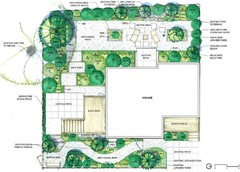
    A master landscape plan is like creating a blueprint for how you would like the garden to function....the entire garden. It would take into consideration all existing elements that would remain in place - the house, any out buildings, all hardscaping that will remain and any major, immovable plantings (the trees, etc.). And then any proposed changes - a new patio or any additional hardscaping, new, defined planting beds and any new plants to be added.

    You can do this yourself although there is a bit of a learning curve involved. You first need to prepare a to-scale measured drawing of the property with all existing conditions and then use that as a base map from which to develop an actual master plan. It would be a lot faster and easier to hire a designer to help you with this and generally only a modest dollar investment....but one that wll eliminate a lot of potential mistakes and trial and error. They will also be able to help you sequence the landscape renovations as well.....for instance, clearing out, grading and all hardscaping would take place before anything else.

    The biggest expense in landscaping is labor costs. In the overall scheme of things, design or consultation fees are minimal with respect to other costs - generally only a few hundred dollars, depending on the size of the project. if you can do the actual landscape installation work yourself you will save a bundle.

    This is roughly what a master plan will look like.

    hartcm08 thanked gardengal48 (PNW Z8/9)
  • PRO
    7 years ago
    last modified: 7 years ago

    The master plan that Gardengal showed has been colored to make it easier to read ... like a presentation plan that one might show a client. But if you're doing your own, for yourself, it can be a simpler black and white line drawing.

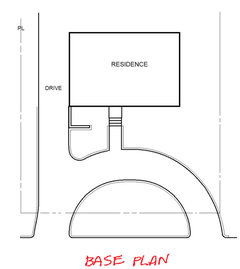
    All planning begins with the creation of a base plan, which doesn't show any proposed work but only existing site features that will remain through all the time you own the property. It would look generally like this:


    On the base plan, I don't show trees ... just tree trunks, the general rule being to show only what exists at grade level, not things that are raised up above the ground. (You would add such things to other plans that are created from the base plan.) The goal is to keep it simple and easy to read. If you show details on the base plan, you might end up needing to erase them when you use the base plan to create another, specific purpose, plan. On a copy of the base plan as a starting point, you would add hardscape, beds, plants, etc., in order to make a master plan. At the home sale closing, you will usually get a document that shows a plan of the house, drive, walks, property line, etc. You can use that, enlarging it, to create a base plan -- correcting any mistakes or omissions it has. You would not show anything extra on the base plan. Proposed elements and details will be shown on the master plan and other plans that you make from the base plan.

    For a residential property, the smallest scale you'd want to work at is 1"=10'. On a piece of copy paper, you can draw a yard space that is roughly 80'x100' maximum. If your backyard is larger than that, you'll need a larger piece of paper. The larger the scale, the easier it is to draw and read. The maximum practical scale to work at is 1/4"=1'. At that scale, on a piece of copy paper, you can only show a yard that is 30'x40'. It might take a very large piece of paper to show your whole backyard, or your whole yard, if that's what you want to work on. To work at that scale, you'd basic drawing tools: T-square, triangles and a straight-edged table to tape your drawing to.

    If you have an inclination to using the computer, it's possible to draw a plan in MS Paint (or probably many other drawing programs.) An advantage is being able to zoom in and out, creating the whole drawing on a sheet of paper of virtually infinite size -- and secondly, being able to erase, copy and paste, color, etc., with ease. There is a modest learning curve but it is not too bad. (By default, it prints out at 1"=10'.)

    hartcm08 thanked Yardvaark
  • 7 years ago

    Yesterday I went to the home again. Took more photos & stood there wondering... What in the world was I thinking?!?


    I can't do this! I can't afford to hire someone to do this. This is a real house with a real yard. I must have lost my mind.


    But we close sept 30th. Smh

  • 7 years ago

    You don't have to do it all at once. In fact, you could live through the winter and start in the spring.

    hartcm08 thanked emmarene9
  • 7 years ago

    If you have some moisture gathering at the base of a tree, and not much grass growing, that's probably a sign that your tree is in good health with lots of leaves. If water pools near the tree, it may be providing much-needed moisture to the tree roots.

    Don't be in a big hurry to make a change before you look into this. Your healthy tree is an enhancement that you don't want to damage by burying its existing roots under deeper soil that wasn't there as the tree was rooting itself. It can kill some trees.

  • 7 years ago

    Closed September 30? So you're in the home as of this month? Congrats on the new home. Nice place. Once you've had a real yard for a while, then not having one will seem almost like punishment.


    Take your time trying to get stuff done, especially major landscaping -- it is an ongoing issue. Before you ADD landscaping, you should decide how much time and effort and energy and money you want to put in it on an ongoing basis. For now, you may want to just keep the grass and weeds mowed.


    Putting soil against a tree trunk will eventually cause growths on it and rot that will kill it even though it can take several years to do so. Falling trees can damage a home or car or anything else in its path.


    If you had lived in the home for all four seasons you'd probably have a good idea which trees you definitely want to keep and which you definitely would like to remove. You might want to begin paying attention to what trees shade what areas and what the trees look like during the different seasons so that by this time next year you'll be able to make a more informed decision as to what trees to to keep and what trees to remove. No rush to remove trees as "landscaping" unless it is dead and could fall, thus poses a threat to persons and/or property.


    When you're ready to remove trees, you MIGHT be able to find pros that would cut and haul off the trees you want cut in exchange for keeping the lumber of firewood from them; however, if you make such a deal, both you and the pro need to be very clear on what will taken and what will be left... stump, roots, limbs, etc.


    Ideally, the pros should be from an established local business with liability insurance but, depending upon where you are, there might be some "self employed" loggers, too, that work out of their homes. Talk with a local landscaper and see if they might provide information on options.


    A pro should know how to make the tree fall away from you home or outbuildings or fence or any neighbor's property.


    If you're even considering DIY on this, first watch a lot of You Tube vids and Reddit vids, etc., on how to cut a tree and "what could go wrong" doing so before you begin cutting trees yourself.


    If you just want any tree(s) only trimmed to let in more sunlight, however, that will definitely cost you and it will need to be done during the cold months -- after the sap goes down for the season when the trees are dormant.


    As to mud or standing water, you might consider the slope of the yard specifically with regard to whether or not it would be practical to create drainage for the mud -- without dumping all the water/mud on your neighbor. You might also want to be certain that a problem with your septic system is not contributing to the problem -- do you have a septic tank and where is it and where are the drain lines or utility sewage lines. You need to know where any/all the utilities are buried before doing any major digging.


    Depending upon whether or not you'd actually use it, it might be worth considering to create a deck and/or boardwalk over some of the more problem wet/muddy areas.


    IF you don't have a septic tank and drain field, and after you talk with a local landscaper. you might plant the kind of tree(s)/plants that like a lot of water (weeping willows come to mind) to see if they'll absorb more water more quickly. Note: The "thirsty" trees can fill up your tank and drain pipes with roots. Search the web and talk with landscapers: Be careful not to plant an invasive species or you'll be creating work for yourself long term..


    In a really shady area, I like moss. It can take a few years to spread to cover the shady dirt/muddy areas but when it does, you can mow over the moss to get rid of any weeds and not have dirt sprayed everywhere. The moss becomes an outdoor carpet, albeit a damp one in a damp area.


    As you decide what to keep/plant, keep in mind how you'll maintain it -- can easily mow your yard around whatever plants you'll have in your yard with the kind of mower you'll have -- gas powered push or riding mower.


    hartcm08 thanked suezbell
  • 6 years ago

    hello all-

    Grass is a serious issue at this home, or lack there of. Last fall I removed leaves and there was pretty much just dirt. I planned to do a bit of seeding this month.. well the Moss beat me to it. All our dirt patches are quickly getting covered by the stuff. I’m not surprised because it’s shady here and plenty of rain. Some spots im ok with this but in the front yard, grass is our preference. Any tips? Last house we had Bermuda. This home we considered maybe fescue? Can grass and moss politely co exsist in a yard? any grass type favorites? When is an ideal time to seed?

    thank you all for you valuable insight.

  • 6 years ago

    Virtually no type of turf grass will grow in heavy shade, such as that provided by the trees in your second photo. A minimum of 4 hours direct sunlight or 4-6 hours of dappled sunlight. You need to think of a different type of groundcovering that will be more shade tolerant.

    In more open areas with more sunlight available, you can address the moss issue. Just killing it off will be a temporary measure at best......you need to correct the conditions to get rid of it entirely. Moss thrives in areas with compacted, low fertility soils, with poor drainage, with excessive shade and with low pH. Correct any or all of these that apply and then you can overseed.

    hartcm08 thanked gardengal48 (PNW Z8/9)
  • 6 years ago

    Please listen to the design suggestions here but not the suggestion to spray herbicides - not only as the first step but as ongoing weed control?? Stop the insanity! Lay newspapers down on the area you define as the bed. Wet them and cover with wood chips available free from arborist, if you want to plant, just use a knife to cut thru the paper. I respect you Yardvaark but really wish you would cease and desist with the herbicide regime. It’s 2020 and we are so beyond it. This is s new homeowner. Let’s help her become a responsible custodian of the land she just acquired.

    hartcm08 thanked kitasei
  • PRO
    6 years ago

    ",,, but really wish you would cease and desist with the herbicide regime. It’s 2020 and we are so beyond it." I appreciate, Kitasei, that you express your opinion in a humane way, as many would not. Unfortunately, we never going to have a meeting of the minds on this. As much as you're convinced that herbicides are evil, I'm just a convinced that, used responsibly, they're not, and that the people who share your sentiments know little to nothing about actual chemistry. A much greater threat IMO is the doomsday crowd's insistence that everyone be forced to live according to supposed "enlightened" viewpoints, especially as those viewpoints infringe ever more on everyday aspects of life.

    hartcm08 thanked Yardvaark
  • 6 years ago

    Hello all!


    Boy O boy is this home work. The weeds seem to be super weeds, quickly covering areas. I sprayed the area yesterday and I think this year we will just do our best to keep the area mowed and trimmed and continue to work in the front. I am telling you, this is too much work for myself and my husband. I did not show you all what’s to the right of our backyard, another huge headache beside a small rocked creek. Weeds, weeds everywhere. Some things I’ve never seen. I bought some wild flower seeds I was going to sow to help with the weeds. After one look I tucked them back into my bag. Smh I fear I have made a mistake. I will post a photo shortly. I am hoping after I spray with round up then I will have to dig up roots and maybe have a chance to plant something.. will seeds germinate fast enough? I have some things to help them

    germinate quicker.. is it possible to multiply my lirope using a root hormone? I am telling you all, this is bad.

  • PRO
    6 years ago

    No, on the liriope and rooting hormone. Liriope (presumably we're talking about L. muscari -- the clumping kind. I don't think anyone would ever ask if they could speed propagation of L. spicata, since it rapidly runs amok where and whenever unconfined.) You can divide L. muscari clumps annually, if you like, and they will keep multiplying. Since their numbers can be at least doubled (more likely tripled or quadrupled) every year, it does not take long to develop large numbers of them.

    hartcm08 thanked Yardvaark
  • 6 years ago

    My Mom planted monkey grass under the shade trees in our front yard in Charlotte. It took a couple of years to get it all in, but once it was established the maintenance was pretty easy and it looked great. Lots of our neighbors did the same thing after seeing how good it looked.

    hartcm08 thanked shivece
  • 5 years ago

    This is the tear we tackle the back. Wish us luck !