Software
Houzz Logo Print
the_silent_seed

Sansevieria OMAKE ?

6 years ago

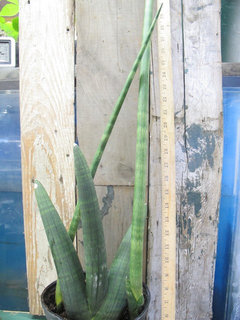
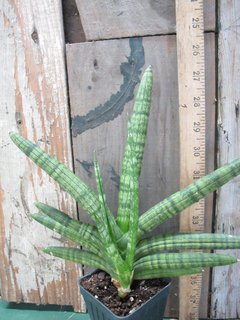
Anyone have any information on this plant? Looks similar to S. pfisteri to me?

Comments (16)

  • 6 years ago

    pls try your pic again as it didn't attach, try the Houzz photo icon.

  • 6 years ago

    Karen,

    I did not attach a picture yet. I'm wondering if anyone has any experience with this plant.

    Thanks!

  • 6 years ago

    Here is a picture of one of mine.

    Jude's ideas · More Info


  • 6 years ago

    Anyone have any insights on this plant?

  • 6 years ago

    I have never seen cylindrica with 2 1/2 - 3 inch thick leaves - Recently there was a Sans. pfisteri rooted leaf cutting on Ebay - that's what this reminds me of. Have you seen pfisteri?


  • 6 years ago

    Wow, I think your right. Took a better look. That's one plant you can put on hold for me. Love it.

  • 6 years ago

    I'll get a piece started for you, my friend!

  • 6 years ago

    It is a common cylindrica var. patula treated with paclobutrazol ( a dwarfing chemical, used in Poinsettias) . You can buy it with the trade name 'Bonzi' . The new shoots, of course, revert to the normal length of this species.


  • 6 years ago

    Roberto,

    Thank you for your insights.

    The boncellensis produces offsets that are the same as the mother plant, and does not revert to anything else. The offsets also stay small, like the mother plant. At least that's what I've been seeing in U.S. stock.

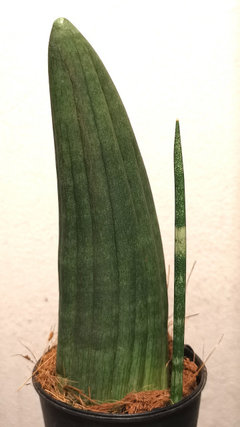
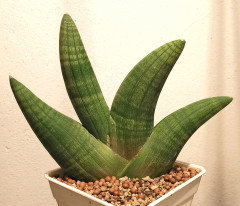
    Here is one of them, complete with an offset to compare to the above plant. (that is a 4 inch pot. The Omake / pfisteri is in a 8 inch pot.)

    I would be interested in any literature you may have to share about the Omake.

    To me, the Omake looks like a pfisteri. Is there a distinguishing characteristic?

    (In the other thread called Flowering Sans, I share a picture of my giant cylindrica, also for comparison in leaf thickness and growth habit.) I'd be curious to hear what your thoughts are. Thank you.

    Jude's ideas · More Info


  • 6 years ago

    The plant in Your last photo looks like plain 'Boncel' (it is a cultivar, S.boncellensis does not exist.). I was speaking of those 'monsters' traded as 'Rhino Horn', as shown in Your first photo. There are around some different forms of 'Boncel' (I have a 'dwarf' and a 'black' one).


  • 6 years ago
    last modified: 6 years ago

    Hi Roberto,

    I did mean "Boncel" and thanks for clarifying that "boncellensis" doesn't exist.

    I would love to see what the dwarf and black Boncel look like!

  • 6 years ago

    By the way, pfisteri is a totally different species, with reflexed, unmarked leaves. The original photos of the species in habitat show very big and thick plants. I never attained that size in my plants, though I grow them in the open ground.


  • 6 years ago

    May I see a picture of yours? Thank you for sharing your knowledge.


  • 6 years ago

    @Roberto Mangani,


    Thank you for that information about Sansevieria cylindrica var. patula treated with paclobutrazol. Are you certain about this? I'm really interested and curious.


    I have been searching the world wide web for any reference from any respectable botanical website to S. omake or S. obake, but there was none. So I guess these scientific names must have been made up by nursery owners as a marketing ploy.


    Since it doesn't breed true, can it be considered a cultivar then? If so, can we call it Sansevieria cylindrica var. patula Rhino? Rhino being the trade designation. I also don't know if this has been registered as a cultivar. Is the above naming scheme acceptable then?


    Thanks in advance for any information.

    Thomas


    PS. I just want a proper name for it.


  • 6 years ago

    AY, Sorry, but both Silent Seed and Roberto Mangani don't post anymore. I can't get in-touch with them.

0
Sponsored
J.Holderby - Renovations
Average rating: 5 out of 5 stars4 Reviews
Franklin County's Leading General Contractors - 2X Best of Houzz!