Software
Houzz Logo Print
sukranbahar_sener

Help with snake plant! (Mushy leaf!)

6 years ago
last modified: 6 years ago
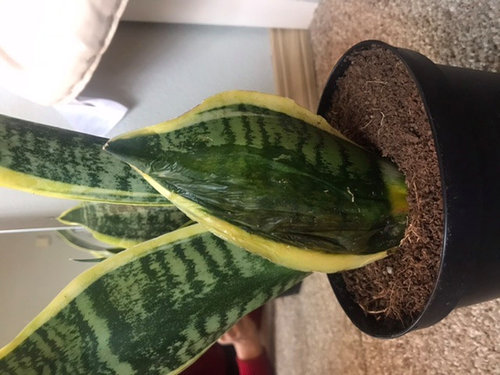
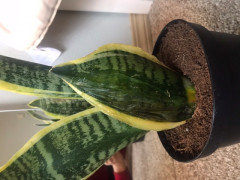
I ordered this plant online a couple of weeks ago and it barely had any water since. The soil is dry to touch at the top and when I put my finger in it’s damp (not soggy). The leaves have opened up a bit in the middle and one of the outer leaves is mushy on halt of it, the skin of the plant is wrinkly and it’s soft! I kept it in the pot with holes under it and in the soil it came in. I don’t know why this is happening or how to fix it, please help! Right now, it looks healthy other than that half leaf but I’d like to take quick action, thanks!


Comments (16)

  • 6 years ago

    Your plant doesn't like wet feet and will show its displeasure quickly if it's asked to tolerate excess water in the soil. While it would rather not be allowed to dry down completely, it will tolerate that condition well, and it's preferable to wet feet by a wide margin. I'll leave you with a little piece I wrote about using a wooden "tell", to "tell" you when it's time to water.

    Aside from using a medium that does not hold excess water and keeping watering under control, it likes warm temps 65-80*F and very bright light but not direct sun. A good quality fertilizer with a 3:1:2 NPK ratio will work very well for your plant. NPK RATIOs are different than NPK %s. Fertilizers with NPK %s of 20-20-20 and 14-14-14 are 1:1:1 ratios, while 24-8-16, 12-4-8, and 9-3-6 are all popular 3:1:2 RATIO fertilizers. I use Foliage-Pro 9-3-6 for nearly everything I grow, for a number of reasons, which I'll share if you have interest.

    Using a 'tell'

    Over-watering saps vitality and is one of the most
    common plant assassins, so learning to avoid it is worth the small
    effort. Plants make and store their own energy source –
    photosynthate - (sugar/glucose). Functioning roots need energy to
    drive their metabolic processes, and in order to get it, they use
    oxygen to burn (oxidize) their food. From this, we can see that
    terrestrial plants need air (oxygen) in the soil to drive root
    function. Many off-the-shelf soils hold too much water and not enough
    air to support good root health, which is a prerequisite to a healthy
    plant. Watering in small sips leads to a build-up of dissolved solids
    (salts) in the soil, which limits a plant's ability to absorb water –
    so watering in sips simply moves us to the other horn of a dilemma.
    It creates another problem that requires resolution. Better, would be
    to simply adopt a soil that drains well enough to allow watering to
    beyond the saturation point, so we're flushing the soil of
    accumulating dissolved solids whenever we water; this, w/o the plant
    being forced to pay a tax in the form of reduced vitality, due to
    prolong periods of soil saturation. Sometimes, though, that's not a
    course we can immediately steer, which makes controlling how often we
    water a very important factor.

    In many cases, we can judge whether or not a
    planting needs watering by hefting the pot. This is especially true
    if the pot is made from light material, like plastic, but doesn't
    work (as) well when the pot is made from heavier material, like clay,
    or when the size/weight of the pot precludes grabbing it with one
    hand to judge its weight and gauge the need for water.

    Fingers stuck an inch or two into the soil work ok
    for shallow pots, but not for deep pots. Deep pots might have 3 or
    more inches of soil that feels totally dry, while the lower several
    inches of the soil is 100% saturated. Obviously, the lack of oxygen
    in the root zone situation can wreak havoc with root health and
    cause the loss of a very notable measure of your plant's potential.
    Inexpensive watering meters don't even measure moisture levels, they
    measure electrical conductivity. Clean the tip and insert it into a
    cup of distilled water and witness the fact it reads 'DRY'.

    One of the most reliable methods of checking a
    planting's need for water is using a 'tell'. You can use a bamboo
    skewer in a pinch, but a wooden dowel rod of about 5/16” (75-85mm)
    would work better. They usually come 48” (120cm) long and can
    usually be cut in half and serve as a pair. Sharpen all 4 ends in a
    pencil sharpener and slightly blunt the tip so it's about the
    diameter of the head on a straight pin. Push the wooden tell deep
    into the soil. Don't worry, it won't harm the root system. If the
    plant is quite root-bound, you might need to try several places until
    you find one where you can push it all the way to the pot's bottom.
    Leave it a few seconds, then withdraw it and inspect the tip for
    moisture. For most plantings, withhold water until the tell comes out
    dry or nearly so. If you see signs of wilting, adjust the interval
    between waterings so drought stress isn't a recurring issue.

    Al

  • 6 years ago

    Thank you so much! Some photos for extra info!


  • 6 years ago

    Remove that rotting infected leaf before it spreads to other healthy leaves. It will not heal, get better, or save itself.

  • 6 years ago
    last modified: 6 years ago

    If I understand what you said, you haven't repotted since you received the plant. It looks like it's planted too deeply, which could well be why the compromised leaf is in the shape it's in. What do you think about the depth it's planted at? The medium, because it's comprised of nearly all fine material, appears to be very water-retentive, so you'll need to be vigilant about how/when you water.

    You might find this to be helpful.My purpose for writing it was to help others avoid all the most common obstacles growers encounter on their journey toward a green thumb.


    Al

  • 6 years ago
    last modified: 6 years ago

    The mix it came in may work in a greenhouse, but isn't likely to work in the home.

    I'd go buy a bag of Cactus & Succulent mix & another bag of Perlite & mix them in equal parts, like 1 cup of each depending on pot size, mix together well to use to repot this.

    If mine, I'd take it out of the pot, crumble ALL that soil off the plant, clean that out the pot completely & start over, repotting in your new mix as I've suggested. Mush is rot & it spreads quickly.

    Remove the mushy leaf & anything else that's soft or mushy. Any dry, brittle roots can also be removed while you're there.

    Take some pix of it unpotted, w/out soil so we can see the roots pls.

  • 6 years ago

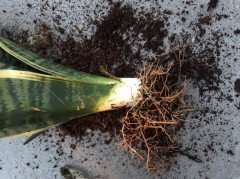
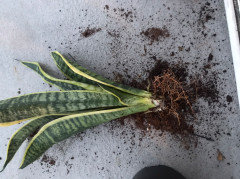
    Thank you so much for all the help! I am new to this- so I thought starting with a snake plant and sticking with the soil it came in would be a good idea. I removed the plant from the pot, and it didn’t seem to be very deep in there, I didn’t have to crumble it either, it just came out. I cut the infected leaf at the very bottom and made sure to remove any remains of it and took a photo of it. Since I couldn‘t get a new potting mix today I ended up putting it back in its pot for now, hopefully by tomorrow I’ll get new soil. Here is the root


  • 6 years ago

    The problem with most of these plants is the place you purchased it from over watered it and rot started to set in. They can take lots of water only in warm summer heat otherwise they do better with out water. They can go months with out water.

    Tapla gave great advise but don't fertilize until growing season and very little at that. Only a healthy snake plant could use it. A sick plant has other issues and will harm it.

    That plant was started with very little root rhizome and surprised it is doing as well as it is.

  • 6 years ago

    HC, Where do you live? Do you leave your sans out all year?

  • 6 years ago

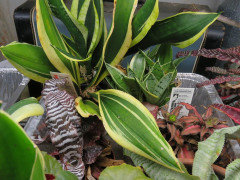
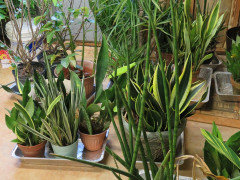
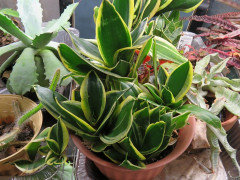
    Guess that post didn't go. I live in the suburbs of Atlanta. I must bring in all my houseplants before frost or a hard frost. Some I move to under my deck for the month of November to give me a few more weeks to get ready for the bigger pots.


  • 6 years ago
    last modified: 6 years ago


    So disappointed that Houzz/GW seems to be out of sorts on adding photos to threads yesterday and today.


    Let's see if I can add a photo to this post.

    Wow, that seemed to go. Let's try another.


    Wow, maybe I have to add one at a time and then post.


    Yay, seems to be the answer.


    One more.


  • 6 years ago

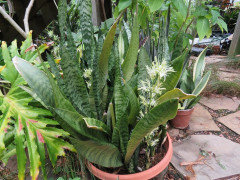
    HC, Looks like you got some interesting ones there. I see you got one that flowered from the roots. It happened to me once but is very rare in trifasciata.

  • 6 years ago
    last modified: 6 years ago

    Hi Sukran,

    Sorry to be long in getting back here, hopefully you've bought mix & repotted your plant already.

    Happy to say your roots look good, Sans. roots tend to be tan to beige to orange in color, so that looks fine too.

    Nice bloomers HC, have rarely had the pleasure of seeing blooming Sans. in person.

  • 6 years ago

    Thank you everyone for your help! I bought new fast draining soil and removed the leaf, repotted and even put some pebbles on the surface to give it some stability after the repotting (so I wouldn't have to plant it too deep and stop it from leaning) and now it seems happy and healthy! Haven't watered it since then, and it still seems to be doing well. Does anyone have suggestions on when I should water it again or a good "tell" for when it should be watered?

  • 6 years ago

    Glad it's better, search around here for 'using a tell for when to water".

  • 6 years ago

    Using a "tell":

    Over-watering saps vitality and is one of the most common plant assassins, so learning to avoid it is worth the small effort. Plants make and store their own energy source – photosynthate - (sugar/glucose). Functioning roots need energy to drive their metabolic processes, and in order to get it, they use oxygen to burn (oxidize) their food. From this, we can see that terrestrial plants need air (oxygen) in the soil to drive root function. Many off-the-shelf soils hold too much water and not enough air to support good root health, which is a prerequisite to a healthy plant. Watering in small sips leads to a build-up of dissolved solids (salts) in the soil, which limits a plant's ability to absorb water – so watering in sips simply moves us to the other horn of a dilemma. It creates another problem that requires resolution. Better, would be to simply adopt a soil that drains well enough to allow watering to beyond the saturation point, so we're flushing the soil of accumulating dissolved solids whenever we water; this, w/o the plant being forced to pay a tax in the form of reduced vitality, due to prolong periods of soil saturation. Sometimes, though, that's not a course we can immediately steer, which makes controlling how often we water a very important factor.

    In many cases, we can judge whether or not a planting needs watering by hefting the pot. This is especially true if the pot is made from light material, like plastic, but doesn't work (as) well when the pot is made from heavier material, like clay, or when the size/weight of the pot precludes grabbing it with one hand to judge its weight and gauge the need for water.

    Fingers stuck an inch or two into the soil work ok for shallow pots, but not for deep pots. Deep pots might have 3 or more inches of soil that feels totally dry, while the lower several inches of the soil is 100% saturated. Obviously, the lack of oxygen in the root zone situation can wreak havoc with root health and cause the loss of a very notable measure of your plant's potential. Inexpensive watering meters don't even measure moisture levels, they measure electrical conductivity. Clean the tip and insert it into a cup of distilled water and witness the fact it reads 'DRY'.

    One of the most reliable methods of checking a planting's need for water is using a 'tell'. You can use a bamboo skewer in a pinch, but a wooden dowel rod of about 5/16” (75-85mm) would work better. They usually come 48” (120cm) long and can usually be cut in half and serve as a pair. Sharpen all 4 ends in a pencil sharpener and slightly blunt the tip so it's about the diameter of the head on a straight pin. Push the wooden tell deep into the soil. Don't worry, it won't harm the root system. If the plant is quite root-bound, you might need to try several places until you find one where you can push it all the way to the pot's bottom. Leave it a few seconds, then withdraw it and inspect the tip for moisture. For most plantings, withhold water until the tell comes out dry or nearly so. If you see signs of wilting, adjust the interval between waterings so drought stress isn't a recurring issue.


    Al

Sponsored
Hope Restoration & General Contracting
Average rating: 4.7 out of 5 stars35 Reviews
Columbus Design-Build, Kitchen & Bath Remodeling, Historic Renovations