Software
Houzz Logo Print
pereiracity

Cymbidium Help please

6 years ago

Hi!

I live in the coffee region of Colombia. Tropical climate, 25/29°C days, 15/18°C nights all year round. (80/85°F days, 60/65°F nights). Hot and sunny in the summer and winter, rainy season in Fall and Spring . I am 7° North of the equator


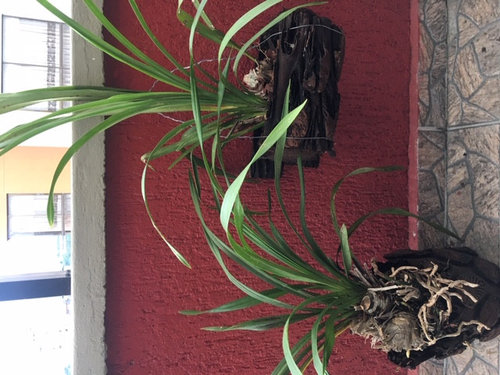
I was given a couple of very neglected cymbidiums that had been left in the full sun on a very hot balcony for a few years. No care at all, not even water. The existing growth is weak and spindly. I've had them since about May. I watered and fertilized all summer. The roots are in good shape considering.

I've never had the climate to grow Cyms so I would love some guidance.


My questions are about the Cymbidium's natural cycle:

Do I cut back on water and fertilizer in Fall (now)? a couple of the leaves turned brown and fell off recently and I wonder if they have a Fall rest as some orchids do.?

They get a good light. I understand Cymbidium light. What puzzles me is they did not produce any new growth this summer. They have only just started to produce new growth. (and boy, do they need healthy growth)


I really don't know what I am doing with Cyms. so any advise would be appreciated. I remember these being sold 3 christmas's ago in the street. They were still in their original pot when I inherited them and looks like they haven't done much in 3 years. I would love to salvage these. As I recall, the man was selling deep red Cyms. and Yellow Cyms. They were gorgeous

Saludos from Bella Colombia!

Suzanna


Comments (22)

  • 6 years ago

    Hi Suzanna. Just like you I know very little about cyms. But your story indicates that you have other orchids. And I know lots of species come from your area. So I was hoping you can share what and how you grow. Pictures would be nice. The weather description seems very favorable for humans and orchids. Thanks, Harvey

  • 6 years ago

    I'm not much of a Cymbidium person either, I think my summer nights are too warm.

    There are a few types considered to be warmer growers, like ensifolium and sinense. They tend to be smaller than the standard Cymbidiums and yours do look to be on the small side.

    The leaves look to be healthy but it looks like the new growth is much smaller than the older bulb in the front. If they have been neglected for a while they were probably living off the reserves in the old bulbs.

    I'm hesitant to give growing advise since your conditions are very different from mine but I can tell you what I do. I use taller narrow pots, they have a large mass of very "chuncky" roots. You don't see Cyms putting out aerial roots like other orchids, they seem to like to go deep into the mix almost like a terrestrial plant. I would try a coarse potting mix, maybe lava rock and bark mix so they don't rot in your rainy season. I think the light levels they were in were good since the leaves look to be in good shape.

  • 6 years ago

    mmmm I wrote a lengthy response with lots of pics. It just disappeared. when I hit "submit" Let me try to break it into 2 posts.

  • 6 years ago

    nope, not either. Let me get some help.

  • 6 years ago

    Here are some notes written for here. Might help! This cold tolerance thing in summer nights comes from Cymbidium lowianum which was used extensively in breeding. But there are some "warmth tolerant types". AND, of course these notes are for the Southern Hemisphere.

    Cymbidiums By Dr Fred

    Your first orchid was probably a Cymbidium which arrived as a gift, with spikes of large colorful flowers which then languished until thrown away. This is a pity, because these are some of the easiest, most available and rewarding orchids for beginners. Unfortunately some are quite large and if space is a problem, consider the miniatures. The most popular Cymbidiums are hybrids which can be quite spectacular, but species are available.

    Location is the key. An easterly aspect is ideal to get morning sun and afternoon shade in summer. In winter they will tolerate full sun all day long. A shade house with about 30% shade is ideal but alternatively they can be scattered through the garden. Light shade under a (preferably deciduous) tree will suffice. In both situations they seem to enjoy the natural cycle of rain and dry. A reasonable amount of sunlight (short of scorching) is required year-round to promote flowering. Too many Cymbidiums languish under dense shade at the bottom of the garden, neglected and unloved. This must be the commonest cause of failure to flower. A little extra protection from frosts in winter is appreciated. A front porch or the eaves of the house provide sufficient shelter if you don’t have a shade house.

    If you have multiple plants avoid crowding as it reduces sunlight and free air movement, leading to infestations and rot. Pots should be raised off the ground, ideally at about knee height to promote free drainage and sun exposure. This also discourages snails.

    Water Cymbidiums as they dry out. In summer watering is often necessary daily and should include the foliage. In winter, a morning watering once every week is enough. Remove that saucer under the pot in winter as retained water will lead to root rot.

    A regular feeding program pays dividends and this should include occasional trace elements (eg seaweed solutions) and calcium (eg Magamp) to promote strong flower spikes. While in active growth feed at least weekly with a soluble fertilizer at half strength. This should be done after watering.

    In March/April the plant needs signals to tell it to change from growth to flowering mode. For the bigger Cymbidiums flowering is triggered naturally by a drop in evening temperatures. In Sydney you may need to help this along by evening spraying, misting or watering in February and March. Miniature Cymbidiums do not seem to share this trigger for flowering. They are better adapted and will flower well despite our warmer climate. Both types appreciate feeding with one of the commercial bloom boosters from February as the spikes form. These are high in phosphorus and potassium.

    You can then join in the excitement of hunting for early flower spikes in mid-year and prepare to stake them. If you plan to bring the spikes into the house, cut them off just before the last flower opens and they will be quite long-lived in water. After flowering, remove the old spikes and consider repotting if the plant is becoming pot-bound. For smaller plants, pot on into a new,

    slightly larger pot and top up with fresh Cymbidium mix. Take the opportunity to remove any dead husks from around the back bulbs as these harbor pests such as scale.

    For larger plants requiring division simply divide in two with a sharp sterilized instrument. Don’tbother to tease out the roots although any obviously dead roots can be removed. A little root damage is expected, but hopefully this will be confined to the older roots. After division there may be a delay before flowering resumes but often plants which have been pot-bound will make up for lost time and flower next season.

    Use only orchid potting mix and do not reuse old potting mix. These encourage disease.

  • 6 years ago

    pereiracity, Try again. It appears that several people had some difficulty with this site. And I would love to hear about your other orchids. I've read that Columbia has more than 4000 orchid species. The most of any one country.

  • 6 years ago
    last modified: 6 years ago

    Hi

    Arthur! Thank you! That gives me some idea of what to do.

    Harvey, I tried again- nothing. I have contacted admin for this site. I am on a different browser. I am going to try a 3rd time. If it doesn't post, I'll wait for admin to advise

    Colombia and Venezuela have the highest distribution of orchids. There is a "sweet spot" that runs through both countries. stable temps, no heavy wind, plenty of water. Hunting is best after a good torrential downpour. Many branches thick with complete eco systems come down during a good rain.

    I have 1 comment about misting. It is the wackiest advise to give anyone, especially people new to orchids. I live in an orchid rich country and misting does NOT mimic conditions in any way. We don't hit dew point, almost ever. We get torrential downpours for 30 minutes to 4 hours and then the water stops; things dry out- FAST. This is a mountainous, volcanic environment. Soil is dry and porous and everything runs downhill into a river. I don't own proper rain boots. I don't need them. We don't have issues with mold in houses. I no longer suffer from allergies like I did in Florida. If we were in mist, the coffee cherries would rot on the bush. We never experience fog. We have what appear to be low clouds but we are at high altitude. The clouds never touch the ground

    Just my .2 cents- If you want to rot or infect an orchid -mist it

    I say that because the article above recommends misting...uyyyyy. not in 21 century New World orchid growing please. Shame Shame Dr Fred ;-)

    OK let me try again to post

  • 6 years ago
    last modified: 6 years ago

    PART 1

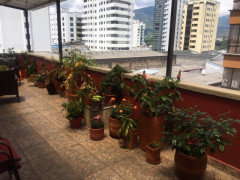
    Thank you so much for the responses. OK, let me tell you/show you my grow area. I should state that I move about every 6 months. Leases in Colombia are 6 months. I am a free bird here. I like to try the different neighborhoods. I rent furnished apartments or airbnb's. If I see a better place to grow, I move The plants keep on chugging along at full speed. I moved into this place a month ago. It has a covered balcony. What a score! I really needed some cover. My last place was full sun, no cover. This cuts the sun by about 30-40%


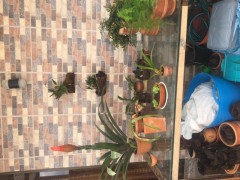
    James- The plants came to me in very tall, skinny black plastic pots, you're right about that. Unfortunately, plastic here tends to rot orchid roots. and yes, they both have a big chunky root balls. I went on youtube to see what people were saying about cyms. Cyms can be grown in the ground. I don't have access to lava rock, even though I live on the Nevado del Ruiz (the active volcano). It would have been my choice for media. I can get cheap Chinese bark or local moss. 1 Cym is in bark, the other is in nothing right now. I think the bark is too wet. I can get local, unamended volcanic soil. It's very dry but growing orchids in dirt just seems so wrong

    The mature growth was there when I received the plants- uff so pathetic. As I remember, these were not exactly standard size cyms when I saw them being sold in the street 3 years ago. The BB's are big so they aren't mini's either. Chinese hybrid imports. We get them occasionally along with Phals


    The plants made no progress in 5 months despite excellent care. Just now they decided to move out of stall. Less intense heat on the balcony may have something to do with it. We had a nasty August and early September. It hit 90F/32C almost every day. Not normal.


    At this time of year, I decrease fertilizer but I am not so sure I should do that for these 2. They need healthy growth I doubt there will be flowers from the existing growth and I would likely abort blooms due to the condition of the plants. They are too frail. Health first, then flowers.

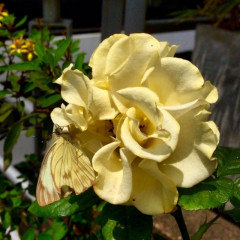
    We have such mild change of seasons that Fall becomes a big question mark for me. It is a little bit cooler and more cloudy. Sun in the mornings and monsoon style rains in the afternoons and evenings. Plants do all kinds of funky things at this time of year. I just go with it until I can figure it out. I haven't fertilized in a month. The roses are blooming and dormant plants are pumping out new growth- go figure

    Arthurm- Don't you grow cyms? You have the climate for them

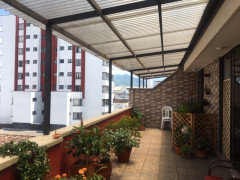
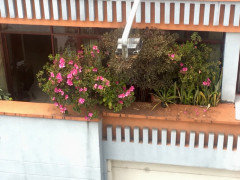
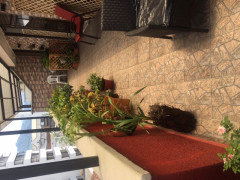
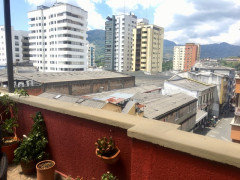
    My grow area for Harvey- You can see that right now I have only a small band of sunlight, so I've had to line them up. The sun moves only a little bit during the course of the year. I will have a little less direct sun by December and a bit more sun come April. The rain doesn't come onto the balcony so I can control the water. I even managed to find a garden hose that hooks up to the sink. It's leaky but it does the trick.. There is electricity on the balcony so if it gets too hot, I can run a fan. Such luxury for Colombia! I don't want to invest in plant furniture because I bop around so frequently. There is another table inside if I need it but they are ok where they are. It seems all the apartment dwellers grow on the floor here. My neighbor:


    --------------------------------End Part 1--------------------------------------

  • 6 years ago

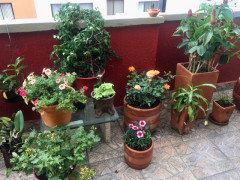
    This is where I grow - for now


    I grow a little bit of everything. Roses (easy, like weeds), carnivorous plants, Gardenias, sunflowers, little colored Brazilian flowers that never stop blooming, indigenous creepers and climbers for the butterflies and hummingbirds, tomatoes, ginger- anything I can get my hands on.


    ==============end part 2============================

  • 6 years ago

    The butterflies and hummingbirds are amazing here -the colors!. They get in a flower frenzy just before lunchtime. My balcony is busier than O'Hare


  • 6 years ago

    Orchids are harder to come by. I have a nobile Den that never blooms, A purple catt ( the national flower of Colombia) The 2 orphaned Cyms, 2 mini phals, 1 oncid., 1 odontoglossum, and a variety of pluero /masde types. The odontoglossum took a beating in the heat but it is also putting out new growth now


    Most of these come from a higher altitude. If you recall, I posted about these cooler growers. I lost the orange Pluero. It got too hot in August. The rest stalled but they are growing again. These are wild collected and do not behave the same way as a cultivated orchid. They are a giant pain in the _____. very sensitive to everything. Constant attention. small flat psuedobulbs no matter how much they are fed. The roof is a blessing.

  • 6 years ago
    last modified: 6 years ago


    I live in the valley in a city of about 500,000 but the mountains are never far! Gorgeous air comes off the mountains at night which drops the temps down to about 60F. They grow coffee and bananas on those mountains. I thought about growing coffee but they become 2-3 (6-9 feet) meters tall and need lots of room. Coffee is not an indigenous plant to Latin America either


    Would it be so bad to just let the orchids with new growth grow? Many have been given to me because their owners couldn't grow them. Don't be scared to advise me. I think it was Harvey told me that failure is a valuable learning experience and that is true. I have to re-learn how to grow, especially orchids. I will lose some. It's ok. I seem to attract orchids.

    Always a pleasure to get input from the 3 of you! Thank you

    Suzanna in heavenly Colombia

  • 6 years ago

    TA-Da! heehee. max 2 photo, using a VPN and a browser other than Chrome. That seems to be this site's parameters these days


  • 6 years ago

    Probably too heavenly for Dendrobium nobile which needs a cooler drier sunny winter, but you could be lucky with the Cymbidiums, They are semi terrestrial and I've seen them grown as garden plants, but they were the tough old fashioned types, Better grown in pots.

    I had a similar experience with Houzz when I tried to put the Cymbidium photos in one post. Wouldn't load, but seems OK now.

    Thank you for the lovely photos and descriptions.

  • 6 years ago
    last modified: 6 years ago

    I'm still having problems but I got it posted. I agree Arthur- we have summer conditions in winter. Much like Miami. Dry and sunny but the temps remain the same. 80/60F. So I have a little green decoration.

    I am going to look around for the Cyms to see what I can grow them in. The 1 Cym likes the traditional Colombian wooden basket but they just don't last and all the media comes spilling out. I'll leave it until it breaks. Do you think a mix of bark and volcanic dirt would work? The bark I get here is chips. Too small and water retentive. It's about 1 step off from seedling bark with a few bits of charcol

    Maybe I'll take a little bus trip up into the mountains this weekend and hunt for something to grow in.. Thank you ever so much for responding. I always learn something valuable

  • 6 years ago

    I don't mist anything either. There are plants that get that naturally but we don't live there. Like Borneo. I agree with Arthur. The wrong plant where you live. Is there comfortable living in that sweet zone where most orchids grow? Rather than getting orchids that do not fit where you live, find out which ones thrive naturally in the same micro climate as your growing area. See if there is a local orchid society. They will know all the local trick and plants that like your growing area. When I first started growing orchids I picked the plants that had flowers I liked. I don't do that anymore. Now first it must like the local climate. Starting there give you a better chance to be successful. Good luck!

  • 6 years ago

    O hear you Harvey although our climate is similar to SOCAL and I should be able to grow Cyms. They were freebies but they are not happy.


    You know there is a fakey orchid society. 4 old ladies having coffee. Gringos not welcome. They gave my friend a nobile Den that does not bloom here. I'm sure they had a good laugh.


    I finally have a resource. He doesn't grow Cyms. He has 4 greenhouses stuffed with commercial New World Orchids, Mainly catt-types, very common, very expensive, very hard to hook up with him. I saw Bucket orchids, Catts, Prismatocarpa and a couple of yellow Oncids. He is about 25 minutes by car and his micro-climate is totally different. Much cooler, darker, rainier. He grows incredibly dark. Everything is covered with lichens. My Spanish is average, but It is really hard to have a conversation with him or he is a little wacky. He wanted sell me very expensive orchids that would croak it fast in the heat of my city. People are not that forthcoming with information here. I think they just don't know.


    Yes there is amazingly good living here in the "sweet spot". I pay $400USD for a 2 bedroom penthouse in the city, utilities included. I have to be in the city because of my work but It's less expensive in the country. I can ride about 25 minutes in any direction to the forest. I love Colombia. It was the best decision I ever made. It's like living in the 1950's or 1960's when people were polite and had some patience. Common down!!!!!


  • 6 years ago
    last modified: 6 years ago

    Suzanna,

    There is a "major" Cym breeder in El Retiro, no sure how far that is from Pereira. It's New Horizon Orchids which is owned and operated by Andy Easton, NH used to be based in the US/SOCAL until a year or so ago. He also runs a forum that is mainly dedicated to Cyms. Try searching for New Horizons Orchids and try that forum to get local advise from the man himself.

    Good luck,

    Bob

  • 6 years ago

    Hi Bob

    Thanks so much! He is way out there, by Envigado, near Medellin. Gorgeous area. About 6-8 hours from me though. I am going take your advice and see if I can find a website and communicate with him. I would like to hear what an English speaker has to say about growing here in Colombia.


    Ironically, the Cyms seem to want to go down for a rest. Yellow leaves in such a short time.

    Suzanna Gringa

  • 6 years ago
    last modified: 6 years ago

    It is a small world. Over on the gallery is a picture of Cymbidium Heartbreak Doctor in the

    Spring (Southern Hemisphere) Cymbidium flowering time thread

    Here is the orchid registration details of that orchid.

    Cymbidium Heartbreak Doctor

    Genus Cymbidium

    Epithet Heartbreak Doctor

    Synonym Flag This is not a synonym

    Registrant Name Torrance Cym.Soc.

    Originator Name A.Easton

    Date of registration 03/02/2004

  • 6 years ago

    No way! Indeed a small world. I am going to take a look.

Sponsored
Miller Woodworks
Average rating: 5 out of 5 stars23 Reviews
Franklin County's Trusted Custom Cabinetry Solutions