Software
Houzz Logo Print
mattybur

Antique (?) Plan Chest - any info please?

6 years ago
last modified: 6 years ago
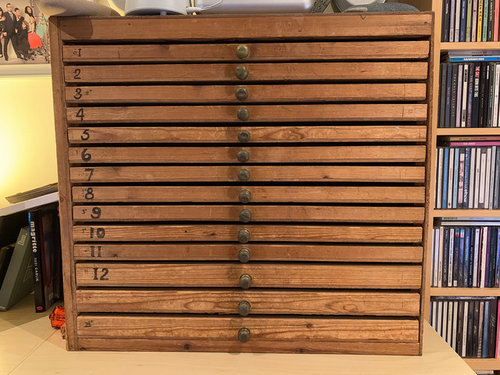
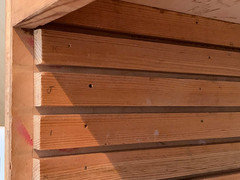
Can anyone tell me anything about this plan chest, which I bought at an antiques fair in Brighton a few years ago?

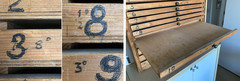
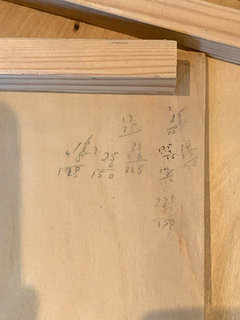
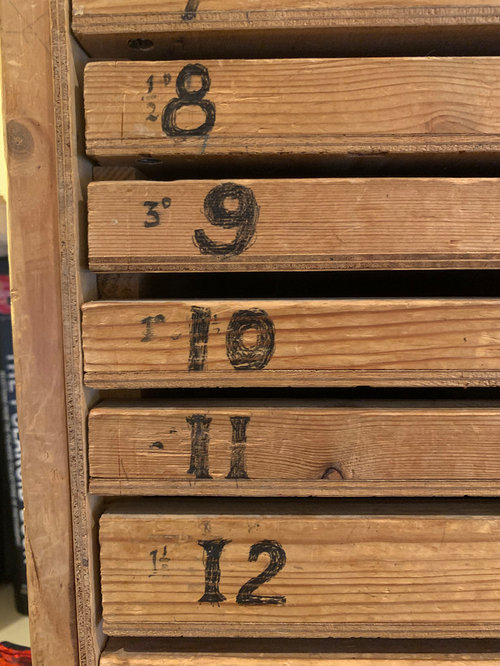
It's 58cm wide, and 53cm tall, and has 14 drawers, 12 of which are numbered by hand, with some other smaller numbers next to them, such as 3D, 1D and 1/2D, which I presume refers to pre-decimal currency.

I'd just love to know how old it is, what it might have been used for, and anything about it, really, if anyone can help!

Thanks, Matt


Comments (19)

  • 6 years ago
    last modified: 6 years ago
    I don't think it's that old. Looks like some kind of storage for something that was mechanical in nature with the degrees marked. Looks very home made, maybe a wood workers tools and instruments. But who knows for what. I've seen type setters (letters used in printing) with shallow drawers.

    What do the drawers look like inside?

    mattybur thanked Izzy Mn
  • 6 years ago

    I agree that it doesn't look that old. Plywood wasn't used much in antique furniture. And the numbers look like they were drawn on in ball point ink- the ball point pen wasn't marketed commercially until the late 1940s.

    mattybur thanked colleenoz
  • 6 years ago

    I need to see the inside of the drawers. If the drawers are divided into compartments, it may have been a machinist's chest. However, machinist's chest usually do not have open spaces between the drawers, but closes snugly. It may have held various sizes of nuts, screws, and washers as found in a hardware store. It could have been used in a woodworker's shop to hold fasteners, parts, or tools.

    mattybur thanked jemdandy
  • 6 years ago
    last modified: 6 years ago

    Thanks for all your responses, everyone!

    So, yes, the fact that it's made of plywood would imply it's not that old and that it's home-made, I suppose.

    However, the numbers that look to have been added in ballpoint pen at some point appear to have come after original numbers that look like they were written in quite an old-fashioned calligraphic style with an ink pen. The '1/2D' especially, looks very calligraphic and carefully done.

    If they are 'D's, in might relate to pre-decimal UK currency, (ie before 1971), which consisted of Pounds, Shillings and Pence, where pennies were denoted as a D. There were 240 pennies in a Pound!

    The drawers inside are completely plain, so I don't think it was for printing blocks, as I have a few wooden drawers like that and they are very compartmentalised, so I suppose it would have been used for documents or maps..?


  • 6 years ago

    PS - I just read that plywood started to be used industrially in the 1850's!

  • 6 years ago

    I think the small more precise numbers were printed on it when made. The later ink letters were added when another person started using it. With no sides to the drawers it would be hard to keep something other than flat sheets in them.

    Just because plywood was used in the 1800s you also have to look at the item to see if the plywood has aged. Most plywood simply because it was made with layers of soft small pieces of wood sandwiched between thinner pieces of wood will have some of the small pieces rot and simply fall out. This would leave a dent in the edges of the plywood which you do not see in the above piece. The edges on this piece are as pristine as the day they were sawn.

    mattybur thanked User
  • 6 years ago

    Thanks maifleur! I'm not sure the smaller numbers would have been printed on it, as they seem a bit randomly placed and handwritten. Yeah, the plywood is quite pristine, isn't it.


    I suppose there's no way of knowing how old thins thing is!


    Also, it's probably not an antique then, is it. Maybe just 'vintage'...!

  • 6 years ago

    I agree that it's to hold plans or documents. Older plywood was much better quality than more recent stuff, doesn't loose the interior part of the sandwich as easily. To say that ply wood was made from pieces of soft wood with other pieces of soft wood is to ignore things like birch or maple faced ply wood. Plywood was often used instead of "solid wood" because it didn't warp like large board of wood might.
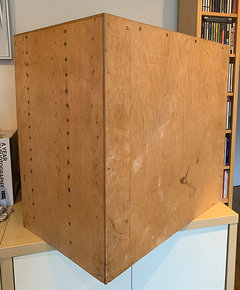
    What is the drawer bottom made or? What does the back sides and bottom look like?
    My gut feeling is that it's from the early 20th century, made by a craftsman of some sort to hold plans for what he was making next.
    Drawer fronts are pine....what does the handle/pulls look like? How are they fastened?

    mattybur thanked lindac92
  • 6 years ago

    Hi Lindac92.


    Sorry for the delay!


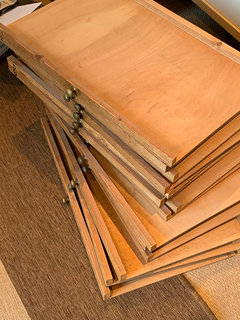
    THe drawer bottoms are made of thinnish plywood. I'll take some photos of the back and sides, but they're very plain and nothing remarkable about those.


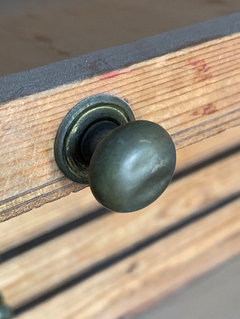
    The handles look like brass and have no screw on the inside of the drawer, so either screwed in directly, or glued on, I suppose.


  • 6 years ago

    More pictures are needed—the top, back, sides, bottom, and interior of the carcass (with drawers removed); back, sides, and underside of a drawer. Also, unscrew a knob and take a picture of the back of it, please.

    P.S. The three bottom drawers are taller than the rest. Do they have sides?

    mattybur thanked Sammy
  • 6 years ago

    Will supply!


    None of the drawers have sides, no. I'll take more pics.....

  • 6 years ago

    I'd guess late 1940s to early 1960s.

    mattybur thanked H202
  • 6 years ago


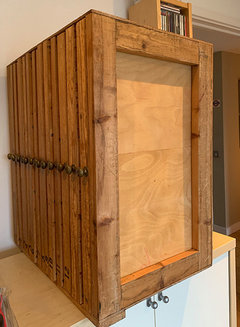
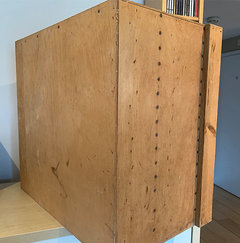
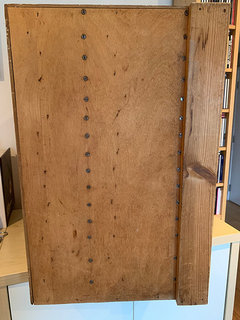
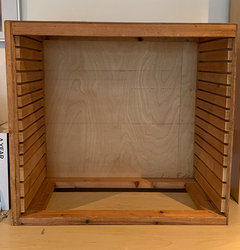
    Some more pics. I quite like how whoever made it did the maths of measurements etc on one of the drawers in pencil!


    The left side has an extra piece of wood on it, so maybe this was part of a row of cabinets, so that the right side could butt up against another one...?

  • 6 years ago


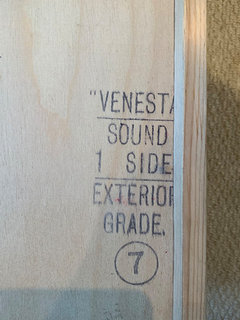
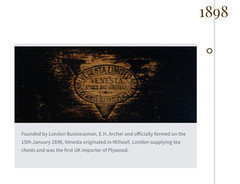
    Found this on the Venesta website. Interesting!

  • 6 years ago
    last modified: 6 years ago

    See? That’s why you should always remove drawers, flip things over and turn things around! The stamp on the plywood can now help you identify the era in which this cabinet was produced. :)

    mattybur thanked Sammy
  • 6 years ago

    How though? I could maybe email Venesta and ask them if they know?

  • 6 years ago

    Now that I have seen the drawers, I think it is a cabinet to hold drawings and blueprints. I don't know the size of the drawer interior, but it may hold up to size C drawings.

    Architectural and engineering drawing sizes (in the US) are multiples of 8.5 x 11 inch sheets. A-size: 8.5 x 11; B-size: 17 x 11; C-size: 17 x 22; etc.

    mattybur thanked jemdandy
  • 6 years ago

    Those would be rather small architectural drawings/plans. 58 cm equals about 23 inches.

    I'm wondering if it came from a shop?

    I think it's odd the drawers have no sides.

    & might a D stand for diameter?

    mattybur thanked carolb_w_fl_coastal_9/10