Software
Houzz Logo Print
dorothy_adamsteach

Oh Those Beautiful Teas!

6 years ago

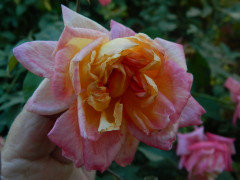
Well, I'm falling deeper into this rose obsession with all of you, happily I might add. :) My question is about the Teas that are found in the old cemeteries. Do they have pampering, such as drip systems etc? I would like to flank our driveway with a couple of matching teas, but that area only has overhead sprinklers. Certainly those big teas could handle that? Maybe let them grow big in pots and transfer them? The area is shaded for a small portion of the day and I know that can invite trouble, but I'm of the "try it and see how it goes" camp. Our home is sort of an olive color, so I was thinking maybe a pink or a white. Suggestions?

Comments (13)

  • 6 years ago

    Where are you, Dotsie? No Cal or So Cal?

  • 6 years ago

    Central Texas.

  • 6 years ago

    Dotsie - Is it humid in the summer where you are, or dry? (Different roses like different conditions). How many hours is "a small portion of the day"? There are teas which tolerate some shade, and some which do not. Sorry for all of the questions, but the more we know, the better suggestions we can make.

    Jackie

    Dotsie Adams 8b thanked jacqueline9CA
  • 6 years ago

    Hi Jackie - Central Texas is very hot and humid in the summer. We live in a fairly well established neighborhood so there are large trees that the sun filters through in the afternoon. There is a lot of morning sun.

  • 6 years ago
    last modified: 6 years ago

    Mike Shoup at Antique Rose Emporium in Texas would pitch in an opinion if you phoned and asked to speak to him. He is a wonderful man and sells great Tea roses. When I think overhead sprinklers I would worry the blooms get all wet and ball. If the sprayers were low just above ground that might be just fine. The drought in Texas had greybird at her wit's end a while back.

  • 6 years ago

    Before anyone goes off expecting miracles and the impossible, "found" roses exist because they have found the minimums of what they need to maintain their existence. Old cemeteries, abandoned gardens, what have you, must provide either sufficient rainfall and moisture retention or high enough ground water to allow the plants to exist. Add that the particular varieties also either have the right resistance to whatever types and races of those types of fungi surrounding them, or the conditions don't support fungal issues. NO rose exists without water, anywhere, period. There IS either sufficient rainfall, ground water, dew/fog condensation off or surrounding canopy plants, etc. to maintain and support that "found" rose. Take a look at many of the old cemeteries in the Gold Country. There are many oak trees in many of them. Those oaks transpire tremendous quantities of water and often result in "rainfall" of their own under their canopies. They also drop copious quantities of leaf and twig litter which, when allowed to remain on the ground, maintain a very high level of ground moisture. NO rose will survive if planted anywhere there isn't enough water supplied in whatever fashion necessary to maintain it. NO rose will survive where the heat levels are too high for it, either direct or radiated/reflected heat. If you take ANY of these "found survivors" and plant them where they don't receive the bare minimum of what they require to survive, they will NOT survive. Period.


    I agree that it's romantic and fun growing the found "survivors". I have for years. But, none of them are miracles. Every one of them will succumb to being cooked where it's too hot and too dry. Every one of them will die from lack of water if not supplied what is needed, however it's necessary to provide it. Every one of them will succumb to fungal issues when planted where conditions support the fungi and particularly when something is wrong with the plant's culture, making it more susceptible to whatever fungus issue is around. So, while these found survivors may be "tough", they are also blessed to have found the minimums of what they have required to survive in the specific locations in which they have survived. How many of the same varieties have NOT survived in less ideal situations? Instead of placing all the acclaim on the particular rose for its "durability", I strongly suggest more thought be placed on what it has been about the specific locations in which they have been "discovered" that permitted them to exist until being "discovered".


    Just as a case in point, Jesse Hildreth "survived" in the San Juan Bautista cemetery for decades UNTIL the drought took its toll and nearly eliminated it. Without locals bringing water to supplement the rains which didn't arrive and the ground water which subsided, the rose would not have made it. Of course the stupidity of the supervisory personnel in using Round Up around those plants certainly didn't help. But, had they not received enough water naturally to survive the heat on that hill, they wouldn't have survived to be found and now they aren't receiving it naturally and are having to endure greater heat than previously, without our intervention, they won't survive.

    Dotsie Adams 8b thanked roseseek
  • 6 years ago

    Kim is correct -- and note the roses I posted above ... ALL of those three are gone now, victims mostly of drought (though in the case of the China I collected, it was mostly Round-upped to death, despite the protests of local residents.

    They are beautiful, romantic, and we are losing them at a terrific rate.

  • 6 years ago

    I can't "like" the above.

  • 6 years ago

    Me neither.

  • 6 years ago

    Thank you all! It is such a shame to lose those roses, and it fascinates me to learn more about how many of them have survived.

    I hope I didn't give the impression I'm looking for a rose to take care of itself so much, but rather my question was more about watering overhead and rain, vs. drip systems. They seem tough, and I wonder if they would be suited for that type of situation.

  • 6 years ago

    Given the appropriate care and concern to insure their success, MANY roses would be suited. There have also been many old Hybrid Teas and floribundas found in old cemeteries. At San Juan Bautista, the HT Lady Mary Fitzwilliam was rediscovered and reintroduced from 'extinction' in the US. As long as the type is suitable for your climate and conditions and the specific variety in that type is, also (not all types nor specific varieties are suited to all conditions), you should succeed with your selection.


    I live with a heavy marine influence and usual lack of real "heat", so I have avoided the Teas and other types well known for bloom balling and mildew issues. I have a number of Teas and most of those I grow have proven healthy here. I think I would avoid the overhead sprinklers with Teas and most very double types out of fear of balling. LOTS of petals require a lot of heat to push them open. Teas have rather large, papery petals which can easily seal together with too much moisture, whether it's fog, dew, rain or irrigation. You may wish to see about altering your sprinkler heads to avoid wetting the flowers. The more mildew resistant types should be able to handle the sprinklers. In my Zone 9b coastal climate, I grow George Washington Richardson (Mlle de Sombreuil); Ping Dong Yue Ji; Faith Whittlesey; William R. Smith; Mons Tillier; Mme Antoine Mari; Edith Perry; Maman Cochet; Niles Cochet; Rosette Delizy; Mrs. Dudley Cross; which have all grown cleanly and not had issues with balling. Jesse Hildreth opens well but has experienced mildew issues. Bassoues Tea is relatively clean with slight mildew issues but the petals fry quickly and easily on sunny days, even without any real "warmth". It's beautiful but much better where the blooms can be protected from any real "hot sun". This is how it is now with "highs" in the low seventies.

    Plus, particularly with the Teas, they perform at their best with plentiful water. They will survive on the barest minimum, but if you want real growth and spectacular bloom, don't be miserly with the water!

    Dotsie Adams 8b thanked roseseek
  • 6 years ago

    Oh how beautiful!!! Thank you so much for such great information. Perhaps adjusting the sprinkler heads is the direction I need to head. Giddily off to HMF! Thank you!