

Recommendations for LED T5 light housing?
Hello,
A few years ago, I got some great advise on this discussion thread regarding setting up indoor grow lights. After a few unrelated set backs, I’m ready to set up my indoor growing arrangement.
Since my space is limited and I'm new to this (though, a fairly experienced gardener), I want to start small and grow as I get the hand of it.
First my plan, then a few questions:
PLAN
I have a space that is roughly 24” long x 13” deep x 18” tall on top of my kitchen cabinets. This is where I plan to put the lights and plants. (I live in a tiny apt. so the very most I can get is 24” more inches left to right!)
I plan to put my plants/seeds on the top of the cabinet, and raise lower and raise the lights as needed.
QUESTIONS
If I used fluorescent lights, I would use 3-4 T5 lights to cover the 13" space (back to front of the cabinet), 6500 K, 4500 lumen lights. However I have made the decision to use LEDS.
My questions are:
1. Does anyone know of a reasonable housing (painted white, not black, so it will look nice in my kitchen) for the bulbs? For the life of me, I can’t find one that is roughly 24x13 and white.
2. Are there T5 LED lights bulbs? I know this sounds like a weird question, but so far I’ve only found LED strips or lights in housings that can’t be replaced. Once they burn out, you throw them out. I’d definitely prefer bulbs that a replaceable since I’ll have them on for 16-18 hours/day.
I guess I am imagining a housing much like the ones for fluorescent lights, for LED lights. Does this sort of thing exist?
3. Lastly, are LED lights measured in K and Lumens? I’m having trouble figuring this out. If not, what is the equivalent?
If I went with fluorescents, I think I’d have some options. But for LEDs, I’m not finding anything I can use.
These are the kind of things I’m imagining only these are florescent and I’d prefer LED.
https://www.amazon.com/gp/product/B071L6RZ85/ref=ox_sc_act_title_2?smid=A1HA3ELYKMTQ4S&psc=1
https://www.amazon.com/dp/B019J3UPTY/ref=psdc_14252961_t2_B071L6RZ85
Any tips?
Should I just go with florescent?
Thanks very much!
Noel
Comments (32)
 6 years agolast modified: 6 years ago
I think you need to consider the feasibility of what you want to do in such a limited space. Specifically, the vertical space. With only 18 inches available, I personally wouldn't try much more than seed starting, microgreens, or cutting propagation.
Consider: 3 inch tall light fixture (the fluorescent ones you were looking at), 2-3 inches height for hanging hardware (or is the light going to be flush with the ceiling?), 2-6+ inches for the height of the pots, and 2-6 inches between the light and the top of the plants (so you don't fry those poor plants).
That comes to 9-18+ inches of vertical space you need WITHOUT even taking the height of the plants themselves into account! That leaves you with 0-9 inch tall plants.
Are you OK with such short plants? Keep in mind, too, that as the pot sizes increase, the height you have available for the plants themselves will decrease - the exact opposite of what you need!
As for your light question, why don't you buy a T5 fluorescent housing like you showed, and buy T5 LED tube lights to put in it? Search for "T5 LED replacement bulbs" or "T5 LED tube lights".
heidinoel
Original Author6 years agoHello, illsstep:
Very helpful points. Thank you!
I guess I figured I would only need about 3-4-5 inches for the starting plants from seed (in other words, by the time the plants got to about 3-5 inches, I'd be putting them outside). What I critically neglected to consider was allowing for space between the plants and the light.
It sounds like you are suggesting that my set up might not work all that well. Nuts! Although, if this is the case, I'll be sad, but grateful that I asked before spending the money.
Is 3-4-5 inches too close for the seedlings to the light? Probably not initially, but what about as they begin to grow? Right before I put the seedlings outside (in the spring), how tall would they be?
As for buying the T5 housing, and swapping out the fluorescent lights for LEDS, I didn't know I could do this. Is it possible? Do they connect the same way? Is there anything I need to consider? For example, I noticed that several of the larger LED housings have "wings" ("flaps" on the sides which point downward a few inches, which presumably reflect more light back onto the plants or, maybe it's for protecting the grower's eyes?) but fewer of the florescent housings have them. Maybe this is just a fluke, but I'm wondering if the housings for fluorescents vs LEDs can be just the same.
As for the T5 LEDs bulbs, do you happen to know, are they measured the same way? In Kelvin and Lumens? If not, do you happen to know the equivalent?
Thank you very very much for your help!
NoelRelated Professionals
Fort Myers Landscape Architects & Landscape Designers · Logan Landscape Architects & Landscape Designers · Cherry Hill Landscape Contractors · Peoria Tile and Stone Contractors · Lawrence Tile and Stone Contractors · Missoula Tile and Stone Contractors · Albany Landscape Architects & Landscape Designers · Salem Landscape Contractors · Omaha Home Builders · Clarksdale Interior Designers & Decorators · Enid Interior Designers & Decorators · Sugar Land Interior Designers & Decorators · Marinette Interior Designers & Decorators · Pullman Interior Designers & Decorators · Chatham Furniture & Accessories- 6 years agolast modified: 6 years ago
As far as LEDs, yes, some might have enclosed fixtures where the actual LEDs aren’t serviceable. However, that shouldn’t matter if you buy a reputable brand has they should last 50,000 hours or so.
you can get some direct replacement led tubes for the fluorescent housing. Just make sure they say direct replacement otherwise they require you to disconnect the ballast and wire directly to the tombstones.
Leds are measured the same way, yes. In lumens and color temp (k).
heidinoel
Original Author6 years agoHi Dave,
I think buying a reputable brand is the key! I was looking on Amazon and people were complaining left and right about how lousy the fixtures were, and that after 5-6 months they had stopped working. Do you happen to have any recommendations? Personally, I find making choices sight unseen on Amazon to be really difficult.
Thank you for the heads up re: replacement LED tubes. Great to know!
As for measuring lumens and color temp, do you have an recommendations for bulbs? When I was at Home Depot yesterday, all the replacement bulbs seemed to be measured in watts, which really surprised me. Also, at the store, they told me that they still hadn't gotten any T5 replacement bulbs in - only T8 & T12 bulbs.
Thank you!!!
Noel- 6 years agolast modified: 6 years ago
The fluorescent fixtures you linked to have reflectors under the housing, above the bulbs, to reflect as much light as possible downwards. They aren't really visible in the pictures given.
But they also aren't relevant if you use LED replacement tubes, as the LEDs will (I assume) only be directing light downwards, not out from the tube in all directions (which is what a fluorescent tube does).
If you are only expecting 3-5 inch tall plants, max, I think you have enough space, assuming the LED replacement tubes can be kept as close to the tops of the plants as fluorescent tubes can be. I know higher powered LED grow lights need a fair bit of space between them and the plants, but the LED tubes probably have such low intensity that they will be fine a few inches away. I haven't used those LED tubes myself, so I can't say for sure.
heidinoel
Original Author6 years ago(Thank you! I'm sorry for the delay in replying, bad cold/sore throat, the works - Ugh.)
So I'm a tad confused. Is there something about LED bulbs that make them not reflect outward (on the sides) the way LEDs do?
Just curious, how much space do you keep between the tops of your plants and the bottom of the lights?
I am imagining that seedlings won't grow more than 4" before I plant them but maybe I am wrong?
Thank you for any insight!Noel
 6 years ago
So I'm a tad confused. Is there something about LED bulbs that make them not reflect outward (on the sides) the way LEDs do?
Leds that are used in most light bulbs, tubes etc are flat "chips" and produce light in one direction sort of like a flashlight. To make the led bulbs look like traditional bulbs that glow in all directions they use a plastic diffuser to enclose the leds. This leads to some loss of light. In case of tubes you can get them with clear tubes. That way most of the light is aimed towards the plant with much less loss. Housings with reflectors help though to refocus the light in one direction.
- 6 years agolast modified: 6 years ago
Led tubes are normally unidirectional while fluorescent tubes are omnidirectional.
Reflector housings are meant for fluorescent and incandescent light.
That’s why you get blinded by people these days adding plug n play led lights in their cars headlight housing that’s meant for an incandescent halogen light. LEDs simply dont produce light the same way.
- 6 years ago
Led tubes are normally unidirectional: I have all three kinds - omni-directional, directional with diffuser and directional with clear cover.
I usually take out the diffuser from an led bulb when using for plants. That way I do not need reflectors and the light is way more intense and directed. But I would not recommend that to others. It exposes a high voltage DC connection on the led panel. Mine are 84vDC. I put a dab of hot glue to be safe.
heidinoel
Original Author6 years agoThank you tropicofcancer and Dave! So that's why I get blinded by the lights from cars -- good to know!
So now I am completely confused. Which type of LEDs do you recommend?
It seems like unidirectional would work well, and not require reflectors. My question is, Tropic... Why are you using directional with a diffuser or clear cover? Because the light is too strong otherwise?
I have actually seen some LED fixtures with clear plastic covers over the top. Thus far, I have stayed away from them as I didn't think the light would be strong enough. Sounds like I might be wrong.
I wonder if any of you can provide a link to the fixtures/bulbs you use? I haver no idea where to find/buy these.
Thank you all again!
Noel- 6 years agolast modified: 6 years ago
It seems like unidirectional would work well, and not require reflectors. My question is, Tropic... Why are you using directional with a diffuser or clear cover? Because the light is too strong otherwise?
I can see why it is confusing. I was talking about what is available and what I have. The led tubes I have for plants are uni-directional and have clear cover. The others are in my basement and shed. The tubes always come with a cover. I have put them in regular fluorescent fixture that already have reflectors - nothing much I can do about.
The leds, although unidirectional, still throw light at quite a wide angle - something like 120 degree and over. A reflector helps narrow that angle a bit so as to not waste too much light.
My suggestion is that since you are going to just have one fixture and your space is limited go for a T5 fluorescent fixture. Something like this: https://www.amazon.com/Light-4lamps-DL824-Fluorescent-Hydroponic/dp/B009GU4RMC/
I do not have one of those and I cannot vouch for their reliability. The above fixture has independent controls for inner two tubes and outer two tubes. It is going to consume more than led tubes. But you are not going to gain much by going led unless you need a lot of light. At this level of power consumption the difference is not much. That is what I would have done in your situation.
Leds are a lot of hype. Compared to florescent you are not gaining much in terms of cost. Let us say you run 500W of fluorescent for 12 hrs for 30 days. That is 180Kwh. At $0.10 per KwH its $18 per month. If you replace all by led and you believe their numbers you will save at most $6 per month. In overall scheme of things that is hardly much. Especially since you will end up spending more on the lights and fixtures, Now if you want to be green and consume less energy as a matter of principle, that is a different thing.
heidinoel
Original Author6 years agoYikes, Looks like my reply/post disappeared. I'll try again.
First, thank you for your comments! I really appreciate this help!
Next, so it sounds like I should remove all those plastic clovers, whether they are on individual tubes or across the entire fixture that might com with the fixture/tubes? Is this treu even if I use the hotter-running fluorescents?
As for your link (thank you!), I'm assuming I would only need the reflectors if I went with fluorescent tubes?
I think I am stuck on LEDs because they are not as hot (so therefore less chance of burning my seedlings and the seedlings can be a little closer to the light - important since I don't have a lot of room). Also, I am seeing fewer and fewer fluorescent tubes available, and I'd like to set something up that I can continue to use for years.
I guess it I knew that I could easily swap out the fluorescents for LEDS, when nec., I'd be more comfortable buying the a fixture made for LEDs first. But I'm worried I won't be able to.
Thank you again.- 6 years ago
If you buy a fluorescent fixture, you can buy LED tubes for it. If you buy an LED fixture, you cannot buy fluorescent tubes that will work with it.
You will likely be able to buy fluorescent tubes online for quite some time, even if they become less common at your local stores.
The fluorescent fixtures you have been looking at do not have any plastic covers, and fluorescent tubes definitely do not have any sort of removable cover.
Fluorescent lights have been used for a long time for seed starting.. and as I mentioned earlier, if you keep your house in the temperature range most people do in the winter, that little extra bit of heat is more likely to help than hurt.
heidinoel
Original Author6 years agoThank you, illstep! Any suggestions of where to buy LED 6500 K tubes online?
- 6 years ago
I would suggest not to remove the plastic covers from the led tubes either. If you get led tubes get ones with clear covers.
Usually led tube fixtures have their tubes built into the fixture and not replaceable.
There are some 2 ft led fixtures on amazon. I do not have any 2ft fixture so cannot really vouch for them. Sunblaster is a good company as someone else on this forum said. They tend to be on expensive side too.
 6 years ago
How about using these? Hytekgro LED Grow Light 45W Plant Lights Red Blue White Panel Growing Lamps for Indoor Plants Seedling Vegetable and Flower (2 Pack) https://www.amazon.com/dp/B07GWQW8GM/ref=cm_sw_r_cp_apa_i_dJ12DbBBFJ1WM
This two pack or similar could be all you need without having to improvise anything. I have used led grow bulbs (e27) and tubes for a couple of years now with good results for growing flowering plants and annual seeds in conjunction with some sunlight. They are unbranded but cheap and will probably last longer than technology or their need. I have never grown with fluorescent or incandescents so I don't know how they compare but they are surely efficient.. I haven't done any precise math but when I replaced my halogen/incandescent house lights (about 250 watts for 6-7 hours daily) with led bulbs my monthly bills dropped by $15-20. Totally worth it.
LED Grow Light Strips for Plants,
Cholas 36W 132 Leds Auto ON Off Function,3/9/12H Timer 5 Dimmable Levels and 3 Switch Modes for Indoor Plants Gardening Hydroponics Greenhouse 3 Pack https://www.amazon.com/dp/B07PWC3F8B/ref=cm_sw_r_cp_apa_i_MU12DbTJ45H6Y
UNIFUN LED Grow Light E27 Bulb Greenhouse Light Plant Grow Lights Growing Lamp for Garden Greenhouse (24w) https://www.amazon.com/dp/B01ABSQ4N2/ref=cm_sw_r_cp_apa_i_JV12DbTTVA0YH- 6 years ago
Getgoing, you must live somewhere with much more expensive electricity than myself. For me, 250 watts running 7 hours a day won't raise my electric bill by more than $6 or $7 a month.
- 6 years ago
Just looked up my electricity bill. It costs roughly 15.5 cents kwh. The LED lights roughly consume 1/4. My consumption estimate may have been off and I think I started using fewer lights generally when I switched to led as part of general saving the planet mindset.... Anyhow, bottom line is the Leds pay for themselves soon enough and the recurring costs of busted lights are eliminated by their longer life. Additional savings incur when using led grow lights because they skip the wavelengths not used by plants. My petunias, calibrachoa, pentas, coreopsis and Lobelia are blooming non stop with about a 50 watt arrangement. Newly acquired rozanne geranium is in buds. What more could I wish for?
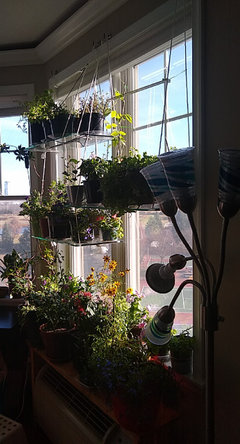
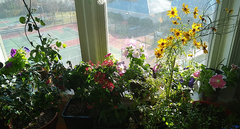
 6 years ago
There's no reason to think in terms of 24", T-5, tubes, etc. if using LEDs. You can buy LED tape (Armacost is one brand), and a transformer to match, and make a light fixture any shape or size you want. The "fixture" could be nothing more than a 24 x 18 sheet of plywood, painted white for reflection. Carefully staple the tape to the plywood using as much as needed for light output you want. It's all low voltage after the transformer so you can't hurt much. Does LED provide a full spectrum of light for growth?
heidinoel
Original Author6 years agoHi all,
Thank you !!
Getgoing 100: I've seen a lot of these online and I have to admit that I amsuper confused by these red lights. Do you know what temperature they are? THey seem to say watts rather than the kelvin measurement I"m used to. I'm guessing that they ae red because they a re a lower temp? Thank you for the picture!! I'm just a little unclear though -- where are the lights?
Gardengems: These look good. To questions -- does one need the reflectors on LEDs? Also, do you find 5500 K enough? I've always heard 6,500.
Seabornman: This is an excellent idea, and I had kind of thought about this as well. This said, my husband just say "You would want me to do that???" (in a very sarcastic tone). He knows I am neurotic about safety, and never want him to do anything when it comes to electricity.
Noel- 6 years ago
Noel, the k number is used to indicate the color of the light - yellow or white (like daylight) . Watts indicate energy consumption. If intensity and hence effectiveness of light is what you need to know, which is what I think is the relevant query here, the measure to use is PAR.
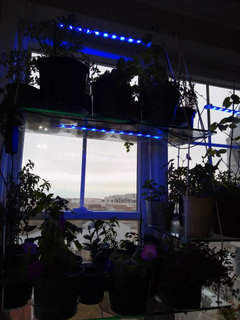
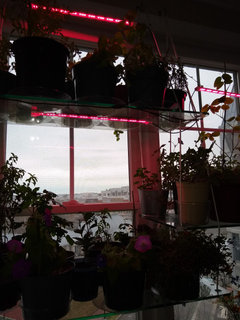
For the LED grow lights I posted links to, they selectively use certain wavelengths of light, red and blue, and omit green. By doing so, they achieve more efficiency. The lights are more effective than they appear in terms of visual intensity by choosing only the wavelengths that plants need. The downside is that the lights appear purple/red. My neighbors think its romantic. :) I choose them so I feel less guilty about wasting electricity for growing petunias and such indoors throughout the winter. :) The lights are single strips above the 3 hanging glass shelves. The floor lamp has led grow bulbs that are focused at the bottom stand. In total, I barely use 50 watts or so for the entire set up for about 40 pots. Here is another picture with the lights on but there is lot of reflection from window panes and frame to make it look like there are more lights than there actually are.
I would not get bogged down with the numbers though. You may want to look at the reviews. If a thousand people have reviewed the lights and it still has 4+ stars, it is probably a good bet. I think I saw at least some reviews where people were using the lights to grow pepper seeds quite successfully, which I understand is your intended use. There are enough reviews to assess whether people found the particular lights effective for the purposes you are intending.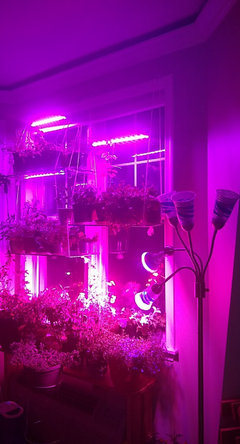
heidinoel
Original Author6 years agoWow getgoing, thank you!!! You have really solved my curiosity about these colored lights! Thank you for these great pics, as well.
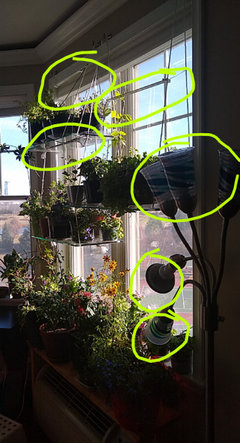
Okay, so here are my questions (of course): During the day, when the lights are on, hw "red" do they appear? Or, does the color blend in with the day light? My lights will be in my kitchen so I want to make sure I"m not creating a mood that feels a bit lurid for daytime activity (LOL).For example, in the bottom photo, with the lights circled, are the lights off or on?
The other thing I am confused about is the K vs watts. My understandings is that 6500 k and 1000 lumens is a good measurement of heat/ light that works well for growing indoors.
How would I convert or even know what the equivalent is in watts? Par?
Thank you!!!
Noel- 6 years ago
They do appear a bit colored (the strips are less so than the bulbs and can actually be adjusted to red, blue or mixed and have a built in timer. The color is more noticeable when the daylight is low (which is when I switch them on. The picture where I circled the lights does not have lights on. Your kitchen probably does not get much light, in which case there will be some color for sure. I will try to post a pic with just the strip lights during daylight. The k and lumen thing really doesn't translate to selective wavelength led. Some of these led lights do provide par values others don't. I am afraid I am more of a try based on product reviews and see results than calculate and optimize parameters person. Here's some reading and calculators that might help:
https://www.waveformlighting.com/horticulture/convert-lumens-to-ppf-online-calculator
https://www.lumigrow.com/learning-center/blogs/demystifying-lumens-lux-and-par/
https://forevergreenindoors.com/blogs/news/86675143-lumens-vs-par
http://www.just4growers.com/stream/grow-lights/lumens-are-for-humans,-par-is-for-plants!.aspx
https://fluence.science/science/par-ppf-ppfd-dli/
Happy growing.
- 6 years ago
Here are the lights during daytime on a cloudy day. They are really not noticeable until it gets darker.
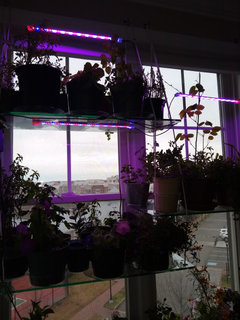
heidinoel
Original Author6 years agoThank you very very much for taking the time to do this! This is super helpful! Unfortunately this is blowing my mind a little (hard for me to understand). My take-away is that 400-700 par is the best bet for plants. Why then, are your lights different colors (some purple, some blue, same red)?Wouldn't they be all the same color? Are some different PAR?
- 6 years ago
You are mixing and confusing various concepts of light. Color of the light is related to its wavelength. For visible light that happens to be from 400 to 700 nm (nanometers). Blue is closer to 400 nm and red is closer to 700 nm. All light is some combination of blue, green and red. Kelvin or K is a measure of color composition of light. 6000K has more blue than red. 3000K has more red than blue. Lumens is a measure of the amount of light as perceived by human eyes. It is different from the actual amount of light as perceived by plants. What is perceived by plants is measure in PAR units. For a given type of light there is a relationship between lumens and PAR. Most manufacturers will not list the PAR value. For practical purposes lumens is good measure of amount light. Any light that has a color temperature of 5000K+ is a good bet. How much you need (lumens or PAR) depends on the plants. How many, size, type etc.
heidinoel
Original Author6 years agoHi and Thank you tropicofcancer (and getgoing.)
This is a great explanation!
My problem is / Where I get confused is that a lot of the LED fixtures/lights do not give a lumens or K measurement. They only provide a watts number. And, many of them tend to be red-ish in color.
I would prefer 6500k+ which I understand to be a more blue-ish light.
The two plants I most want to grow from seed are: tomatoes and Gerbera daisies (I understand these are not easy, but I really want to focus on trying this!). With this in mind, what would you suggest for lumens?
As I said, I totally confused because a lot of the LED lights (& fixtures) on Amazon don't list lumens or K. They only list watts. Like, for example, the one that gardengems lists above.
Thank you so much!



tropicofcancer (6b SW-PA)