Software
Houzz Logo Print
caitlin622

Can I get hydrangeas to grow here??

6 years ago
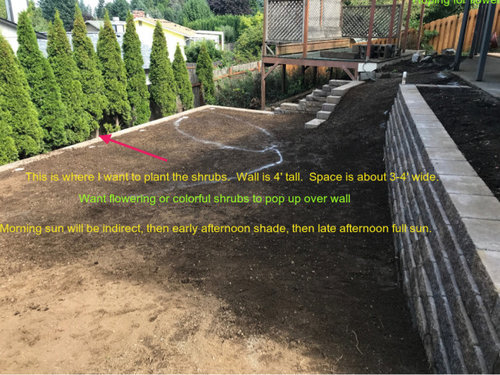
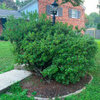
I live in PNW- Zone 8- Washington State. Do you think Hydrangeas would grow in this spot? I am wanting a fast growing plant with color to fill in this spot. My greatest concern is that behind this wall there isn't much direct sunlight. This is on the Northside of my 2-story house, behind the 4' retaining wall.

shrubs · More Info


Comments (29)

  • 6 years ago

    Your old wooden deck with lattice looks familiar. We have discussed your back yard before. The walls and terracing look good.


    Do I have this right? You want to plant the hydrangea at the bottom of the lower wall, in front of and on the same level as the arborvitae screen?


    Yes, Hydrangea would grow there. A cultivar of Hydrangea paniculata would be your best bet I think to get you well above the wall. Check for the height you want at maturity. The only potential problem I see is that if the planting space with the arborvitae is too narrow and the hydrangea crowd and shade the sides of the arborvitae it can cause them to have dead spots from lack of sun. Some minor pruning as the hydrangea grow to give them some separation will prevent that.

    caitlin622 thanked Christopher CNC
  • 6 years ago

    That is me! Still working at it. So frustrated its nearly winter and probably not the best time to plant new shrubs. Im so ready to get this party started.

    Any other plant/shrub suggestions besides Hydrangea? I thinked the Hydrangea option because of the color and FAST growth rate. Was considering Camellia bush but those grow slower, and Forsythia but not much summer interest.

  • 6 years ago

    Yes, not much more space than 4 feet. So I think I am hoping for a rather hardy plant that can withstand being crowded, shaded and full sun ... a giant beautiful weed? just kidding.

  • 6 years ago

    That looks to be a lot wider than just 3-4 feet!! Hydrangeas will easily grow there and I'd opt for a macrophylla before any paniculata. Far more shade tolerant and with more colorful flowers over a very long season here. Look for some of the dwarf or compact forms to avoid having to do any pruning (affects flower production). But you are not going to find them easily at this time of year :-)

    Other possibilities are pieris, dwarf rhodies, azaleas, fothergilla or hardy fuchsias. Of all of these, hardy fuchsias have the longest bloom season, sometimes throughout most of the winter if the weather is mild (mine are still blooming nonstop now at the end of November). But with small flowers so not nearly as showy as the hydrangea or rhodies might be. But very dependable, tough as nails and our resident hummingbirds adore them!!

    caitlin622 thanked gardengal48 (PNW Z8/9)
  • 6 years ago

    Speaking of weed, isn't that legal in Wa. now? A hemp strain would certainly get taller than the wall. But on that note, weren't you wanting to use the new terrace for growing some vegetables? Planting some tall herbaceous flowering perennials below the wall would help attract the pollinators and put the flowers at eye level on the terrace above.


    Tall herbaceous perennials I can think of off the top of my head are Vernonia, Ironweed; Cup Plant, Silphium; Joe Pye Weed, Eutrochium; Helianthus, the sun flower family has a lot of tall perennials. Even annual common sunflowers would work and they come in lots of colors with branched multi-bloom varieties. That is a very short list, but the idea of fast growing, giant beautiful weeds is not so far fetched.


    caitlin622 thanked Christopher CNC
  • 6 years ago

    Thanks GardenGal. I think I may have just fallen in love with Fothergilla 'Blue Shadow'!!

    I like the plants you suggested. I am concerned with some of those possibly never growing tall enough to be a real focal point above the 4' wall.

  • 6 years ago

    Christopher I like the idea of growing some hemp and/or cannabis in the back yard. Yes its legal here although I am not sure of the growing restrictions; with that said - my north AND east neighbors both have Marijuana growing in their back yard. I will have to look into where I could get some plants and what variety would work.

    Love the Joe Pye Weed and sunflower idea! I figure I could plant some of the sunflowers for some FAST gratification while I wait for more permanent plants to fill in. I love it.


  • 6 years ago

    They all come in a range of mature sizes :-) About the only thing that may not consistently reach the 4' mark would be the azaleas.

  • 6 years ago
    last modified: 6 years ago

    I think that perhaps we all don’t have the same spot in mind. Are you planning on planting on the lowest level between the wall and the evergreens? If so don’t. The evergreens will need space to grow, and the hydrangeas will shade out their lower foliage leaving bare branches.

    Or are you planning on putting the hydrangeas on the broad area that stretches across most of the photo and having them pop up over the retaining wall that is on the right side of the photo? This is where I would want them in order to allow each plant sufficient space.

    I like GG48’s list of suggestions, though how long there is afternoon sun in that spot as well as if you will have irrigation will influence whether Hydrangea paniculata or macrophylla will be a better fit. Are you considering using more that one kind of shrub or do you want a mass of all one kind?

  • 6 years ago

    Just an FYI but Hydrangea macrophylla can take a lot of sun in the PNW.....probably a lot more than less northerly locations with hotter summer temps :-))

  • 6 years ago

    I am only a bit farther south and have wetter summers than the PNW, and my macrophyllas droop in afternoon sun. :>)

  • 6 years ago

    But you have much warmer summers. Hitting 80F here is a big deal!! And according to latitude, we are a lot further north than you :-) We are even quite a bit further north than Maine!

  • 6 years ago

    You want to plant them at the base of the retaining wall—between the evergreen shrubs and the wall? If so, I don't think that will work. Hydrangeas do best in full sun.

  • 6 years ago

    " Hydrangeas do best in full sun. "

    Sorry but this is just not true. Almost without exception all hydrangea species are woodland understory plants and do best in at least partial shade. And some - like H. macrophylla, serrata or aspera - will routinely wilt or scorch if in too much sun, especially hot afternoon sun. In fact, the basis of much of this discussion is that the hydrangeas might get too much sun in that location!!

  • 6 years ago
    last modified: 6 years ago

    My experience growing them in MA is that full sun in the eastern exposure works best. Sounds like you (gardengal48) have had a different experience, but I can just share what has worked best for me. Also, OP stated the area gets full sun in the late afternoon, which means western exposure, which will be difficult for hydrangeas due to the scorching/wilting you mentioned above.

  • 6 years ago

    And I also clearly pointed out that full sun in the PNW is nothing like full sun elsewhere in the country. Location does make a big difference!

  • 6 years ago

    Autumn is an excellent time to plant both herbacious and woody perennials, especially if your ground does not freeze hard. If not completely dormant, they will have time for roots to get established a little bit in the fall, and more rapidly in early spring. If completely dormant, that's fine too.


    But if you have hard freezes, beware of fall plantings being heaved up several inches over the course of the winter's freeze/thaw cycle. Deep mulch can help minimize this. Just wait to apply it after the first freeze, so bark-eating mice don't take up residence. Christmas tree boughs make a handy mulch; they don't compress the way leaves do, and are easy to remove in spring (if you don't mind pine needles in your soil).


    Your upper level could be a great home for rhododendrons, though those get rather big. It could be a nice place for a stand of ferns.


    Good luck finding a solution.

  • 6 years ago

    I am planting at the base of the lowest wall in the same terrace as the arborvitae. That is why I suggested an H. paniculata. They can easily be grown with one to several trunks and have the tops above the wall. Make for easy deadheading from above come spring.


    Think of it as a bit tight shrub border. We've all seen that happen. I warned about shading out the arborvitae and getting dead spots. There is room it seems for a foot path between them and the hydrangea would need to be kept trimmed off the arbs, but that is doable and they will only be viewed from one side anyway. You might be surprised by how low and how well evergreens will hold their foliage when the neighbor plants are not actually touching them. She has ground to plant and doesn't want to waste it.


    I did have one of my wild ideas about what to plant down there. Instead of flowers, what about some great textural contrast. What about Rice Paper Plant, Tetrapanax papyrifera? Those leaves would easily come above the wall and contrast dramatically with the arborvitae hedge. It should at least be root hardy there. Yes?

    caitlin622 thanked Christopher CNC
  • 6 years ago

    There is no need to get snarky!! The Pacific Northwest has an unusual climate and unusual planting conditions that those who do not live here or are not familiar with the area do not understand and are really not qualified to comment on. What works well for you in MA will not be at all similar to what works well here. The above comments about hard freezes and freeze-thaw cycles are just an example. The soil does not freeze here and there are no freeze-thaw cycles.


    I have spent the last 30 years of my life gardening professionally in this area so pretty well qualified to comment. And you, smitrovich ........??

  • 6 years ago

    " What about Rice Paper Plant, Tetrapanax papyrifera? Those leaves would easily come above the wall and contrast dramatically with the arborvitae hedge. "

    And then some!! This grows to tree-like proportions here, even with a colder winter dieback. Would pretty much dwarf anything else nearby. Also not the colorful, floriferous plant the OP requested, although incredibly architectural and dramatic!

  • 6 years ago

    I actually love! the Rice Paper Plant. I wasn't sure it would be hardy enough for the PNW (I am admittedly not a professional gardener). I have some Fatsia Japonicas that I love, I thought they would be closest I could get to it. True it wouldn't have any color..... but I love the large leaves. I could still grow sunflowers or other fun "weeds" for color pops. I could live with that.

  • 6 years ago

    Chris- with the Hydrangeas- do you think they grow taller when pruned as trees into one or two trunks rather than letting it shrub out?

  • 6 years ago
    last modified: 6 years ago

    They might grow taller a bit faster by training them towards a trunk structure from the start, but the mature height will end up the same most likely. There are so many cultivars of H. paniculata that you really need to measure the space, height/width you want to fill and then aim for the one that is most likely to fit.

    Now you need to figure out where you are going to plant a nice patch of Rice Paper Plant.

  • 6 years ago

    I also live in the PNW and have different types of hydrangeas all over my property. None are in full sun and all of them do very, very well. Oh, I do have one PeeGee in pretty much full sun for the midday - 11 am to about 4 pm in the summer. It's happy, but so are the other types in different areas of dappled sun/shade.

  • 6 years ago
    last modified: 6 years ago

    Be aware that you are looking at the current space available next to the arborvitae/Thuja. How wide is your cultivar predicted to get? Will there actually be space there in 4 or 5 years? My arborvitae and panicled hydrangeas have grown to fill a 6’ space between them in about 4 years, so I am just sharing my experience. I am more likely to fill temporary space with trellised vines or tall perennials that will die back or be removed as the evergreens gain size.

    Also be aware that the paniculatas should be hand pruned one stem at a time, not trimmed with hedge trimmers, at least once a year in very early spring. Alternatively, you can check more often during the growing season and just rub off branch buds as they start swelling and growing to keep your trunk bare up to the level you need. So with the length of hedge you have there it will take time and attention. My paniculatas do fine in full sun to half day sun.

  • 5 years ago

    That will vary by state and climate to a small degree.


  • 5 years ago

    If you do some Googling, there are scores of websites dedicated specifically to the growing of cannabis. They will tell you everything you need.

  • 5 years ago

    The internet! The answer is in the cloud.