Software
Houzz Logo Print
malokd

vent hood height for bluestar broiler

6 years ago

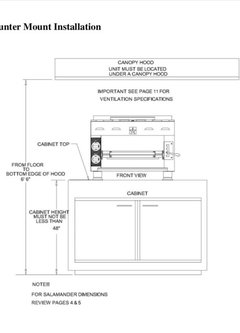
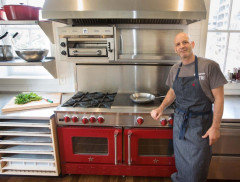
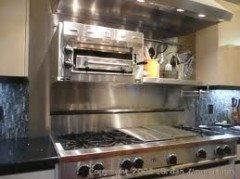
We are installing a 60 inch bluestar gas range. The hood we are using are 2 side by side 40-3/8inch 900CFM vent a hood inserts( VBH340PSLBSS). I understand that vent a hood typically recommends a 30 inch mounting height above the range. We are installing a bluestar broiler(https://www.bluestarcooking.com/cooking/broilers/salamander-broiler/) above the range mounted to the wall. I need to know what the minimum clearance is between the hood and the salamander so that I can still clean and maintain the hood. The broiler/salamander is 15inch in height so we cannot install the hood at 30inch above the range ---we will have too little clearance. Bluestar recommends mounting the broiler/salamander 18 inches above the range. If we do this the top of the salamander/broiler will be 33 inches above the range.

  1. How much clearance do we need between the top of the broiler and the bottom of the hood. I have heard varying opinions— most around 6 inches?
  2. If we do mount at 6 inches above broiler it will put our hood height at 39 inches above range. We have oversized our hood to account for this but will a 39-40 inch height be an issue. Can we make up for this by having the hood project anteriorly beyond the range?
    Thanks in advance.

I am attaching the links to the products being used:
Hood: https://www.fergusonshowrooms.com/product/vent-a-hood-VBH340PSLB-stainless-steel-954304
Range: https://www.bluestarcooking.com/cooking/rangetops/60-platinum-rangetop/
Broiler/Salamander: https://www.bluestarcooking.com/cooking/broilers/salamander-broiler/

Comments (21)

  • 6 years ago

    Is the wall a non combustible assembly? Metal framed? No wood? Is the hood planned for a minimum of 78” from the finished floor? A minimum of 6” wider? And not wood? This isn’t something for every kitchen. You basically need to rebuild your kitchen to make it work. Do you have your multiple fire extinguisher locations picked out?


  • 6 years ago

    Effluent spreads out as it rises so the higher your hood the less that will be captured. A hood at 42" above the range (diagram posted by @User) s/b a minimum of 30" deep and ideally 36-40" deep.

  • 6 years ago
    last modified: 6 years ago

    You will probably be better off having the salamander with it's own separate station with it's own hood.

    The hood you are using is too shallow to begin with. It's only 22 1/2 inches deep. It sounds like you will be doing some serious cooking being you will have a 60 inch range and a salamander. The hood at 39-40 inches will not be effective enough especially with the hood being so shallow.

    As far as cleaning the vent-a-hood it will be very hard with that salamander in the way. I have a vent-a-hood. I don't know how you would slide the trays out to clean regularly or even to do a more detailed cleaning with the salamander there. Look at this video to see what I mean as far as cleaning:

    https://www.youtube.com/watch?v=LqG-RcxhGnc

  • PRO
    6 years ago

    Always defined by installation instructions of the heating unit, not the hood.


    https://www.bluestarcooking.com/wp-content/uploads/2015/12/BlueStar-Salamander-3.29.19-1.pdf

  • PRO
    6 years ago
    last modified: 6 years ago

    I suggest going to a store with a demo of the BS infrared broiler in the oven before deciding on a salamander. The broiler is quite capable. A salamander addition may be overkill. It certainly adds a great deal of complexity and expense. Your ventilation choice won’t really work. You are setting up a very large restaurant style kitchen in the home. You are going to need large commercial ventilation if you want this all together. The commercial requirement for fire suppression is a good idea here, as cleaning the vent will be difficult. The national building code requirement for make up air will be huge for this setup.

    What professionals do you have advising you for this renovation?

  • 6 years ago

    Wow! This is clearly a case for a commercial hood size and height (4 ft above the range). The only good news is that there was a study that showed that a salamander (in a commercial configuration) did not interfere with capture and containment.

    If the VaH units are on hand and cannot be economically returned, then they may need to be installed high up with auxiliary sheet metal (SS) to provide an adequate capture area. Further, it is not clear to me that a VaH squirrel cage motor can tolerate the potential heat from a salamander just below it.

    And I worry as live_wire_oak does that wall inflammability requirements for both the stove and salamander may not have been taken into account, given that insulation over wood is not generally sufficient to meet safety (and code).

  • 6 years ago

    We are basing install of specs from bluestar and our appliances guys have been in contact with them
    The install guide does not specify need for fire suppression— the kitchen will certainly have fire extinguishers close by.
    We can adjust the catchment area of the hood to a certain degree with sheet metal. It is an alcove style hood. I contacted captive site prior to build to see if they would give me a quote and essentially they refused saying they do not do residential builds. My two main concerns are optimizing the function of the hood and having clearance to clean remove and clean the inner portions of the hood
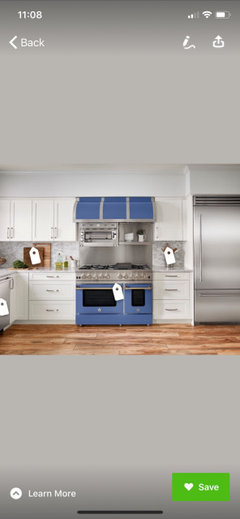
    Here is a sample pic of a bluestar install with the broiler:

  • 6 years ago

    @The Cook's Kitchen A salamander addition may be overkill.

    This is a recurring theme in this forum. I fully understand the appeal of a shiny 60" range and of a dedicated salamander. I'd be drooling too. It certainly sounds fun to put all that equipment into your kitchen.

    In practice, it almost always is highly impractical. A home rarely has the same needs as a restaurant. Few families cook for hundreds of people who all want food at the same time. Also, few families have three or four chefs all working at the same time. On the other hand, the downsides of needing complicated fire proofing/suppression, elaborate make-up-air, and oversized vent hoods are not a great fit for residential settings. Not even to mention the downside of loosing so much cabinet space.

    I usually recommend going back to the drawing board and starting with spelling out exactly what you want to do in the kitchen and what your cooking style looks like. Chances are extremely high, that a residential kitchen which meets actual cooking needs will take a very different approach towards which appliances need to go where.

    Due to project delays, I had a really long time planning our kitchen. It is by far the most functional residential kitchen I have ever seen. Both my architect and my contractors were puzzled by the amount of customization and attention to detail. During the early phases of the design, I was briefly contemplating a bigger range. I am so happy we actually stuck with our 30" range. It doesn't sound impressive, until you see how it combines with all the other appliances, equipment, and overall layout of the kitchen.

  • 6 years ago
    last modified: 6 years ago

    Even a large family with large cooking demands usually does not overwhelm a 60” range. The success is more about the overall design of the kitchen, rather than the specific equipment in the home. The layout of the space is critical. You want a kitchen design expert to do this, so that it fosters multiple cooking stations, instead of 5 people all clustered around one cooking zone in each other’s way.

    That means multiple sources of water, and can mean multiple cooking stations as well. Splitting the wall ovens from the cooktop may aid that. Or, adding wall ovens, like the BS french door wall oven with the infrared broiler. Or, doing 2 separate 30” ranges, separated by a deep fryer station, or salamander. Etc. You will need a giant custom stainless wall hood to do any of this properly.

    You should look for a local restaurant appliance dealer. They know the guys that do the custom stainless welding fabrication for the restaurants. You are not ever going to be able to do a wood surround for a hood like that. That wood has to be 30” above any heat source as a minimum. I’d want 36” above a salamander. Way too high to function then. That would put it at ceiling height, necessitating a whole wall capture and filtration system. You’re already 75% of the way there as it is. If you are in a cold zone, the heated make up air that this will require will be commercial level. Not just the ventilation. That means it will cost more than the cooking equipment.

  • 6 years ago

    I would go to someone like Modern-aire and have a hood custom made for your set up. They can customize all dimensions and the material. Made in USA, right here in the Los Angeles area. I bought a 48" hood from them 2 years ago and I'm very happy with the function and looks of the hood.

  • PRO
    6 years ago
    last modified: 6 years ago

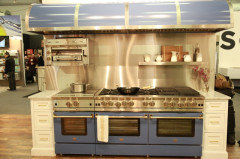
    You see how closely Bluestar themselves follow commercial hood designs for their products that they showcase. No wood in sight. It’s all 100% custom stainless. This is 100% a home safety issue. Most fires start in the kitchen.


  • PRO
    6 years ago

    Plus, I’d like to point out that even Nacho Flay’s servant, Bobby, doesn’t have a salamander in his home kitchen.


  • 6 years ago
    last modified: 6 years ago

    Suggest finding a recent ongoing thread by opaone wherein a commercial hood design is integrated into a residence. Even there the stove, as I recall, is smaller than 60 inches.

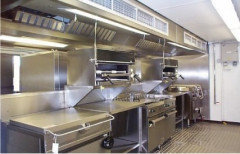
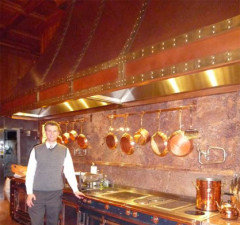
    For the MUA enthusiasts: Notice in the no.2 photo of the group [penultimately] above the means by which MUA is introduced into the kitchen -- just below the ceiling and directed away from the hood zone so the flow of MUA back to the range space can be more uniform and less turbulent.

    It is possible to make large hoods that aren't commercial looking, but cost will rise accordingly.


    http://www.handcraftedmetal.com/

  • 6 years ago

    Isn’t that a Molteni?

  • 6 years ago
    last modified: 6 years ago

    I second Live_Wire_Oak's comments about Kitchen Design/Layout being the key here, not the size of the cooking appliance. I'm not saying not to get them (BS range + salamander), but if you do, be sure you do it right. If you don't and you do have a fire, it's possible your home owner's insurance won't cover it if you haven't followed all safety precautions and industry best practices for a setup of this type.

    .

    "...often have two or three generations of family cooking at the same time."

    "...we are all over each other."

    Based on your comments, it sounds more like you don't have sufficient workspace in the right places and/or you do not have enough "work stations" to support having 4 to 6 or 8 or more people working in your Kitchen.

    Our Kitchen has twice supported sixteen 12-year old girls making multi-course meals for their Cooking badge (much to the amazement of the moms sitting around watching!) It frequently supports 4 or 5 people working in the Kitchen and 6 for major holiday cooking or baking. Our Kitchen is a medium size Kitchen, not huge, and only has a 36" cooktop (with double ovens elsewhere). But, it's all about the layout!

    We have a 2-bowl 36" wide sink on one side of the Kitchen and a 16" prep sink on the other side of the Kitchen.

    In each case, I have plenty of workspace on both sides of the sink - that means I have 4 prep stations with direct water access.

    I also have plenty of workspace on both sides of my cooktop and on my two peninsulas - adding three additional prep stations with indirect water access - but the water isn't far.

    I don't have an island to get in the way of Kitchen traffic/workflow, but I do have the two peninsulas to help direct through-traffic away from the primary prep and cooking areas.

    .

    I suggest posting your layout for a review of its design. Perhaps we can help you find a way to have sufficient prep workspace as well as adequate cooking space without having to create a commercial Kitchen - or at least design it such that appliances, sinks, and workspaces are located and sized to maximize their usability by many people. (Yes, perhaps including your coveted range & salamander but designed/located so they're more useful for multiple people.)

    I understand that you went to cooking school, but additional sets of eyes will often find improvements or see things you've overlooked for whatever reason. (It's similar to having someone proof-read and edit a professional report or paper you've written.)

  • 6 years ago

    Kaseki,

    Can you bring in MUA in an unobtrusive place away from the flames. Having tubes snaking down is quite odd looking although could be a conversation starter.

    TIA

    Inga


  • 6 years ago

    Inserting MUA well away from the hood is the goal. I insert mine via a ceiling diffuser into a hallway that leads to the kitchen. In the image I commented on above, the MUA appears to be pushed out registers from a soffit above the hood area and directed across the kitchen ceiling, from which the air likely curves around and approaches the hood from the distance. (I'm not aware of any tubes-snaking-down examples, unless one looks at opaone's photo of his attic.) Another option is via toe kick areas, but in all these cases, the registers and/or diffusers, along with any MUA filtering, will cause a pressure loss that may need to be countered by an MUA blower. See Fantech's site for examples of turnkey MUA systems.

    Commercially, the air is often introduced at the back of stand-alone cooking units to flow across the floor and thence back to the hood.

    In test kitchens, the MUA is introduced via perforated walls to make it relatively laminar so that hood measurements are as unaffected by the MUA as possible.

  • 6 years ago

    MUA can be introduced in a number of ways and be effective. A lot depends on the kitchen layout, your climate and how much MUA needs to be conditioned, etc.

    - In very cold climates for residential it's common to bring MUA in to the return duct just prior to the furnace so that the furnace/AC can condition the air. This is what we've done.


    If you have MUA dedicated conditioning (or conditioning is necessary) then you have a number of better options. The top three are:

    - In several places on the opposite side of the kitchen near the floor so that fresh air flows across the kitchen somewhat evenly. Best locations depend on kitchen layout.

    - Along the base of the wall behind (underneath) the range so that it flows under the range and then up along the front of the range and helps to pull effluent in to the hood.

    - From the front of the hood where it can help to create an air curtain to assist with pulling effluent in to the hood.

  • 6 years ago
    last modified: 6 years ago

    Generally true, given the caveat that the MUA must not create turbulence in the rising plumes. Else, effluent may be disturbed enough to cause some to miss being captured by the hood overlap, even when, without turbulence, full capture would have occurred. Strive for the MUA to be spread out when it gets to the face (and sides, as applicable) of the air volume between hood and cooktop.

  • 6 years ago

    Also, read the first dozen pages of the Greenheck guide for insight -- available here:

    https://www.tagengineering.ca/wp-content/uploads/2015/02/KVSApplDesign_catalog.pdf