

Vent Hood Recommendation
Hello! Recently moved, and have now gotten around to looking at renovating the kitchen - and we need to close on a vent hood soon. Here's the background context (sorry, it's long):
History: Last kitchen reno we did back in 2010 (different house), we ended up with a Vent-A-Hood PRH18 (42" wide overtop a 36" Viking gas range). We can do heavy cooking - wok, searing steaks, etc. We found it decent - it did seem relatively quieter than other options, did reasonably well with effluent (with some spillage, I think is the term kaseki would use, despite the large reservoir and 600CFM dual motors), but it was a bit of a pain to clean.
Fast forward to today. While I'm not dead set against going back to Vent-A-Hood, reading a lot of posts here suggests there's a better solution. In the new house, we'll be putting in a 36" full induction top, so looking for another >= 42" vent hood. The design currently calls for an insert/liner, with the panel being 48" (so I guess I can fit up to ~46" up in there?), but we can switch to a wall-mount if it makes sense. There will be upper cabinets on both sides to help direct effluent up into the cavity. In the current setup, the hood is 28-1/2" from the countertop, leaving about 17-3/4" for ducting which is directly out the wall (currently a 6" duct, but not sure exactly how high). I will still be doing wok cooking/searing, but it's induction instead of gas. I want a reliable long-lasting solution that's effective at removing effluent and as quiet as reasonable (open kitchen design, and I often cook for large parties), and am willing to pay a little extra for it (but within reason). Don't worry about MUA, that will be handled.
The salesperson who we got our other appliances from recommended an Elica Trento (1200CFM in 40" or 46"). It's only got an 18" depth though, so I would instead choose the Arezzo line, which is otherwise identical but with a 22" depth. But I can't help but think there's better choices, especially since there's no reservoir to speak of.
I would like to consider an inline or remote blower to make it quieter. I assume because we only have about max 31-1/4" in height for the hood and ducting (less if the hole to the outside is not at the very top), an inline blower or even an inline silencer would not fit. I've also heard that remote blowers don't deal well with (Canadian - Southern Ontario) winter weather? I also wonder whether we'll really get that much noise reduction since the ductwork would be so short, less than three feet including an elbow.
I've seen that gurus @kaseki and @Aglitter have Wolf hoods with inline/remote blowers (the liners don't see to have much reservoir), but I've also seen recommendations for real commercial hoods, which as far as I can tell don't typically come with blowers and I have no idea where to source one in Ontario, Canada. Vent-A-Hood also offers a remote blower with baffles in the hood itself, but at that point you're paying an unnecessary premium for the brand?
Essentially: Elica Arezzo (40"/46") vs. VAH BH340PSLB/BH446PSLB vs. Wolf liner (PRO 22" depth, say the PL4x2212) vs. commercial solution vs. something else? Is remote blower feasible/worth it with a short duct run?
Thoughts? Thanks!
Comments (28)
 3 months ago
Some relevant thots:
Short ducts preclude silencers and will not provide significant reduction of blower blade tip turbulence noise. If noise reduction is critical, then ducting through an attic where the silencer can be placed, or up an exterior chase where a silencer can be placed, may be a solution.
Large reservoir designs (e.g., commercial hoods) allow better averaging of transient plumes allowing lower CFM. However, in residential applications, commercial designs can be too large to fit. John Liu, however, has shown that it is possible.
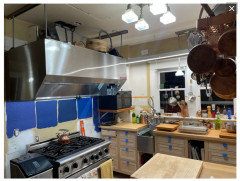
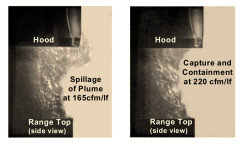
With enough air velocity (e.g., 90 ft/min actual across the entire hood entry aperture) plumes from wok cooking on induction should be nearly fully captured and contained.This will depend on local turbulence and cross drafts. Household interior flow from MUA and/or air conditioning will deviate cooking plumes; a lot of motion around the cooking area can induce turbulence. In one case reported on this forum, MUA from toe kick areas under the cooktop caused local turbulence and some missed capture. Note: spillage (a Greenheck term that may have started with the CARB) refers to captured effluent that reflects out of the hood.
It is generally desirable for the hood to overlap the cooking zone, and should do so in every direction not protected by a wall, side skirts, or deep cabinets. Side-to-side seems to be covered here, but front-to-back hood aperture area should extend at least 6 inches outward from the edge of the largest pan contours used on front hobs (scale against 36 inches height).
Perfect is the enemy of good enough, so while spillage is a sign of insufficient air velocity, missing the hood entirely is something that results from a less deep hood than needed. Wall mounted hoods have an advantage of forcing more of the flow to occur from the hood front, thereby virtually increasing [slightly] the effective front-to-back dimension.
An example:
22 x 46 = 1012 sq. inches = 7 sq. ft.
7 x 90 = 630 CFM [actual]
630 x 1.5 = 960 CFM rated at zero pressure loss. (crude approximation)
(duct loss may be minor, but MUA and baffles will be worth significant inches of pressure loss)
I think I'd use 8-inch ducting for this case)
Air velocity in ducting should fall between 1000 and 2000 ft/min to balance condensation grease collection against impingement grease collection.
I have no problem on my S. NH roof blower from local weather. My blower is a Wolf (Broan-NuTone) 1500 CFM (rated) assembly.
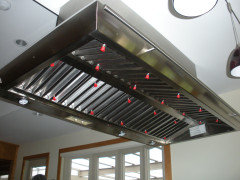
My Wolf hood is for islands and peninsulas, but the modest but useful reservoir area is as seen below.
- PRO3 months ago
Hoods ae noisy if propersized but only really run while cooking and for a few minutes after you are done . I loved my Venta-a- Hood but had 1200CFM for a 36" gas range and vented straight up throuh the roof in my MCM ranch and really do you want that behemoth hood that John Liu has , I think not All of them are a pain to clean properly but I found if I did mine every 3 months it was much easier and quicker . I ran a catering biz from my home hence the more times cleaning
Related Professionals
Miami Kitchen & Bathroom Designers · Alexandria Kitchen & Bathroom Designers · Columbia Bathroom Remodelers · Cookeville Kitchen Remodelers · McComb Interior Designers & Decorators · Pittsburgh Interior Designers & Decorators · Sheridan Interior Designers & Decorators · London Interior Designers & Decorators · Jackson Architects & Building Designers · Sault Ste. Marie Kitchen & Bathroom Designers · Abilene Kitchen & Bathroom Designers · Emporia Kitchen Remodelers · Middlesboro Kitchen Remodelers · Florence Custom Countertops · Oshkosh Custom Countertops- 3 months agolast modified: 3 months ago
I have Vent-a-Hood in the new house and had Modern-Aire in my previous house. Both were custom ordered (special dimensions) to fit the kitchens.
I don't really notice any difference between them.
- 3 months ago
What I dislike is the moderately misleading VaH Magic Lung version claim about air flow rate. In a VaH with no baffles and Magic Lung squirrel-cage blower, the blower rating, e.g., 600 CFM, is likely to be the actual flow rate with the hood hanging in free air. Rating this at 900 CFM because a 900 CFM rated in free-air blower installed in a baffled hood would also plausibly flow 600 CFM with the hood in free air, neglects the fact that both hoods would be installed in kitchens with varying MUA path resistances and varying exhaust duct pressure losses.
In real world cases, the additional pressure losses lead to lower flow rates for both designs. The fan curves for the two blowers will reveal the penalty each will suffer. Based on VaH web site data, the flow rate penalty for additional pressure loss is greater with the Magic Lung design than that of a comparative centrifugal Broan-NuTone or Abbaka (Bluestar) blower used in or externally to a more conventional hood.
My general view is that residential kitchen hoods should approximate commercial hoods to the degree that cost and house architecture allow.
I have no negative opinion about VaH conventional baffled hoods. I expect them to be superior to Magic Lung hoods.
Relative noise opinions vary; @clinresga has commented on this in: https://www.houzz.com/discussions/2324336/vent-hoods-and-noise-the-real-scoop-on-vah and I think other more recent threads. The Magic Lung design precludes using a silencer to attenuate noise from an in-line or external blower.
- 3 months ago
Linking a 17yo post, is much like that technical paper opaone has often posted. It’s from a long time ago.
@kaseki, is it not possible that VAH improved their technology in all those many years since both @clinresga’s thread, and opaone’s technical report were posted? It’s highly unlikely that VAH has stood still, and not improved their products.
- 3 months ago
Agreed, but we still have to be sure which of two design approaches (Magic Lung with squirrel-cage centrifugal filtering vs. baffles or mesh filters with centrifugal or axial blowers) are being compared, noise-wise. And this should be done for the same actual air flow rates. I believe I reported in a hood noise FAQ started by @opaone the noise level of my Wolf hood, which uses a roof blower and in-duct Fantech silencer. I doubt that a pair of Magic Lung blowers just above my head with nothing in between can compete. @opaone's system is even quieter.
I'll look for links later today.
 3 months agolast modified: 3 months ago
Range hood noise charts are here: https://bamasotan.us/range-exhaust-hood-faq/
I don't believe VAH have made any substantial improvements. As @kaseki mentioned, noise is inherent in their design. There is no way around it.
To reduce noise:
- Large containment volume
- Good baffles that work at low flow rates
- Solid mounting of hood
- Remote blower
- Blower and nearby duct iso mounted
- Silencer
- Larger duct
- 3 months ago
In the two-years-old https://www.houzz.com/discussions/6417748/hood-depth-question#n=10 @clinresga references his earlier message. The most recent topical Houzz thread with new data is: https://www.houzz.com/discussions/6040827/range-hood-noise-project.
 3 months ago
I think maybe the reason VAH has not changed their design could be that they got it right the first time. If something works why mess with it. I read the replies and they refer to good baffle filters with low flow rates to keep the noise down. There is a reason for this. Baffle filters do not work well at low speeds. They require high air movement for the filters to do the marginal job. High speed equals noise, the only way to get quieter is to slow the blower and when this is done there is no air movement and sorry to say no air movement means poor grease removal. This leads to grease not being removed by the baffle filter and then getting behind the filters and then on the inside of the hood canopy and even worse inside the duct pipe. People say that VAH is hard to clean, I get that, I have had 3 VAH's in different houses and baffle filters also. The hard part of VAH is cleaning the blower wheel. If it is kept up on cleaning this is not bad and if they get too bad, they cost $25.00 to get new wheels. Most importantly all the grease is in the clean out tray, a little inside the blower housing and the rest is on the interior of the hood. No grease is behind a filter bank that you need to work through a small opening to get up behind to clean the rest of the canopy.
I 100% agree that a large canopy for containment is critical. The big question is if you have an average 30"- 36" range do want or have the room to have a huge commercial-looking hood in your home kitchen, I sure don't. If you are in a cold winter climate having the blower on the outside of the house can lead to problems with it freezing up in the winter when it is really cold. Then you have the look of the remote blower mounted on a roof or side of the house. I personally do not want one of these things sitting there and having to look at it when I am outside. One thing most people do not think about is years down the road and the remote blower quits working, you better hope that there is a replacement available or you will be looking for something that will work and fit in the existing space and hope that you do not need to do roof or siding work to get it replaced. Also, good luck finding someone that will come and do the work, it is just much harder to do all of this on the outside of the house. I would rather have the motor inside my VAH right there held in with 3 screws that I can replace myself in 10 minutes and most importantly still be able to get the motor even if my hood is 20+ years old.- 3 months ago
I have heard quite a few good arguments or debate points on all sides of the issue of baffle versus squirrel cage, blower designs. A friend of mine has a VAH installed with the proper installation requirements and I was actually very impressed with the low noise level. Mind you, my friend took MUA quite seriously, and I actually had showed them the very helpful content that Kaseki, @Opaone and others here have each shared over the years. I wonder if reported lowVAH noise at low levels is due to the use of more than one blower motor versus other designs that have one single blower? And, alternately, I also wonder if perhaps those who were unhappy with VAH, or other brands for that matter, had duct sizes that were inadequate or a lack of MUA all of which could have contributed to both performance and noise issues. As people here have pointed out in the past, there are quite a few variables that determine whether a hood specification will do its intended job and whether it will do it with a reasonable level of quiet. As for the use of in-line or remote, blower designs in combination with silencers, I see no issues with either, provided that the homeowner understands how to access service and or maintenance when the time comes. Here in Canada, we have long stretches of winter where snow remains on the roof, but the blowers themselves don’t freeze up as long as the duct on the roof is not blocked by ice. Where a person lives greatly influences access to Service. I would imagine that in New Hampshire where Kaseki is based would be much like here in Canada, where the world is set up for winter weather. Those of you who live in milder climates might find it more challenging to get anyone to deal with anything on a roof in the winter time.
As I plan a new kitchen renovation, I see the benefits of both VAH as well as baffle designs. The primary advantage tempting me with a baffle design is that I can reach up, remove the baffles, put them in the dishwasher, and carry on with my life. With a VAH set up such as my friends, the grease trays themselves are pretty straightforward to remove and clean, but taking the blower wheels out and reinstalling them with the Allen wrench is not intellectually challenging, but getting my 6‘5inch body contorted underneath the hood and doing all of this is not one of life’s pleasures. I am looking at a 42 inch, VAH, hood with a 900 CFM rating. If the VAH “magical claims“ of extra CFM beyond this prove true, well… mazel tov, but I will make my plans based on standard CFM ratings and not what is essentially, marketing. I should also add that my friend engages in very high heat cooking, and even when frying up onions, with the VAH hood turned to medium speed, I cannot smell anything when walking into her home until the food is brought to the table, which is exactly how many of us prefer our food smells to behave in our homes. And so for my part, my choice comes down to noise versus cleaning blower wheels. Decisions….. decisions.🤔
- 3 months ago
Oh, I forgot to add that the other hood I’m looking at is a 42 inch blue star with 1000 CFM single blower.
 3 months agolast modified: 3 months ago
I have a 48 inch 1200 cfm Vent-A-Hood. Have been very happy with it. We wok and sear and do all sorts of stuff. I am always amazed with the amount of grease it collects. The worst part about it is getting up in it to clean the inside of the hood and part of that has to do with having the high shelf on our range and also I am short so things are a bit awkward. It would be no different than other hoods. I throw the squirrel cages in the dishwasher and then hand wash the boxes and trays. I do the full clean 2-3 times a year and other times I just clean the trays. It is much quieter than the 1200 cfm 48 inch Wolf hood I had in my previous house. That thing sounded like a freight train.
 3 months agolast modified: 3 months ago
Since you are in Canada, have you heard of Victory Hoods, absolutely amazing. Built in Vancouver
basilisk
Original Author2 months agolast modified: 2 months agoHey all! So sorry for the radio silence, I had a bit of drama with street construction wiping out my home Internet and the provider taking a week to finally get it fixed. It has also taken a while to read through and digest all the excellent comments and reading through (most of) the reference material.
That being said, I haven't made any headway in my decision. My thoughts continue as follows:
* I have experience with Vent-A-Hood (600CFM B200 dual motor). I found it generally worked well, there was some spillage (effluent "spilling" back out of the capture area). It wasn't quiet, but not too loud either. I'm hoping to get a little quieter, and a little better exhaust performance. Thinking of upgrading to the 2xB200 dual motors (1200CFM) will allow me to run at lower speeds and get a quieter result. (That being said, I found the high and medium settings on the single B200 dual motor to be similar loudless, but the high setting had a better pitch - can someone with a 1200 CFM model comment on how many speed settings there are and how the sound is at each level? @Clyde Kalvin?). The PRO is I think there's the most containment volume short of a commerical hood. CON is cleaning the blower wheels and housing. I had paint peeling off the housing of my last one. I didn't even clean it very often - every couple of years really. The tray is very easy to wash though. Up to 6.6 sones.
* Elica - I only mention this because one saleperson recommended it, but it has no containment area, and is really loud (relatively speaking) at 8.5 sones at high (1200 CFM). I think this is highly unlikely as a candidate.
* Victory Typhoon - Made in Canada! Better than average containment volume. Large bar for controls and lights though. Up to 6.8 sones. Nowhere on display to go listen to it though. :(
* Wall mount remote blower with a Wolf or Prestige insert. Not sure this will give significant sound improvements. No one publishes sound seems to publish sound information?
* Build an exterior chase on the wall to house a Fantech silencer and remote blower. Will be quieter, and probably a lot more expensive. Since this is on the side of the house, it will rarely be seen by anyone, so aesthetics is not really a factor here.
I measured the existing AVG AVM-278PS (860 CFM @ 4.0 sones, haha right). I can't speak to the actual CFM, but it seems to pull okay. It's got no capture volume. Sound is about 58dB at max, 53dB at medium and 45dB at minimum. Baseline ambient was 31dB. I consider 58dB to be annoyingly loud, 53dB is pretty good, so I'd like the final result to be 53dB or lower at 900CFM or so. Maybe this is not realistic.
Anyway, any other products or solutions I should be looking at?
 PRO2 months ago
Please remember the replacement air system that is required for any hood over 400 CFM's. With a powerful hood like a 1200 CFM you would poison your family with Carbon Monoxide from your furnace and possibly water heater without the required replacement air system. Many designers and appliance salespeople don't mention this.
basilisk thanked Main Line Kitchen Design basilisk thanked foodonastump
basilisk
Original Author2 months ago@Main Line Kitchen Design Thank you for taking to time to point out health and safety risks!
@foodonastump Thanks for remembering that detail! :)
- last monthlast modified: last month
Addendum @basilisk: re 1200 CFM, I'm not convinced many applications at home need this much? My whole takeaway after reading about the quasi-commercial setups that some here have done (opaone, billy_g, I think a couple others) is that if you have the trio of good capture depth, more containment volume, and active makeup air, you can achieve effective ventilation with lower CFMs.
The counterargument on the other hand for still having a high maximum I think is that an over-specced motor may be able to deliver its lower settings more quietly
But then downside is most control setups with a high maximum don't seem to provide a low enough minimum setting. My 1200 CFM Elica's fixed settings are 375,640,940,1200 on paper and I really would prefer to have a lowest setting that was more like 150 CFM, especially on our heatwave summer days, 375 CFM or whatever I'm actually getting in practice on "low" is quite a lot of humid air pumped into the house by active MUA. I couldn't find Vent-a-hood's specific CFMs-per-speed-setting but I had one distributor say the B200 would be 600 (both fans max), 300 (one fan max), 150 (one fan reduced). I assume their 1200 would therefore be 1200/600/300 for its three settings.
Last note, a couple comments mention Victory and I guess it's cool that they're made in Canada but when I look at the models on their website they appear to have the same standard flaws every other residential hood has: mildly slightly angled baffles that provide little containment volume, not that deep and further wasted depth due to a light bar, etc.
- last monthlast modified: last month
The minimum CFM, after taking into account pressure losses, has to, or at least should, still allow centrifugal extraction of the larger grease particle sizes by the baffles. One may also have a motor design that doesn't run well at very low speeds. DC torque motors driven by electronics synthesizing the correct phases for the motor wiring can go very slow but cost more.
The requirement for full power flow rate is still the same as repeated here ad infinitum. The flow rate after pressure losses has to entrain the plume to enter the baffle slots. It must overcome the tendency for plume momentum to be reversed on surfaces (reflect) and escape the hood (spillage). I have touted an actual 90 ft/min as a good number for maximum cooking plume velocities (potentially up to 1.2 m/s using gas -- Finnish study). With large reservoir volumes below the hood baffles, such as on commercial hoods, there is general averaging at the high baffle area and the plume velocity will have dropped allowing lower hood air velocity and thus lower CFM.
The figure below taken from the Greenheck guide applies to commercial hoods. For residential hoods trying to fit into a residential kitchen, and importantly not having side curtains, I nominally go one column to the right (Greenheck Method row) for cooking content.
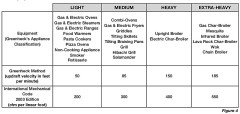
Note that "wok" is very high even with commercial hoods, but this is for 100k+ BTUh knee control gas burners, not for more modest capability residential cooktop burners. - last month
Most baffles have a minimum flow rate to function properly. Somewhere I've a chart from Acurex for our baffles that provides the efficacy vs flow rate. IIRC, there was a cliff around 420? CFM where efficacy plumets. That's also the bottom of the knee. I think the top of the knee was about 550? CFM.
But yeah, designed properly most homeowners don't need more than maybe 600 CFM 99% of the time. But as pointed out, the larger system will be quieter.
Also keep in mind that consumer extractors in the U.S. are advertised as free air flow. We measured a few of these along with blower door tests and most were about 30-50% of advertised CFM. Even minimal restriction of MUA caused some to drop precipitously. - last month
The really frustrating thing is that making a good consumer hood system would not be much more expensive than what's on the market currently. A bit greater depth and containment volume would go a long way and a good ECM motor would complete the system.
basilisk
Original Authorlast monthThank you all for the comments. I generally agree. I think I have to unfortunately abandon the idea of a remote blower since I'm not going to save much in the way of noise since there's only going to be a few feet of pipe.
The comment about Elica's push rotary dial is funny, because I saw the exact same thing at a demo unit I saw, the knob had just fallen out.
I agree that the Victor hood doesn't have as much containment volume as I would like to see. Which brings me back to VAH which at least has the containment volume closer to a commercial solution.
The local appliance store has a demonstration VAH model with the two B200 dual motors, so I plan this weekend to go listen to the sound at what I assume are the four speeds (one motor at low, both motors at low, one high/one low, and both high - maybe there are only three speeds?). The rep has already said it's not representative of a typical installation, but I'm more interest in just having a sense of the relative sound level.
And yes, I am absolutely over-specing the CFM hoping to run them lower. My previous kitchen had a VAH with one B100 and one B200, so I know how loud that is already, and still there was some spillage despite the containment volume and relative depth/width (42" wide over a 36" range, with adjacent upper cabinets providing partial side curtains).- last month
Please be aware that VaH Magic Lung systems have a fan curve that does not tolerate to the same degree centrifugal fans do pressure loss in the ducting (maybe not a problem here) and in MUA, which might be a problem if passive. So apparent over-speccing of VaH is likely not actual over-speccing, as the actual flow rate could be as low as 50%, whereas with baffled system it may be closer to 66%.
- last month
@opaone good point re baffles having an effective minimum air flow. I wonder if that specific floor is different for the non-baffle VAHs? A low effective setting of 420 does seem quite high to me, it's very cool that this ends up being basically silent in your setup but my concern with that is it's quite a lot of conditioning load for MUA, I'd hope to be able to get away with something closer to 150. Your hood is significantly wider than mine, I have a 30" Capital range with a 36" gap between upper cabinets for a hood, is this number based on the width?
Fully agree that it seems crazy that nearly every residential hood on the market share the same design flaws when meanwhile there's this whole other world of commercial ventilation with well established knowledge on how effective ventilation works. It's the same reason I got a range with open burners...entire market of residential gas burners share the exact same basic design flaw that throws a ton of heat sideways and leaves a colder centre, except just BlueStar and Capital that do the extremely simple correct thing of sending the flame upwards.
Maybe someone should send Opaone's blog post to Victory and try and convince them to be the first residential company to actually sell a truly commercial-style residential range hood, since they seem to be a fairly small company that markets themselves as being all about quality.
But that's ultimately why I'm still stuck on the VAH PRXH18, because it actually does seem to be the only residential product I'm aware of with significant empty volume which also wastes very little of its 27" depth. The non-baffle design is more of a question mark for me, but since the commercial ideal of a remote blower with a silencer isn't a viable option for my kitchen, and if the "Magic Lung"'s main downside (aside from cleaning) is greater sensitivity to pressure loss according to @kaseki, well I have very minimal duct length it has to deal with as well as a Fantech MUA system, so in principle I should have close to optimal conditions for it to perform well.
@basilisk Our situations sound similar, we're both in Southern Ontario and being pushed to buy Elica (but I made the mistake of buying it as advised six years ago when I didn't know anything, all I cared about at the time was the range) and also we both have configurations involving a straight short duct run directly out the wall, sort of ruling out remote blower setups. Are you in the Toronto area by chance, if so what is the appliance dealer you're visiting that has these set up for demonstration? - 15 days ago
Following along. Also in Southern Ontario (Toronto) and trying to decide on a range hood. Leaning towards Vent a Hood. Prestige looks like it might be the best option but I cannot find anyone local that is familiar with their products and can order one. Can’t find information on pricing either.
- 15 days ago
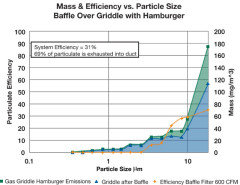
From a grease removal POV, the baffles use double reversal to centrifugally extract grease particles from the larger end of the particle spectrum. The Magic Lung uses squirrel cage blade impact and centrifugal sling. I expect both will be adequate under normal circumstances. Example plot. Click to enlarge.
Noise that one can do something about depends on blade tip velocity. So larger rated blowers that are run at reduced speed should be relatively quiet. Otherwise, noise abatement by silencer is needed, which mandates an inline or remote blower.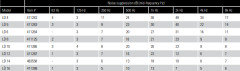
However, the first requirement is full capture and containment. This means a large enough hood to envelop the trajectories of the growing plume diameters and enough upward air flow to entrain the plume content into the baffles or into the squirrel cage(s) without allowing reflection of plume momentum and consequent spillage.Example schlieren photo of commercial hood.


d7sharp9