Software
Houzz Logo Print
robert_brown97100

This Exterior Wall Fan Enough?

6 years ago
last modified: 6 years ago
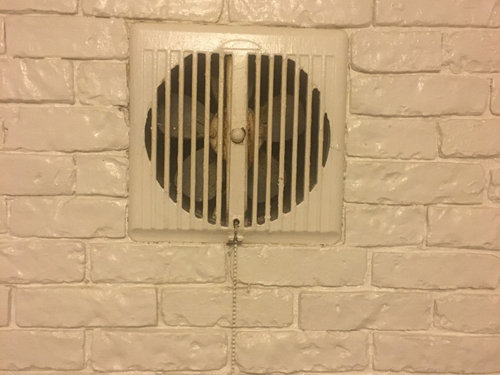
I live in an 1888 home. This is the exterior wall fan for my kitchen. I pull the chain to release it from the lock and the fan takes off, sucking air and venting directly to the outside. I use it all the time currently with my induction range and it is great. Everything from boiling water to smash burgers in my cast iron pan, it collects the steam and grease and really keeps the kitchen and house clean.


I have no idea what the cfms are, but given that most people who have gas ranges have the typical recirculating under microwave fan, any reason this exterior wall fan wouldn’t be enough for a gas range?

What about a Blue Star? I’ve read and been told by dealers (yes, I know they are just trying to make a sale) that the recirculating fans are acceptable (such as a Zephyr with a carbon filter) for Blue Stars, so wouldn’t this fan that vents directly to the outside be acceptable?

Thank you for your input!

Comments (9)

  • 6 years ago
    last modified: 6 years ago

    I had a similar or same fan in a travel trailer. My trailer was built in 1959.


    there are air measuring devices.


    wonder if there is a current fire code you would have to deal with if you changed.

  • 6 years ago

    Honestly, I’d be surprised if there was a fire code I’d have to deal with. And I still don’t see how this is unacceptable compared to a recirculating fan.


    This is all for educational purposes. Frankly, I love my induction range. Just don‘t like how I’m limited by only being able to use one 11” pan at a time.

  • 6 years ago
    last modified: 6 years ago

    Well, if the only comparison is to a recirculating fan system in a microwave oven, then it is likely that this wall fan is not worse, mostly because the MW oven sets the ventilation bar so low only ants have trouble leaping over it.

    Some useful information would include height of fan center from cooktop and whether there is any cabinetry above the fan. I would not assume that this can capture and contain all effluent from more lively cooking such as searing and wok cooking.

    What you really need, even with this wall fan, is a type of hood mounted above the fan height that captures the rising and expanding effluent before it can move into the room. In a real hood this captured cooking plume content is then passed through a filter (also acting as a fire stop) and thence sent outside. With this wall fan operating openly, some of the effluent will not be immediately captured, and significant grease might be expected to coat one's walls and fabrics. With a non-ducted hood that kept the effluent where the wall fan could remove it, one could exceed (perhaps by a lot) the performance of a MW oven system. (The wall fan illustrated is significantly larger than ones used by most MW ovens.)

    All that said, if these wall fans are operated with a powerful gas cooktop, or even an induction cooktop that was ignored too long causing a pan fire, they might be susceptible to fire ignition if significantly greasy. The Blue Star installation directions should comment on suitable ventilation.

    On a personal note, years ago my mother-in-law's kitchen had one of these over a conventional coil electric cooktop. I considered it inadequate for bacon cooking, even before I learned anything about real kitchen ventilation.

  • 6 years ago

    Yeah this fan does a great job with bacon. Like I said, I've done smash burgers in a cast iron pan with the fan on and it helps tremendously. The grate gets coated with grease, but I easily wipe it down when I'm done with paper towels and it cleans it all up. I can also take off the front grate to access inside the fan if I needed to clean anything. I also have an electrician who can supply me with a new fan and motor if I decide to completely replace it, therefore making it completely clean. It works so well though I've held off on spending any money on replacing it.


    Completely agree about how much a hood to collect the effluent would help. Obviously it can't get everything. I posted as I was just more curious about what limitations I'd find considering how successful (relatively speaking of course) people seem to be with microwave oven fans when here I have a fan that vents directly to the outside.

  • 6 years ago
    last modified: 6 years ago

    We lived in a house that had a fan like this, when I was growing up, it really moved some air, too. I have thought of that fan often, wishing I had one like that for the master bathroom shower.

  • PRO
    6 years ago

    Kitchen fans are required to be able to have the grease cleaned, as that is a large fire risk. That has no filter mechanism allowing that. If you‘ve ever seen a kitchen fire feeding off of a greasy duct.....

  • 6 years ago

    If you‘ve ever seen a kitchen fire feeding off of a greasy duct.....

    I believe this fan doesn't even have a duct. It's as big as the wall is thick. It also is a pretty big diameter. It's hard to tell from looking at it, but I wouldn't be surprised if it was 10". That has the potential to move a lot of air. So, even if capture and redirection of air is entirely inappropriate, it'll still end up doing a passable job. And it can't really build up all that much grease, so while there is some fire risk, it isn't as bad as many here would make you believe.

    Having said that, if OP instead got a modern hood with baffles and with a 10" duct connection, things should get much better. Having a directly venting hood through a large opening is great for efficiency.

  • 6 years ago

    Yep, 10”. Really moves air.

  • 6 years ago

    From a health standpoint I would not rely on the wall fan or any type of recirculating fan for any gas range and particularly any kind of open burner.

    Beyond health it comes down to what's important to you. If it does a good enough job removing odors and grease for your comfort then go for it. If you like to entertain then I would try to get something more effective.