Software
Houzz Logo Print
trpnbils

Need advice for starting a new orchard

6 years ago
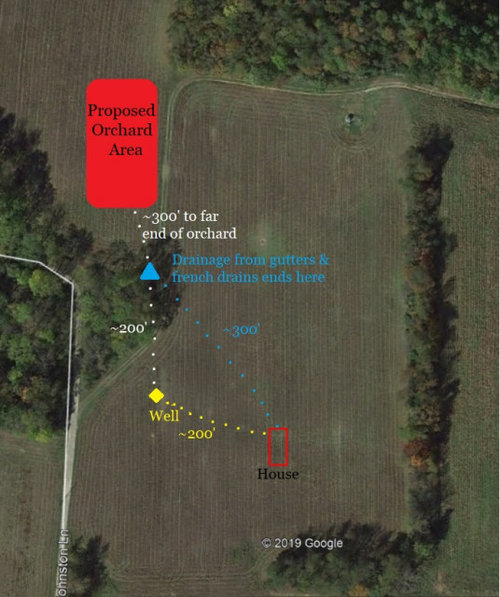
We are building our house now and will be moved in by end of May sometime. Eventually we would like to have a small home orchard of 10-15 trees off in the one corner of the property (see below). The current plan is to bare-root the trees late fall of this year, which means we'd have basically from now until then to get the site ready. The area, as you can see, is all farm field that has been planted with either corn or soy (occasionally hay) since at least back as far as the 30s up to as recently as 2018. We will soil test before planting anything, but haven't yet.


My question is this: There are lots of junk weeds there now and I'm assuming we should probably plant some kind of more substantial cover crop to help the soil, eventually cut back on water needs, and even just to look better. What kind of cover crop would you recommend, and how would you recommend prepping the site for that? I've seen things online about fruit orchard cover crops where they let the cover grow right up to the trees and to a couple of feet high, which seems ridiculous. I don't want it to look like a forgotten farm field for 75% of the year, so if I can find something to provide those benefits while still being able to mow it would be ideal (even if it means letting it get a foot high between mowings or whatever).


Comments (11)

  • 6 years ago

    Why so far from the house?

    trpnbils thanked Embothrium
  • 6 years ago

    I've read that dandelions are good for fruit trees as they draw bees for a long period of time each year. So perhaps other plants would create a similar situation. Like clover

    trpnbils thanked John D Zn6a PIT Pa
  • 6 years ago

    Right now, you could just buy cover crop mixture (nitrogen fixer - like clover or field pea, soil loosening - like daikon radish, and general - like ryegrass). Not sure any cover crop should be grow up to the trees (nutrition and water competition) - I would clear under the canopy. I would just mow-mulch down the tree planting zones, when you do plant them. Keep in mind, if that was not organic, there is a reasonable chance that the corn/soy grown was GMO and they used roundup herbicide in the production. So, cover crops may not grow well, until that has all recomposed.

    trpnbils thanked Ken "Fruity Paws" (N-Va 7a)
  • 6 years ago

    Yes, don't get in a big rush, you will need to protect the trees from rabbits, deer and porcupines if they are in the area. high fence is the easiest way. Voles may girdle the trees also, I use hardware cloth. Look up permiculture for more ideas.

    trpnbils thanked wayne
  • 6 years ago

    Yep, taking it slow. We were thinking an early clover followed by possibly something like sudangrass for biomass to loosen the soil over the summer because we're not planning in putting any trees at all in until Fall. Getting a soil test done next week to see what we're working with. The main reason it's going to be so far from the house is we're designating the large area as pasture/barn area for the coming years. We were hoping to keep the orchard and garden as part of the initial phase while we're saving up to build the barn and fence in the pasture.

  • PRO
    6 years ago

    I started my hobby orchard 10 years ago. Still on a steep learning curve. Soil test a correct 1st step. Check drainage in your proposed area; fruit trees "don't like wet feet."


    In the 1st few years fruit trees might need regular watering so you might want to run a water line to the orchard area which could easily be added when they're trenching for the drains.


    Re: mowing and cover crop; I mulch the trees which has multiple benefits and simplifies mowing. I planted wildflowers along the perimeter of the orchard areas and most years have very successful pollination based on how much thinning I have to do. After a lot of reading I am adding mason bee houses this spring to help insure pollination in a cold spring like 2019.


    Wildlife damage to your young trees is a concern particularly with the proximity of the wooded areas. The plastic tree trunk wraps seem to work for everything except deer. For many years I had no deer damage and didn't really know why. Then my hunting dog which roamed free and hunted every day of her life got old. Suddenly the deer became a problem and I learned the free ranging dog had marked the area with predator urine which kept the deer away even at night when she was in the house. Plan on spending considerable effort to protect young trees.. "Deer away" sprays are somewhat effective but I have had young trees ripped up only days after a spray application so I'm not a fan. A physical barrier of a ring of heavy gauge wire fence (hog fence) is effective and can be erected with only one or two steel fence posts for support.


    I learned to buy trees from a nursery in the same zone as me. I've only had one fail with new trees (most cherry trees died the 2nd winter) and those were bought from a nursery in WA. Failure rate from trees in my home state of MN or nurseries in WI and upstate NY has been very low.


    If you are going to have several varieties I'd suggest making tags. I found the best tag is a small brass disc engraved with the variety, rootstock, planting date. Years from now people will ask you. Different varieties can give you freshly matured apples over a period of a couple months.


    Learn about your local pests. In my experience apples take a LOT more attention than cherries, plums, or pears. I have found a pre-bloom of fungicide and two post bloom applications of triazicide is very effective for apples my area.


    This forum is a great resource. People here have solved many problems for me over the years. Good luck.

  • 6 years ago

    I looked through some of the comments, and it's not clear to me where this proposed orchard is located, e.g., zone 6, 7, 8, 9, etc. It looks like you have a large area, so I'm not sure how you might mulch something that size to reduce weeds. It also looks like you might be quite a distance from a water source, so how do you propose to implement a water supply and run drip through the orchard? If you can solve these technical issues, it looks like you have a ton of space to plant almost anything you want. If it were me, I'd plan for fruit varieties to pick through the season, and plant pollinators as close as possible to each other (as needed, of course).

  • 6 years ago

    Yes, improve the soil using green manure and plant some native wildflower to attract pollinators are very good suggestions. Work a thick layer of horse manure or other organic matter to enrich the soil and help it become moisture retentive or increase worm activities. You could test the drainage of your plot by digging 1 foot hole in various area and pour water down to see how fast they drain. Also get to know your soil, acidic, neutral or alkaline. Sand, clay, loam or silt. Running underground pipes is also a good idea. I have seen people here slant their fruit trees to increase yield. Also learn to prune and decide upon the kind of trees you want. How tall they will be. Visit orchards in your area to get some idea.

    There are loads of fruit trees and in every single species, there are loads of different varieties. I was on the point of buying an Avalon peach until my son read out loud that I might have to go around with two dusters to artificially pollinate its flowers as they bloom too early with very few pollinators around. It might be a good idea to get some step-over varieties, or trees with shorter final height. Something compact, productive and good flavour. The end of the day, you don't want to get a ladder to go round every single tree.

  • 6 years ago

    Location of source nurseries has nothing to do with likelihood of good or bad outcomes except where material shipped from a warmer climate might be too seasonally advanced for planting that first year in a colder one. As in the trees show up with tender new growth that gets frosted afterward. Otherwise it is entirely a matter of the genetics of the purchased stock, if the varieties chosen are locally adapted they will grow wherever they came from.

  • 6 years ago

    Since most fruit trees bloom early enough that the presence of active pollinators can be an issue, planting the area with native wildflowers may not have the impact you expect. Unless they also are very early bloomers :-) You may need to look at cultivating orchard mason bees instead, which will appear much earlier in the season than bumble or honey bees.

    And lists of the best 'locally adapted' fruit trees are typically available from your county extension office. Not all fruit trees will grow equally well in all areas but the extension service focuses in on varieties and cultivars that will perform best, regardless of where they are sourced from.

Sponsored