Software
Houzz Logo Print
nelson_keating100

Money Tree Struggling

6 years ago
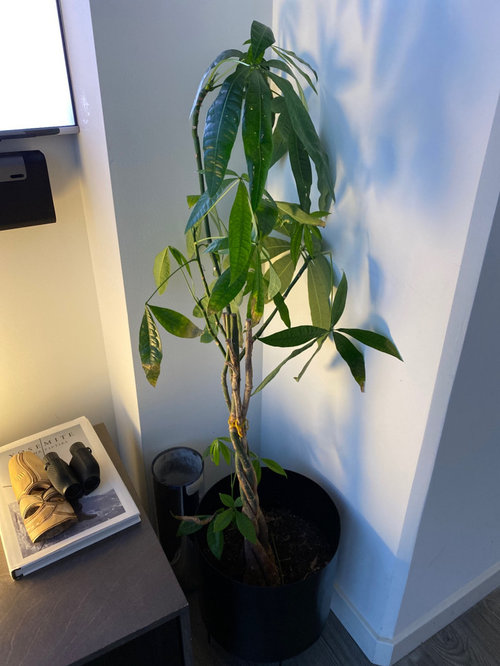
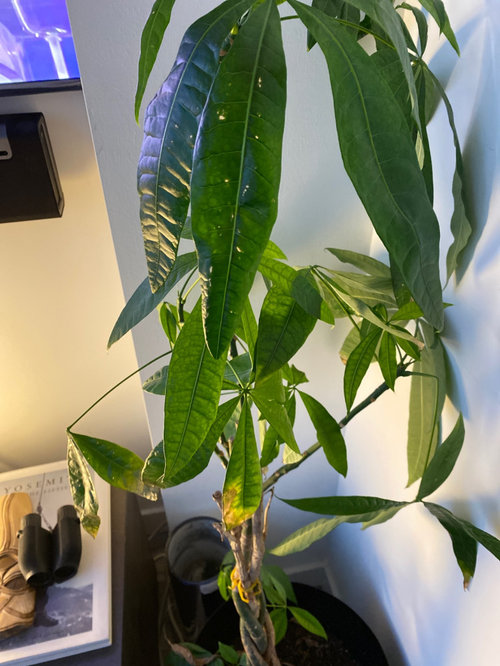
My money tree is not doing so great :( - the leaves are curled downwards, and some have little holes or are brown/dead towards the end of the leaves.

A few weeks ago I moved it to a spot with much more sunlight but have not seen any change.

My current care regimen/notes (apologies I’m a plant newb):

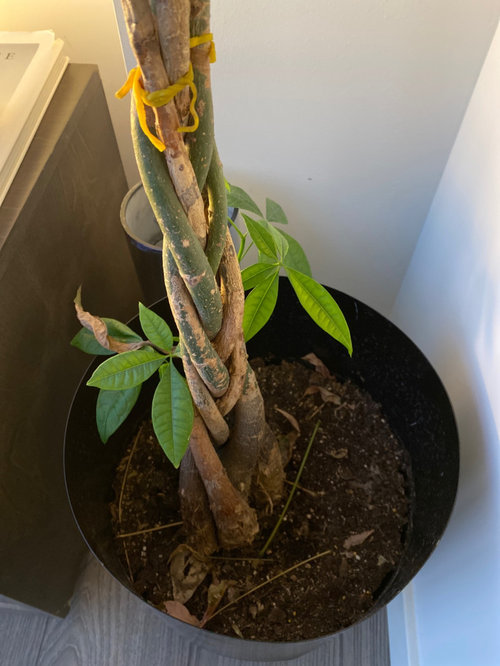
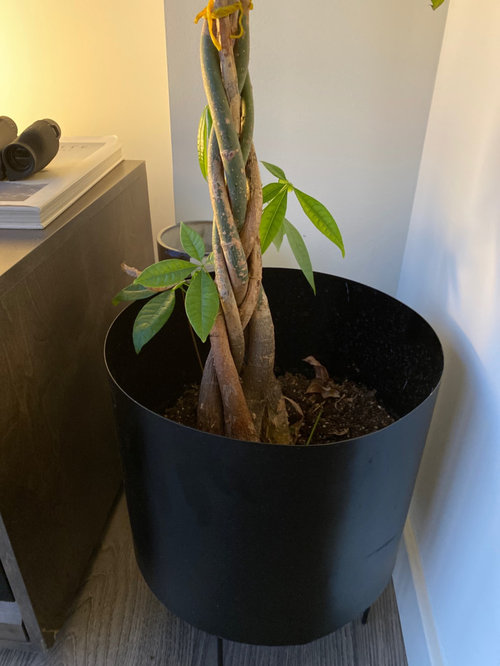
  • I’ve had a money tree for a few years and it’s been in the same planter with same soil the entire time.
  • I water it about once per week with a full glass of water.
  • every few months I put some plant food sticks in the soil I got from amazon.

Anyone have any ideas to help me make my tree thrive? Thanks so much!

Comments (2)

  • 6 years ago

    Cut those yellow ties on them immediately.

  • 6 years ago

    A) Stop using the fertilizer sticks. Instead, flush the soil thoroughly (see below). The leaves have the look of foliage suffering from plasmolysis (fertilizer burn). After flushing the soil thoroughly, wait to fertilize until you see new growth.

    B) Change your watering habits to an "as needed" regimen and get your watering under control. Use a "tell" to "tell" you when it's time to water, instead of the digital device you currently use (finger). More about using a "tell" below.

    C) Think about undertaking a full repotting of your plant; and when you do, make sure you're using a medium you won't be constantly battling for control of your plant's vitality. Regular repotting, which is more involved than potting up because it includes bare-rooting and root pruning, and an appropriate soil are critical parts of care regimens of those who would like to see their plant thrive for decades or generations as opposed to months or a few years. Timing of the repotting exercise deserves some consideration, but your plant has a wider "best time to repot" window than many other trees commonly grown as houseplants. I'm not sure where you live, so I can't be more specific than suggesting as a generality you repot in the 90 days prior to the spring equinox if you live more than 25* N or S (latitude).

    D) The plant isn't getting near enough light, so it would help if you correct that. Too, summering the plant outdoors would provide significantly greater opportunity for it to realize a much larger measure of its genetic potential.


    Flushing Soils

    When you water, you should be able to flush
    planting's soil to eliminate the potentiality of salts from
    fertilizers and tapwater accumulating in the soil, thereby limiting
    the plant's ability to take up water and the nutrients dissolved in
    the water. If you think you shouldn't flush the soil during your
    regular water applications for fear the soil will remain saturated
    for a lengthy period, limiting root function or worse, you should
    consider a different soil or take steps to reduce the amount of
    excess water your soil can hold. By whatever means necessary, getting
    to the point you can water correctly is going to make a very big
    difference in the opportunity to realize as much of it's genetic
    potential as possible. Once you can water correctly, you no longer
    have to do battle with a water-retentive medium over control of your
    plant's vitality. There are several methods of limiting how much
    water your planting can hold, all but 1 or 2 are completely passive,
    requiring no effort on your part other than set-up, which is monkey
    easy. I can help if you have interest in that, I'm continually
    improving my proficiency at monkey easy tasks.

    To flush the soil of a planting: Water with room
    temperature water until the soil is completely saturated. Allow the
    planting to rest for 15 minutes to an hour to allow as much of the
    salt accumulation as possible to go into solution, then pour a volume
    of room temp water equal to at least 10X the volume of the pot the
    plant is in slowly through the soil. This will remove most of any
    accumulation of offending salts and resolve any skewing of nutrient
    ratios.

    It's a good idea, no matter what time of year, to
    fertilize most plants immediately after flushing the soil. Try to be
    sure you're using a fertilizer that has a ratio as close as possible
    to the ratio at which the plant uses nutrients. The NPK % listed on
    fertilizer packaging is not its ratio. 7-7-7 and 14-14-14 are 1:1:1
    ratios. 9-3-6, 12-4-8, and 24-8-16, are all 3:1:3 ratios. Container
    growers should try very hard to avoid use of fertilizers advertised
    as 'bloom-boosters', or any number with a middle number (Phosphorous)
    higher than either the first or third numbers (Nitrogen or
    Potassium). These fertilizers can badly skew nutrient ratios with
    even the first application). On average, plants use about 6x as much
    N as P, so there is NO potential for a positive outcome when
    supplying many times as much P as the plant requires. I, and a large
    number of other members, use Dyna-Gro's Foliage Pro 9-3-6. It's
    designed to closely mimic the uptake ratio of the average plant, and
    has many other attributes not commonly found in other fertilizers. It
    also has ALL of the nutrients essential to normal growth. Summarized,
    it makes fertilizing as easy as it can be, and from 1 container.

    ***************************************************************************

    Using a 'tell'

    Over-watering saps vitality and is one of the most
    common plant assassins, so learning to avoid it is worth the small
    effort. Plants make and store their own energy source –
    photosynthate - (sugar/glucose). Functioning roots need energy to
    drive their metabolic processes, and in order to get it, they use
    oxygen to burn (oxidize) their food. From this, we can see that
    terrestrial plants need air (oxygen) in the soil to drive root
    function. Many off-the-shelf soils hold too much water and not enough
    air to support good root health, which is a prerequisite to a healthy
    plant. Watering in small sips leads to a build-up of dissolved solids
    (salts) in the soil, which limits a plant's ability to absorb water –
    so watering in sips simply moves us to the other horn of a dilemma.
    It creates another problem that requires resolution. Better, would be
    to simply adopt a soil that drains well enough to allow watering to
    beyond the saturation point, so we're flushing the soil of
    accumulating dissolved solids whenever we water; this, w/o the plant
    being forced to pay a tax in the form of reduced vitality, due to
    prolong periods of soil saturation. Sometimes, though, that's not a
    course we can immediately steer, which makes controlling how often we
    water a very important factor.

    In many cases, we can judge whether or not a
    planting needs watering by hefting the pot. This is especially true
    if the pot is made from light material, like plastic, but doesn't
    work (as) well when the pot is made from heavier material, like clay,
    or when the size/weight of the pot precludes grabbing it with one
    hand to judge its weight and gauge the need for water.

    Fingers stuck an inch or two into the soil work ok
    for shallow pots, but not for deep pots. Deep pots might have 3 or
    more inches of soil that feels totally dry, while the lower several
    inches of the soil is 100% saturated. Obviously, the lack of oxygen
    in the root zone situation can wreak havoc with root health and
    cause the loss of a very notable measure of your plant's potential.
    Inexpensive watering meters don't even measure moisture levels, they
    measure electrical conductivity. Clean the tip and insert it into a
    cup of distilled water and witness the fact it reads 'DRY'.

    One of the most reliable methods of checking a
    planting's need for water is using a 'tell'. You can use a bamboo
    skewer in a pinch, but a wooden dowel rod of about 5/16” (75-85mm)
    would work better. They usually come 48” (120cm) long and can
    usually be cut in half and serve as a pair. Sharpen all 4 ends in a
    pencil sharpener and slightly blunt the tip so it's about the
    diameter of the head on a straight pin. Push the wooden tell deep
    into the soil. Don't worry, it won't harm the root system. If the
    plant is quite root-bound, you might need to try several places until
    you find one where you can push it all the way to the pot's bottom.
    Leave it a few seconds, then withdraw it and inspect the tip for
    moisture. For most plantings, withhold water until the tell comes out
    dry or nearly so. If you see signs of wilting, adjust the interval
    between waterings so drought stress isn't a recurring issue.

    If you made it this far, you might also find this to be helpful.


    Al

Sponsored
Peabody Landscape Group
Average rating: 3.5 out of 5 stars8 Reviews
Columbus' Reliable Landscape Design & Contracting