Software
Houzz Logo Print
terraschulz75

Character tree pruning help

6 years ago

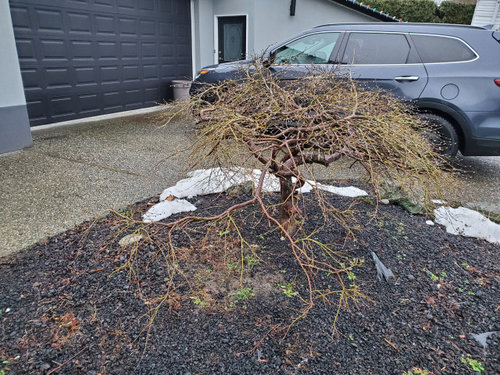
We moved into a "new" house last year and instantly fell in love with this little japanese maple. I love all its twists and turns but I assume something like this needs a little more attention than I'm accustomed to giving a tree. I know this isn't a bonsai but I'm assuming some of the same pruning principals would apply?
Confession, I have never pruned a tree, we've always just let them do their own thing.
What does this need to keep it healthy and looking good?

Comments (29)

  • 6 years ago

    I was trying to find a picture of it leafed out but I think this is the best I can do. I could have sworn I took a picture in the fall when it was red but I guess not.

  • 6 years ago

    Japanese maples of this age and form need almost NO pruning attention!! Just the removal of any dead wood and the very occasional thinning of small branches forming the canopy to reduce the possibility of damaging snow loads.

    Just keep cultivation of anything in the root zone to a minimum. JM's have a very surface oriented root system and react very poorly to root disturbance. My choice is a low growing evergreen ground cover....or just a layer of mulch.

  • 6 years ago

    Thank you! I was concerned about with our recent snow. How do I choose which small branches should go? Probably a stupid question, but total newbie here. I think I would l like to be able to see a bit more of the structure when it has leaves, I thought it looked quite heavy last summer

  • 6 years ago

    For the weeping forms like yours, you shouldn't be able to see any of the structure in season. Ideally it will have branches cascading all the way to the ground and in full leaf, you should not be seeing any wood :-)

    Appreciation of the structure is saved for winter when the lack of any foliage shows off the growth habit and its sculptural qualities. And I see no obvious need for any thinning at this point in time. Both the leafed canopy and the branch structure do not look overly dense or congested.

    If a total newbie, I'd suggest you look into some pruning classes. Not sure of your location but here, most nurseries offer free ones in early spring, some even focusing on specific plant types, like fruit trees or Japanese maples. Pruning is as much of a science as it is an art form and knowing how and when and what to prune makes all the difference between an attractive and structurally sound plant and one that has just experienced a cheap and dirty, half-a**ed haircut :-))

    It is my firm belief that no pruners/secateurs should be sold without a license to prune. More plant abominations are created by unskilled pruning than just about any other gardening mistake.

    Terra S. thanked gardengal48 (PNW Z8/9)
  • 6 years ago

    Lol! Fair enough. I will take a look around for pruning classes (I'm in SW British Columbia)

  • 6 years ago

    Could we get a picture of the top taken from above? Seems like there might be a lot of crossing branches there, towards the apex of the tree.

    Are some of the lower branches's tips contacting the ground or will they do so during the next growing season? I don't think that is a good thing

  • 6 years ago

    Why do you think it's a bad thing for branches to touch the ground, val? I don't grow JMs but ime the most attractive are those left to grow naturally. I find the one in the picture to already be showing signs of having been trimmed like an umbrella around the bottom, not to its advantage, imo.

  • 6 years ago

    I, on the other hand, prefer the open, layered look of Japanese maples typical in Japanese gardens. That requires removing growth from the lower side of branches so that the structure is in fact visible, and not a single "mop." But I wouldn't do it if you don't know what you're doing. It looks good to me now. Make sure your groundcover is in scale with a small tree to preserve the quasi-bonsai effect.

  • 6 years ago

    ^^ Exactly, floral!! That little tree has already experienced some malpruning via lifting its skirts :-) A weeping laceleaf of that size should naturally have skirts that touch the ground.

    And this type of tree will always have a number of crossing branches forming its canopy, In fact, they typically layer one on top of another.....but that is a desired and intended growth habit for this type of JM. Removing all crossing branches would scalp the tree!!

    Comments like these make me wonder just how much experience one has in growing and training JM's.........

  • PRO
    6 years ago

    Though we're calling it a "tree," this plant is in the shrub form (with foliage to the ground) and would seem better left that way. It would make better sense to make trees out of the larger type Japanese males -- that one can walk under -- and leave the shrub kind to grow naturally, with their foliage sweeping the ground. Even so, the shrub type can become quite large. You can re-evaluate it down the road when outgrowing its spot seems imminent.

  • 6 years ago

    kitasei, some weeping laceleafs are pruned like that.......many others are not. It depends on the selection/cultivar and how/where it was grafted. And also on how it was trained. A great many laceleafs will never achieve that layered look regardless of how much pruning is done. I would include this little tree as as one of those. It just does not have a physical structure that lends itself to that pruning style.

  • 6 years ago

    Since it has a single, clear trunk before higher branching, this is indeed a tree.....just a very short stubby one (height alone does not distinguish a tree from a shrub - that is dependent on other characteristics). As are many other cultivars of Japanese maples. Not all that many will ever grow large enough to walk under.......the number of cultivars that ever exceed 15-20' are limited.

  • 6 years ago

    Yep, it's a tree. A small one, but still a tree.

  • 6 years ago

    Thanks all, so much to consider.
    while I love how it looks in the winter I don't love the umbrella look. I'll let it fill in and lengthen the "skirt" and go from there.

  • 6 years ago

    FloralFloral_uk I am just repeating what Cass Turnbull teaches.

    I don't know why she says that but if I was asked to make assumptions it would be to limit the spread of diseases onto the tree, including by way of a lot more bugs being able to get directly into the foliage instead of having to climb the trunk and branches to get to it.

    It may seem it has been mal-pruned at the bottom but nobody here is addressing the lack of branches on the lower side towards the lawn, and the surplus of branches on the opposite side.

    Also I've never pruned a laceleaf JM or been the caregiver of one.


  • PRO
    6 years ago

    But that's semantics, Functionally, it acts as a shrub.

  • 6 years ago

    Interesting read on The Art of pruning this type of weeping Japanese maple. That is all fine and good in the hands of a skilled Japanese gardener in a classic Japanese garden where the tree is given ample room to grow. In the real world where many of these get planted between the house and front walk with a lot of other plants or in this case in the corner between the drive and front walk, pruning considerations make take a turn to the non-art as the bush tree starts to grow over the walk, driveway or other plants.

    So yes keep pruning to a minimum. Start by removing any dead branches from the interior. Dead branches will tend to look a light grey compared to live wood. If you do need to cut stems spilling over the walk or driveway follow them back to where they attach on the branch and cut flush with the adjoining branch at the base of the stem you want to remove. You don't want to leave branch stubs.

    Because your tree is wedged in a corner you may need to prune a little on the lawn side for balance so the bush tree doesn't get lop sided if that look would bother you.

    As for lifting the skirt, I don't see the need here. When they are next to and close to other plants, you might have to.

  • 6 years ago

    Because it's dead of winter and I'm starved for conversation, I'll take up Yardvaark's gauntlet. I think if a compact japanese maple is a mop, yes it does function as a shrub. That is, a blob. So the question is whether that is what you want, or a more architectural specimen. A bush can be a functional tree, as when pruned to be a standard or multi-stemmed form. So if a plant offers you a choice to go either way (or no choice), make your decision based on how you see it fitting into the larger composition. For this we need a broader photo.

    As for the tips grazing the ground, I would like to know the answer to that myself. I am a devotee of Cass Turnbull myself (so enlightening about how different species respond to different cuts!) and I do remember her saying this. I have a laceleaf Japanese maple that not only grazes the ground, it is a foot prostrate on the grass and growing. It concerns me, but I also observe how many of the most beautiful weeper do the same - beeches, hemlocks, spruces, etc.

    If you are concerned about crossing or touching branches, you can keep them separated with some kind of spacer. It should be soft enough not to injure the bark. I just watched Monty Don's program on Japanese gardens. Now there's an example of this art!


  • 6 years ago

    The issue of the draping skirts only arises if the branches in question lay along the ground....there is none if they only "kiss" or brush the ground. But what you do not want is a lollipop or umbrella of foliage perched on a bare stalk :-) In leaf, the base of the trunk should not be obviously visible. As Cass described it, these types of maples should be 'shells' or trained/pruned so that the canopy forms a thin dish or shell-like covering over the entire structure.

    btw, I actually knew Cass and benefited from some direct pruning instruction from her when I attended hort school. She alone has been responsible for more excellent pruning advice and wisdom being dispensed than just about anyone else I can name.

  • 6 years ago

    Who knew my little tree shrub Japanese Maple would generate such discussion!?


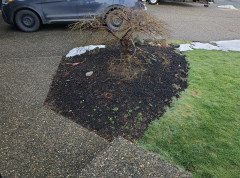
    I took a few more pics from further out, I don't think its at risk of outgrowing its spot any time soon. I tried to figure out how long it has been there by going into my city's historical arial maps and it was for sure here in 2003 but anything older than that is too blurry to tell. The house "appears" in 1992 but that is about it for detail back then.


    I've gone out and snapped off anything grey and tried to untangle some of the smaller, bendy, overlapping branches. None of the branches are currently on the ground but when they are and I want to avoid trailing, the proper way to trim them is to follow it back to a fork and cut there, yes? I HATE the hard cut line I often see on the bottom of these and want to avoid that. (all previous skirt lifting and franken-pruning was done by previous owner)


    It does have a pretty significant bare area facing the house, does it make any sense to wire some adjacent younger branches to head in that direction?


    We also plan to add another walk mirroring the existing and join up at the bottom stair. At that point we will clean up the planting area and likely have nothing but the JM here, maybe a few interesting rocks.


  • 6 years ago
    last modified: 6 years ago

    Back in the ~early days I was made a Life Member of Plant Amnesty for my contributions to the promotion of better gardening practices. What turned out unfortunately to be the last time I saw her before she passed Cass paid me to identify some shrubs in a local heritage garden she was trying to see preserved. When I arrived at the organized gathering held In her memory at a local college auditorium it was standing room only.

    Anyway the thing about weeping lace leaf Japanese maples is that - except where they have been trained through the use of staking to have an elevated crown, or are old enough to have produced one on their own - when in frequently quite dense leaf they function as foliage plants. But when bare during winter their often tree shaped architecture becomes visible. So whether they read as a tree or not often depends on the time of year.

    Otherwise it is a matter of which concept of tree hood a body ascribes to, that is one where it's a tree if the woody plant is above a certain height or the one (gone with in my preceding remarks) where it's seen as a tree if it has a certain shape, regardless of how big (or small) it is.


  • 6 years ago
    last modified: 6 years ago

    kitaseiI find the weeping form of Japanese maple rather blob like too. The Western mind might not know how to place that shape. The foliage of course more than compensates for the blob.

    Tree, shrub, blob, whatever, for the purpose of pruning, it needs to be respected as the tree that it is.

    "what you do not want is a lollipop or umbrella of foliage perched on a bare stalk :-)" Got it. That would be bad form period.

  • 6 years ago

    Can someone post a picture showing a compact weeping Japanese Maple in blob form as an asset in a landscape?

  • 6 years ago
    last modified: 6 years ago

    I can show you my "compact weeping Japanese Maple in blob form." This is 'Kigiri Nishiki' bought as a second year graft and is now eight years old. There are bound to be a number of opinions on whether or not it is an asset in this landscape. To a certain extent the landscape was designed around the JM. This picture is in fresh spring growth showing the setting on the edge of the septic tank, the shores of Turd Blossom Lake.


    This is 'Kigiri Nishiki' today showing the branch structure. The entire tree is growing east towards the sun. Just a jump to the west is tall forest. It is under light bondage, mainly an effort to lift the branches off the ground. I don't think I can or really care enough to try and force it to grow west. There are a lot of other tall herbaceous plants in that bed. I have considered training a taller leader and never gotten around to it. At this point it is only about a foot tall. Eight years! I should live long enough.


  • 6 years ago


    I have one of these lace leaf maples and I prune it at least once a year because I’m not a fan of the Cousin IT look where i have the tree planted near my pond and not surrounded by other plantings. Mine grows quite fast, so can quickly “revert” back if left alone for too long. The process I follow….

    • I prune once it leafs out. Pruning in the winter doesn't work for me since I can't see what they heck I'm doing and would be guessing.
    • I try to break the tree into different sections to prune them into separate “clouds” or “fans" with a bit of visual separation between each one. This makes it not look like a single blob.The branch structure tells you where the “clouds" will be. So you get big “clouds" on the bottom and then staggering medium to small ones as you go up. The main trunk and branches can only be seen underneath the “clouds".
    • I prune a bit and the step back to look … constantly. Gluing branches back on doesn’t work too well. You can always prune a bit and then come back later.
    • In my area any branches exposed to direct sun will scald over the summer. Because of that, I don’t remove anything on top of any lateral branches or top crown. Leaves always protect the main structure. So you end up pruning the bottom skirt of each individual “cloud” to separate it from the one below it.
    • I get under the main skirt to remove branches to get it off the ground. Depending on the form of the “clouds”, I will prune different areas higher up to give more visual interest so the whole thing isn’t evenly trimmed off the ground all the way around…. Making it look like Cousin IT.

    Early on when I first began pruning… I use to go overboard… but after half a season … it starts to fill back in and I could try again. Just don’t go crazy and have some pruning fun (being light handed!)

  • 6 years ago

    I went through the tree a couple of times this weekend and got rid of all the dead stuff. There was a lot more of it than I thought but it was the perfect time to see it easily, buds are swelling so if a branch was empty I gave it a gentle bend and the dead ones just snapped.
    I think just spending time getting in there helped me to see where things might need thinning down the road and where I might be able to train branches to fill in the naked spot. Time well spent!
    Now I want to go out and clean up all the trees and bushes in my yard!

  • 6 years ago

    The weeping lace-leaf maple and white gravel in the one picture look completely out of context in front of that naturalistic woodland backdrop. Also the maple is not yet big enough to be in scale with the space defined by the bed edging around it - and won't be for decades.

    I have considered training a taller leader

    That would help, by making the specimen look taller and more dominant.

  • 6 years ago
    last modified: 6 years ago

    No lakes or ponds or blobs allowed in the forest eh? The turd box directly below that tableau is an actual requirement to live in the forest. At least my sweet baby Japanese maple doesn't have scale. I got time.