Software
Houzz Logo Print
jjsage

Money Tree- yellow/brown leaves?

6 years ago
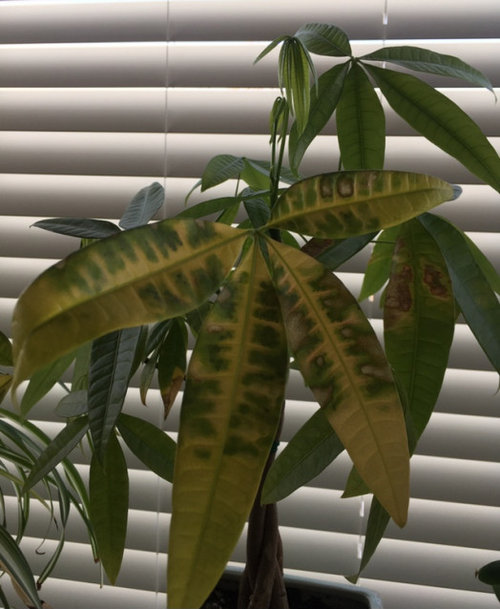
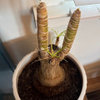
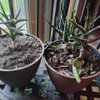
Does anyone have any idea what is going on here with my pachira money tree? I have had it for a few years and it was fine until a few months after I repotted it. It is still producing new leaves but the older ones get really big and then do this and then fall off. Ahhh! Any ideas? Thanks!


Comments (14)

  • 6 years ago

    Following as mine is doing the extact same thing and it's about 3yrs old too. Hope someone has the answer...

  • 6 years ago

    Need to know more details re how you went about repotting; and, did you really repot (includes bare-rooting and root pruning) or just pot up? How much larger was the pot you used when you repotted/potted up? What type or brand of medium did you use? Does your pot have a hole in it? Is your pot in another cache pot, or, does it sit inside a collection saucer? Is your plant allowed to sit in the effluent (at the bottom of a cache pot or collection saucer) that exits the drain hole? What about your fertilizing program - please describe it. Was the plant outdoors for the summer? Has the light level it was acclimated to changed significantly within the last several months? Are you using 'softened' water to water with?

    Al

    jjsage thanked tapla (mid-Michigan, USDA z5b-6a)
  • 6 years ago

    Thank you for your response Al. I only potted this plant up from a 4 in pot to a 5 in pot. I did not mess with the root system. Both pots are ceramic. There is a drainage hole and a saucer underneath which I empty quickly of any excess water. It is in the same spot that it has always been in. The soil is store bought fertilome that was labeled well draining. Over the summer I fertilized it with kelp every other week or so but right now it’s just getting watered when the soil is dry- I stick a long wood skewer in. It seems like it has been getting watered about once a week. I wonder if that has been too much but my house is so dry and the soil has been getting dry. Maybe it’s under watered. I’ve probably backed off of the watering since this started bc I think yellow felt like overwatering to me- although I know that’s not always the case. It is close to a heating vent but it always has been. I am not using softened water. It is not in another cache pot- just potted in the ceramic as it was in the last one. This plant did not go out for the summer- it’s been in its same spot. Does it seem like a pest or more like a cultural problem? Thanks again!

  • 6 years ago

    My money plant lasted about 3 1/2 years and then died; tried saving it, but no luck. Won't invest in another one.


  • 6 years ago

    Oh wow- thanks WalnutCreek. Maybe it’s just done!

  • 6 years ago

    Thank you gardengal for your answer! The plant is in front of a big bright window- I closed the blinds in order to get a better pic. I will look into the fertilizer. Do you think I should repot it with different soil?

  • 6 years ago

    My money plant lasted about 3 1/2 years and then died; tried saving it, but no luck. Won't invest in another one. When someone purchases a perennial plant (like a tree) in a pot or establishes a perennial planting, that someone assumes entirely the responsibility for the well-being of the plant(s) in the planting. If the plant dies or grows weak, it is the grower's responsibility.


    JJ - I agree with Pam in that it's not unusual for Pachira to shed some older leaves in the cool dark months.. I also agree that the seaweed as fertilizer strategy could be improved upon by changing to a soluble synthetic, and the best I've found for the largest fraction of houseplants is Foliage-Pro 9-3-6. It has every element essential to normal growth in an appropriate ratio.

    If you're using a "tell" effectively to determine what interval is appropriate between waterings, please don't break that habit. Let me know if you want me to post more about using a "tell".

    If it was my plant, I would skip the seaweed and go to the FP 9-3-6. Fertilize at full recommended strength all year; or, if you like, use half strength in the cool low light months. I would fertilize every 4th time I water. To keep track of many plants, drop a marble or plastic bottle cap in the pot each time you water. Tying fertilizer frequency to the number of times you water makes much better sense than trying to fertilize by the calendar, this, because you might water 3-4X more frequently in the summer than in the winter. If you're flushing the soil when you water, and you should be, nutrients are washed out of the soil faster when you're watering more often, so they need to be replenished more often. Instead of just watering when the 4th interval is at an end, Flush the soil well, allow it to drain, then fertigate (apply a fertilizer solution when you irrigate). "Do you think I should repot it with different soil?" Best would be to repot in mid-late spring (mid Apr - early Jun) using a medium you can water to beyond the point of complete soil saturation, at will, w/o the need to worry your chosen soil will remain soggy for an extended period - impeding normal root function or or setting the table for root diseases of the fungal variety. If you don't think that's possible, you can do a work-around that will limit the plantings ability to hold excess water. Learning to avoid being in constant battle with your medium for control over your plants' vitality is the largest step forward you can make as a container gardener, so you'll not be doing yourself a favor if you skip lightly past that consideration.

    Al

    jjsage thanked tapla (mid-Michigan, USDA z5b-6a)
  • 6 years ago

    @tapla (mid-Michigan, USDA z5b-6a):

    My money plant lasted about 3 1/2 years and then died; tried saving it, but no luck. Won't invest in another one. When someone purchases a perennial plant (like a tree) in a pot or establishes a perennial planting, that someone assumes entirely the responsibility for the well-being of the plant(s) in the planting. If the plant dies or grows weak, it is the grower's responsibility.


    You are absolutely correct. What was the point of your comment?

    jjsage thanked WalnutCreek Zone 7b/8a
  • 6 years ago

    Although it may not have been intentional, your comment implied that these plants had a naturally short lifespan and would simply keel over from "old age" at some point in time. Al was only pointing out that the "keeling over" is due to the gardener/caretaker, not a characteristic of the plant itself.

    jjsage thanked gardengal48 (PNW Z8/9)
  • 6 years ago
    last modified: 6 years ago

    WC - Pam said much of what I will add in this offering. I have a formula I use to decide whether or not to reply to info posted by others. If I see misinformation with no or exceedingly little potential to confuse or do harm, I generally skip any sort of reply. When I see the gist of someone's comment has the potential to be misinterpreted or detract from the growing experience of others, I often offer an alternate point of view. When I read that you wouldn't invest in another one, I didn't want the OP to think the plant had idiosyncrasies that somehow made it challenging to maintain in a high state of vitality. It's actually a very easy plant to grow, nothing inherently difficult about it, and the cause for your plant's demise would be attributable to grower error rather than something like an internal time bomb that innately causes it to self destruct after 3.5 years in a grower's care. In short, I was reassuring others they needn't be particularly worried that your experience with the plant would be mirrored in theirs. I hope that sounds fair enough. Have a good weekend. Chilly here, 20*F.

    Al

    jjsage thanked tapla (mid-Michigan, USDA z5b-6a)
  • 6 years ago

    I understand, now. Thanks for the replies. I did not mean to imply the plant was at fault, but on rereading what I said, I can see that it could read to a wrong impression. Thank you both for clearing that up for me, as well as all the other readers of this thread.

    jjsage thanked WalnutCreek Zone 7b/8a
  • 6 years ago

    Thank you all so much for your input. I appreciate It all. I have been looking into some synthetic fertilizers. For many years I had a cat that I adored that chewed on plants. I was always very conscientious about using fertilizers that were safe for her. Hence, the kelp. Sadly she is no longer around for me to yell at to get away from my plants! Now I’m looking into some other options. I do feel like the soil that I am using is well draining but I’ll perhaps change the soil this spring/summer. Could it possibly be something that would spread other plants? Should I isolate it? From the conversation thus far, it seems that is not the consensus. It seems that you all feel that it is cultural and it seems that way to me too. I could see it being a lack of nutrients or a problem with the soil/drainage. Thank you all for the respectful conversation. Your input has been so helpful!

  • 6 years ago

    There's no question, if the plant's sole source of nutrition has been the seaweed product, there are nutritional deficiencies, a high probability there are nutritional disorders related to skewed nutrient ratios - which carries with it the potential for toxicities (depending on your watering habits). Also, "organic" fertilizers and soil amendments in no way ensure the product is any safer than, say, Miracle Grow soluble synthetic of Foliage-Pro 9-3-6. The product "Milorganite", which is made with human waste products produced by the good citizens of Milwaukee, WI, is very high in heavy metals.

    Based on what I'm seeing, I don't think it's anything you need to be concerned about spreading to other plants because there is likely no biotic pathogen TO spread; however, if your care regimen is pretty much the same for all plants across the board, it wouldn't be unreasonable to think other of your plants might be similarly limited by cultural conditions at or near the limits the plant is genetically programmed to tolerate.

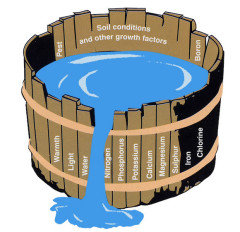
    In the end, our only job as growers is to identify and to the greatest degree possible eliminate those factors that are limiting. Unfortunately, there is something called Liebig's Law of the Minimum. It goes something like - It is only the most limiting factor that limits the plants ability to function normally, but, when you fix the most limiting limiting factor, what would have been the second most limiting factor takes the place of the first. So, if a lack of nitrogen is the most limiting factor, and you fix that, a lack of magnesium or over-watering or not enough light becomes the most limiting. Liebig's Law of the Minimum is most often illustrated with an image of a wooden barrel with staves of varying lengths.


    ..... hard to tell from the perspective, but it looks like when the nitrogen deficiency is fixed, 'temperature' is set to take over the dubious title of 'most limiting'.

    Don't despair though. If you get to the place where you're using a soil that allows you to water to beyond the point of total soil saturation, so the entire soil mass is moistened and at least 15-20 % of the total volume of water you applied exits the pot, and this, without need for concern the soil will remain saturated for an extended period, limiting normal root and potentially wreaking havoc with root health, maintaining an exceptionally sound nutrient supplementation regimen becomes monkey-easy and requires use of only 1 product.

    Al

Sponsored
Mary Shipley Interiors
Average rating: 4.8 out of 5 stars34 Reviews
Columbus OH Premier Interior Designer 10x Best of Houzz