Software
Houzz Logo Print
lomoyer

Blustar 48" Range - Need help customizing from current owners

6 years ago

I think I've decided on the Blustar 48" range for my kitchen remodel (would prefer separate wall oven but don't have the wall space). I am looking for advice on the following:

1. I want an integrated griddle so that rules out the Platinum line, any opinions on this good or bad?

2. Can't decide if I want a 12" or 24" griddle. Thinking I rarely need more than 4 burners and I could always slide a pot onto the griddle to keep it warm. Opinions?

3. Is the oven preheat stage very long without the PowrX option in the Platinum?

4. Anything you don't like about this setup if you currently own it?

Thanks for your help!

Comments (11)

  • 6 years ago

    Are you also planning the required mega ventilation and make up air?


    Skip a griddle. Get a stovetop one that you can actually clean.

  • 6 years ago
    last modified: 6 years ago

    I'm going to suggest you select the BS 36" rangetop with a double wall oven configuration. It's the best bang for the buck. You can always use a drop in griddle/grill or get the Platinum model. If you have room for a 48" range, you have room for this set up. It is more versatile and the ventilation cost savings are significant.

  • 6 years ago

    Is venting for the 48" really that expensive?

  • 6 years ago
    last modified: 6 years ago

    Yes. If you need locality approved heated make up air, it’s often more expensive than the range. At a minimum, the right ventilation for a huge range comes with an equal price tag as a budgetary place holder. Effectiveness comes at a premium, no matter what. That assumes you don’t want an ugly jet plane sounding actual commercial vent above it. Quietness and prettiness comes at a premium too.

  • 6 years ago

    How do you use your griddle now or how would you use it?

    Advantages to a built in griddle

    You can turn it on to the same setting and get the same temperature each time.

    You would have a little more stability.


    Advantages to an add on griddle.

    You can use different metals. Aluminum when you want more even heating, like grilled sandwiches. There are are nonstick aluminum griddles. You can use steel when you want that. It seasons like cast iron.

    The 15”x23” 2 burner griddle that Royal Industries has is about 50% bigger in surface area than the built ins.

    You have at least twice as many BTUs as the built in. You can also use low heat on one end and high on the other end.

    You can position the griddle anywhere you want on the burners or have all burners. I have moved the griddle into the oven at times to hold or cooked with it in the oven because of the size.

    You can take it off to wash.


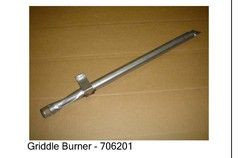
    If you really want a built in and it is important, consider Wolf. This is the burner on the BS.

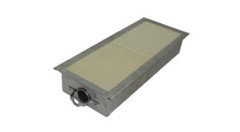
    The Wolf has an infrared element under their griddle for more even heating. .

    They are both steel and season but the Wolf is twice as thick as BS.

    These are the Royal Industry griddles.


    http://royalindustriesinc.com/index.php?main_page=index&cPath=4_22_48

    These are the Chef King griddles.

    https://www.dvorsons.com/ChefKing/Griddles.htm

  • 6 years ago

    Welcome to the Bluestar family!


    1. I want an integrated griddle so that rules out the Platinum line, any opinions on this good or bad?

    I love my RNB. I upgraded all front burners to 27.5k, can’t go back to regular gas stove 15k burners anymore, whether it be wolf, thermador, whoever.

    2. Can't decide if I want a 12" or 24" griddle. Thinking I rarely need more than 4 burners and I could always slide a pot onto the griddle to keep it warm. Opinions?

    My opinion, 24” griddle for home is overkill.

    3. Is the oven preheat stage very long without the PowrX option in the Platinum?

    Oven preheat is pretty fast in my opinion. One interesting thing I learned is the preheat between the large and small oven is nearly identical. Didn’t expect that.

    4. Anything you don't like about this setup if you currently own it?

    I don’t have the built in griddle, I like all burners for woks and large pans. It’s pretty easy to take up all the spaces on a 48” range with one large wok and a few pans simmering away. Griddles are nice, I don’t like how the built in ones look after heavy use. I’ve worked in enough restaurants, you won’t catch me scraping a griddle any time soon!

    Bonus: high $$$ of make up air depends on your location, and some mystery element I haven’t figured out yet based on the astronomical prices some here quote on MUA packages. When we are talking 10-15k ranges, paired with 3k-5k ventilation systems, the cost of MUA is negligible. I live in SoCal and didn’t need heated MUA. My MUA system for a 1500cfm hood was about $600. If heated, I think I was looking at double that cost.

  • 6 years ago

    high $$$ of make up air depends on your location, and some mystery element I haven’t figured out yet … I live in SoCal

    And there is your answer. I was surprised to discover that, while California is usually one of the stricter states with regards to building codes, it is one of the very few states that don't have any requirements for make up air. I guess, the moderate climate helps and everybody permanently lives half-way outdoors anyway. So, windows and doors are all open the entire year.

  • 6 years ago

    M, my MUA system is rated at about 1100 cfm, and consists of a Broan damper and inline blower. These systems are so simple I find it hard to believe the cost would be much greater in other parts of the country (unless you had to heat the air) but figured I would clarify my location Incase I am missing something. The way I have my MUA routed, there would never be a need to condition the air anyway since it never gets a chance to circulate in the rest of the house.

  • 6 years ago

    I have a 48 inch RNB and I love it! My configuration is 6 burners and a grill.

    I went with a grill because I figured it would be more useful than a 7th and 8th burner and I could always turn burners to a griddle with an overlay, but could not turn them into a grill. Not sure I made the right decision - the grill seems a bit underpowered, though that could be due to the fact there is no lid to close when cooking/heating. It works well for grilling more medium heat foods like fish, shrimp, thinner cuts of chicken breast, etc. However, the broiler (which is the one thing I did not think much about during my research) is just absolutely incredible, further marginalizing the grill.

    I would probably do a 12 inch griddle if I could do it over.

    For the ovens, I have found the pre-heat times to be fine and to my surprise, I use the smaller oven far more often (family of 4), really only needing the large oven if having company. The small oven fits a half baking sheet perfectly.

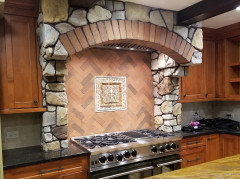
    Ventilation - The vent hood insert cost me around $1500 and then heated MUA plus install was another $5k. Well, maybe it was much more than that if you count the stone work. ;-)

    Blue Star color is olive drab.

  • 6 years ago

    Dumping freezing air into the kitchen, no matter how arraigned (assuming the arrangement is appropriate for the needs of proper MUA) will chill the kitchen down quickly. In such climates, electrical or hydronic heating of the MUA is needed. Neither of these is inherently highly expensive though at the 1000 CFM level, depending on how much one depends on others to do the conception, implementation, and testing.

    Complexity can occur when the MUA has to deal with multiple exhausts; i.e., a condition where the needed MUA flow cannot be predicted from a single blower's power setting, current, or duct air flow. Then it may be necessary to control a blower based on differential pressure. The whole issue is simplified if passive MUA can be used, and this depends on presence or not of combustion appliances that don't have their own MUA source.

    On top of that, MUA is rarely designed into a residence ab initio. Air sourcing, ducting, HVAC mechanical placement, and air release into the kitchen such as to minimize drafts at the hood can all play a role in complicating the system and hence adding cost.