Software
Houzz Logo Print
dmacsimus66

Cloning a Grafted Tree Question

6 years ago

Hello peeps, I have a Keith Davey variety Pistach tree in my back yard, and I'm wanting to clone it to have another exact same tree. I have read up on cloning trees by using rooting products, i.e , such as "Clonex", and making tree clones from small branch cuttings from a tree etc. However, I do not know what the cloned tree would be, if it was cloned from a "Grafted tree", which the Keith Davey variety is. With that all said, does anyone know if the cloned tree from the grafted tree would be identical, i.e. male etc? thank you.

Comments (39)

  • PRO
    6 years ago
    last modified: 6 years ago

    In grafted trees, the rootstocks are not clones. They're grown from seed. The grafted/upper portion is cloned. If you made a new tree of it, it will be the same as the original tree. Just don't clone the roots of a grafted tree or you'll have a copy/clone of an unnamed seedling tree that no one wants, except to use as root stock.

  • 6 years ago

    Cool, ok thanks for the info. Going to clone one today. cheers

  • 6 years ago
    last modified: 6 years ago

    Rooted cuttings are identical clones, environmental conditions permitting. The reason your tree is grafted is because that is a more successful way to propagate this tree than by rooting stem cuttings most likely. You may need to learn how to graft.

    That said, if you can buy another grafted 'Keith Davey' Pistach tree, it should also be an identical clone of the tree in your back yard.

  • PRO
    6 years ago

    Grafting is the preferred method of making cloned trees commercially because it is cheap and efficient. Imagine that you have a new, outstanding tree that will be named and introduced to market. There is only one of this tree in the whole world. How will you mass produce it and get it on the market quickly? If you take cuttings, there might only be 300 available per year before the tree is decimated. On the other hand, there might be 10,000 individual buds that could be had from the same tree. There would also be millions of seeds available from any number of "no name" trees of the same species. If you sprout 10,000 of those seeds to grow for root stock, you will have same-species material to which you can graft buds of the new, named tree, thereby being able to produce thousands of clones from a single tree in one year. This procedure could be replicated exponentially with each passing year, for a quick, virtually unlimited supply of the original individual plant.

  • 6 years ago

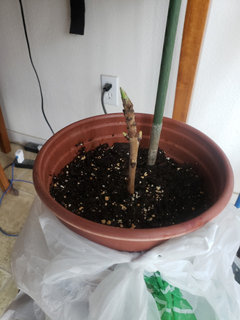
    It all makes sense, and very well explained. My attempt to clone; I have cut a small, straight piece of branch off the tree, prepared a 1 gal container with watered in miracle grow outdoor plant soil, scraped method used on lower section of branch cut, dipped in Clonex, firmly planted in container, watered in, and bagged with small vent. If I would have thought about it, I would have took some pics b4 I bagged it. I will try and remember to post updates. Hopefully it will work because the tree is an awesome one! Time will tell, and thanks again, all.

  • 6 years ago
    last modified: 6 years ago

    Many things are grafted because stem cuttings don't root well or easily and grafting is the only reliable way to propagate the clone - 'cultivar'. There are a number of reasons why grafting is a preferred method of propagation for some plants, most often trees.

  • 6 years ago

    Ok, there is a vent on the top of the bag, opposite side, and the 1 gal pot has drain holes at its bottom for very good drainage. I will try and only keep the soil damp. I have it close to my house, and off the ground in an attempt to keep it from freezing. ;) I'm also thinking of cloning a Scarlet Letter oak I have which I have posted on this website. Gorgeous Tree btw and would love another!

  • 6 years ago

    miracle grow outdoor plant soil


    ==>>> might not be the best media for rooting trees ... ken

  • 6 years ago

    Any sort of asexual propagation - cuttings, grafting, layering - will result in an exact clone of the mother plant. It is only when you grow from seed (sexual propagation) that you cannot control the outcome.

    A great many woody plants - trees and shrubs - can be grown from cuttings. But much like growing from seed, the conditions necessary for good rooting and growth will vary by species. You need to research by species the recommended methods as they can vary widely.

    There is a Plant Propagation forum here that might be of more help. And fwiw, pistache have a reputation of being difficult to grow from cutting. And you always want to take multiple cuttings as the failure rate for any sort of cuttings is often high.

  • PRO
    6 years ago

    Vent holes and drain holes do not guaranty that the soil is not too wet. Best to check with finger and adjust if needed.

    Also, cuttings generally do not like to be cold.

  • 6 years ago

    I thank each and everyone's response, for they all are welcomed information. This is my first attempt in trying to clone anything, and I have a lot to learn I'm sure. I will try and continue to keep this thread going of how this cloning venture turns out. :)

  • 6 years ago

    From the reference manual of woody plant propagation: (M. Dirr & C. Heuser jr)


    'Juvenility is a very important factor in rooting. Softwoods from one year old seedlings root 50-90% using May or June cuttings, 10 second dip in 5000 or 10,000 ppm IBA, coarse sand and mist.


    Good Luck! If these fail it won't be long before you can try some softwood cuttings.

    Keep us updated, very interesting to see others trying this sort of thing. You just never know when things will decide to root.


    I agree with GG, put as many cuttings in the pot as you can fit (1" apart?) that way if a small percentage roots, you'll at least get few that do. :-)

  • 6 years ago
    last modified: 6 years ago

    You cannot legally propagate patented plants until they are off patent. The royalties earned are what help hybridizes achieve enough success to keep developing new varieties. https://www.gardeningknowhow.com/garden-how-to/propagation/propgen/plant-patents-and-propagation.htm

  • 6 years ago

    'Keith Davey' pistache is not patented.......

  • 6 years ago

    Thank you Bill, will do. Live wire oak, ok, I hear that and I guess I will wait to continue in my cloning venture until the patent has expired. cheers to all.

  • 6 years ago

    I'll check on that gardengal48! Whew!

  • 6 years ago

    Yes you most certainly can propagate patented plants for personal use. You can't propagate them for sale without a contract to do so.

  • 6 years ago

    I suppose it would depend on when it was patented. According to the article linked to above, patents in the US span a 20 year period. Many of the Chinese pistache cultivars were patented back in the early 90's, so patents are now expired?

    There's also a 'research clause' that can be found in other articles on the www.

  • 6 years ago

    To be precise, plant patent laws do not make any distinction on who can or cannot propagate a patented plant or for what purpose. A home gardener cloning a patented plant is just as illegal an activity as a wholesale grower doing the same without permission and selling the result. It is just that home gardeners are unlikely to ever be prosecuted for such an activity.

    But it IS a matter of ethics.....and that does matter to many.

  • 6 years ago

    As this post veers off topic...……..The ethics of a home gardener propagating a patented plant for personal use is debatable. I wonder if that question has been legally answered under a fair use aspect. Has it? The ethics of plant patents in general is also debatable and is hot topic in some circles particularly as greed takes hold on far reaching plant patent claims.

    I found two white flowered Spirea japonica seedlings in my garden. Monrovia has a patent pending on a white flowered one, trade marked named of course, 'Yeti'. Can I patent my found white flowered spirea? Who gets to patent nature?

    https://www.monrovia.com/plant-catalog/plants/6267/yeti-japanese-spirea/

  • 6 years ago
    last modified: 6 years ago

    Aside from the fact that propagating patented plants without permission is essentially stealing and therefore emphatically unethical, this is a very appropriate and on-topic discussion to have regarding plant propagation.

    And if you look at what is involved in applying for and being granted a plant patent, it is pretty specific. And also expensive. The vast majority are not patenting "nature" but a carefully selected and highly bred intentional product via a process that is expressly reserved for "new" and unique" varieties. White flowered spiraea seedlings you find in your garden are just that....white flowered spiraeas and a dime a dozen....unless they have a unique and distinct characteristic that puts them apart from all others.

    btw, it is not Monrovia's patent....Conard-Pyle is the patent holder.

  • 6 years ago

    If the one I bought was a "Pearl Street" Pistache, than it looks like it would be until Aug, 15th, 2025 until it can be cloned without violating its patented rights. I have no idea what the name mine was, except it was called a Keith Davey Pistache which was and still is, very purdy. Thanks everyone, and I didn't mean to start a conflicting discussion, nor violate and patents. What's 5 years.... ;)

  • 6 years ago

    The name on yours is just as you stated........Pistacia chinensis 'Keith Davey'. And that particular cultivar has never been patented (introduced to the trade in 1958).

    'Pearl Street' was granted patent approval in 1995....so the patent should already have expired.

  • 6 years ago

    Than it's a done deal then. Gonna try and clone that bad boy then. Thanks all, and I will try and update any progress. thanks all!

  • 6 years ago
    last modified: 6 years ago

    'I didn't mean to start a conflicting discussion'

    Ooh, don't worry, that's just when it get's exciting. :0)

  • 6 years ago

    LoL ;)

  • 6 years ago
    last modified: 6 years ago

    Patents on plant tissue of all kinds are not confined to ornamental horticulture. With agriculture it generates another ballpark of ethical and political considerations. Plants are not the only biological processes and organisms that are being patented with all the new biotechnology these days. Nothing new to see here, nature has always been a commodity.

    I don’t disagree with what you wrote gardengal. I’m not from Mars. I am a product of and live in this culture. What you wrote prioritized the business interests involved over the plant and human interests involved in the relationship. As we plunge head first into the sixth mass extinction on planet earth it should be obvious Homo sapiens’ relationship with the natural world is unbalanced and needs to be reexamined.

    In the situation of a gardener propagating patented plants for personal use, the answer is no, I will not allow any business interest or act of commerce to steal my propagation knowledge from me and turn my use and personal relationship with the life forces of nature into a criminal act. Period. There is no exception for the business of horticulture. The interests of commerce have no priority and little value in my garden. Those are the priorities that got us in to this mess. Put another way, there will be no money changers in my temple. Those are the ethics that guide my decision in this instance. TS to the patent owner.

    Obviously a patent on the ‘Yeti’ is not of earth shattering consequences. I don’t wantonly propagate patented plants just to be mean. I wanted a summer blooming (hence Spirea japonica) white spirea for my Wedding Cake garden. I was ready to buy the ‘Yeti’ in bulk. It couldn’t be found. This plant had to be a joke of some sort.

    A couple months later I find some white Spirea japonica seedlings in the garden. Seriously? This must be a joke. How hard could it be to have a white, summer blooming Spirea japonica in the trade when they are showing up unwanted in the garden? And they couldn’t find the ‘Yeti’.

    Are you sure a white S. japonica seedling is a dime a dozen? There are plenty of other species of white, spring blooming spirea of course. I wanted summer bloomers. I have my seedlings tagged for observation. They come from round compact parents so that is a good start. One had remnant pink flowers in the head. It might be a keeper to patent. I can call it ‘Abominable’.

  • 6 years ago

    Christopher, when you say you have white S japonica seedlings do you mean seedlings from a white japonica, colour as yet unknown, or seedlings from a japonica which have already flowered white?

  • 6 years ago

    Floral, these are white flowered seedlings, all ready bloomed, from normal pink S. japonica parents. Most of the seedlings get pulled before they have a chance to bloom. I actually find this spirea to be a bit of a pest because it self sows so much.

  • 6 years ago

    I see. Thanks.

  • 6 years ago

    a bit of a pest because it self sows so much

    No argument there, I posted about that on the shrubs forum. What I don't understand is why make a lengthy post about an introduced, weedy plant having nothing to do with the OP? Why be preoccupied with a patent issue having no relevance to the OP?

    A better way to handle that is to make a different post on the appropriate forum like I did HERE

  • 6 years ago

    Thanks for the direction sam_md. Nice to see my lengthy off topic comment about propagation and patents in this post prompted you to make a brand new post on a non-native invasive, many of which are likely to be patented. That might be an interesting topic for a new post, the patenting of non-native invasives and the ethics surrounding that.

  • 6 years ago

    Clonal rootstocks are also used to grow grafted plants in production nurseries, a plant having been used as rootstock does not automatically mean it was seed raised. Orchard fruit cultivars for example are often grafted on named rootstock selections. As are many rose varieties, and so on.

  • 6 years ago

    Thank you for the further information Embothrium. Much appreciated.

  • 6 years ago

    Update 2-22-2020, it appears the cloned small branch is budding out, so I'm assuming it has/is rooting and will be successful. I will try and continue to provide updates. Thanks again for all of the replies! I think I'll have a cup of tea now for we're actually getting some rain in Cali and it's a good day for a cup! Cheers!

  • 6 years ago

    Not until you can see roots, a bit of green doesn't not guarantee that this is successful.

    It might be easier to air layer it or they call marcotting. Keep doming the cuttings though as the moisture might help the cuttings to succeed.

    Grafting, airlayering or layering, taking cuttings all guarantee exact clones. Some plants are easier to take at certain times of the year and there are hard wood, soft wood and semi to take .. Don't feel bad when your effort doesn't come to fruition. It's not an easy art! Hope the last photoed cutting is rooting.

  • 6 years ago

    Yes, don't count your chickens yet. A twig will bud out in a vase of water but that doesn't necessarily mean it has roots. Be patient. Cuttings can take weeks or months to root. Put the bag back on it. As others have said it pays to take multiple cuttings to allow for failures.

  • 6 years ago

    update, actually on around 4-15-2020. It failed to root. I'm looking for another attempt, but possible with something else. ;)