My builder uses Houzz Pro to plan the timeline and give detailed estimates and daily updates with photos of progress, and provide invoices at pre-agreed key points in the build. This made the whole experience much more efficient and stress-free.
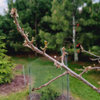
My Quercus acuta is looking good so far. Not in the best spot. Not much room and not much sun. But, the mild winter so far has not challenged it. One of the more handsome evergreen oaks, in my opinion. Very 'un-oak-like' by American standards.
Glad it's doing well for you but I go back to the issue with plants like this, what is it going to look like after winters like 2013-2015? I remember the Q. acutas and IIRC also a Q. glauca at W&M just well enough after the winter of 1994 to write them off. 1994: 0F in Willamsburg, -10F or so in most of the DC area, and cold so extended you could walk from DC to Virginia on the Potomac. They took a long time to look acceptable again. (And already had not the most inspiring appearance, having been damaged in 1985, probably) OTOH the hardy local forms of Q. virginiana were burnt but looked normal again by midsummer. The PV winters in the mid 2010s really weren't as bad although they were no walk in the park either. I have a feeling if Q. acuta were really hardy in the area we would see more of them? That being said I think you've mentioned one at the national arboretum that looked good but I have missed it on my trips. That's pretty mild location. OTOH the Lithocarpus in a frost hollow in Howard County looked fine after the polar vortex winters.
But one always decides what the trade-off is, how badly do you want a plant to put up with it sometimes looking bad. For example with the magnolias I mention in this thread: https://www.houzz.com/discussions/1610031/growing-banana-shrub-in-zone-6a I will probably make an exception. For one thing they recover quickly and "cleanly". Old dead foliage quickly falls and is replaced by new growth if the branch is alive. M. skinneri is looking like it might finally have a chance to bloom well this year; M. 'Frosty Pale Purple' has already bloomed and the flower scent is great.
I wonder if it would cross with Q. myrsinifolia. Might produce some plants that are better looking that either parent, and a bit hardier. There is something about the leaf that is more appealing though I can't say for sure what.
Davidrt, that is why I put it in a more hidden spot in my yard. No guarantees for survival. But no, they are not well adapted for our area. Snow loads, ice build-up, super cold temps … all being issues. Sure, you'd be safer with a red maple. LOL!
"But no, they are not well adapted for our area. Snow loads, ice build-up, super cold temps" well this is why crossing it with Q. mysinifolia might be interesting. Those seem to be a little tougher, the contrast between Q. mysinifolia and Q. virginiana at Udel is rather striking. The former might be in a slightly more sheltered spot, but not one that's going to protect it from snow and ice. Yet it has developed like a 'normal' tree, no issues with branch structure.





UpperBayGardener (zone 7)
UpperBayGardener (zone 7)
Related Professionals
Mobile Landscape Architects & Landscape Designers · Tampa Landscape Architects & Landscape Designers · Savannah Landscape Architects & Landscape Designers · Wenatchee Landscape Architects & Landscape Designers · Sarnia Landscape Architects & Landscape Designers · Westminster Landscape Contractors · Plainfield Landscape Contractors · Rockford Landscape Contractors · Marinette Landscape Contractors · Albany Home Additions · Grand Rapids Home Additions · Bakersfield Home Additions · Bismarck Home Additions · Chatham Home Additions · Magog Home AdditionsDave in NoVA • N. Virginia • zone 7AOriginal Author
UpperBayGardener (zone 7)