Software
Houzz Logo Print
andrea_pavan47

Soil test came back with very low Phosphorus. What should I do next?

6 years ago
last modified: 6 years ago
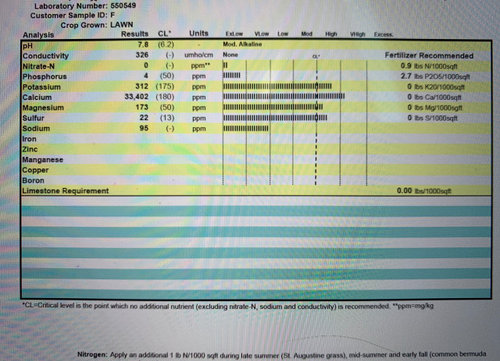
Attached you can see the soil test results I just received from Texas A&M.

The only thing I've found that can get the suggested rate into the soil is this 0-46-0 triple phosphate. But since I have a pretty big lawn, close to 1 acre, I would need to put around 50lbs of that per 10,000 sqft to hit the suggested rate.

It seems very drastic. Should I split the applications? Should I wait for the zoysia to green up as it is still dormant?

Also, I would need to put down some Nitrogen separately. If the Potassium was not so high I could try starter fertilizers?

We moved into this house this winter I think previous owner had a lawn care company do the fertilization.

Looking for advice or tips or experience with this.

THANKS!


Comments (4)

  • 6 years ago
    last modified: 6 years ago

    That's drastic. Overly drastic. Not to mention something you shouldn't do at once because P is very slow to perk down anyway, and creating a very high P zone at the top of the soil is a bad idea (it'll create a zone where the roots are somewhat blocked from absorbing other nutrients that P antagonizes). Fortunately, due to the pH issue I mention below, this problem never really materializes easily in your soil.

    I never recommend slamming a soil all at once anyway. It creates the aforementioned zones, which aren't great for the plants, and the microbes in the soil aren't thrilled about it either. Given that your pH is quite high as well, I'd also set your optimal P levels rather high to begin with; P availability is extremely limited at high pH.

    So personally? I'd target the high range.

    First off, I'm going to assume that Texas A&M soil tests are OK, I have no direct experience with them (I read Logan for the most part).

    No, seriously, you'd be surprised and head-to-head test comparisons with known samples varied widely between labs. My mentor used to have a cat about this.

    Fortunately, P levels are pretty flexible if high and P has to be sky-high to be a major issue.

    You can use triple superphosphate if you like. You can also use any good starter fertilizer and feed the lawn at the same time--just make sure the first and second numbers are much larger than the third, although potassium isn't one of those nutrients one has to be overly concerned about, either (and if you look at the magnitudes on the graph, we're moving from 4 to about 60 on P, which would move you from 312 to 370 or so on K...not really a noticeable change if we used a high-K fertilizer as well).

    Personally, I'd go with the starter. It's cheaper overall, will serve two purposes at once, and can be tossed in your spreader and used like any other fertilizer so the hassle quotient is so much lower.

    Just look for something like 20-27-5 (Scott's brand is around that, but I wouldn't pay for Scott's, any off brand is just as good) so you get a good dose of N (20) and P (27) without paying for K (5) that you don't really require.

    But if it turns out to be something like (for example) 15-25-15, that's just fine, too. N's good, P's high, and K isn't outrageous.

    Follow the bag settings. But ask here if you have any questions whatsoever!

    Zoysia likes between 2 to 4 pounds of nitrogen over the growing season, tapped out pretty regularly when it's warm like any other warm-season grass. So once it's fully back, feed it nicely at bag rate, which should target around 0.8 pounds N (most starter fertilizers do).

    Then about a quarter way through the season, do it again.

    At the halfway point, do it again.

    At the three-quarters point, do it for the last time.

    You're done. You just applied 2.4 pounds of N, and about 3 pounds of phosphoric acid equivalent (about 0.85 pounds elemental P equivalent) for most starters (but again, let us know the bag rates and we'll translate that).

    You'll want to re-test next year to see how it's coming along (probably not that well, given the perk-down time on P) and keep going, but over a couple-three years, it'll be along.

    This is not a fast process.

    Now, then. I note that none of the minor elements were tested but that you seem good on all other major elements (congrats on that, BTW). Higher-pH soils frequently bind up iron something fierce, so if your zoysia seems light green and disappointing, or, worse, yellow, iron might be to blame. Just something to keep in mind.

    A P thanked User
  • 6 years ago

    For some reason that reply isn't showing. I'm adding this to see if it kicks the reply so you see it, OP.

  • 6 years ago

    Where do you live? Texas soils and climates differ quite a bit, so this makes a difference. West Texas is not close enough. Neither is Central Texas. Those areas are larger than some states. We need a town to get started.

    Are you hoping to have a showcase lawn, or a mix of green grass and plants (weeds) to keep the mud out of the house? Or something else? One acre is a lot to deal with, so plan to buy stuff in bulk. Wait, is the lot 1 acre or the lawn 1 acre?

    If you have a 1-acre lawn, you'll likely want a garden tractor type riding mower, too. Get something that can take attachments for broadcasting fertilizer and a 25-gallon ag sprayer. Don't let them sell you a core aerator, roller, Harley rake, or any fancy attachments. Those can be rented, but you likely won't need them.

    What about irrigation? Is there an inground system? Are you willing to apply 1 inch of water per week during the hottest heat of summer? That's over 3,600 cubic feet of water per week.

    Do you know what variety of zoysia it is? You might ask the neighbors if they know.

    Now to your question. Please wait until May to think about applying any fertilizer. Let the lawn awaken, grow through the fast spring growth, and settle down. That puts you into May before you need to fertilize. If the lawn looks pretty good in late April, then you probably can ignore the TAMU soil test. If you really want an acre of showcase lawn, then consider tuning up the soil.

    You can spray for weeds in April, or if you're in southern Texas, any time now to spray for weeds.

    Several years ago the TAMU soil test lab disgraced itself and admitted they had been doing soil testing wrong since they opened. The upshot was that farmers all over the state had overapplied (P or K, I don't remember which one) for literally generations. Their testing had been suspect for a long time, but the arrogant denial of improper recommendations pissed off a lot of people. Then when they finally admitted it, well, vindication was not enough. What do you do with all this soil? I think a lot of farmers went to the Texas Plant and Soil Lab in Edinburg for their testing. Folks on this forum like the tests from Logan Labs in Ohio. Search this forum for tests and recommendations. If you decide to get a Logan Labs test, the $25 test is all you need. Post the results here, like you did, and let the comments guide you. I believe you'll be happier with the LL test comments than the TAMU test.

    A P thanked dchall_san_antonio
  • 6 years ago

    Thank you guys for the detailed responses. I live just north of Dallas so everything is still pretty dormant. I will look into some starter fertilizer options as you suggested!

Sponsored
Peabody Landscape Group
Average rating: 3.5 out of 5 stars8 Reviews
Columbus' Reliable Landscape Design & Contracting