Software
Houzz Logo Print
webuser_554079829

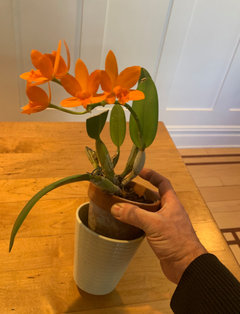
Can she be saved?

6 years ago
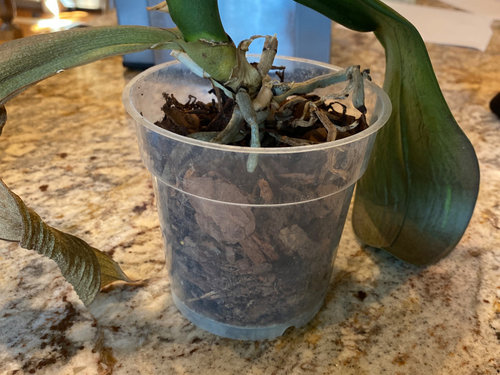
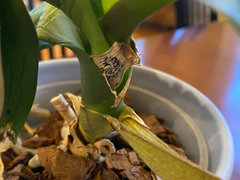
We aren’t sure if she’s been over or under watered. We replanted this orchid last summer. Any tips on how to bring it back to good health?


Comments (31)

  • 6 years ago

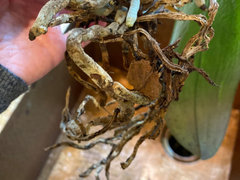
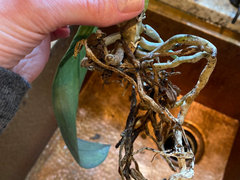
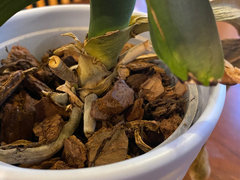
    It has some healthy roots from what I can see. take it out of the pot to see what the root system and the media looks like and post pics.

  • 6 years ago


  • 6 years ago


  • 6 years ago

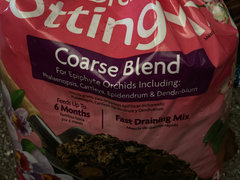
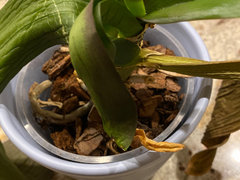
    Okay, not as many roots, it is probably too much water. Can you show me the media? You need to cut off the dead roots, pot it up in healthy media and give it more humidity for some time till it grows more roots by putting a transparent plastic bag with holes for air. If it was mine, I would let the roots soak in water with some hydrogen peroxide. Once the roots are hydrated, you can tell the viable once from dead or rotten (soggy that are easily pulled off to reveal a thread like center). Cut off dead roots with a sterilized scissor (bleach or isopropyl alcohol). Wash remaining roots and rhizome with hydrogen peroxide (3%). Then pot it up in bark media that is already soaked in water for some time. Preferably use new media or thoroughly wash big chunks from old media if you don't have new media and would rather not spend on it to save a sick orchid. You could use sphagnum instead of bark. Cover with a ziploc bag or similar with hole around the leaves to allow for air and to prevent fungal growth. You could also the container on a humidity tray (put some gravel in a tray, add water but not enough to drown all the gravel). Good luck.

  • 6 years ago

    It does look like all the shriveled up roots are dead and you can cut them off. Still, a good soak would help hydrate the plant. Also spray the leaves liberally with water taking care to avoid the crown (the center between the leaves).

  • 6 years ago


  • 6 years ago

    That should work. Soak it for a few hours in water before you use it.

  • 6 years ago

    This sounds like good advice. But how do you know it is a she?

  • 6 years ago

    ha! I don’t know!

  • 6 years ago

    Thanks for the advice! Should I take off the wilted leaf?

  • 6 years ago

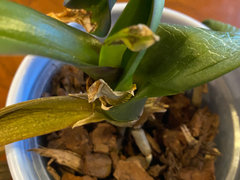
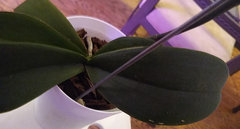
    More pics of the foliage including the crown would help figure that one out.

  • 6 years ago


  • 6 years ago


  • 6 years ago


  • 6 years ago

    They are all wilted but yes the bottom one is probably no good for the plant and you can get rid of it.

  • 6 years ago

    What's happening with the youngest leaf? It looks a bit weird, that's why I wanted to look at the crown- a picture from the top would help rule out at any fungal infection/crown rot. The portion shown in the pic below

  • 6 years ago


  • 6 years ago

    OK, that looks healthy enough, all things considered. It does have enough roots to make it. Good luck.

  • 6 years ago

    I guess I'll be devils advocate. I think the roots look dried up and dehydrated. I would never cut off a leaf unless it was dead/brown. A green leaf is still functioning.


    You never stated what zone you live, that makes a big difference giving advice. Does this plant grow on a window or outside? Give us some idea how this plant has been treated.


    Depending on growing conditions, if you are in a northern area with dry winters, you'd want to add some sphag to the mix to retain some moisture around the roots. In a southern area, repot in some medium size bark with some sphag mixed in.


    Either zone, keep it warm, soak the bark before repotting or after. Soak for at least a few hours to help the bark to take up the water. Keep the plant warm, give it good, bright light and water when almost dry (stick your finger down in the mix).


    Those roots look dry and dehydrated. Leave the leaf alone until it turns brown.


    Jane

  • 6 years ago

    I’m in zone 5b. I’ve had this orchid for 2.5 years. It’s been kept in one If the brighter rooms in my home, next to the window. We have a lot of trees all around our house, so I don’t get direct or full sunlight anywhere, inside or out. I water with tepid water from the kitchen sink once a week. I initially used ice cubes when I first received the plant because I didn’t know any better.


  • 6 years ago

    Move it into a smaller bark mix with sphag mixed in. If you can, soak the bark in some warm water over night or at least a few hours.

    Pot the plant, put in a nice, warm, bright spot. Give it some diluted fertilizer. Stick your fingers down in the pot every 3 days to see if you feel moisture. If it feels almost dry, water it. If you notice its dry after a day or two, sit the pot on a try to get the bark to absorb water.

    It's Spring in zone 5. My guess is your plant will turn around.


    Don't cut off that green, wilted leaf. I don't even see rotted roots, just dehydrated. The plant needs moisture.

    Jane

  • 6 years ago

    Looks like you had a terminal spike that has been cut down. This is what the American Orchid Society has to say about a terminal spike:


    Top Ten "Uncommonest" Questions Asked About Phalaenopsis

    Q. My phalaenopis has a bloom spike arising out of the apical crown of the plant. What effect will this have on future flowering?

    A. Probably this means that your plant has reached full maturity, and it will cease to grow and flower after this spike is finished. However, we've seen some plants resume growth, and thenceforth act in a normal manner. Some say this atypical flowering results from too much light; others blame insecticides, especially the systemics. A plant that does not resume normal growth will usually throw one or more new plants or "keikis: from the base of the plant, so don't throw it away. Until it does produce new plants, continue to treat it in a normal manner.

  • 6 years ago

    It's not a terminal spike, it's a new leaf which is a bit discolored at the tip.

  • 6 years ago

    Having different opinion is fine, having a definite opinion of being right to the exclusion of others isn't. Thar last leaf looks brown and dead to me. And yes the roots are dried up. In any case, "leave the leaf alone" sounds more like a command than a suggestion. I don't know why some veterans at this forum are so full of themselves that they feel an existential threat if someone else posts an advice, and feel compelled to swat that person away. Such pettiness leaves a bas taste in the mouth.

  • 6 years ago
    last modified: 6 years ago

    Hey gg100, a little snippy there aren't we? Being locked in for weeks on end getting to you? As far as your "addressing down" of us older posters: Maybe it is because the older posters here know of which they speak? Jane has been growing orchids for decades in multiple environments, how about you?

    Now back to orchids...

    I've grown and killed many, many phals over the last @20 years, I'd say that one was too wet at one point (dark brown roots) and then kept too dry (lighter colored shriveled roots) to try and compensate. The few light firm roots are still viable.

    Unless it is diseased, I've always heard the best practice is to not cut green leaves. I personally wait until they can be easily pulled off or they fall on their own. If it is green it is helping things, besides cutting a living leaf can induce disease/fungal/bacterial issues.

    Honestly, unless that phal has special meaning, I'd compost it and spend $15-20 to purchase a new one. It is at least 1 year from seeing any blooms under perfect conditions and care, and that is if you can save "her" at all.

    If you do try and save "her", trim all dead/brown/shriveled roots with a sterile blade/scissors. Pot it up into a 4" pot and fill it in fairly tightly with new mix from your existing bag that has soaked overnight. Set in warm bright indirect light and only water when dry, I'd guess 2x per week for the first month or two, once a week after that.

    In my opinion and experience, the bag trick (usually called "spagh and bag") isn't too helpful. You can do just as well with correct watering and placement while it re-establishes.

    Good luck kate,

    Bob

  • 6 years ago

    Yup, a snippy comment begets another. Perhaps Jane didn't come across as snippy to you but I have had these slights some veterans on here way too many times to let go everytime.
    And no, getting cooped up inside isn't getting to me because I have worked from home for a while now and don't do a whole lot of partying and socializing. I am overlooking the Manhattan skyline here from jersey city and do feel for what people are going through there as well as here as well. Makes all this seem even more petty than in normal times.
    I have grown phals for at least 10 years, killed quite a few too. I have at a couple in my care for 5 years that have survived transitioning from sphag to water culture to bark and are blooming right now. I even have a miltoniopsis in bud that has been in my care for 3 years and budding right now-it has grown in fine fir bark, mix of sphag and bark and is now growing in coir fibers. So, yeah, I sort of know what I am talking about when I volunteer some advice in a public group where posters know that they are not necessarily getting pro advice, just inputs from others in the community.

  • 6 years ago

    And yes, I may not be a veteran here but I have grown plants for a good chunk of my life, 50 yrs and counting.

  • 6 years ago

    Kate,

    Based on the background, I'd try to save it if it were mine also. Be sure to water out of the cache pot and then return after the plastic pot has stopped dripping. It's not good to let it sit in standing water for too long.

    Good luck,

    Bob

  • 6 years ago

    Asking for advise on growing Phals is a little like asking a room full of Italian grandmas how to make spaghetti sauce. Half of them will whack you with a ladle for calling it sauce and not gravy, and they will all have a recipe that will taste awesome.

    Everything I’ve read here is good advise, just slightly different approaches based on different experiences. Phals are quirky plants, they seem to fight to survive no matter what you do, or seem determined to die no matter what you do.

    I’ll add my 2 cents now. Be careful with plants in windows over winter. There can be a big temperature drop close to the glass compared to the room. I have an old house with drafty windows where on a windy day you can feel the draft about 6 inches off the glass. Damage from cold dry air can take weeks to show up on the plant so when you see a problem think about what was going on last month.

    To boost humidity I like to sit the pot in a vase with some water in the bottom, the water in the vase shouldn’t touch the pot . I feel this keeps the root zone humid


    Whatever you do, once you clean it up and repot don’t make any other big changes. A stressed plant will go dormant until conditions stabilize. You might not see any growth for weeks or months. Don’t pull it out of the pot again to check the roots.


    I had to re read this thread twice, I didn’t see anything above that I would consider a slight. Whenever I read Janes posts I have Jane Goodall’s voice In my head doing the narration, maybe you have a different narrator?


    I lived in Jersey City for years, in the Heights and Downtown by City Hall. Great place to live, I miss it.

  • 6 years ago

    Gee Wiz! I'm sorry if I sounded snippy to anyone.

    I was speaking to the OP, Kate telling her how I would deal with her plant. Everyone has good ideas and I was sharing mine.


    Phals do not usually have more than 3-4 leaves. Kate's leaf was wilted but green. Even though it was wilted it is still supplying energy and food for her plant. I do not remove a green leaf even wilted unless it shows signs of disease.


    Her plant was set back, the plant was not getting enough moisture (for whatever reason) and the leaf wilted. In my experience, that leaf will remain wilted and never recover. However, it is still functioning supporting the plant. For her plant to recover, it needs everything it has going for it. The root system looks dehydrated probably due to dry conditions and lack of humidity during the winter months.


    Her plant can turn around. I'm a great believer in Spring, longer daylight, warmer temperatures. She needs to provide a good potting mix, small bark, some sphag and bright light. I would not cut off any roots which are not rotted. When I say rotted, I mean mushy, black. Dehydrated doesn't mean rotted. Roots can hydrate and branch forming new roots to support the plant. The roots work like that wilted leaf. The dry, dehydrated part of the root is the outside velamen. The actual, functioning part is inside the velamen, the stringy part. That continues to function.


    I have numerous Phals, both given to me as gifts and others which need rehab. We live in Florida now and there are many people who come down for 4 months, buy a plant and go back North in the Spring. They had bought a pretty Phal during their stay and ask me to take care of their plant over their absence. I get Phals in all sorts of shape and have learned that with warmth and proper watering, these plants turn around quickly. As long as they have a few roots, a few leaves, they can be saved. If they are diseased, that's another problem for another post.


    Thanks Bob and James, good advice as always.


    Jane


Sponsored
NME Builders LLC
Average rating: 5 out of 5 stars2 Reviews
Remodeling Company in New Albany, Ohio