Software
Houzz Logo Print
webuser_228959258

How do you pronounce corydalis?

6 years ago
Years ago I had an English friend who told me that the correct way to pronounce Latin plant names was to say every letter in the name out loud and if you can put an English accent on it it will make it even more convincing.

Do you say cory-dalis or coridilis?

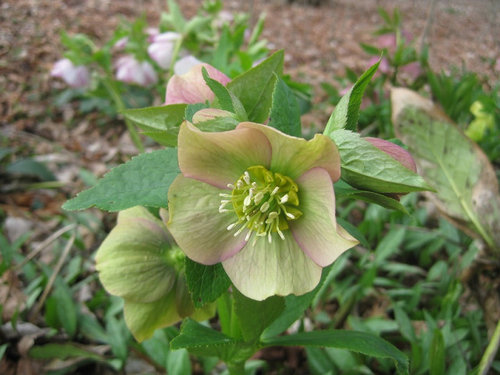
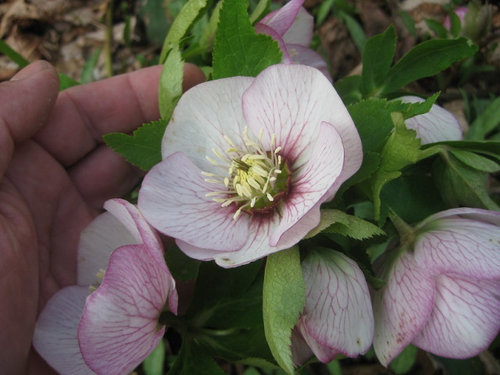
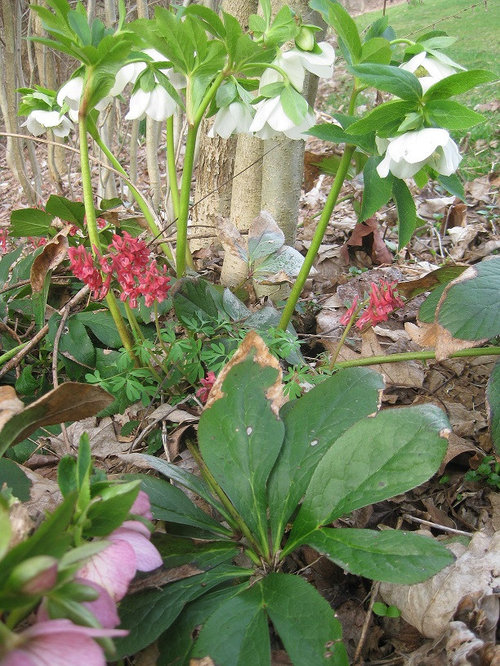
Pics from this morn, the hellebores are amazing this spring! Hope you are all enjoying your gardens and the beatiful spring weather!


These are the Ashwood Strain back when they used to sell seeds.

Comments (30)

  • 6 years ago

    and if you can put an English accent on it it will make it even more convincing.


    ===>>> lol ....

  • 6 years ago
    last modified: 6 years ago

    There's no correct way. There are accepted ways but even plant experts don't always agree. I tried a few online guides and it seems I've been pronouncing Corydalis 'wrong' all my life. Not surprising since I've learned most names from reading, not listening. But since the names are invented and botanical Latin is essentially a written medium which sometimes gets spoken out loud, I don't really care that much.

    Jeb thanked floral_uk z.8/9 SW UK
  • 6 years ago

    If two or more people are discussing certain plants they should all be talking about the same plant! It should be agreed on no matter how it is pronounced. It isn't a big deal for me either because like you floral I have learned most things from reading with some first hand experience. Trial and error! There are a few words that I say out loud that no one understands because I have been saying them in my head most of the time. I had a ,mother that was a substitute elementary English and grammar teacher and as often as she corrected me growing up, I still say things wrong sometimes!

  • 6 years ago

    Back in the day when I was attending hort school, we were instructed to put the emphasis on the second syllable. While that seems to be valid 80% of the time it is not consistent :-) And there is enough non-Latin involved in botanical nomenclature that you can't really rely on that at all.....just as many Greek derivations or names derived from the humans that discovered or introduced the plants to throw a wrench in the works!!

  • 6 years ago
    last modified: 6 years ago

    Jeb, as some one who took (classical) Latin throughout high school, in England, I wouldn't put much faith in your friend's comment. To be candid, it seems a bit chauvinistic.

    Re Latin:: most "Latin" plant names are "New Latin", not part of the vocabulary of say the ancient Roman naturalist, Pliny the Elder. They are names, constructed, along Latin lines, during the (European) Age of Discovery. At that time, Latin was the llngua franca of European academics. If the great Swedish plant taxonomist, Linnaeus (Carl von Linne´), spoke his Latin with an accent it was presumably a Swedish one.

    Jeb thanked sunnyborders
  • 6 years ago
    last modified: 6 years ago

    My English friend's name is Hannah! She had a wonderful witty sense of humor! ;)

  • 6 years ago
    last modified: 6 years ago

    Glad to hear, Jeb. Humour trumps chauvinism!

  • 6 years ago

    I attended a lecture by Dan Heims of Terra Nova and he said "coridilis"

  • 6 years ago
    last modified: 6 years ago

    In botanical nomenclature (naming), the Genus is definitely Corydalis, as in the binomial Corydalis lutea.

    Checked the origins of the word a bit further. It actually was a Roman loan word from ancient Greek (meaning "crested lark"). Linnaeus talked about Corydalis, the plant. In the New Latin of his time, the "u" (upsilon) of the Greek word had been replaced by "y"; hence Corydalis.

    There doesn't appear to be either a botanical, or even a philological basis, for "coridilis".

    Jeb thanked sunnyborders
  • 6 years ago
    last modified: 6 years ago

    But Jen was enquiring about pronunciation rather than spelling. How is the pronunciation determinable from the etymology?

  • 6 years ago
    last modified: 6 years ago

    The etymology may not be important to the pronunciation. I think, however, the actual botanical nomenclature is; that is in cases where the common usage is the same as a formal botanical name (viz. Corydalis). In such cases and in the interests of precise communication and notably in more formal contexts (e.g. a lecture by Dan Heims)), I'd say that pronunciation should not diverge from the spelling. If it does, circular questions may arise, such as that initially posed by Jeb.

    https://www.herebydesign.net/how-to-pronounce-botanical-names-hint-it-doesnt-matter/

  • 6 years ago

    Was thinking: specifically, according to what I just posted, etymology (origin of words, etc.) is highly relevant (viz. Systema Naturae, etc.).

  • 6 years ago
    last modified: 6 years ago

    Since botanical nomenclature is based on a mangled amalgam of Latin, Greek (and sometimes French and old English) as well as proper names, pronunciation will often deviate heavily from the spelling. As an example, the botanical combo of 'ch' is pronounced hard like a 'K', whereas it is almost always pronounced soft (as in chips or chicken) in every day usage.

    btw, the pronunciation of botanical terminology or nomenclature is typically spelled out phonetically just for this reason....the spelling does not necessarily match the pronunciation :-) Corydalis = kor-ID-ah-liss (note emphasis on the second syllable) And not 'cory-dalis'

    Also most pronunciation sources will state that as long as you are understood as to what plant you are referring to, your pronunciation is 'correct' :-)

    Fine Gardening has an excellent botanical pronunciation guide with audio online HERE

    Jeb thanked gardengal48 (PNW Z8/9)
  • 6 years ago
    last modified: 6 years ago

    I'm not really following what you are trying to say, sunnyborders. You suggest that pronunciation should follow spelling. But what does 'follow' mean? Spelling tells us very little about pronunciation. You and I both speak English but I can guarantee that my pronunciation wouldn't be the same as yours even if we were reading the same words. And since botanical names are universally used there's little hope the whole world will pronounce them the same. I recall telling a French botanist that I'd just seen a Pinguicula. He had absolutely no idea what I was saying until I wrote it down.

    The link you posted says it doesn't matter and I agree.

  • 6 years ago

    Perhaps the IPA alphabet is needed to precisely indicate the sounds; however, GG, I believe that your "kor-ID-ah-liss" supports my point. My objection to "coridilis" has been based on its divergence from the spelling of Corydalis. I've forgotten most of the phonemic analysis I once knew, but I assume that the main phonemic difference (in sound), between "cory-dalis" and "coridilis", is in the "a". This comports with the case I've been making.


  • 6 years ago
    last modified: 6 years ago

    Quite possibly the contentious 'coridilis' is the OP's attempt to transcribe a schwa sound. The online pronunciations I found were all American and all said 'coridilis' with a schwa for the second 'i'. They also placed equal emphasis on each syllable. Entirely different from how I've always said the word. But it bothers me not one jot.


  • 6 years ago
    last modified: 6 years ago

    Interesting Floral, so pronouncing the "a", as an "I", would be an American variant. Haven't heard it here in Canada.

    The history is: it was written an "a" (alpha) in Theophrastus' "Enquiry into Plants" and written an "a " in the botanical work of Linnaeus. The latter being the basis of all modern biological nomenclature, the botanical name is Corydalis. An argument, sometimes given, for using botanical names rather than common names is avoiding ambiguity.

    Jeb thanked sunnyborders
  • 6 years ago

    imo avoiding ambiguity is the paramount reason for using botanical names, not just an argument 'sometimes given.' But the OP's question was purely about pronunciation, not the use of binomials per se. I'm not sure how anyone can say what Theophrastus' alpha sounded like.

  • 6 years ago
    last modified: 6 years ago

    Going back to "the OP's question"; it is about pronouncing, notably, "Latin plant names". The latter seems to often mean the botanical species names, which are binomials. In this case, however, the "Latin plant name", Corydalis, is at the Genus level.

    At least in my experience, academically, the pronunciation of such names are tied to the spelling.

    Perhaps the problem is with such a vague term as "Latin plant names". "Botanical names" would be more meaningful.

  • 6 years ago

    Corry-day-liss…. with a slight emphasis on 'day'...

    Jeb thanked User
  • 6 years ago

    Haha. Just goes to show. I'm a Cory-da-lis myself. Emphasis on 'da'.

    Jeb thanked floral_uk z.8/9 SW UK
  • 6 years ago

    I have a strange feeling that I am back in high school and Mr. Laures is going to come in the classroom with the next Latin reading and translation for the day.......am I down the rabbit hole???? :-D

  • 6 years ago
    last modified: 6 years ago

    Maybe! However, at one level, it's a background in Botanical Taxonomy (classification) and particularly Nomenclature (naming) which is more relevant. It's about how gardening borrows from Botany.

  • 6 years ago
    last modified: 6 years ago

    Wish I could show this thread to people mangling the pronunciation of my name! LOL.


    I keep saying, "Accent on the SECOND syllable!"

  • 6 years ago

    Corydalis prounounced "kor-ID-ah-liss" is what I meant by coridilis....

  • 6 years ago

    sounds like Co- rid-a-lis

  • 6 years ago

    I say Linnaiya with the emphasis on the nai.

    For corydalis I say Cori Da lis with the emphasis on Da.

  • 6 years ago

    I read about a man who was outraged because a plant named after his friend Mr. Kniphof (nip hoff) was said to be correctly pronounced as Nie foe fee a. So it goes:)

  • 6 years ago

    That would actually be K nip hoff ia You'd sound the K in German. I'm guessing the story is apocryphal unless the friend recorded the complaint for posterity back in the 1790s.

0