

Container Soils - Water Movement and Retention 4/11/20
Hello! Houzz's format won't allow me to post the thread in it's entirety, so the thread will continue in the first three text boxes of this thread. When you get to the link that says "READ MORE", please click on it.
I want to thank all the growers and good people who have participated and been so supportive of the thread over the years. Their contributions are one of the main reasons viewers continue to find interest in it, so thank you very much! If you find value in the information I have set down in this post and feel there is anything pertaining to the topic that should be added or explored in more detail, please contribute your suggestions. My goal is to offer information that allows you to avoid an ongoing battle with your medium for control of your plants' vitality, information that will help you increase the reward you get in return for your efforts.
I started this thread about 15 years ago, in March of '05. So far, it has reached the maximum number of posts GW allowed to a single thread twenty two times, which is much more attention than I ever imagined it would garner. Currently, there have been just under 5,000 posts to the singular topic. I have reposted it in no small part because it has been great fun, and a wonderful catalyst in the forging of new friendships and in increasing my list of acquaintances with similar growing interests. The forum and email exchanges that so often stem from the subject matter are in themselves enough to make me hope the subject continues to pique interest, and the exchanges provide helpful information. Most of the motivation to post this thread another time comes from the reinforcement of hundreds of participants over the years that strongly suggests the information provided in good-spirited collective exchange has made a significant difference in the quality of their growing experience. Thank you for taking the time to examine this topic - I hope that any/all who read it take at least something interesting and helpful from it. I know it's long, and grows a little longer each time it's reposted. My hope is that you find it worth the read, and the time you invest results in a significantly improved growing experience. Since there are many questions about soils appropriate for use in containers, I'll post basic mix recipes later, in case any would like to try them. Also, you will find I use the terms medium/ media and soil/ soils interchangeably.
As you eye the length of this post, one thing you might ask yourself is, "Why the interest and all this talk about soils and water retention?" In all honesty, soils obscure the reason we talk about them - they hide the roots and the roots' state of vitality. Vitality is not the same as vigor. Vigor is a genetic factor, something the plant is endowed with because of how it was programmed by Mother Nature. It is also something we have no sway over. Vitality, on the other hand, is dynamic and variable, essentially a measure of how well a plant is/ has been able to deal with the cultural hand it has been dealt by the grower. Vitality is something you have much, perhaps nearly total control over. The visual signals we get from the parts of the plant we CAN see allow us to take measure of the condition of the roots and the plant's overall vitality. Soil choice and watering habits, have a very
significant impact on root health. As you read, keep in mind that good root health and root function are an essential PREREQUISITE to a healthy plant. We cannot expect to grow healthy plants w/o a healthy root system - it is impossible; which brings us full circle to why we discuss soils.
Poor root health is responsible for a very high percentage of the ills that befall plants, and the reasons people flock to the forums seeking remediation for widely varying issues. Poor root health means a reduction in vitality, which leaves the plant looking shabby while compromising its ability to defend itself against insects and diseases. So, let's talk about some things we can implement that should go a very long way toward providing you with the ability to consistently keep the root systems of your plants happy.
Before we get started, I'd like to mention that I wrote a reply and posted it to a thread some time ago, and I think it is well worth considering. It not only sets a minimum standard for what constitutes a 'GOOD' container medium, but also points to the fact that not all growers look at container media from the same perspective, which is why growers so often disagree on what makes a medium 'good, bad, or somewhere in between. I hope you find it thought provoking:
IS 'X' A GOOD SOIL?
I think any discussion on this topic must largely center around the word "GOOD", and we can broaden the term 'good' so it also includes 'quality' or 'suitable', as in "Is X a quality or suitable medium?" How do we determine if medium A or medium B is a good one? And before we do that, we had better decide if we are going to look at it from the plant's perspective or from the grower's perspective, because often there is a considerable amount of conflict to be found in the overlap - so much so that one can often be mutually exclusive of the other.
We can imagine that grower A might not be happy or satisfied unless knows he is squeezing every bit of potential from his plants, and grower Z might not be happy or content unless he can water his plants before leaving on a 2-week jaunt and still have a weeks worth of not-having-to-water when (s)he returns. Everyone else is somewhere between A and Z; with B, D, F, H, J, L, N, P, R, T, V, X, and Y either unaware of how much difference medium choice can make, or, they understand but don't care.
I said all that to illustrate the large measure of futility in trying to establish any sort of standard as to what makes a medium 'good' from the individual grower's perspective; but let's change our focus from the pointless to the possible. We're really only interested in the comparative degrees of 'good' and 'better' here. It would be presumptive to label any medium "best", though 'best I've found' or 'best I've used' CAN sometimes be useful for comparative purposes, but that's a very subjective judgment. Let's tackle 'good', then move on to 'better', and finally see what we can do about qualifying these descriptors so they can apply to all growers.
I would like to think that everyone would prefer to use a medium that can be described as 'good' from the plant's perspective. How do we determine what a plant wants? Surprisingly, we can use %s established by truly scientific studies that are widely accepted in the greenhouse and nursery trades to determine if a medium is good or not good - from the plant's perspective, that is. Rather than use confusing numbers that mean nothing to the hobby grower, I can suggest that our standard for a good should be, at a minimum, that you can water properly. This means at any time during the growth cycle you should be able to water your plantings to beyond the point of saturation (so excess water is draining from the pot) without the fear of root rot or compromised root function due to (take your pick) an excessive volume of water or too little air in the root zone.
I think it is very reasonable to withhold the comparative adjective, 'GOOD', from media that can't be watered properly without compromising root function, or worse, suffering disease from one of the fungaluglies that cause root rot. I also think anyone wishing to make a case from the plant's perspective that a medium which can't be watered to beyond saturation w/o compromising root health can be called 'good', is fighting uphill against logic.
So I contend that 'GOOD' soils are those we can water correctly; that is to say, we can flush the medium when we water without concern we would be compromising root health/function due to long term retention of excess water. If you ask yourself, "Can I water correctly if I use this medium?" and the answer is 'NO' .... it's not a good choice .... for the reasons stated above. Can you water correctly using most of the bagged bagged potting media readily available? 'NO', not without work-arounds in place, and we can talk about those.
What about 'BETTER'? Can we determine what might make a better medium? Yes, we can. If we start with a medium which meets the minimum standard of 'good', and improve either the physical or chemical properties of it, or make it last longer structurally, then we have 'better'. Even if we cannot agree on how low we wish to set the bar for what constitutes 'good', we should be able to agree any medium that reduces excess water retention and increases aeration ensures better potential for optimal root health than media which only meet some one's individual and arbitrary standard of 'good'.
All the plants we grow, unless grown from seed, have the genetic potential to become beautiful specimens. It's easy to see the absolute truth in the idea that if you give a plant everything it needs to prosper it will flourish. The better we are at it, the better our plants will grow. But we all know it's not that easy. Lifetimes are spent in careful study, trying to determine just exactly what it is that plants want and need to make them grow best.
Since this is a discussion, let's examine what the plant wants from its soil. It wants a soil in which we have endeavored to provide in available form, all the essential nutrients, in the ratio in at which the plant uses them, at a concentration high enough to prevent deficiencies yet low enough to make it easy to take up water (and the nutrients dissolved in the water). First and foremost, though, the plant wants a container medium that is evenly damp, never wet or soggy. Giving a plant what it wants to flourish and grow doesn't include a medium half saturated for a week before aeration returns to the entire mass, even if we only water in small sips. Plants might do 'ok' in some water-retentive soils if the grower is highly skilled, but in order to actually flourish as plants are genetically programmed to do, they would need to be unencumbered by media which do not remain wet/ soggy for extended periods.
What defines our proficiency as growers is our ability to identify and reduce the effects of limiting factors, or by eliminating those limiting factors entirely; in other words, by addressing those influences inhibiting the plant from reaching its genetic potential. Even if we are able to provide every other factor that influences plant growth/ vitality perfectly, it could not make up for a substandard medium. For a plant to realize its full genetic potential, every factor has to be perfect, including the medium. Of course, we'll never manage to get to that point, but the good news is, as we get closer and closer, our plants get better and better; and almost certainly, we'll find our growing experience more rewarding.
In my travels, I've discovered it almost always ends up being that one little factor that we willingly or unwittingly overlooked that limits us in our abilities, and our plants in their potential. Mother nature always sides with the hidden flaw.
Food for thought:
A 2-bit plant in a $10 has a future full of potential, where a $10 plant in a 2-bit has only a future filled with limitations. ~ Al
CONTAINER MEDIA – and WATER RETENTION
This is where we get to the meat of the subject. As container gardeners, our first priority should be to ensure the media we use provide adequate aeration for the intended life of the planting, or in the case of perennial material (trees, shrubs, garden perennials), from repot to repot. Aeration/drainage is arguably the most important consideration in any container planting. The soil is the foundation all container plantings are built on, and aeration is the very cornerstone of that foundation. Since aeration and drainage are inversely linked to soil particle size, it makes good sense to try to find and use (or make, in the case of 'media/ soils') soils or primary components with particles larger than peat/ compost/ coir/sand/ top or other traditionally 'fine' ingredients.. Durability and stability of soil components so they contribute to the retention of soil structure for extended periods is also extremely important. Pine and some other types of conifer bark fit the bill nicely, but I'll talk more about various components later.
What I will write will also hit heavily against the futility in using a “drainage layer” of coarse materials in attempt to improve drainage. It just doesn't work. All drainage layers do is reduce the total volume of medium available for root colonization. A wick can be employed to remove water from the saturated layer of medium at the container bottom, but a drainage layer is not effective. A wick can be made to work in reverse of 'self-watering' pots.
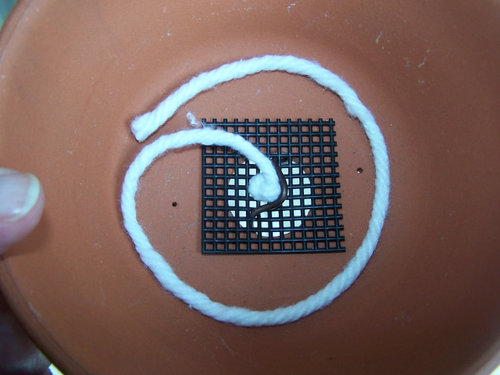

CONSIDER THIS IF YOU WILL:
If we agree we should avoid ingredients that are phytotoxic (toxic to plants) our primary consideration when building/buying a container medium should be the medium's structure and its structural stability. Size of the particles that make up a medium, the ratio at which they are combined, and the long term durability (resistance to breaking down into smaller and smaller particles) plays a primary role in determining whether a medium is suited or unsuited to the application. The medium fills only a few needs in container culture. Among them are: Anchorage - a place for roots to extend, securing the plant and preventing it from toppling. Nutrient Retention - it must retain a nutrient supply in available form sufficient to sustain plant systems. Gas Exchange - it must be amply porous to allow air to move through the root system and gasses, which are a by-product of decomposition, to escape. Water - it must retain water enough in liquid and/or vapor form to sustain plants between waterings. Air - it must contain a volume of air sufficient to ensure that root function/metabolism/growth is not impaired. This is extremely important and the primary reason that heavy, water-retentive media are so limiting. Most plants can be grown without soil as long as we can provide air, nutrients, and water, (witness hydroponics). Here, I will concentrate primarily on the movement/ retention of water in container media.
There are two forces that cause water to remain in or move through soils – one is gravity, the other capillary action. Gravity needs little explanation because all things are pulled toward the center of the earth. For this writing I would like to note: Capillarity is a function of the natural forces of adhesion and cohesion. Adhesion is water's tendency to stick to solid objects like particles and the sides of the pot; it is the reason water can stick to the inside of your vertical shower door. Cohesion is the tendency for water to stick to itself. Cohesion is why we often find water in droplet form – because cohesion is at times stronger than adhesion; in other words, water's bond to itself can be stronger than the bond to the object it might be in contact with. Capillary action is adhesion + cohesion, forces in evidence when we dip a paper towel in water. The water will soak into the towel and rise several inches above the surface of the water. It will not drain back into the source, and it will stop rising when the force of gravity is equal to the capillary attraction of the fibers in the paper.
There will be a naturally occurring "perched water table" (PWT), also referred to as a 'perched water column' in containers when soil particle size is under about .100 (a little smaller than 1/8) inch. It is created whenever the capillary pull of the medium (remember how the water climbed up the paper towel and defied gravity) surpasses the Gravitational Flow Potential GFP (weight of the water column in the pot); therefore, the water does not drain, it is said to be 'perched'. The smaller the size of the particles in a medium, the more surface area there is for water to 'stick to', so the greater the capillarity and the greater the height of the PWT. Perched water can be tightly held in heavy (comprised of small particles) soils where it perches (think of a bird on a perch) just above the container bottom where it will not drain; or, it can perch in a layer of heavy medium on top of a coarse drainage layer, where again it will not drain. It is water that resists gravity whenever the force of capillarity is stronger (when particle size is too small) and will not allow the PW to drain from the portion of the pot it occupies. It can evaporate or be used by the plant, but ambient physical forces will not allow it to drain naturally.
Imagine we have five cylinders of varying heights, shapes, and diameters, each with drain holes. If we fill them all with the same medium mixture, then saturate the medium, the PWT will be exactly the same height in all the containers.
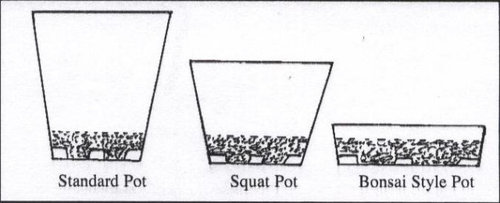
This saturated area of the container is where roots initially seldom penetrate and where root problems frequently begin due to a lack of aeration and the production of noxious gasses which cannot escape waterlogged media. Water and nutrient uptake are also compromised by lack of air in the rhizosphere (root zone). Keeping in mind the fact that the PWT height is dependent on soil particle size and has nothing to do with height or shape of the container, we can draw the conclusion that: If using a medium that supports perched water, taller growing containers will always have a higher percentage of unsaturated than squat containers when using the same medium. The reason: The level of the PWT will be the same in each container, with the taller container providing more usable, air holding above the PWT. From this, we could make a good case that taller containers are easier to grow in.
~ continued in the text box below ~
Comments (123)
 6 years ago
Hi. I've been reading about the gritty mix for several weeks now and I'm planning to use it for our indoor plants (ficus lyrata, ficus elastica, monstera, photos, philodendrons, etc ).
I'm from Sydney and it's a bit challenging to find the exact recipe for gritty mix. Can I use this as an alternative for gran-i-grit? - Calgrit (https://www.petandgarden.com.au/poultry-supplements/33-inca-poultry-wormer-piperazine-solution-clone-html.html#/30-select_bag_size-20_kg)
Description from that website:
Calgrit is a natural mineral grit derived from calcium carbonate which is a great alternative to shell grit providing more calcium (for hard egg shells) and more essential minerals than regular grit. Calgrit is a granular shaped limestone that adds Calcium and raises Carbonate Hardness (KH) in your water to help keep your PH in the 7.5 - 8.0 range.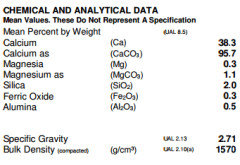
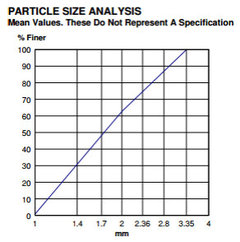
Appreciate any feedback. Thanks to Al and for everyone for sharing this information. Cheers 6 years agolast modified: 6 years ago
@Dom That is limestone and will send pH too high. What you want to find is "crushed granite" and get the particle size analysis.
For the product you found, there are 30% of the particles below 1.5 mm in size, so technically that is not the specification and a purist would filter those out (a major hassle).
Related Professionals
Kankakee Landscape Architects & Landscape Designers · Greenville Landscape Contractors · Janesville Landscape Contractors · San Jose Landscape Contractors · Terre Haute Home Builders · Salina Home Builders · Saginaw Home Builders · North Platte Home Builders · Leamington Landscape Architects & Landscape Designers · Gainesville Landscape Contractors · Auburn Landscape Contractors · Jacksonville Stone, Pavers & Concrete · Orangeburg Landscape Contractors · Rapid City Landscape Contractors · Newburyport Interior Designers & Decorators 6 years ago
Agreed with Westes. The particles sizes are such that you will lose a lot after sifting and it is mainly skewed towards the smaller size. Limestone will raise the pH and as they say it can raise it to 8. That can cause difficulty in uptake of some nutrients such as Iron. Although I have not deliberately grown in limestone but I did observe some plants do not mind and seem to thrive in it. I have a bed of crushed limestone where I place some of my potted plants such as ficus, bougainvillea, schefflera, etc for the summer. And in a month or two some will grow deep and fine roots into the limestone. These plants seem to have little problem growing in that. Just an observation - cannot be generalized to all plants.
Westes: Yes there can be lot of wastage sifting the bark for 511 and gritty especially. I just recycle them as mulch or top dressing in the yard. There is quite a bit of variation between bark sources and even between bags from the same source.
- 6 years ago
Hi @westes Zone 9b California SF Bay, thanks for the reply. Yeah I found a similar thread about limestone earlier and I decided not to purchase it. I got these ingredients this morning:
- Pine Bark Mulch Fine
- Pumice (2-5mm)
- Diatomaceous Earth (3-4mm)
I sieved the pine bark using a 10mm garden sieve and I think I can only use 30-40% from the bag. Can I use the fine dust/particles in making 5-1-1 mix? I think the answer is yes, based on this comment from Al:
Ideal Particle SizesIn a perfect world, the mineral fraction for use in the gritty mix would range in size from 1/10 - 5/32" (.100 - .156", or 2.5 - 4.0mm). The bark fraction would be slightly larger to allow for some breakdown over the life of the planting ........ from 1/8 - 1/4 is about ideal (.125 - .250" or 3.25 - 6.25mm).
For the 5:1:1 mix, particle size should be from dust to 3/8". (0 - .375", or 0 - 4mm), with most of the bark ranging in size from 3/16 - 3/8" ( .188 - .375", or 4.8 - 9.5mm). The perlite should be on the coarse side - something like the all purpose or super coarse shown below. If you read the size gradation next to the images, you'll see the images are misleading as the product appears to be much larger than the size listed in print.
- 6 years ago
Try to get in touch with Sydney bonsai society amd they know better sources of various components. Pumice and DE both hold water and so you may need to be a little more careful.
The problem with using dust and larger pieces from sifting bark is that is now skewed for 511. You may be able to substitute the peat for the finer fraction. - 6 years ago
Thanks @tropicofcancer (6b SW-PA). I've been searching for weeks on where to get alternatives for crushed granite or poultry grit but can't find locally that's why I ended up with that mix. I understand that this will hold more water (compared to using crushed granite) but I'm hoping it will be significantly better than the 'premium potting mix' from store?
Sorry, I didn't get your second statement. So what I mean is that the coarse pieces filtered by 10mm sieve will be used in gritty mix and the fine ones went through can be used in 5-1-1. Does it make sense? - 6 years ago
Aah. For gritty you need bark between approx 3mm and 6mm. Anything below 3mm and above 6mm is discarded. So anything above 10mm size from sifting for 511 is not useful for gritty anyway. Only thing I can think is to use the > 10mm pieces for epiphytic plants or as top dressing for potted plants to conserve water.
Earlier I thought the question was: can the discarded fraction from gritty be used in 511. And I suggested that the smaller fraction (below 3mm) can be used as a replacement for peat in 511. I do this by I eyeball the mixture usually and decide whether and how much of this fine fraction to use for 511. Note that I do not use peat at all in my 511 mixes. I decided to simplify the process of making 511 since there is quite a bit of fine fraction (< 3mm) in my bark anyway.
May be bit clearer this time. - 6 years agolast modified: 6 years ago
Thanks @tropicofcancer (6b SW-PA), you explained clearly what I'm trying to say :)
This is how I sifted the pine bark (fine):
- First sift using 10mm - the coarse particles that remained on the sieve (which can be used as top dressing for potted plants):
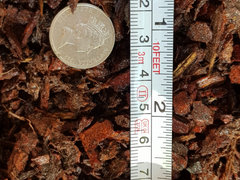
- Second sift using 3mm - this is what I used in gritty mix:
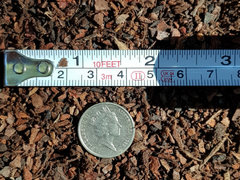
- The finer particles/dust which can be used as replacement to peat in 5-1-1?
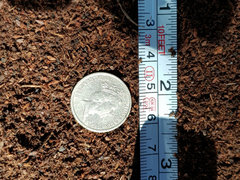
- 6 years ago
Soaked the pine bark for ~2 hrs. Sifted using fine kitchen mesh then rinsed the pumice and DE. Equal parts prior to mixing;
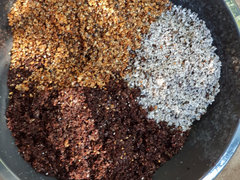
Mixed: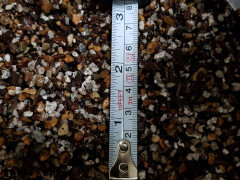
Bare-rooted and transplanted some small plants to gritty mix (with a bit of slow release ferts) for testing: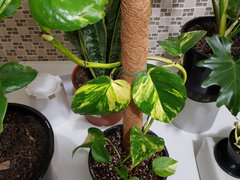
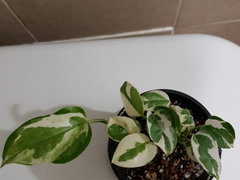
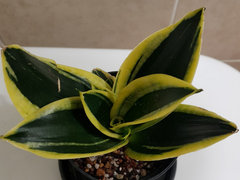
I tried using a soil moisture meter 4 hrs after re-potting and it's already reading 'dry'. I guess moisture meters are unusable for this kind of mix. I'll try using a 'tell' instead (which I learned from Al as well)
Questions:- Is it ok to store the extra gritty mix and ingredients wet or do I need to dry them?
- For 5-1-1 mix, the 5 parts of pine bark should be a combination of the second sift and the dust particles (based on the photos I posted above), is this correct?
- 6 years ago
For long term (> 2/3 weeks) of storage I have the gritty on the drier side. This is to prevent build up of anaerobic bacteria decomposing the bark. Just moist but not soggy is fine.
First think of 511 independent of what bark goes in gritty. Bark fraction of 511 is 0-10mm. However you have to be careful here since the relative proportion of small vs big particles can vary a lot between source of the bark and even from bag to bag from the same source. Ideally you want most of it between 3 and 6mm and relatively speaking 0-3 and 6-10 should be a smaller fraction. I know it is a bit imprecise but you will get the hang of it. In my case, the 0-3mm fraction is fairly high and so I often skip the peat part or if I feel I need to add some finer material I use the saved 0-3mm bark from gritty.
- 6 years agolast modified: 6 years ago
I find myself re-reading the same threads and going back to Al's posts and it seems like I learn a bit more each time. Thanks again @tropicofcancer (6b SW-PA), your statement about bark fraction being 0-10mm makes it a lot clearer. I think the pine bark I got has a good ratio of different sizes (0-10mm) based on my experience sifting it today.
Wow, I just realized 5-1-1 could have been a lot cheaper (and easier since no need to sift) for me compared to gritty mix. DE and Pumice is significantly costly here. I really hope this experiment will work since I really wanted to transplant (or 'repot'?) my ficus lyrata to gritty mix
- 6 years ago
511 is a pretty good mix - you cannot go wrong. It is lightweight, roots grow uniformly through the mix, and easy to repot when time comes. It is quite customizable once you understand the role of each component and how they affect PWT.
 6 years ago
hope I'm not hijacking this post, but I have some comments and observations on the 5-1-1.
In order to allow it to dry to the bottom of the pot, I find the mix becomes too hydrophobic. I am able to reset it by watering very slowly, but truthfully this gets very time consuming when you have lots of plants.
I've searched the forums and found one post that mentioned this, I think Al be said to a replace some of the perlite with DE. Then when you water, you apply only a bit of water and the DE would immediately absorb it and give it up to the bark. And when your go back and water thoroughly, the mix is not hydrophobic anymore.
Has no one else experienced this?
- 6 years ago
Yeah, DE or turface will solve that problem. Fresh pine bark holds less water and can turn hydrophobic quickly. Slightly aged pine bark behaves a lot better. After potting in 511 I tend to be more careful and water a bit more frequently for the first month or so.
 5 years ago
what do people use to separate their particle sizes? Is there a good sieving set out there?
- 5 years ago
https://www.amazon.com/Practicool-Garden-Potting-Sieve-Interchangeable/dp/B0834MZC9Z/
The above has all the sizes you need except the 1/16 fine screen. A bit expensive. I have like many homemade screens that are larger. Made with hardware cloth and wood frame. Sometimes it is hard to find the right hardware cloth though. 1/2 is easy to find. 1/16 and 1/8 aluminium screen is also easy. 1/4 is available but not often in stock at HD or Lowes. 3/8 is impossible. The down side is you have to buy a whole roll and can turn out to be more expensive if you have no use for the leftovers.
Besides that for quick sifting I have a sifter similar to the link I posted but with 3 screens - 1/16, 1/8, 1/4. Look for bonsai soil sieves and you will get plenty of hits on amazon, ebay, etc.
- 5 years ago
Al, thank you so much for all your contributions! I put together this little infographic after reading through your longer posts. Hope it's helpful (and accurate!)
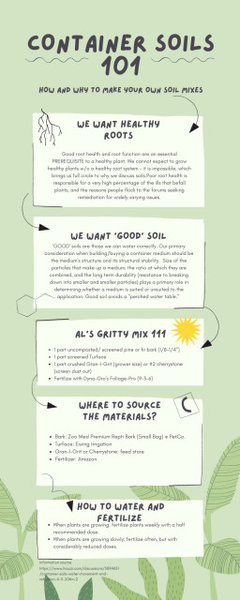 tapla (mid-Michigan, USDA z5b-6a) thanked Chris Jacobie
 - tapla (mid-Michigan, USDA z5b-6a) thanked tropicofcancer (6b SW-PA)
tapla (mid-Michigan, USDA z5b-6a)
Original Author5 years agoStrong work, Chris. Thanks for adding to the group effort to be helpful - much appreciated.
Al 5 years ago
Thanks so much AI and others - I'm a beginner and I've learned a huge amount by reading through all your various posts.
Could someone please help me with this issue: I have 150 litre half wine barrels that I want to plant pittosporum tenuifoliums in. I want these plants to last as many years as possible and have treated the half wine barrels to last. I had decided on AI's long term 1:1:1 gritty mix with one part pine bark, which you can get here in Australia in the right size from the orchid growing suppliers. It's supposed to be good quality pine bark from New Zealand. But now I've read that pine bark is acidic, which orchids like apparently, but not pittosporums. My pittosporums need acid neutral soil (pH 6.0-6.5). I've read that you can add limestone to raise the pH level but I wouldn't know how to go about incorporating this into my gritty mix. Very grateful for any advice.
- 5 years ago
Chris: Could send a link to a high resolution version of your infographic? With your permission I would like to use in our local bonsai society. You can message me directly if you prefer.
Lindy: You do not need to worry about Ph of gritty mix. It will be slightly acidic and will serve your purpose. Peat is more acidic and needs Ph adjustment considerations. Plus bark is only a third of the final mix by volume. What will be useful is to add some gypsum to the mix - 1 tablespoon per gallon. Mix that well into the mix and leave it alone for a day or two before using. Gypsum provides both Ca and Mg without altering the Ph. I use gritty mix like this for many of my plants. You will be fine. - 5 years ago
Thanks a lot for your advice tropicofcancer. I'm a bit more relaxed now. Today I've been reading a bit about gypsum and I see that, while it provides calcium, it doesn't alter the pH, as you also mentioned in your response. It seems that plants have other reasons to like or not to like an acidic soil, apart from the nutrients in them - not that I have any idea what that's all about. But anyway, there is another product, Dolomite (or dolomitic lime) that provides calcium and magnesium AND also neutralises the soil. What about adding that to my gritty mix instead of the gypsum for my acidity hating pittosporums? It's not as soluble as gypsum though, but maybe the tablespoon per gallon formula would be enough to counter the acidity as the pine bark decomposes. What do you think?
Thanks again. - 5 years ago
Lindy: From my reading on the plant: pittosporum tenuifoliums it seems it can thrive in acidic to alkaline soils. I could not find any info on specifically that it likes alkaline soil or hates acidic soil.
Bark is only slightly acidic and if you are using soluble fertilizers your plant should be OK. And I so far I have not found that to be a problem. But I have not grown the plant in question.
If you do still want to raise the Ph then you can use dolomite. It will at most bring it up to neutral Ph of 7. If you want to raise even further then you have to use other means. But it is not necessary really to go over 7.0. Also remember that your tap water may already be alkaline. - 5 years ago
Thanks a bunch Chris. It took some messing around but got a 1024x2560 png image.
- 5 years ago
Many thanks tropicofcancer. The conversation with you has been really valuable, not just in terms of the information but also the sharing instead of battling through these issues alone.
These pittosporums don't want an alkaline soil, just acid-neutral (pH 6.0-6.5). So a bit of the dolomite might be the way to go. I haven't got my fertilizer figured out yet - we don't have AI's preferred one here in Australia - so that might have a role to play.
I don't actually know, but it's likely my tap water is acidic because Australian soils are acidic. But thanks for pointing me to this aspect.tapla (mid-Michigan, USDA z5b-6a) thanked Lindy - 5 years ago
@tapla (mid-Michigan, USDA z5b-6a) would you recommend your 1-1-1 mix for a Staghorn Fern in a hanging basket? Or should I go with 5-1-1 or something different? This fern was a gift from my father-in-law a few years ago before I cared about plants. Best I can tell, it is planted in sphagnum moss and there's a coir basket liner. It's growing great right now (just put out a new basal frond) but the moss is looking really tired and, like I said, it's been in this soil for 2-3 years.
- 5 years ago
If you do mind me answering Chris:
I have not grown one myself. But since they are epiphytic plants I would think a a chunkier version of 511 will do quite well. This is my version: no peat and the bark is 1/8 inch and up - so no bark dust either. A bit of sphagnum moss can be mixed to sort of hold everything together and still keep it very porous. I use this mix for other epiphytes such as holiday cactus and Hoya and they do quite well.
- 5 years ago
@tropicofcancer (6b SW-PA) of course! That makes sense.
How big are we talking on bark? Like just a bag of nuggets with the 1/8" and smaller stuff sifted out? - 5 years ago
I usually limit to 1/2 inch max. You can use some bigger pieces if you have a large plant with larger root system. Nuggets are usually too large. You can look for bark at orchid supplies. Pet stores carry something called Repti bark which is already sifted. I believe they have two grades - small around 1/4 and larger around 1/2 inch. Amazon also carries Repti bark. In general Repti bark is more expensive. I buy bags of pine bark mulch from Agway. If you have a Agway store nearby check with them. The Agway bark is dust to 3/4 inch or so. Or look for bags of pine bark conditioner or pine bark fines around you.
Remember that you will have to water a bit more often with such a well draining mix but you get very healthy plants too. I have a rabbit's foot fern that quickly becomes huge and I have to split it every Summer.
- 5 years ago
@tropicofcancer (6b SW-PA) okay, that clarifies it. Thank you!
The extra cost for repti bark is probably fine for this one plant.
If I had a bunch to re-pot, that would add up quick!
No Agway's around here. Looks like there's one outside of Pittsburgh but that's a 23 hr. drive. Hardly worth it for the savings haha - 5 years ago
Wow. I am in Pittsburgh - lol. I think Agways are mostly North east thing. But keep a lookout. At one point the big box stores used to carry decent bark. Now they do not. But some local nurseries carry products like PB Fines or PB conditioners and both are usually suitable size. Landscape supplies places may be another source. Anyway let us know how your plant fares.
- 5 years ago
I am looking to use the gritty mix in a 600 litre/160 gallon pot outside to grow a Paw Paw tree. Anybody have any insight into if this would work or if I would run into any trouble?
I also live in a cold climate (Toronto) so it can get down to around -15c/0F. Would the porous nature of the gritty mix affect how low the soil temperature gets?  5 years ago
Hi Al, my head hurts from learning from this much information on this post, but it will make me stronger 😁.
I have a baby 1.5' m. Alba tree transplanted in a HUGE 35 gallon "root pouch". No drain hole because the whole bag is essentially a draining machine. How does this factor (plus a lot more soil than what a baby tree needs) change my watering requirements? Do you still recommend flushing 20% , when water keeps going out on all sides of the pouch (theoretically)? My first problem is that I have no idea how much water I dispense when watering because I use a garden hose. My second problem is I don't know how much water I SHOULD use in that much soil. So far I water lightly (shower setting) when soil 2" down feels dry. I stop based on my "mood", but it is very possible I am under watering?
Looking forward to your advice. Thank you!tapla (mid-Michigan, USDA z5b-6a) thanked RoseMe SDtapla (mid-Michigan, USDA z5b-6a)
Original Author5 years agoHi Al, my head hurts from learning from this much information on this post, but it will make me stronger 😁. Well, are you sure you read it all? After a given number of replies to a thread, Houzz/ GW starts to archive the replies. Since the post was too long to fit in the opening text bux, I had to use 2 'reply' boxes to get it all done. See all 3 pages here.
I have a baby 1.5' m. Alba tree transplanted in Probably not. If you use the top 3 inches of the medium to guide you toward an appropriate interval between waterings, you're more likely to be over-watering than under-watering; this because (depending on your medium's tendency to hold water) the lower reaches of the pot might still be very wet when the top 2 inches are dry.entially a container that dries out faster than a container considered more 'conventional, like a nursery can. If it is resting on soil, which acts as a giant wick, from the perspective of hydrology it would be a raised bed and virtually impossible to over-water unless it rests in a depression above clay soil. Do you still recommend flushing 20% , when water keeps going out on all sides of the pouch (theoretically)? How often you should flush the medium is linked to how closely the ratio of nutrients in your fertilizer matches the ratio at which the plant actually uses/ takes up the nutrients. If you're using Foliage-Pro 9-3-6, a flush every other week or so is fine. If you're using something like 10-52-10 which supplies far far too much phosphorous, it would be best to flush before every fertilizer application. My first problem is that I have no idea how much water I dispense when watering because I use a garden hose. Precision isn't a priority. First priority is that you wet the entire soil mass when you water, which in itself almost guarantees you'll be at least partially flushing the medium each time you water. I suggest you buy a water break hose end fitting so you're covering the entire surface of the soil when you water. That does the best job. This tool is expansive, but it does a great job, even at very low pressure: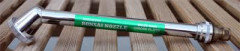
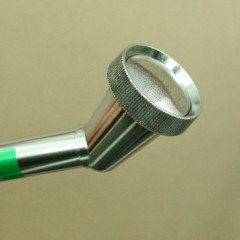
It's made by Masakuni.
My second problem is I don't know how much water I SHOULD use in that much soil. If your grow medium is one conducive to good root health, and because they dry down so quickly (a good thing in most cases) it should be very difficult to over-water plants in a grow bag. So far I water lightly (shower setting) when soil 2" down feels dry. I stop based on my "mood", but it is very possible I am under watering? Probably not. If you use the top 3 inches of the medium to guide you toward an appropriate interval between waterings, you're more likely to be over-watering than under-waterting; this because (depending on your medium's tendency to hold water) the lower reaches of the pot might still be very wet when the top 2 inches are dry.
I very often point out how using that metric as a trigger to water is not a good strategy for the reason already outlined. You could try using a "tell" to probe the soil mass when you think it might be time to water. That will likely reveal some surprises unless you're already using a medium that holds little in the way of excess/perched water.
Al
- 5 years ago
@tapla (mid-Michigan, USDA z5b-6a) haha my brain has exploded partially so since last night's continued reading so let's just use one case to get me back on track. This is the baby I am nursing, hopefully to adult. I have a stick I can use as a tell (same as the support stick here) but I am afraid to break baby roots with it. Also, since the tell goes through all layers of soil before it reaches bottom
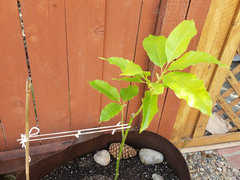
how can it tell us moisture differentials on different levels?
- 5 years ago
I appreciate all the great information I got by reading through these 16 years of boards discussing water flow and potting mix. This came after I first rushed in not knowing about container water flow and used garden store potting mix in all my new patio containers. I know.
While I confess to skipping around and not completely reading everything, one thing appears to be missing, and that is discussion of safety in mixing the components of the gritty mix.
While I am new to gardening in containers, I am not new to material handling safety. It is a very important part of being a custom jeweler. Allow me to explain.
I carve wax models of jewelry, anything from rings to pendants, sometimes earring (though more likely to be fabricated than cast). The exact engagement ring I drew is now a life scale model out of hard carving wax that can be filed, milled and drilled for review and approval. Customer comes in and says that is amazing, take our money.
After they leave I tree it up with any other final wax to be cast. By treeing I mean using a hot wax pen to attach one end of a wax rod to the target wax and the other to a main larger wax if there are others of same metal, or direct to a rubber base that I will get to. This rod will be path for the molten gold or silver geting from my crucible above to the target void below.
Once treed to the rubber base, a collar, like a coke can with both ends removed, is placed around the wax tree and the rubber base has lips that seal around the collar. Then I mix the investment to pour around wax while liquid then be fired to a hard porcelein mold.
PUBLIC SERVICE MESSAGE
What I mean by investment is the silica-containing powder that is mixed with a precise amount of water to become a paste that then seals off into a solid in about ten minutes. Everything from pottery to china to porcelein in some fashion uses the ability of silica to fuse to itself to turn a malleable material into a hard one capable of containing liquids.
From urns holding water to jewelry and dental lab molds containing molten precious metals. The raw powder is very dense. During its handling, from scouping the material from a sealed bin to a scale, then slid into a large rubber mixing bowl where a deathly cloud of smoke would rise containing silica. When I had my own store I used a partial face mask with particulate side cartridges. When I managed the shop of a major retail jeweler we were required to have active ventillation, meaning a hood to outside, and N95 mask at minimum during the investment mixing process.
We then took the rubber base off the hardened mold and put in the kiln, ramp up the temperature to I recall maybe 1200 but dont quote me. After the wax inside the porcelin melted off around 300, there became a hole where the wax was. I then heat in a crucible and pour molten metal into that void after removing it from then kiln, making what was wax, 14k white yellow or pink gold. Then cut off the jewelry from the rods and buttom, and put the excess button away to be used in next cast.
Long I know. The point is that when I recently bought Turface on Etsy, I got a broken down quantity from a larger lot, the definition of retail. I then wanted to see if I could get a whole bag of Turface, since they sell them to people responsible for baseball diamonds, they can't be that choosy. I did get one, but the point is I read the Safety Data Sheet, that boring document no one reads. While Turface is generally regarded as safe, it does have one large warning:
GHS Hazard Statements:H335 - May cause respiratory irritation
GHS Precautionary Statements:P201 - Obtain special instructions before use.
P202 - Do not handle until all safety precautions have been read and understood.
P261 - Avoid breathing dust.
Ingredients:Cas# % Chemical Name
---------------------------------------------------------
14808607 3-5% Silica, crystalline quartz
It gives a lot of technical details about what constitutes acceptable levels, but I do not care. The issue is the silica particles are so small they become a lifetime burden leading to silicosis. I argued with a lot of very old and top talented jewelers while I was manager as they scoffed at the idea of hazard safety, but it is very real.
When I mixed a larger batch of the gritty mix, the Turface and cherry stone caused a cloud that persisted outside for three to four minutes on a relatively calm day. Realizing this was free silica I kept stopping, leaving the bucket to settle, or moving to new areas on our patio.
I fear that a lot of people here are mixing quantities of mix using these silica containing materials but not knowing to actively avoid breathing the dust.
Please take your own safety into consideration and do your mixes outside and avoid breathing the dust! - 5 years ago
To follow up on a couple of points: The collar containing the fired investment still contains free silica once broken, somilar to the post-firing Turface. To avoid the free powder after the cast is complete, we can quench the still hot collar in a bucket of water so the investment breaks away from the metal without raising silica dust into the air. When quenching is not advisable, such as with white gold (which gets brittle if cooled so quickly), then the mask and ventilation is needed and the investment is broken by hammering around the collar to release the casting. The lesson being, the dust that rises from pouring the Turface is no safer due to the prior firing.
Also, this is not just about Turface. The Cherry stone grit also has silica in it and the packaging provides similar warning to avoid breating its dust. - 5 years ago
Turface issue:
I have 5 plants in 8" pots that will need full repotting (including root pruning) next year: three ficus benjamina, one schefflera, and one overgrown dracaena. I'd like to put them all in gritty mix, but my small apartment & lack of access to outdoor space create serious problems with the ingredients (sifting indoors coats every surface with a thick coat of dust. I've found graded bark online, and bonsai sources have grit. Both are $$$$$ plus shipping for, say, 5 gallons, but would at least work.
The problem is sourcing the same quantity of turface, and totally stuck out on getting it from landscapers and the like here in Salt Lake..
So, does anyone know of an online source that would sell me several gallons of graded turface, or of any other other absorptive pH neutral material? tapla (mid-Michigan, USDA z5b-6a)
Original Author5 years agoProfile (they package Turface) packages a horticultural grade of Turface which is larger than Turface MVP and prescreened. I'm not sure how you would find it in stock in Utah, but because of its high bulk density, shipping is a large part of the price when ordered onesy twosy online.
Enter your city/state on the Turface Finder to find multiple sources near Salt Lake.
Al
- 5 years agolast modified: 5 years ago
Al,
Is the horticultural grade called something in particular?
And do you know if those are the giant bags of turface? The problem isn't finding Turface, it's finding it in smaIl quantities because don't have room to store them (again, little apartment with no garage or outdoors space, just a small storage locker), and it would take years to use them up with my collection of five plants, which is why I'm looking for smaller amounts. I called around town last time and places like Ewings weren't interested in sharing a small quantity with me, as they usually deal in large quantities. I ended up buying a bag and throwing more than 3/4 of it away when I downsized a few years later. - 5 years ago
Here is the shop on Etsy where I ordered a smaller quantity of Turface MVP:
https://www.etsy.com/listing/805140258/horticulture-grade-turface-mvp-high?ref=yr_purchases
The largest size for singe shipment is 39 cups, At 16 cups per gallon, it is about 2 1/2 gallons. So you would need two orders for about $72 total. tapla (mid-Michigan, USDA z5b-6a)
Original Author5 years agolast modified: 5 years agoLB - it appears there are a multitude of entities selling small bags of repackaged Turface MVP just as it comes from the 50 lb bag, fines included, and calling it "horticultural grade Turface". The product Profile packages is around 5 lbs and is pre-screened, but I'm unable to find it. My suggestion would be that you buy a screened product. You can find prescreened calcined clay at American Bonsai in FL. Follow the link and scroll down to the product, which comes in several sizes. Here is a screenshot to help you relate a dimension to their screen sizes:

Al- 5 years agolast modified: 5 years ago
Since I am new to Al's gritty mix, I got to start fresh looking for sifting solutions for the Turface. I thought I would share what I found. It may be useful to others, or it may be me doing it wrong and you can let me know.
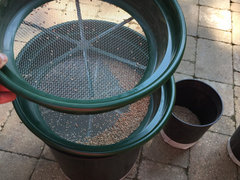
I ordered these screens off of Etsy, https://www.etsy.com/listing/1019347355/18-classifier-sifting-pan-stainless?ref=hp_rv-4 for about $28 each. I got the 1/8 and 1/12 sifter. They stack and are advertised to fit in a 5-gallon bucket. I don't have that but it fit in one of the larger planters I have. It is fairly easy to rock the bucket/sifters and the Turface grades pretty quickly.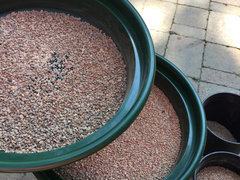
This is the material sizes you get:Complete dropthrough fines
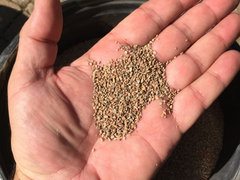
Caught by 1/12 screen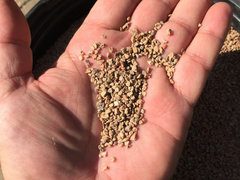
Caught by 1/8 screen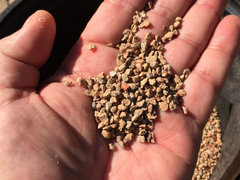
Because a significant amount falls through as fines, I decided I would use the two larger sizes and just sift with the 1/12 screen to separate the fines. This leaves a mix that looks like this: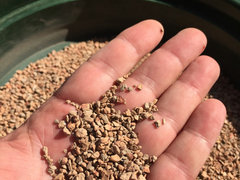
Hopefully this is not too great a variation in size and I hope you let me know. But if I sift to only use the largest size, then a significant amount of a 50lb bag of Turface is not usable. Here is the breakdown of the amounts I got.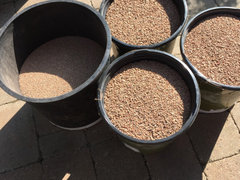
For the amount I sifted to both screens, I got a huge amount of fines (on the left). Two pots of the 1/12 sift, and only one pot of the larger 1/8 sift. That is not much useable material unless I accept everything but the fines.I am planning to use the fines in the drainage for another rain garden I am planning as part of an absorbent filter along with maybe a thick layer of peat moss. My theory is the layering of Turface with peat will help excess rain filter more efficiently into the ground. We have pretty heavy clay soil in our area.
tapla (mid-Michigan, USDA z5b-6a)
Original Author5 years agolast modified: 5 years agoChamaegardener - this is useful info, but I'd like to ask you a favor, if it's not too large an imposition. Would you please repost it to the latest thread which was posted 8/26/1?
Houzz starts to archive replies once a thread reaches a certain number of posts, 100 or 150, I think. Because the OP is so long I had to use the first 2 text boxes under the OP, which means parts 2-3 are hidden from view. Normally, I write a little blurb saying there is a new post and contributors should post there, but I must have been in to much of a hurry when I reposted the most recent thread. Sorry for any imposition. Here is the Here is the link to the new thread.
https://www.houzz.com/discussions/6167237/container-soils-water-movement-and-retention-8-26-21#n=6
tapla (mid-Michigan, USDA z5b-6a)
Original Author4 years agoPlease note: Houzz starts to archive replies once a thread reaches a certain number of posts, 100 or 150, I think. Because the OP is so long I had to use the first 2 text boxes under the OP, which means parts 2-3 are hidden from view on this thread unless readers make the effort to figure out how to access the additional info. Several have mentioned they can't find the rest of the OP, so I'll try to be better at reposting the thread once Houzz archives parts 2-3.
Here is the link to the new thread, or, click the link below.
https://www.houzz.com/discussions/6167237/container-soils-water-movement-and-retention-8-26-21#n=6
Thank you ~ Al




tapla (mid-Michigan, USDA z5b-6a)Original Author