Software
Houzz Logo Print
stephfull

Fiddle Leaf Fig Pruning

6 years ago
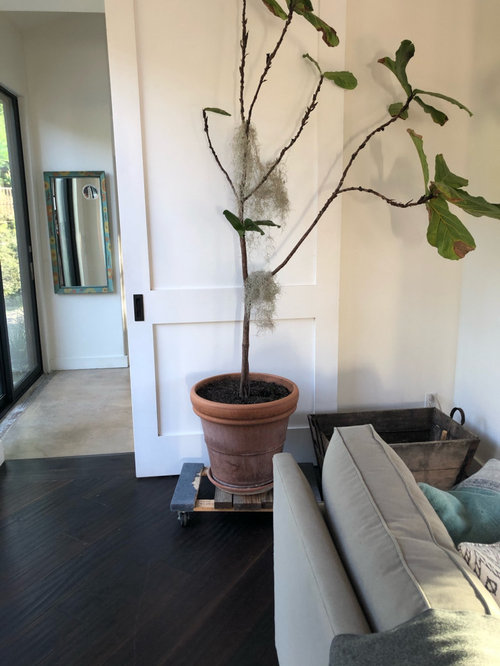
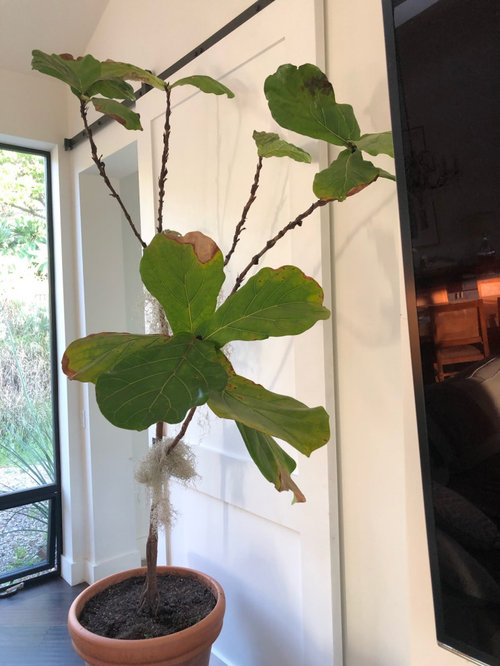
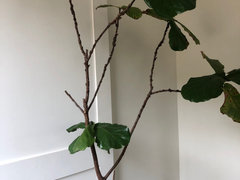
My FLF is not great and I think in need of hard pruning but not sure where to cut. I have recently repotted carefully separating the roots after being quite root bound. The leaves are brown on edges due to confirmed overwatering. The three newer leaves on the lower trunk are encouraging. I need help with where to cut these branches back.

Comments (11)

  • 6 years ago

    Plants make their own food (sugar) during the process of photosynthesis, and each leaf represents an individual food factory. Your tree doesn't have enough as it is, so pruning at this time would be a decidedly counterproductive move. It needs all the help it can get.


    I'm not sure what the future holds for your trees. They look over-potted (in too large of a pot) and the growing medium looks very water retentive. If you rely on the advice to 'water when the top inch or two of soil is dry' you will undoubtedly be over-watering. You'll need to keep your watering tightly controlled and the only realistic way to do that in so large a pot is by using a 'tell' (see below). The color of the foliage also leaves me to wonder if you're fertilizing, something essential to potted plants?


    Using a 'tell'

    Over-watering saps vitality and is one of the most common plant assassins, so learning to avoid it is worth the small effort. Plants make and store their own energy source – photosynthate - (sugar/glucose). Functioning roots need energy to drive their metabolic processes, and in order to get it, they use oxygen to burn (oxidize) their food. From this, we can see that terrestrial plants need plenty of air (oxygen) in the soil to drive root function. Many off-the-shelf soils hold too much water and not enough air to support the kind of root health most growers would like to see; and, a healthy root system is a prerequisite to a healthy plant.

    Watering in small sips leads to avoid over-watering leads to a residual build-up of dissolved solids (salts) in the soil from tapwater and fertilizer solutions, which limits a plant's ability to absorb water – so watering in sips simply moves us to the other horn of a dilemma. It creates another problem that requires resolution. Better, would be to simply adopt a soil that drains well enough to allow watering to beyond the saturation point, so we're flushing the soil of accumulating dissolved solids whenever we water; this, w/o the plant being forced to pay a tax in the form of reduced vitality, due to prolong periods of soil saturation. Sometimes, though, that's not a course we can immediately steer, which makes controlling how often we water a very important factor.

    In many cases, we can judge whether or not a planting needs watering by hefting the pot. This is especially true if the pot is made from light material, like plastic, but doesn't work (as) well when the pot is made from heavier material, like clay, or when the size/weight of the pot precludes grabbing it with one hand to judge its weight and gauge the need for water.

    Fingers stuck an inch or two into the soil work ok for shallow pots, but not for deep pots. Deep pots might have 3 or more inches of soil that feels totally dry, while the lower several inches of the soil is 100% saturated. Obviously, the lack of oxygen in the root zone situation can wreak havoc with root health and cause the loss of a very notable measure of your plant's potential. Inexpensive watering meters don't even measure moisture levels, they measure electrical conductivity. Clean the tip and insert it into a cup of distilled water and witness the fact it reads 'DRY'.

    One of the most reliable methods of checking a planting's need for water is using a 'tell'. You can use a bamboo skewer in a pinch, but a wooden dowel rod of about 5/16” (75-85mm) would work better. They usually come 48” (120cm) long and can usually be cut in half and serve as a pair. Sharpen all 4 ends in a pencil sharpener and slightly blunt the tip so it's about the diameter of the head on a straight pin. Push the wooden tell deep into the soil. Don't worry, it won't harm the root system. If the plant is quite root-bound, you might need to try several places until you find one where you can push it all the way to the pot's bottom. Leave it a few seconds, then withdraw it and inspect the tip for moisture. For most plantings, withhold water until the tell comes out dry or nearly so. If you see signs of wilting, adjust the interval between waterings so drought stress isn't a recurring issue.


    Al


  • 6 years ago

    Thank you, Al. You may not remember, but we spoke and you had me put the tree back in the original 15gal nursery pot and use your gritty mix. I got the Dyna-pro fertilizer and am now only watering once every two weeks or so and using the fertilizer when I water. I am using your tell method. I am happy to report that I have 6 new leaves (soon to be 7) that are growing on the main trunk, lower down. We are still in a sad state, but I am taking this as a good sign. If and when to prune remains to be seen so I would love any input on that front now that I have some new growth. You're a tremendous resource!


  • 6 years ago

    I would cut the stems off about 5-6 leaf nodes below the lowest leaf on each, and put them in water for about a month, then once roots are established, put them in dirt and you will have a few new little trees! Of course you don’t need to do this, but instead of an etiolated large tree, you will have healthy babies!

  • 6 years ago

    You might do that, but I say pruning off a struggling plant's photosynthesizing machinery is a wonderful example of a bad idea.


    Stephfull - I don't remember our exchange precisely, but it sort of rings a bell. At any given time I probably have at least 20 different conversations going re trees in pots, so you can imagine how hard it might be for me to keep each conversation straight in my mind. I often can't even manage it when it's a current conversation.


    It's good your plant is in the process of reversing course. I suggest you remain patient and plan on pruning sometime in mid to late spring, after the tree has recovered enough to build-up some energy reserves. When it's time to prune, stop back and we can talk about pruning off winter growth and starting a pinching program that will ensure your tree ends up looking full and compact. Until then, be sure to give it all the light you can ..... just don't move it to a full sun abruptly w/o acclimating it.

    stephfull thanked tapla (mid-Michigan, USDA z5b-6a)
  • 6 years ago

    Is it unusual that I waited about one month between waterings using the "tell" method? I kept feeling slight moisture and, given that I nearly killed the FLF from over-watering, I'm now a bit nervous to water too often but a month just seems like a long interval.

  • 6 years ago
    last modified: 6 years ago

    It IS a very long interval. Most sites you visit for advice recite the cookie cutter advice to "Water when the top inch or two of the soil is dry" or "Water when the top of the soil is dry to the second knuckle like a mantra. I wonder how many millions of plants had their fates sealed by that advice? If your pot is 10" deep and the top of the soil column has just reached the point where the top 2" of soil feels dry, the bottom 6" of soil is as often as not, 100% saturated. That means that it's closer to the rule than the exception that growers are watering when somewhere near 60% of the soil column is still saturated; and, that's not a good arrangement, from the plant's perspective.

    The tell doesn't lie. If you're still reading moisture on the end, the leaves are cool to the touch, and the plant isn't wilting, you can imagine how much potential is being lost while the plant is drying down to the more appropriate ratio of air to water in the medium. For as long as water occupies space between soil particles at the bottom of the pot, excess water is a limitation. Personally, if my plants are able to go more than 3 days w/o watering, I know I'm losing potential in areas like growth, appearance, o/a vitality, and defense against insects/diseases.

    If you're serious about giving your plants as much opportunity as possible to realize as much of their genetic potential as possible, you might want to consider taking a closer look at the medium you're using. Choice of medium can reduce your watering intervals from 30 days to 3 days over-night. Then you KNOW you've got the grow medium working for you instead of against you.

    Al

  • 6 years ago

    Thanks, Al. Earlier on this thread I wrote that I am using the gritty mix (which you talked with me about on the phone) and I have a brick ballast which you again advised me to use. So it appears all my conditions are correct with cool leaves and no wilting so then I do not understand this: "If you're still reading moisture on the end, the leaves are cool to the touch, and the plant isn't wilting, you can imaging how much potential is being lost while the plant is drying down to the more appropriate ratio of air to water in the medium." So I may revisit how I am "reading" my tell - when i pull it out it is cool and slightly damp but not really wet.

  • 5 years ago

    Goodness -- a 'tell' -- just get a water meter! Instant green thumb. No weight lifting. Unambiguous.


  • 5 years ago
    last modified: 5 years ago

    Logic 101: Our reasoning would benefit significantly if by habit we never accept the proposition that because a solution seems to satisfy a problem, it must follow that it is the rightful and only solution.

    Al

  • 5 years ago

    Al, Al always words of wisdom. Hated your opinion on Hot Topics but loved them in Container gardening. There are three main root types air, water and soil. If you create an environment that makes the plant try and grow two or more different roots in the same environment it wastes the plants energy. They die, so root rot. As far as the plant goes let it dry out till you can stick two knuckles into the dirt. Then if you want a bushy plant cut it back to 6" per branch. If you want something leafy but thinner cut it back to 18" per branch. Either way you'll have cuttings to play with. After you prune it place it in bright light because it's the right time of year. You'll have an amazing plant by Fall.