Software
Houzz Logo Print
lplantagenet

Teas with Beautiful Form

6 years ago

Which Teas or Tea/Noisettes have the perfection of form and superb fragrance comparable to the form and fragrance of old European roses?


Lindsey

Comments (19)

  • 6 years ago

    Old tea roses frequently do not have strong fragrances, although most have some. Ditto noisettes. So, it is not a question of "which" teas and tea/noisettes are as "perfect" as the old European roses. It is more, IMO, a matter of climate, and which type of rose likes the climate where you garden, and roses which have almost continuous repeat bloom, vs those which do not. Here is what I mean:


    1) Teas and Tea/noisettes re-bloom from early Spring to Winter, in the warm climates which they prefer. It is my understanding that almost all of the old European roses only have a (large) Spring bloom.


    2) In my warm climate, and I believe in many other warm climates (which teas and tea/noisettes love), there is not enough "winter chill" for many old European roses to thrive. So, in those climates, not only do they not repeat, many are not happy at all.


    3) Form - I am not familiar with the "perfection of form" of old European roses, because I cannot grow any. The "form" of many tea roses is free standing, LARGE rose bushes (most of mine will get 8 ft by 8 ft by 8ft, again in the warm climates they prefer. Most of mine form a rounded, dense bush if left to their own devices. Of course, some of the tea/noisettes are very tall climbers, so their form is dictated by how tall they get and what support they are growing on.


    My point is not that one type of rose is better or worse than the other, but that they are entirely different. I would love to grow old European roses if they liked my climate. I have many once blooming roses which I love, but they are the warm climate loving types: banksias, hybrid

    giganticas, and ramblers. IMO if you concentrate on growing roses which LOVE the climate conditions in which you garden, you and the roses will be happy. Happy roses are the most beautiful.


    Jackie


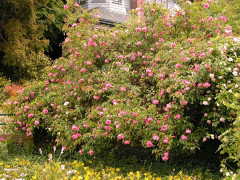
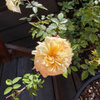
    P.S. The above pic is an old tea rose (some argue that it is a china rose, which is also a very old re-blooming for 10 months warm climate loving rose) called Le Vesuve which grew in my garden for 20-30 years with NO CARE whatever, after being there for at least 40 years before that. It turned out that this massive rose was actually two bushes (it tip rooted itself as far as we can determine), but you can see the form of a tea rose which is left to itself.


  • 6 years ago
    last modified: 6 years ago

    Jackie, I may be assuming too much, but I think the OP was talking about the *flower* form, not the bush shape. But the same generalities hold. They are apples and oranges.

    Lindsey, the true teas tend to have those long, high-centered "perfect" buds associated with florist hybrid teas. After all, that's the genetic basis of the hybrid tea form. They also are called 'tea roses' because their scent is a subtle herbal smell, often quite like real tea. You won't find the classic "rose" scent except in the rare variety. It's more likely to appear in the hybrids with other rose types. The teas were mostly crossed with hybrid perpetuals to create modern hybrid teas...some which have the classic damask scent.

    The old European roses are the look you see (and smell!) in Austin's modern English roses. He used those old roses with a zillion petals and fabulous scent, often crossed with newer varieties, to produce his "new antique" roses. There are a few teas with hundreds of petals, but they tend to frill, cup or reflex, not hold the rounded, mostly flat form of the gallicas, centifolias, damasks, portlands, etc.

    You'll have to be more specific about what you consider "perfection of form", and which scent you're looking for, because the tea bloom is generally different from the old European rose form, and the scents are entirely different. If you're looking for "old rose form" and scent, then Austin-type roses are what you're looking for.

    You don't say where you are, and it may be that you can only grow one type or the other. I'm lucky in Z7 that I have enough winter chill to grow the old garden roses, yet warm enough winters that I can grow a great number of teas.

    John

    Edit: I forgot to mention, that a few of the hybrid perpetuals have *almost* tea flower form, with heavenly perfume. Likewise, many of them have "old rose" form, still with the classic scent. However, the HPs tend to be very leggy, with blooms at the top of the canes, unless you are very careful with pruning. Unfortunately that's a trait hybrid teas inherited from them, the "flower on a stick" look, lol. So, hybrid teas got their looks from the teas, and their legs from the HPs.

  • 6 years ago

    I am zone 7--VA Spice, Safrano, Devoniensis, and Madame Lombard have done reasonably well, but my other teas have declined and eventually died.


    Devoniensis and Lamarque exhibit the beauty of form I have in mind and both are fragrant. I would be interested in hearing about others comparable to them that might do well in my zone.

    Old European once-bloomers are my favorites--they are clean, hardy, fragrant, beautiful, and require nothing but sun and cold to put on a glorious display. They usually produce garden-worthy seedlings, too.


    Lindsey

  • 6 years ago

    There's another question . . . What do you consider to be "Perfection of Form"??


    The "perfect form" is a matter of personal taste or education.


    I once entered a Tea Rose -- 'Marie van Houtte' in a rose show -- though it was really only at the opening bud stage, which isn't "perfection" in a Tea ... though it is for a HYBRID Tea.


    I entered it, because the entry was sparse, and it was my own Society's show, and I wanted to maximize the entry. I figured it would look great tomorrow.


    To my complete embarrassment, it was awarded Victorian Queen.


    The judge who had voted for it came up to me and told me that she'd had no idea that a Tea could have ". . . such perfect form."


    I must have looked as embarrassed as I felt, because she said: "Don't tell me . . . It isn't SUPPOSED to look like that?" And I nodded my head.


    So --- What image is in your mind, when you ask about "perfection of form"?


    To ME, this is "perfect" for THIS Tea Rose . . .


  • 6 years ago

    I don't think there is only one perfect form. I mentioned Devoniensis and Lamarque as examples of beautiful form. order, regularity, formal arrangement of petals, quartering, button eyes, are all beautiful as well as the somple regularity of the almost singles roses like Officinalis. I had in mind what I think growers of the early 19th century had in mind when they aimed to combine the repeat bloom of Chinas with the formal beauty and fragrance of European roses.


    I have in my garden now a seedling which I raised some years ago and which I think most would agree exhibits perfection of form. I believe it is one of several Rose de Resht seedlings I raised that year and its form suggests that the pollen parent may have been the Duchesse de Montebello. Both open as cups tightly packed with petals, quartering toward the center, and a button eye at the center. My seedling has red buds and flower of a lovely coral shade.


    Lindsey

  • 6 years ago

    Hi Lindsey,


    This thread is from a while back, but it does discuss OGRs that grow well in DC, Maryland and Virginia.


    https://www.houzz.com/discussions/2019462/old-roses-that-do-well-in-dc-maryland-va


    Carol (on the other side of the continent)

  • 6 years ago

    Lindsey, I'm getting ready to call it a night, but I've still got Teas on my brain and wanted to mention a couple of cultivars that produce blooms which are almost Bourbon in character. Both Mrs. BR Cant and Rhodologue Jules Gravereaux offer up voluptuous flowers worthy of Victorian garden parties. I'd stack them against old European roses any day. I don't know about health in your zone, but I would think that these two beauties would grow just fine. My biggest gripe with Teas is that the plants are slow to fill out and can look a bit gawky for a few years, but once they come into their own, they are exquisite! This Gallica/Alba/Damask lover has nothing but high praise for Mrs. BRC and RJG. Carol

  • 6 years ago

    Thank you all for your comments. RJG is beautiful and reminds of of La France which I had briefly until it died. I also had Mrs. B.R. Cant, too, but it declined and eventually died. One oroblem may be that Teas and Chinas need good beds and softer soil with little competition from other plants. While the ground here is clean and fertile (everything sprouts, grows, and naturalizes) and free from all chemicals, there is plenty of competition from other plants. Most of the European roses aren't deterrred by it--I can't stop the Gallicas from running everywhere and invading each other's space--they provide competition of their own for every other plant.


    Lindsey


  • 6 years ago

    Teas and Chinas are tougher than that, but need heat. They grow with other plants.

    lplantagenet7AVA thanked Sheila z8a Rogue Valley OR
  • 6 years ago

    I think we have too much heat in summer, but then I don't like hot weather. Teas seem to do quite well at Hollywood Cemetery; however, my friend in Hanover said that teas never did well for her, and I notice that the Richmond Rose Society does not recommend any teas this area--only three Noisettes, several HPs, Portlands, and Bourbons among OGR repeat bloomers.


    Spice has done well for me--it's small, yet put on a lovey display this spring and Cl Devoniensis grew 20 feet or more unti it died back during a cold winter several years ago. Lmarque was smaller, but still quite large. Now the woods behind both have grown dense and with less sun, neither can achieve former size and quantity of blooms.


    Mme. Lombard does reasonably well, too.


    We have many large oaks and other big trees here which limit the amount of sun my roses can get.


    Lindsey

  • 6 years ago

    Le Vesuve is really impressing me so far. Beautiful blooms, foliage and graceful growth pattern. I was just thinking today looking at her, ”this is a must-have Rose!” 😊

  • 6 years ago

    Tea roses like warmth and sun. They grow happily with lots of other plants, and intertwined with other roses. So, I do not think that is the problem. I think the problem is that your local conditions are too cold (in the winter) and not sunny enough for them to thrive. In a climate they like they are the toughest roses I know - several old bushes in our garden were planted by my Dh's grandparents and even great grandparents, and lived to be over 100 years old, with very little care.

    Jackie

  • 6 years ago

    I think you might be right about the climate although one would not expect a great difference over 15-20 miles from Hollywood on the James to Hanover county; however, it is certainly true that most of my teas have failed to establish themselves and eventually die dduring winter. Spice, Lombard, Cl. Devoniensis, and Lamarque are exceptions, but the first two have never grown large.


    I made a mistake moving Safrano and Isabella Sprunt last spring when the weather was still cool.. They had been doing well enough in a protected location with insufficient sun but deer were eating buds and new growth regularly. Isabella Sprunt died and Safrano is still struggling. I had another Isabella Sprunt in a different place but it was small and died this winter (one of the warmest on records for Richmond)


    Average winter temperature here may be less of a problem than rapid temperature changes of 40 to 50 degrees in 24 hours, especially when this happens after four or five unusually warm days.


    Lindsey


  • 6 years ago

    In my area even in the Winter nighttime low temps are almost always in the 50s or 40s (degrees F). If it freezes, it makes the front page of the newspaper. So, my teas are all happy. Of course, they survive a period where a few nights get below freezing, but they do not have to put up with months of that. Many of them start blooming in January, with the fruit trees.


    Unfortunately, there has been over 100 years of the commercial rose industry giving people the wrong impression that one rose will be able to be grown in 100% of climate zones. This is nonsense, of course, but it encourages people to try, and then they get disappointed. An example - when we moved into our house there was a plant of 'Madame Hardy' in our garden. I immediately fell in love with the form of the bloom. However, the actual rose bush was tiny, and so I fed it, and tried to do everything I could to make it happy. For several years, it only had one cane. This was not a "one cane wonder" - this was one small cane, period. Every year in the Spring it produced one or two perfect blooms, never more. Then, the one cane would die back to the soil, and one new cane would come up the following year, and produce one or two blooms. It finally dawned on me, mostly from information gleaned on here, that it simply HATED the climate we are in (I am guessing because we have hardly any "winter chill"), and there was nothing "wrong" or "weak" about the rose 'Madame Hardy', it was just that I was trying to grow it in the wrong conditions. Later, I discovered the LFC Colonial White (aka Sombreuil, which is not its correct name, but is what it is "known as"). Anyway, I am not saying that those blooms are exactly like those on Madame Hardy, but they are close enough for me, and now I have a rose bush which produces literally thousands of them, for 10 months of the year.


    Jackie


    lplantagenet7AVA thanked jacqueline9CA
  • 6 years ago

    I have certainly gotten the impression that teas will do well anywhere in Zone 7 and often in parts of Zone 6. I am trying now to do better with those that are left, and it's interesting and perhaps not entirely coincidental that except for Lombard, they (Safrano, Devoniensis and Spice) are among the earliest--especially if Spice is a near-clone of Hume's Blush. My view has long been that the closer a plant is to its wild ancestors, the hardier it will be.


    Blush Noisette, Champneys', the Hickory Hill Noisette and Lamarque (in one location--itdied in the other) have survived and done well. Janue Desprez, Gloire de Dijon, Marechal Niel (which I bought from Pickering), and Chromatella died.


    Lindsey


  • 6 years ago

    Jackie -- It sounds like you went through the same process I did about the old once-blooming European Roses.


    The first books I devoured told me that "no garden was complete" without some of those roses. HUMPH! Those books were written in England -- not Coastal Southern California where we have ZERO chill hours!


    So I learned -- albeit unwillingly -- that remontant roses did better here.


    And let's not even talk about roses which have more -- or less -- tolerance for heat and drought!

  • 6 years ago

    When this thread began with a mention of "perfection of form" I was reminded of something Dean Reynolds Hole wrote in "A Book About Roses".


    I was too busy right then to look it up, but finally found the time . . . So here it is:


    " . . . Of course, I do not presume, reverting to the shape of a . . . Rose, to propose stereotyped definitions or uniform models. On the contrary, I am well aware that whether the surface of a Rose be globular, cupped, or expanded, and whether its petals be convex or concave, a perfect gracefulness of form is attainable . . . “

  • 6 years ago

    Jeri, I love that quote, and I will add that "perfection of form" is in the eye of the beholder! Ragged Robin is a rose whose form I love, for example!


    Jackie