Software
Houzz Logo Print
turtlegreen

Need help starting my lawn in Colorado Zone 5b

6 years ago
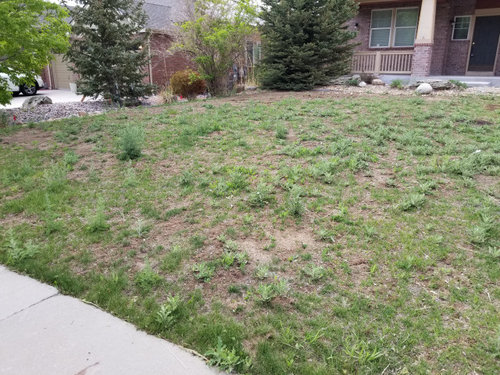
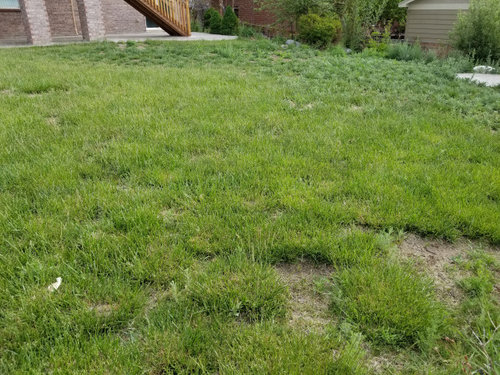
Hello, I’m looking for some help getting my lawn going. I just purchased a house that has been vacant for four years. As such, the lawn, or I guess I should say the place where the lawn should be, is mostly weeds. I attached some pictures of what it looks like. The back yard is better off than the front yard.


Picture of front lawn


Picture of back lawn


I guess first and foremost, what's the best way of going about this. I assumed using seed is the best cost alternative.


1. What grass seed mix should I use and where’s the best place to get it? The house is in Arvada, CO, which is a suburb of Denver. The lawn will get full sun and be played on by kids and a dog. The other houses in the neighborhood have these really lush lawns and that’s what I’m hoping to achieve.


2. I'm planning on pulling all the weeds. Do I need to use a weed killer of any sort? Would it be necessary to scrape off so much of the soil and bring in new soil? It should already be decent soil as I’m sure the developer brought soil in when they first planted the lawn. The back lawn has a lot of grass in it. Do I add seed to this?


3. Can I get a lawn going from seed in the summer? Or do I need to wait now until the fall?


Basically, what would you do to get a nice, lush lawn established?


Thanks for your help!

Comments (6)

  • 6 years ago

    I think with your location you can reseed even in the summer. You will have to watch the grass as it comes in for signs of drying out.

    With the lifestyle in play, you need a grass that will refill by itself after damage. Kentucky bluegrass is that turf for your area. It has the downside of often turning brown in the winter, so many people will mix it with fescue, which remain green in the winter.

    The front needs to be restarted. The back can likely be fixed without a complete renovation. If you have a lawn mower, mulch mow the front weeds at the highest mower setting to get a feel for how bumpy the surface is. Now would be the time to level the surface if it seems extremely bumpy. Believe me, a bumpy surface will make you crazy after awhile. Leveling the surface is relatively easy when you have a blank slate. It's a matter of scraping off the high spots and filling the low spots (with the soil you scraped from the high spots). Then watering to settle all the soil and rechecking for high and low spots. Use a drag to move the soil around. They use drags to tune up the infield surfaces on baseball fields and arenas for horse shows. You can DIY one with a board and some chain link fencing. If you run out of high spots to scrape off before you fill the low spots, then bring in some topsoil. I'm thinking by the bag, not by the cubic yard. Scatter, drag, water, repeat. Three times should be plenty.

    Once you have it leveled, start shallow watering on a daily basis to germinate all the weed seeds in the lawn. After a week, spray with Round Up to kill everything. Continue watering lightly for another week to get the weed seeds that take 2 weeks to germinate. Then spray with RU again. Give that dose a few days to work and then you can rake up the dead weeds everywhere. Then it is time to put the lawn seed down. By germinating all the weeds first, you should have a bare minimum of weeds in your new lawn. Scatter the seed, roll it down with a water fillable roller (rented), and continue with the light watering - this time to germinate the grass seed. Rye grass takes a week to germinate, fescue takes 2 weeks, and KBG takes 3 weeks to germinate. This means if you stop the daily watering after week 1, you'll have minimal fescue and no KBG at all. By the time the KBG finally sprouts, the rye will be going like gangbusters (that's probably not a saying anymore). When the grass gets up around 5 inches, you can mow it back to 4 inches (highest setting on the mower).

  • 6 years ago

    Thanks for the reply!


    How would you fix the backyard with a complete renovation? Add more seed everywhere? Or just take care of the existing grass it and let the existing grass spread? About a quarter of the backyard looks like the front, just weeds.

  • 6 years ago

    If the existing grass is fescue or rye, it won't spread fast enough for you or your children to grow up and enjoy. If it has some Kentucky bluegrass in it, then it will spread. I would reseed with a blend of fescue, rye and KBG.

  • 6 years ago

    I'd jus leave it. round it up and reseed in August. If anything, some milorganite now if you haven't fertilized this year.

  • 6 years ago
    last modified: 6 years ago

    I see Canada Thistle in the front yard. It is going to be a long haul to get rid of the Canada Thistle. You have to completely KILL the root system in order to get rid of your infestation. The roots can go up to 15 feet deep, and can grow up to 30 feet from one side of a house to another. I speak from firsthand experience. Last fall I moved into a rental house where the yard has been completely neglected for six years. In some parts of the back yard, all you can see are Canada Thistles.


    I highly recommend that you look up the USDA extension service at PENN State. Their recommended method is to keep cutting the thistle plants and forcing them to grow back (they DO grow back, within minutes, it seems!) to force the root system to wear out and die. Also, apply an herbicide in the FALL, (use Milestone, expensive, but bee and pet friendly). In the fall, the root system draws the plant essence and juices inward and downward. Herbicide applied a the right time will be naturally drawn right into the roots and will kill that plant-hive where it lives and thrives.

    I am sorry that you have to deal with the Canada Thistle. It is the demon-vampire of all weeds!!

  • 6 years ago

    We get Texas thistle, but controlling it is trivial compared to what you're talking about. With Texas thistle all you have to do is cut off the root about an inch under the surface and the plant dies entirely. A sharp shovel can clear a field of them pretty fast. If you get them before they go to seed they won't come back next year.