Software
Houzz Logo Print
travisaz

Rotate sunburned tree?

6 years ago
last modified: 6 years ago

Hi all,
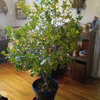
I'm growing some citrus trees (ruby red gf and Meyer lemon) in containers. This is their first summer and we've warmed up faster than usual this year. We've had several straight days close to 110 degrees.
I keep my citrus under my front east-facing front porch, so they get morning sun and are shaded by the porch in the afternoon. Still, I noticed some significant scorching on my leaves that are in direct sun.
I've pulled the trees back father under the porch so they get out of the sun sooner, but I'm wondering if I should also rotate the trees a little to give the scorched leaves a break. My concern in doing this is that I will just spread sunburn to more parts of my trees and end up losing even more leaves. Would it be better to leave the trees oriented as is so the already damaged leaves "take the heat" for the other leaves as long as the trees keep them?

Comments (8)

  • 6 years ago

    Will do, thanks Steve!

  • 6 years ago
    last modified: 6 years ago

    Rotating is good when you have low light levels and are trying to give more of the plant access to light. However, with scorching sun, I would probably not expose every side of the plant to it. Like you said, it will probably do more damage. Once your plant 'gets used to the sun' (it may actually have to grow new sun-tolerant leaves), then I would not rotate it over the summer.

    Travis in PHX (9b) thanked Dave in NoVA • N. Virginia • zone 7A
  • 6 years ago

    Thanks Dave!

  • 6 years ago

    Citrus definitely can be fine in super bright areas. I wouldn't rotate the trees. Sunburn/scald doesn't really heal. I've got the blacked stems on some of my trees still. The leaves have shed and been replaced. Many areas at your latitude or even more equatorial (and subject to more light) do fine for citrus (the resident commercial lemon grower on this forum in Guatemala for instance). Another option to help on the sun burning, is use kaolin
    clay sprayed on the exposed plant leaves, stems, fruit. It will
    reflect a percentage of the light to the degree of clay coverage. Think
    of it as plant sunscreen. Used more for organic insect protection (of
    peaches at some orchards I like to pick from), but would work fine
    solely for sun protection. A hard lattice is another option. Plants to adapt, but in pots, the plants are less tolerant to all issues (excess sun, temps, insects, etc). Transpiration cooling for regulation of temps in pots is much more difficult. You might also want to adopt a pot cooling method, which would allow the plant to more effectively conduct transpiration cooling. Shading helps prevent sunburn/scald, but doesn't fix the limits on the plant physiology when the soil temps surely reach constant 90+. In ground, the roots under it's own shade would be low 80s, still working, albeit slower. Just like below 50's, the roots basically stop most growth activities and the plant is in stasis. So your plants shutdown growth wise at that temperature - no new tissue growth (above or below ground). Energy is expended to try to move water for transpiration that can't achieve cooling (that would otherwise be used for growth) - think of putting a dog in a hot car, it pants but can't cool). If you use a plant cooler to manage the root situation and gradually introduce your plant back to full sun, you can stop with shading except in the most extreme situations and get good growth in your sunlight.


    Travis in PHX (9b) thanked Ken "Fruity Paws" (N-Va 7a)
  • 6 years ago

    Thanks Ken for the great description. I do need to work on a root cooling situation.


    Question, is sunburn purely a function of UV exposure, or are tree factors also at play? In other words, if the roots are happy and the tree can conduct transpiration cooling effectively, does that reduce risk of sunburn because the tree can keep its leaf temps down? Or would the leaves get scorched no matter what because the UV exposure is the same (like a person who gets sunburned in the winter)?

  • 6 years ago
    last modified: 6 years ago

    Travis,

    Glad to help. The sunburn is the result of an overexposure of UV for both plants and animals. Plants just like humans if gradually exposed adjust the physiological makeup to deal with the available light. Humans get tanned when gradually exposed to increasing light levels to a point. Then burn, when the pigmentation can't deal with excessive levels. For plants in low light will produce very light colored and large leaves in longer internodal lengths for new growth resulting in less dense coverage, while in bright light, they will produce smaller darker leaves in closer internodal stem length and denser coverage.) The darker leaves are sturdier due not to pigment, but the result of more structural components - you'll notice they are stiffer than the light colored, which have more and larger chloroplasts to get more light. The plant is a system like the human body. If your body gets to 110 at it's core you will die. So, it's the systemic temperature, roots, trunk, and stem that counts. The leaves are the transpiration point (kind of like our skin sweating). If you keep the root temperature lower, then the trunk and stems will be cooler as well. From a root cooler perspective, you live in a great area, with low humidity. If you can cool your root zones effectively, for instance use a "swamp" cooling system on your pots, you can gradually increase their exposure to full sun with no issues unless an ozone hole opens over AZ and the UV levels go crazy. They will take a few months for proper exposure (ideal way would be to let natural exposure, putting them out in late fall, then when the temps start getting into the 90s' put a cooler on your pots.

    A person gets burned in the winter because the skin has "shed" it's excess pigmentation which blocks some D generation in the lower light of the high lat sun, but then perhaps went to a lower lat area for Christmas (Bahamas for ex) where the exposed light levels were suddenly much higher - not so much because more light in the Bahamas, but because you are in swim trunks versus fully covered. A plant whose light level exposure doesn't change, should not burn, it's leave adaptation will have been working all through the changing seasons.

    * Note - I typoed earlier... I'll put the correction... the leaves from low light are darker green because he extra chlorophyll (which is what makes it green), rather than lighter (I reversed that when I was typing).

    Travis in PHX (9b) thanked Ken "Fruity Paws" (N-Va 7a)
  • 6 years ago

    Thanks again Ken, I'm going to save this as I'm sure I'll come back to it a few times to digest everything. Lots of good information!

Sponsored
CHC & Family Developments
Average rating: 5 out of 5 stars5 Reviews
Industry Leading General Contractors in Franklin County, Ohio