Software
Houzz Logo Print
westes

Ideal Container Soil for Roses?

6 years ago
last modified: 6 years ago

What is an ideal container soil for climbing roses? For azaleas and rhododendrons, I have had a lot of luck with a simple soil that uses sized redwood bark combined with turface (a hard-fired clay that helps store and slowly release moisture). That is a very acidic soil around 4.5 pH. A popular soil in container gardening is the "5-1-1" mix that is 5 parts of redwood bark, one part of peat moss, and one part of pumice or perlite. That would also be acidic, but the acidity can be tamed with dolomite lime. Both of those soils would be mostly well-draining organic components designed specifically for containers. The acid soils sold in garden centers are organic soils designed for in-ground planting, and ingredients like compost are not supposed to be used in an ideal container soil. Container soils are designed to drain well, and you fertilize with inorganic fertilizer to provide nutrients as needed for a specific plant.

In any case, I want a soil I can easily and cheaply make for a large raised bed planting of climbing roses. What are my best options?

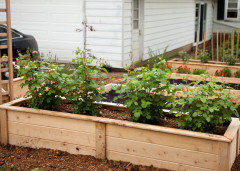
The other point here is that my raised bed is something like 16 to 22 inches high - and bottomless - so the container soil will be in contact with the California clay soil underneath. Some people seem to think that this means it is not a true container situation, and the soil should, therefore, be a more traditional organic soil rather than an engineered container soil. What do people think about that issue?

Just to supply details, I am buying three David Austin climbing roses: Claire Austin, Wollerton Old Hall, and Crown Princess Margareta. If someone happens to know the ideal pH for these roses, please share that.

Comments (20)

  • 6 years ago

    Any bark is NOT "inorganic" and roses aren't "acid loving." just saying...

  • 6 years ago

    @getgoing I changed the language in the original post to refer to well-draining organic components designed specifically for containers.

    I realize roses are not acid-loving and I edited the original post to make that clearer.

  • 6 years ago

    I am still experimenting myself. I think the key is something well draining. I add a lot more perlite to my soil compared to before. I think that has helped. I also add compost and worms.

    westes Zone 9b California SF Bay thanked totoro z7b Md
  • 6 years ago
    last modified: 6 years ago

    Nearly every article online that talks about container soils for roses uses a formula for mixing the soil something like this:

    "Create a potting soil mixture consisting of one-third quality commercial potting soil, one-third garden compost, and one-third composted manure. Add a cup of perlite to enhance drainage. Add 1 cup of bonemeal to the soil mixture. If you wish, you can also add fishmeal or blood meal for added nutrients."

    In the container gardening group, adding compost and manure to a container soil is a big no-no. The container soils I have seen here like 5-1-1 all emphasize the use of carefully sized components that are well-draining. Compost and manure will make container soils extreme water-retentive. Are roses somehow an exception to the rule, or would it be better to just stick to a pH-adjusted 5-1-1 and use an inorganic fertilizer?

    I listened to a presentation that claims that an ideal soil for roses is sandy loam and that the tree roses grown in this can sometimes reach eight feet high. Not sure if that is a productive soil for container roses or not.

  • 6 years ago

    wEstes: you mentioned some people think that a bottomless raised bed is not a true container situation.

    Which people think such a raised bed is a true container situation (in need of container soil)?

    westes Zone 9b California SF Bay thanked rifis (zone 6b-7a NJ)
  • 6 years ago

    I was going to mention the same issue. A raised bed in contact with the ground isn’t the same as a container. You can just fill it with garden soil. Or is this raised bed not on the ground?

  • 6 years ago
    last modified: 6 years ago

    @westes Zone 9b California SF Bay Good luck with your climbing roses!! That area of your house/garden is going to look incredible, I can see it now.... :D

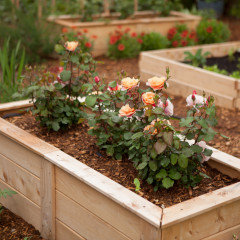
    I agree with everybody else--raised beds aren't containers. I am new to this all myself, but, I planted 3 raised beds with bare-root roses a few months ago, all 16.5" high, 2' wide, and varying lengths. There are 10 roses total and all of them are doing extremely well. I used the Coast of Maine raised bed mix. My beds are overtop of the ground in contact with my native soil.

    I have treated these very differently from the many potted roses I have on my front porch.

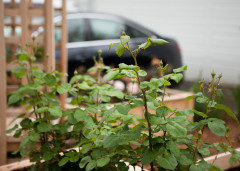
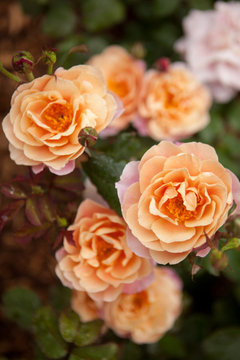
    Here are photos of my raised rose beds. Princess Charlene de Monaco is loaded with buds--so excited.


    Distant Drums didn't grow very tall yet, but is throwing out a lot of blooms!


  • 6 years ago

    @gardengal48 and others: if the roots of a plant benefit from a highly structured soil that drains well - but still retains water in a usable form for the plant - then why does that plant suddenly stop benefitting from highly structured soil when the bottom of the container comes into contact with clay soil? If the roots do better in a soil that lets them breathe, then that should be a fact no matter what the bottom of the container looks like.

    You could argue the organisms in the clay would contaminate the structured soil, but there is no way for that to happen in a large way. It would not be the same as surrounding the roots in compost and manure.

    I hate soils made from large amounts of compost and manure because they do not drain well, and overwatering the plants becomes very easy to do.

  • 6 years ago

    You seem to be under the misapprehension that clay soils somehow restrict root growth. They don't. There are very few plants that cannot adapt to a clay based soil. It just requires an altered planting technique to accommodate. In fact, the layering of a "highly structured" soil on top of a clay one has drawbacks of its own. And that is why a raised bed soil - as opposed to a container or potting soil - is not recommended to be a highly structured or engineered one. Just regular old garden or topsoil amended as necessary with organic matter. And not large amounts of organic matter....no more than 10% by volume.

    I'd also question what you mean by "organisms in the clay contaminating structured soil". Contaminate how exactly? Many of the organisms found in native or indigenous soils of any type are very beneficial and even necessary for healthy plant growth.

  • 6 years ago
    last modified: 6 years ago

    @gardengal48 I have lots of plants that are very healthy in clay soil. I understand that plants adapt and are hardy, and they were doing fine before we created containers and container soils. :)

    Let us talk about why a true container soil - that contains properly engineered ingredients that drain well - should not be mixed with compost. One reason is that the compost will not drain well, thus removing most of the drainage characteristics you took the time to engineer the soil for. But I think it is more than this alone.

    I have been doing experiments where plants grow very well in pure sand. Most container soil purists think that is dangerous because there is too much capillary action in the soil (and related issues like cohesion of water and adhesion). But actually it looks like plant roots in pure sand can stand in water without a lot of damage, for at least half a day. And consider hydroponic gardening, where roots are grown in pure water. Water actually has a lot of oxygen in it. Roots do okay in uncontaminated water. But try to grow anything but fungus in a soil that is mostly compost and manure, and overwater the soil. The plant rots and dies. That horrible material that most nursery plants come in soaks up water in compost soil and never releases and plants quickly start to die off with overwatering. The reason for this is the organisms in compost and manure soils use up all the oxygen in the water. The water-bound soil prevents the replacement of oxygen by airflow. So you get a double whammy that air cannot get into the soil and organisms take oxygen out of the water. The roots rot. But a pure sand soil drowns the roots for a short time in oxygen-rich water, and the plants can tolerate that as the soil drains.

    So that is what I mean by not contaminating an engineered soil with compost. An engineered soil that has some small particles in it is generally going to be well tolerated. Adding compost or manure to such a wet engineered soil is going to kill the plant (if overwatered).

    I am not arguing in favor of creating engineered soils with sand. I am not saying that such soils are optimal for most plants. I am making an extreme point that you can create an engineered container soil that holds a little too much water and many plants can still do okay in them. But contaminate that with compost and manure, and almost no plants can do okay in them if overwatered.

    In any case, if you are going to go with more organic soil for a raised bed, I understand your point about no more than 10% organic matter. Compare that to the advice of nearly every article online written about "container soil" for roses that advises 1/3rd of the soil be manure, 1/3rd of the soil be compost, etc.

  • 6 years ago

    @westes Zone 9b California SF Bay It seems like you came here looking for advice, but actually have done a lot of research and have formed a base of knowledge on the makeup and suitable usage for various soil components, and so your mind was really made up already. I'm not sure what the point of all this is?.... Clearly all of the advice and suggestions thus far are not to your liking.


    I will just say that roses are incredibly heavy feeders. If you want to grow them in a bunch of bark, go ahead and try! Will it work? You can let us know...

  • 6 years ago
    last modified: 6 years ago

    Oh, and I forgot to add. In regards to the "contaminated soil" comment. You might want to look into the entire No-Till organic farming movement.... Growing in a substrate of water and contaminating that water is a world of difference from growing in soil. The organisms in the soil are a part of the health of the soil. They are not "contaminants."

  • 6 years ago

    @mattgrowsflowers PA z6 So there are two separate questions at this point:

    1) What is the ideal soil for roses in a true closed container?

    2) Is there any reason to use a structured container soil in an open bottom container ?

    Regarding 1), I have no idea what is the ideal soil for container roses. But @gardengal48 answered that question pretty well when she said "I use the 5-1-1 or a slight modification of it for everything I grow in containers (except cacti and succulents). No special modification for any specific plant type (other than omitting or reducing the lime for acid-loving plants)."

    My pre-formed opinion was what NOT to use as a container soil. The online articles recommending 1/3rd compost and 1/3rd manure look like a recipe for root rot, particularly if you over water. Having that opinion does not mean I know what the ideal soil is, and nowhere in the thread did I offer an opinion about that.

    Your point on heavy feeding means that in a container - without a lot of nutrients in the soil - that I will need to fertilize the roses pretty regularly? Can you recommend how often?

    Regarding 2), clearly, I am the only one with my opinion. I very much want to hear the counter-arguments.

  • 6 years ago
    last modified: 6 years ago

    @mattgrowsflowers PA z6 Regarding compost and manure in the soil, it is all about finding a healthy percentage. Most farming soils contain between 2% and 6% organic matter. And that is true in-the-ground soil. Let's compare that against the bizarre online articles that recommend we make container soil for roses that is 1/3rd compost and 1/3rd manure. The poison is in the dose... And those components do not belong in any concentration in real container soil.

  • 6 years ago
    last modified: 6 years ago

    Question 1: you are the clear proponent of not creating a container OR raised bed soil that has nutrients in it already, but instead heavily favors drainage. I'm not sure, I guess you can experiment and figure it out yourself? Personally, I have compost in my container soil. And they are doing fabulously. I am picking buds off left and right to promote a bushy shrub out of what once was, just 2 months ago, a whole bunch of three-prong sticks.

    Question 2: Again, I would say, why don't you experiment? What are you really here for, truly? To tell us all of the things you've learned about soil? Or to learn from the experience of the gardeners here? Gardening is one big experiment. You can read as much as you want, try to be as precise as you want, buy all the right plants and all the right ingredients, but it's STILL going to be a toss-up. Your exact climate, your pathogenic pressure, the specific organisms in your soil (whether you want them to mix or not, they are going to), the soil organisms that you may or may not choose to add, and the substrate itself that you *attempt* to so specifically create are all to going blend together and give you a result that may be good or bad. Whatever you decide to do, I hope your climbers like it.

    westes Zone 9b California SF Bay thanked mattgrowsflowers PA z6
  • 6 years ago

    I hope you are aware that in a relatively short time, the organic component of your raised bed soil is going to digest out, leaving the inorganic component. That means your plants are going to sink, potentially substantially. The ideal would be for you to fill the raised beds with the same soil they rest upon, firmed in well to minimize subsidence so your plants don't settle too far, with the "richer" soil as just the top few inches where the majority of the feeder roots will grow. You can continue producing that kind of richer soil by mulching with organic materials each year. If you use a created soil made of organic components, you will be uprooting your plants every few years to renew the soil under them and raise them back up to the level you initially planted them. The raised bed version of having to re pot every few years to replace the digested, washed out soil from the pots.

  • 6 years ago

    @roseseek, yes, you could fill the raised bed with the native California clay, then mulch on top as you describe.

    Note that a true engineered container soil is made from components that have much less of a tendency to collapse. The soil maintains a lot of its structure over time.

    In any case, your approach might actually be the simplest to implement and does not drown the roots in compost and manure. I would love to be able to compare that side by side with other approaches.

  • 6 years ago

    NOW ( 2+ days, and much back and forth, into this discussion) would be an excellent time for : Enter tapla

    Does he shy away from non-container discussions? Hopefully not.

    westes Zone 9b California SF Bay thanked rifis (zone 6b-7a NJ)
  • 6 years ago

    Can anyone recommend a rose bush variety that grows very large and is readily available in Bay Area Nurseries? I want to stay away from modern tea roses and would prefer an older rose pattern like an English rose. I want to use this rose variety as my test plant in a few different container soils.