Software
Houzz Logo Print
katyajini

Is this rose rosette?

6 years ago
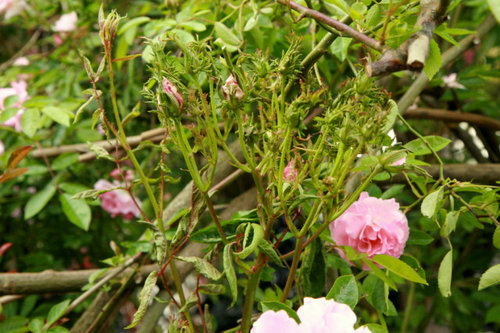
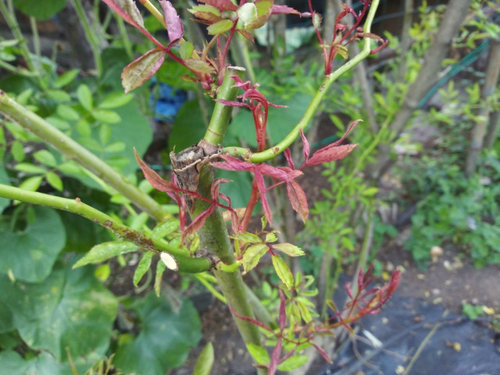
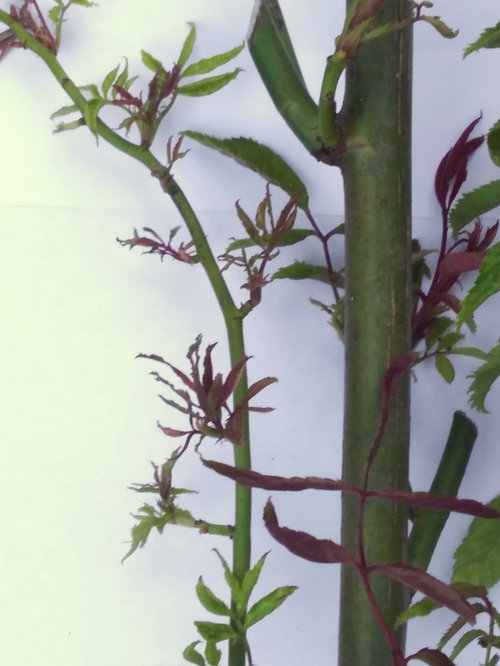
These are a couple of clusters of very strange buds on my very large no name rambler:


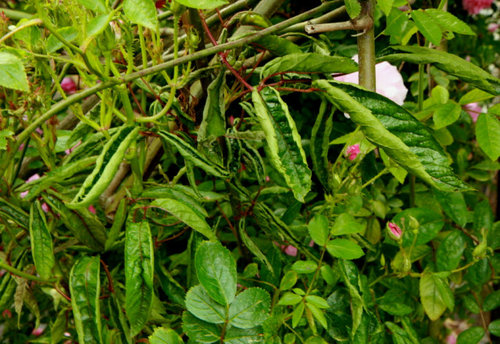
Then look at the leaves in the upper left vs those in the lower right corner.


There is huge gushing growth squeezed into one small area and a lot of red. Its hard to capture in a photograph.

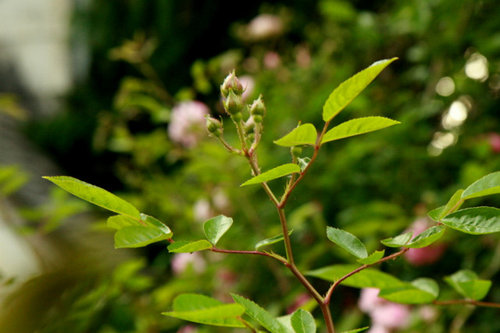
This is what *normal* leaves bud have always looked like.


What is happening? Is this rose rosette? This is happening only in one small section of a very large plant. I think I saw it last fall too, then it seem to disappear or diminish. Actually now that I am remembering I cut off everything that did not seem right (and discarded) and then things seemed to settle down. Now I see it again in the same area.

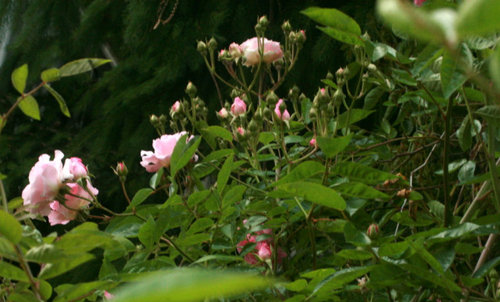
These are a couple of pictures I have from last year. I might be able to find more:


what should I do?

Comments (38)

  • 6 years ago

    I'm wavering between RRD and herbicide damage.....kinda leaning toward the latter. I'd cut the affected canes down to the base, water it heavily over the next couple of weeks, and watch for new growth.


    :-/


    ~Christopher

    katyajini thanked AquaEyes 7a NJ
  • 6 years ago

    No, I really dont think herbicide damage. First I never use herbicide. Second, I cut off the symptomatic parts last fall and the exact same area has this growth. I will cut off the section and surrounding and water and see what happens. Thanks. A little scary isnt it? Thanks!

  • 6 years ago

    I am not wavering near as much as the other posters. I was slow at the stick 10-years ago, and lost 16 rose bushes to RRD. This looks like RRD. Let's say it is herbicide damage, instead. RRD can often be eliminated by cutting out the infected parts right away. There is no harm to cutting out the bad. Start cutting now, so you can have better growth later.

    katyajini thanked mark_roeder 4B NE Iowa
  • 6 years ago

    Then if it grows back in the same way, get out your spade.

    katyajini thanked mark_roeder 4B NE Iowa
  • 6 years ago
    last modified: 6 years ago

    Of course Ann is the expert here, But I would just get rid of ALL of it unless it’s some extraordinary irreplaceable treasure.(And I can’t think of a single rose I own that falls in that category, that I’d risk further RRD on other plants to try to save). I want to minimize the possibility of future RRD as far away from my property as is within my ability.

    katyajini thanked BenT (NorCal 9B Sunset 14)
  • 6 years ago

    Get rid of it immediately. There is a strong possibility that in a year's time, you will regret hesitating.

    katyajini thanked User
  • 6 years ago

    If you take a hatchet to the Rose and keep a section that looks fine, but still harbors the virus, can it serve as a source for infection of other roses? Even before it shows signs - like fever, sputum production and cyanosis? Does it need a face covering in this case? What distance from other roses is safe; does one even need to worry about this?

    katyajini thanked rifis (zone 6b-7a NJ)
  • 6 years ago

    Just voicing my sympathies—-so sorry Katya! It is scary! But you say it’s just this rambler, and it showed this same odd growth last year? But no other plants showing this growth? Did it progress last year?

    katyajini thanked Perma n’ Posies/9A FL
  • 6 years ago

    I feel terrible you have to deal with this. I would dig it up immediately, it is RDD and like BenT mentioned just NOT worth the risk. I have lost 5 roses to this virus in the past year even after removing the infected plants asap, which means like Rifis said they are spreading the virus even when not showing symptoms.

    katyajini thanked dianela7analabama
  • 6 years ago

    I am so sorry.


    katyajini thanked jerijen
  • 6 years ago

    Katyajini, I am so glad Ann, Ben and others saw your photos on this new post! This forum is gifted with so much knowledge. I would follow the RRD protocol I mentioned on your other post, but the ultimate decision is yours --based your concerns, your needs and the personal value of your infected rose versus the risk to the other roses in your garden. Whatever you decide, please do keep us posted. We are all feeling this moment with you. Current times have certainly demanded that we arm ourselves in practicality and take a lot of deep, relaxing breaths (often with a face mask). Sending you a big e-hug and a shoulder, rose lover to rose lover! Carol

    katyajini thanked portlandmysteryrose
  • 6 years ago

    I agree with the comment, that Ann is the expert . . . she identified my RRD by photos on here about 10-years ago. I just did not ask early enough b4 losing 16 rose bushes. RRD is believed to be carried by a mite. If you catch it early enough and cut out the infected parts you could save the plant. But you do say it seemed to appear a year ago. You also say it appears to be in a limited area. So the issue here is whether it worked its way to the bottom of the bush. I am not a plant biologist, but if it gets below soil, I am guessing it starts going up through the rest of the plant. I don't think it spreads below soil to other plants, but I could be wrong.

    You can do as you wish, but aggressive early measures are best. I wished I had dx my RRD early and started cutting bad parts out. I seem to recall I had some infected roses that were not engulfed that I cut out the bad parts and they survived. But I learned what I had too late and dug out 40% of my rose garden in the fall, and worried about the other 60%. I was okay the following spring with the rose bushes remaining, and a friend supplied me with some Griffith Buck roses she was retiring.

    katyajini thanked mark_roeder 4B NE Iowa
  • 6 years ago
    last modified: 6 years ago

    Thank you everyone for being so supportive and standing by me. I have been outside all day looking at this rose over and over between other things. There is no doubt it is RRD and that the disease is spreading quickly now.

    I skimmed a few articles. The virus causing the disease spreads via a microscopic mite. When the mite carrying the virus lands on fresh young growth at the tips to feed they transfer the virus into the vascular system of the rose. The disease then slowly transfer down to the root then back up other canes. The mites move from rose to rose, cane to cane by the wind, clothing, hopping, infecting all of these.

    I see canes and laterals showing the beginnings of symptoms or looking different from normal ones. There are a lot of good looking canes coming up from the base and at least half of them are infected. There is no going back. I didnt know enough last year, the rose should have been removed right then. Even my educated decision might have been to try to save the rose last year though.

    I cut of and bagged the worst parts but this rose is huge. Its grown to the third floor climbing a pine tree. I am going to need some help. We are having strong thunder storms now and will be having them all day tomorrow. So I have to wait.

    Other roses are not obviously affected, not that I can tell, but of course they might have the virus. This rose is in a slightly isolated spot, where there is not so much wind play. So I thought I was relatively safe. Then I realized the rose overhangs a patio-workspace where I do all my potting, soaking..of roses and other plants. All my bare root roses were soaking there for days. I suddenly see the enormity of my mistakes. I am on that patio all the time, regrouping and then going to other parts of the entire garden and this mite travels via clothing.

    Well I will do the best I can. I have to remove all of it including the roots. I have seen roots of this rose extend into my side yard at least 15 feet away.

    So rifis: to answer your question: yes, potentially. A rose may have the virus coursing through it but not showing symptoms yet, a mite eat some it and transfer the virus to another rose.

    Carol: I am receiving your hug and your shoulder. Thank you and my hug back to you. :)

    Christopher, Mark, Ann, Ben, Dianela, Paul, Jeri, Rifis, Perma, everyone, thank you. I know some of you lost a lot in a bad way, thank you for experience and wisdom.

    This was a beautiful rose, no thorns and it had a grandeur that only time can bring.

  • 6 years ago

    I am working on removing all of the rambler. It is huge.


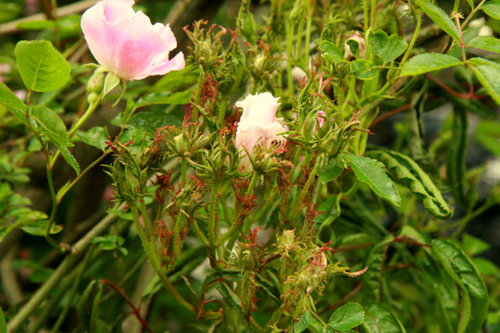
    here I am posting some pictures. To my eyes it looked quite a beautiful and impressive rose. I have no idea what it is, maybe someone will recognize it.


    Rose climbing up a tree and new canes growing in to the tree


    Some close ups of the flowers:


    If you have suggestions of what I might plant in its space,,,I would love to know!


  • 6 years ago

    Wow, what an amazing plant, I’m so sorry this happened, RRD is such dreadful disease. But I think you made the right decision to remove all of it.

    katyajini thanked BenT (NorCal 9B Sunset 14)
  • 6 years ago

    What a sad story--your rose was beautiful,.


    I heard about RRD from Ann years ago and shortly thereafter reported finding it at Hollywood Cemetery in Richmond. Although a representative from the company that cares for the roses called to assure me that infected plants were being removed, I have never wanted to go back to see the roses. I was too afraid of bringing home mites on the car or on my clothes if I got out of the car..


    At the same time, I removed a wild Virginia rose that had spread and grown about 6 feet tall. It made a spectacular display in June; however, I had already decided I did not want any rose that grew large in my garden. When a cold winter killed Cl. Devoniensis to the ground (It had grown 20-30 feet) and climbed into an oak tree, i was not sorry. Devoniensis has recovered since, but I'm watching it closely because we had a warm winter and I don't want it to get big again. More shade in the area should prevent too much growth. I do worry about New Dawn and Awakening on the fence--they are are only about 4 1/2 feet but I don't know how I could discard the canes if they became infected.


    Lindsey

    katyajini thanked lplantagenet7AVA
  • 6 years ago

    It just kills me that you have to remove this gorgeous rose that looks to me like a huge and stunning August Luise. So beautiful. My sympathies, Katy. Diane

    katyajini thanked Diane Brakefield
  • 6 years ago

    Oh, this is such a shame...it's a glorious, glorious rose!!! But, of course, you have to get rid of it. :( I'm so sorry.

    katyajini thanked rosecanadian
  • 6 years ago

    Oh my goodness, I had no idea that it's such a huge and glorious rose. It's one thing to lose a new or a small rose. But I can tell that this rose has given you many years of enjoyment and it's loss will be felt.

    I am so darn sorry that you have to part with this beautiful rose.

    katyajini thanked Kristine LeGault 8a pnw
  • 6 years ago

    Is there any hope of taking a cutting from a "good" section, or is the viris in all the rose by now. I really hope you can ID this rose. I'm so sorry,

    katyajini thanked Vaporvac Z6-OhioRiverValley
  • 6 years ago

    I was going to ask the same thing. Can she save a few canes, just cut out all the bad parts? What a beautiful rambler!

    katyajini thanked summersrhythm_z6a
  • 6 years ago

    no

    katyajini thanked Austin
  • 6 years ago

    Losing such beauty is heartbreaking. Usually we cover diseased plant before removal to prevent mite spreading, since it cannot fly this helps. Your rose is so large that is not possible. It might help to spray the diseased plant throughly with forbid in an attempt to kill the mite before you begin removal. After removal I would spray all other roses. Forbid is said to last 21 days but someone with more knowledge can advise on if this applies to RRD mite.. I once read an article about the very sad removal of 100 yr roses that were growing on the buildings of an estate home in England. they were trying to remove without transferring the mite to the remainder of the large rose garden. I searched but could not locate that link again. I. Removal is not an option but how to best do so may be. I would contact the experts at one of the Universities. They are very helpful. I spread RRD by clipping flowers for the house so take care. None of my RRD roses had the mite just the disease, I had sprayed before removal. I sent samples to A&M to be certain. I have not had a reoccurrence in last 3 yrs. I now spray for the mite, clean my clippers between bushes and pray. 😬

    katyajini thanked Austin
  • 6 years ago

    I've read that hairspray can help immobilize them. Then cover rose with plastic bag. I'm not sure what size you'd need with that rose. : (( Interesting Austin. I didn't realize RRD was present in England.

    katyajini thanked Vaporvac Z6-OhioRiverValley
  • 6 years ago
    last modified: 6 years ago

    You might take a look at Anne Belovich's book on ramblers to see if you can identify the one you have. If you are successful, you might be able to plant a new one of the same rose. It's hard to imagine a lovelier rambler than the one you already have!


    katyajini thanked Rosefolly z5
  • 6 years ago
    last modified: 6 years ago

    It would be a tough task to remove such a nice rose. sorry

    katyajini thanked L Clark (zone 4 WY)
  • 6 years ago

    Hey Ohio I may have my countries wrong. I read about it a few years ago and that is a long time for my old brain to recall with accuracy. I remember the picture vividly showing the beautiful rose growing up sides and onto roof of castle type mansion surrounded by acreage, article discussed roses being over 100 yrs old. All this felt like England to my memory, but in could have been USA. So no RRD is England?? What about other countries? I think I "Peter Principled" out on this one. :)

    katyajini thanked Austin
  • 6 years ago

    Oh my friends, thank you, thank you for your understanding. It means a lot to me!


    I am struggling with the thought how I might be spreading the disease by dispersing mites. I do have to tug hard to get all the canes way, way up that tree. In the first picture the visible roof is my neighbors third floor roof and the rose has grown beyond that height. never in a million years did I think that this rose would get RRD. It was an effortless plant. It asked nothing of me. No feeding, no pruning, no tying of canes, no spraying. And it had no thorns.


    There must be a lesson in this somewhere.

  • 6 years ago

    Chris209 thinks the rose is Tausendschon and I think he is right. Looks the same !


    https://www.houzz.com/discussions/5934056/id-of-this-very-large-pink-no-thorns-lax-caned-rambler#n=5

  • 6 years ago

    It is my impression that when gardeners from the UK talk about RRD, they mean Rose Replant Disease, not Rose Rosette Disease.

    katyajini thanked Rosefolly z5
  • 6 years ago

    Can you cover your other roses while tugging on the canes?Then treat the others as suggested?

    katyajini thanked Theresa24 (NeFL9a)
  • 6 years ago

    I was trying to avoid thinking about using insecticide but maybe it is necessary.


    So for the disease to be spreading to other rose plants, mites have to be landing on this diseased rose, feed on it, (or arrive from some other diseased rose) and then land on my other healthy roses and infect them. How common are this RRD vector mites in a garden such as mine??? Whatever there numbers maybe things got a whole lot worse because there is/was an infected rose right there. And they may have been overwintering on the infected plant as they got there at some time last season.


    I just read the following:


    'Be aware that miticides registered for control of spider mites do not control the eriophyid mites that transmit RRD. Some researchers have obtained reasonable control with either carbaryl or bifenthrin insecticides; however, mites are very small and it can be difficult to get complete coverage. Also, use of carbaryl to control eriophyid mites can lead to outbreaks of spider mites. The insecticide Avid is registered for control of both eriophyid and spider mites on roses.'


    Isnt Forbid is used to control spider mites?


    Three miticides (Avid, Akari and Judo) along with horticultural oil have been listed as controls in Conard-Pyle’s Rose Rosette Disease Guide.
    “We advise growers who use these miticides to rotate between the three chemicals,” Dobres says. “It is important to rotate these miticides so that the mites don’t build up resistance. These are contact controls and it is important to use them in rotation.”

    Bográn says growers should also consider testing Kontos, a systemic insecticide/miticide labeled for spider mites and other sucking insects, on greenhouse and nursery crops. It can be used as both a spray and drench application.

    “The benefit of using a systemic is that it is active in feeding sites that may not be reached by a spray application,” Bográn says. “Also, since the chemical is systemic and is taken up through the plant roots, a drench provides longer residual activity than a spray application.”


    Though it makes sense it gets complicated. Kontos is hard to find.


    Mites overwinter in the plant and feed on tender growth in spring. Then new infections in healthy plants start appearing in july. I think thats when I first noticed this last year but did not take fast enough or correct action. These mites like hot dry sunny weather, which we have been having :( Plants in more shaded areas have lower infection rates.


    So if anyone has any knowledge of which miticide I should start with please advise! Then should I spray all ornamentals to kill all mites? Wow, that sounds horrible!


  • 6 years ago

    Also want to add that these insectides are extremely toxic across the board. Feels like I am in a lose lose situation. So what should I do?

  • 6 years ago
    last modified: 6 years ago

    I am sorry you are in such a difficult position. It's hard to advise and I doubt that most will agree with me, but if this were my rose, I would remove it as carefully and completely as possible, taking whatever precautions were possible, hope for the best, and watch for any sign of disease on the other roses. If I saw suspicious growth, I would cut the suspicious cane to ground level or remove the entire plant if necessary, but I would not spray, because chemicals might put me at risk. I think you can save most, if not all of your other roses with vigilance and determination, and if you do lose one or two more,you can replace them. This is what I would do if I had the same problem. From what I have heard and observed elsewhere , RRD does not spread widely and systematically through a garden, but rather in a random, unpredictable way.


    Lindsey

    katyajini thanked lplantagenet7AVA
  • 6 years ago

    I have yet to see RRD spread within my garden. A rose shows symptoms, I remove it, and a few years later another rose, in another part of the garden shows symptoms. That includes roses that were growing into each other. So, in a relatively similar climate, I wouldn't take more than reasonable precautions. Get rid of it in the trash, and keep an eye on the other roses.

    What you really need to do, it start walking the neighborhood looking for the original source of the infection. In my local conditions, infected multiflora has a short life. So even if it isn't taken care of, it will take care of itself. Oddly enough, infected garden roses can last a fair bit. I watched an infected New Dawn for years before it finally died off.

    katyajini thanked mad_gallica (z5 Eastern NY)
  • 6 years ago

    Iplantagenet: Thank you! Yes, I think I will go your route. Make one decision and be at peace with it. I am constantly second guessing myself. I am going to see the reckoning for my stupidity. One by one all the roses are going to die and I am not going to be able to grow roses again, Partly I am getting exhausted among all the the things I have on my plate and I just dont have strong enough shoulders to pull this rose out all the way from the third floor. Its so big. And all that petal drop. There must be virus and/or mites in those petals, I thought of hiring an young man but my husband still does not want anyone coming over. Finally he helped me this evening and 80% of the rose is out. Finally to dig it out. And I will be vigilant every morning and evening.. Thank you, I dont have to use those neurotoxins.


    mad_gallica: thank you for reassuring me its not necessarily all over.

  • 6 years ago

    How about planting in the same space? How long does one wait? what special actions does one take?