Software
Houzz Logo Print
susieqsie_fl

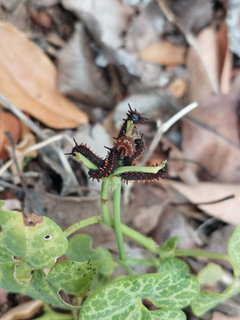
Pipevine Swallowtail Cats

6 years ago
last modified: 6 years ago
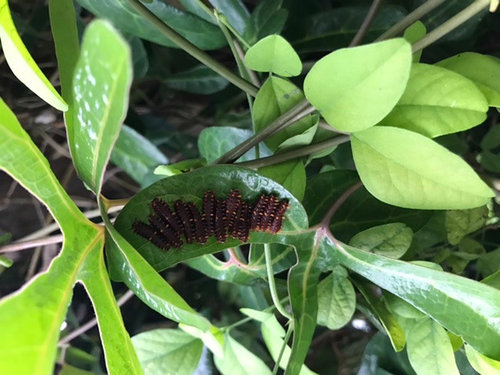
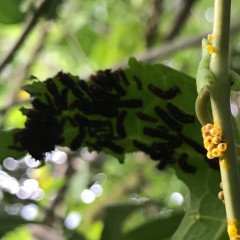
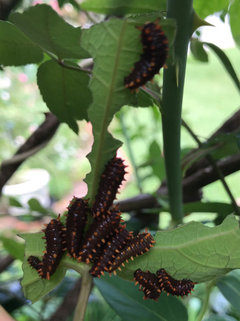
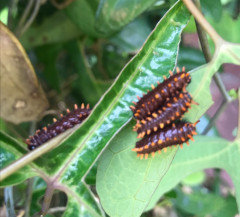
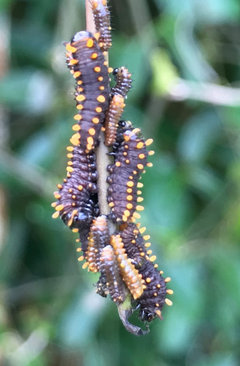
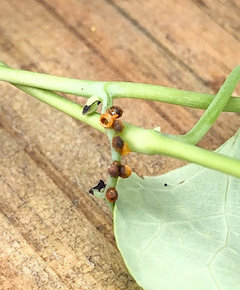
......lined up at the smorgasbord.......


Comments (35)

  • 6 years ago

    Cool!

    Did you mean 'pipevine'?

  • 6 years ago

    Awwww. I hope when they become flutterbys they will fly over to my house!

  • 6 years ago

    They probably will, JG, if you have a pipevine. Trouble is, they fly so fast, it's hard for me to catch sight of 'em!

  • 6 years ago

    > phone meant Pipeline! It’s funny like that!

    A lady returning through the airport was texting with her husband who was to pick her up outside bagge claim. She received, "Booty free yet?" (He had written "Duty-free yet?", i.e. had she reached that point in the terminal.)


    > They probably will, JG, if you have a pipevine.

    For years I have had towers of it, and wide expanses of it. For years I have been waiting for the fabled PVST to make an appearance. In past years, reported not far east (Chuluota), and not far west (Winter Park). Once even a few eggs at Lukas ( I think that some reached adulthood, and ended at that). Do you get them every year, Susie?


  • 6 years ago

    Hey Four

    I read that there’s a pipevine that is toxic to a certain swallowtail larvae. When I had that kind—and it was an expensive plant—it would be covered in caterpillars one day and the next day they’d disappeared. I figured I had a wasp &/or lizard predator problem. Then one day the whole vine croaked just like it got hit with RoundUp, and it was a massive plant. I think it’s invasive here and was destroyed by city or county officials.

    So then I got a different pipevine variety and get caterpillars every year for perhaps 3yrs now. It’s called Aristolochia trilobata. I have it covering my arbor close to the house with roses, honeysuckle, morning glories and jasmine with solanum seaforthia.

    The trilobata pipes kinda stink so I guess that’s how the ST mama finds it amongst all that other foliage. The cats are getting huge now and I’ll be watching for chrysalis action soon.


  • 6 years ago

    Trilobata is what I have.

  • 6 years ago

    Awesome

  • 6 years ago

    Susie, is PVST flight very much faster than that of Spicebush?

  • 6 years ago

    Well, Four, now you've stumped me because I don't know if the Swallowtail I saw zipping around the trilobata vine was a Pipevine or a Spicebush (which I had to look up, since I didn't think I'd ever seen one). Not being super-observant and attentive to details, I would think they look alot alike in flying around, especially without both types together to compare.

    I wish I could answer your question....but I've got one for you:

    Do you have browning out and falling leaves on your trilobata? I hope this is happening because of some indiscriminate pruning I might have done and not because it is sick. There seems to be lots of new growth and most brown leaves are on the top of the arbor and appeared just before the cats. I don't remember this happening before.

    Thanks,

    Susie

  • 6 years ago

    Always a certain amount of old leaves. They tend to stay in place for a long time. The more striking large amount of browning occurs once or twice a year.; the vines always recover to majority green.

    Polydamas take some bites out of medium or large green leaves, but strongly favor the petioles (causing perfectly good leaves to drop), and tender vines, and newly forming leaves. If there are tender vines during recovery, even without leaves these guys are as happy as pigs.

  • 6 years ago

    HaHa your imagery makes me smile!

    Thanks for the assurance about the vine. I was actually hoping the cats would eat the whole thing down this year, and maybe they will, before hurricane season.


  • 6 years ago


    next generation......

    There are lots more leaves covered with tiny larvae. And lots more eggs! Good thing I started more PipeVine cuttings last year. I think we’re going to need ‘em.


  • 6 years ago

    I started a fimbriata patch a couple of years ago, and it's really taken off this year. Additional, I planted a couple of A. elegans purchased from the local museum's butterfly center -- apparently this is what they feed their PVST cats. But it's all over the internet that elegans is (at worst) toxic to the cats and (at best) so unpalatable to them that they die of starvation from not eating the elegans. Local folks in the Houston area are reporting success raising PVST on elegans as long as the diet is mixed to include other pipevine varieties (fimbriata, tomentosa, trilobata). A female laid two batches of eggs about 10 days ago, and most of the eggs seem to be shriveling. Has anyone experienced this? All eggs are in my yard, there's no spraying here, etc. One egg hatched and I saw the cat cruising on Day 2. And then it just disappeared (I have one batch of eggs on a stem in water, with an organza bag protecting the entire set up to keep out predators).


  • 6 years ago

    Susie, please a better photo of any of those caterpillars.

  • 6 years ago

    Pipevines are typically smaller and much faster than Spicebush swallowtails. Spicebush are about the same size as Eastern Blacks and have a similar flight pattern. Pipevines are notoriously difficult to photograph. They are so fast and don't land for a long time. I have a lot of tomentosa, which Pipevines love. I have the fimbriata also, but it is low growing and does not like to climb.


    The finbriata and the trilobata will host pipevine swallowtails and polydamas. Only the goldrims or polydamas can use the gigantea and the elegans. Pipevines will lay eggs on these two, but the caterpillars die soon after.


    I see both the spicebush, polydamas and the pipevine swallowtails every day now. I have lots of black swallowtail cats and eggs, but for some reason I have seen only a few of these butterflies this year.

  • 6 years ago

    > Spicebush are about the same size as Eastern Blacks

    I get Spicebush STs every year. The third largest of all ST regulars here (the first two of course being Tiger and Giant). Always significantly larger than Eastern Blacks.

  • 6 years ago

    Yes, on second thought they are larger, normally, than the blacks.

  • 6 years ago

    Here ya go, Four.

    The little guys are about 3/8 inch and the big ones are 1/2 or more.


  • 6 years ago

    Maybe this is more in focus


  • 6 years ago
    last modified: 6 years ago

    Hey Tom

    Are you in South Florida with your polydamas? I read in my Florida Guide to Butterfly Gardening that polydamus are rare up here but I am not sure how correct that is. I am pretty sure I have seen them on my pipevine and the picture of the larva looks like a big caterpillar I saw. Unfortunately I can’t find him today to take a picture.

    Here’s what the book shows


    (You might have to click or tap the photo to see it better)

    Are you getting these babies?

  • 6 years ago
    last modified: 6 years ago

    Susie, let's assume that the book's information was correct long ago. Certainly it is incorrect now. I have had Polydamas for years, and nearly continuously for a few years; any breaks have been in Februaries.

    Your camera documented them in egg form.

  • 6 years ago

    Susie, I live in Clermont, about twenty miles due West of Orlando. Zone 9b. I have a row of what I believe are elegans aristolochia, which they like. The tomentosa vines seem to pop up all over the place now. The polydamas cats are more brown than the pipevines and they get much bigger.

    I saw some polydamas cats a few days ago. They were small. Some of them must be growing to maturity, since I see grown ones flying around. They tend to stay near where they were hatched, in my experience.

    Four, I think that you should get some pipevines sooner or later on your trilobata vines. I don't know if they tend to stick around the larval plants once they hatch.

  • 6 years ago
    last modified: 6 years ago

    Happy Independence Day firecracker night!

    Instead of watching the sky this evening, I’ve been looking at swallowtail pictures on line.

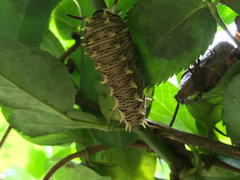
    I have come to the conclusion that I was wrong about the swallowtail larvae I have that I thought were Pipevine. Now I’m pretty sure these are Polydamas. Here’s the big one with his pale color:


    Since you have them in Clermont, Tom, I believe my book is out-of-date like Four says. And I was basing my ID on that incorrectly.

    The eggs on my trilobata vine are definitely yellow, while Pipevines’ are red.

    Sorry for the mistake. I should’ve done more research before I posted. Here’s some more hungry little “pigs”....


    If you’re still reading, Javiwa, I don’t think I’ve ever heard of eggs shriveling up. I think the eggs are eaten by the baby cats when they hatch but maybe your cats wondered off and the empty shells just dried up.

    Let us know what happens with your eggs in the net.

    ~Susie

  • 6 years ago

    Yes, Susie, the first photo that you have here does look like a polydamas. The pipevines tend to be more black and their "horns" seem to be a bit longer up front. The polydamas cats will get to be very large if there is enough food for them to eat. The pipevines are a bit thinner.


    In my experience eggs of both are often eaten by wasps and sometimes by lizards--as are the very small cats. I think that once they get to be a certain size they don't taste too good:)

  • 6 years ago

    Susie: Still here. :) I've raised both Giant & Eastern Black SWTs (in addition to Queens, Monarchs, sulphurs, frits), so I think I have a pretty good handle on what 'normal' should look like. It's not at all that the eggs have disappeared. They're all still in place, but have literally shriveled.


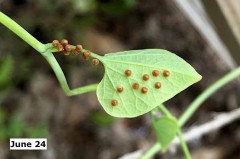
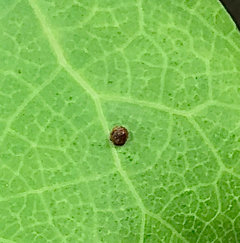
    These eggs were laid June 23, and pic was taken a day later:


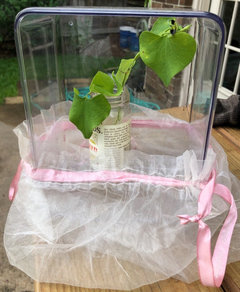
    I separated this batch into two, leaving the batch on the leaf with my fimbriata. I snipped the stem (with eggs) and have had it in this setup for the past two weeks:


    Drawstring has been secured very tightly: nothing in, noting out.


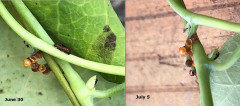
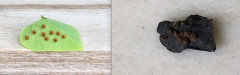
    One cat did hatch (noticed him June 30 - looks to be a couple of days old), and I saw the nibbled egg casing. All other eggs were intact. But judging by their darkened appearance, I expected more cats any day. The right pic was taken today: the other eggs aren't doing anything, but look shriveled to me. They no longer have that plump look eggs usually do:


    Another view, from today:


    This egg was left on the vine:


    And, finally, a shot of those fresh eggs from June 24 (left), and from yesterday:


    Thanks for any advice.


  • 6 years ago
    last modified: 6 years ago

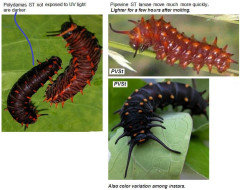
    --------- From my old research notes :


    --------------------------------------------------------------

    My photo taken today :


  • 6 years ago

    I’d love to get these established in my yard in San Diego. Don’t see any egg or cat sources online for our subspecies

  • 4 years ago

    Some that I found on plants yesterday and today.

  • 4 years ago

    Most of them look like Polydamas, Four. I can't get a good closeup. If the horn on the head is orange going across the head then it is a Polydamas. Pipevines are smaller, blacker and the orange spikes on the back are just tinged orange and they are much shorter than the Polydamas. What vines did you find them on? The ones in the picture look like Dutchman Pipevine. The Pipevine cats only grow big on the A. Tomentosa around here---although they also will use the A. Fimbriata.

  • 4 years ago
    last modified: 4 years ago

    Polydamas, no doubting nor questioning. Most of this thread became Polydamas. I posted the photo just to show the multitude.

    >"What vines" ___ A. trilobata.

    >"Pipevine cats only grow big on the A. Tomentosa around here" ___ Why do you exclude A. trilobata?

  • 4 years ago
    last modified: 4 years ago
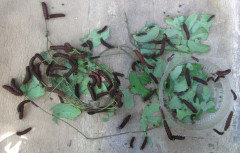
    I got my first cats this year. Carlsbad California. On A fibriata.


  • 4 years ago

    I haven't seen A.trilobata mentioned before in Central Florida. I have seen it discussed, but I have never seen it in any nursery. Do you have experience with it, Four? Trilobata is a tropical plant and since the Pipevine distribution starts only a little south of Central Florida and then extends north, I doubt that it is a major vine used by Pipevines, but perhaps you know better?

    I know that Aristolochia serpentaria is also a host, but it is difficult to grow.

  • 4 years ago

    @shaneatwell, you did it.

    Although some gardeners' A. fimbriatas grow in abundance, it is the exception. Unless you are such an exception, your Polydamas cats will not have enough.

  • 4 years ago
    last modified: 4 years ago
    Tom, my PVST experience and my A. trilobata status/experience are written in this thread.

    >"Aristolochia serpentaria... is difficult to grow." ___ Good to know.

Sponsored
Buckeye Basements, Inc.
Average rating: 5 out of 5 stars40 Reviews
Central Ohio's Basement Finishing ExpertsBest Of Houzz '13-'21