Software
Houzz Logo Print
lindac92

Can we talk sour dough starter?

6 years ago

Can't say I am an expert by any means.....but I have been maintaining a starter for about 3 1/2 months. Since the stay at home order....and since I am high risk and have quite a few friends who are also high risk who don't go out, and who live alone, I have been baking 5 small loaves and giving them away....so I have a lot of use for the discard. I add about a cup of discard to every 2 pounds of flour....and since I want it done the same day I add some yeast. I keep the starter jar on my counter and feed it about 3 times a day.

I know some who weigh the starter and add a portion of that weight of flour and another portion of water.....but I haven't done that. I just measured 2 T flour to 1 1/2 of water. I did that for a few weeks and now I just toss in some flour and water. No measure....and if I am passing the jar and notice it is sinking I will add some more flour just to feed it's hunger.

I also keep another jar in the refrig.....and rarely feed that one....I let ot go for 3 weeks one time....brought it out and fed it and it bounced right back. Was super active within about 3 feedings.

My conclusion from all this is that a starter is not as demanding as some would have you believe. And my advice is "go for it"...the discard adds an amazing dimension to about anything you make with flour. Sweet rolls muffins pancakes....and my grand daughter made chocolate chip cookies and added some discard to that dough.....and of course bread!

Have you tried it?

Comments (21)

  • 6 years ago

    Linda, congrats on your success! It doesn't surprise me, however, since you have been baking bread for so long, and you know when you need a little more flour or a little more water. Also, since you're not relying on the starter for your rise, and basically using it for flavor, it doesn't really matter what you're feeding so long as it's sufficient to keep it alive. When your fridge starter is fully mature, it should revive with one feeding, unless you've neglected it for long enough for it to start dying. Even then, if you remove the dead part, the rest should perk up in a few feedings.

    Congratulations on coming over to the sourdough side!

  • 6 years ago

    I have found that it really doesn't "care" what proportion of flour vs water or flour and water vs starter....as long as I keep feeding it the carbs it thrives. It's plenty strong enough to raise a loaf, but requires an overnight rise......and I am in too much of a hurry to do that daily.


  • 6 years ago

    Yes. Measuring the flour and water is to know how much flour and water there is when you're adapting a specific recipe, or using a sourdough recipe that requires a certain kind of starter. My new favorite basic sourduogh recipe only uses a tablespoon of starter so it doesn't matter what the makeup of the starter is. For fancier recipes, for a specific bread rather than "it's bread", you need to know what the composition of their starter is and adapt to it. It's not a hard thing to do, if you know what you're starting with.

    So, if you wanted to do a wild yeast rise, you could just use two bowls. Start your dough for the wild yeast rise and make a commercial yeast rise one day, and start a new wild yeast rise the next day while you bake off the previous one. Since you're baking every day, it should work out fine. If you have plenty of yeast--I know your bread recipients bring you supplies--there's no need to do so. Just an option if you want to grow your own. :)

  • 6 years ago

    Yeah i could....but that would mean another bowl of "stuff" hanging around the kitchen.
    I can't really think of any recipe that an extra couple of teaspoons of flour in the half a cup of starter would make a difference. also starter as it sits and uses up the carbs gets more liquid. so to be really really precise you would need to know how long ago the starter had been fed, and pretty much the point of a sourdough starter is doing things the old natural way....like recipes that ask for 4 apples chopped, vs a recipe that calls for 2 cups of chopped apples. How big are the apples? How thick is the sour dough? How hungry?
    I guess my point of the post is sour dough is lots easier than most people make it out to be, and a lot less fussy.

  • 6 years ago

    Starter aint that picky, but getting a good rise out of a loaf of bread using just starter is. That's when your gluten development and moisture for "holes" comes into play. I haven't found a fool proof technique yet, but can get something passable. I always want to use some whole wheat flour, but that adds another level of complexity due to it having bran that cut the gluten threads, and due to it absorbing moisture differently. I can make a passable loaf but not a really great one.

  • 6 years ago

    That's why the recipe that calls for a tablespoon of starter and feeds it up in the preferment is so foolproof--you might need to adjust the hydration of the dough a tiny bit, but don't need to be mathematical about it. You're absolutely right about knowing the feeding schedule. Rule of thumb, when using starter in published recipes is that the starter has been fed daily for a few days and has been fed within the last few hours, unless said otherwise. Many call for large amounts of starter, for a quicker rise. That's when it's important to know the hydration. There's such a huge amount of variation that anything you can control leads to better success. For all the flexibility of bread, I've found that wet hands vs. dry hands handling the dough can make a noticeable difference in the finished product.

    OTOH, again, if you just want bread, it doesn't matter. If's for getting a particular bread, with a specific crust, particular crumb, etc., is when precision comes into play. Same as with cake. Do the recipe exactly to get a particular outcome. Do it sort of and you'll still get something nice., but different.

    LPink, have your tried the recipe I posted awhile ago (Fun with Sourdough)? It's the easiest sourdough recipe I've ever tried, and closest to foolproof. It should adapt well to part (or even all) whole wheat because it's low handling, but I haven't tried that yet.

  • 6 years ago

    It's in play right now . . .

  • 6 years ago

    I put it in the porch fridge to rest overnight as the recipe states. It froze.
    https://www.kingarthurflour.com/recipes/no-knead-sourdough-bread-recipe

  • 6 years ago

    It should be fine once it warms up. :)

  • 6 years ago
    last modified: 6 years ago

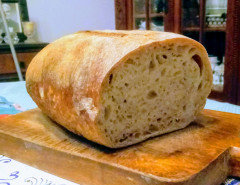
    Here's the end result. I was skeptical of my poor home grown yeastie beasties after I froze and then thawed them! My best so far. Seems like if I want "holey" bread with the air pockets created by gas and steam, I have to have such a wet dough it doesn't hold up very well, sort of puddles. I make it in my oval shaped romertopf. I use the top bowl for the rise and then preheat the bottom in the oven and transfer the bread right before baking via parchment paper. I take the bread out of the romertopf for the last ten minutes to brown the crust overall. Also wet the clay pot before baking and use ice cubes in tray at bottom of oven for steam. This last loaf had good structure but turned out small, not great for sandwiches. I also have a small cast aluminum casserole round pot I can bake in, but my round loaves are flat too, still not sandwich material. I cannot get bread flour reliably so have been adding gluten to AP flour. I think a wee bit too much actually, although I followed the recommended amounts, 1 tsp. per cup of flour. Also mostly white flour. The crust was perfect IMHO, but hubs does not like chewy crust. Sigh.


  • 6 years ago

    Looks beautiful!!....see bread isn't demanding at all. And I am sure it tasted as good as it looks!

  • 6 years ago

    That is a gorgeous loaf of bread Pinkmountain. I am new to bread baking and am on day 6 of my sourdough starter. Would be thrilled if I could bake a loaf like that!

  • 6 years ago

    I agree, LPink! That's a great looking loaf. And yes, if you want the big holes, you need the lot of water. The VWG does help strengthen the rise. Some malt will also help the loft. Smaller loaves are also easier with this kind of crumb. As the quantity of dough gets bigger, it can't support its own weight unless it's just perfect. There is a happy medium, where you can have a soft dough ball rather than sludge, and still have some holes, but that's more dependent on exactitudes which depend on your particular ingredients and environment, and may take some time for your hands to learn exactly what to do.

    Bread flour is more likely to give you an even crumb. The big holes come from the bubbles breaking and merging, like the big bubbles in bubble bath. More water and/or weaker gluten will give you this. The point of bread flour is the higher protein content/more gluten makes stronger bubbles. So if that's not what you want, don't worry about not having any!

    For a sandwich loaf, try baking in a loaf pan. The sides will help support the rise rather than spread of your wet dough. Make sure you have enough dough that the pan is full and the loaf domes above the top edge after the shaped rise. If you're not sure how much to make you can make extra dough, weigh your shaped loaf before putting it in the pan, and bake the extra on its own as a roll or small loaf.

    How does the bread taste? That's the most important thing, right?

  • 6 years ago

    Not sure just what you mean by springy.....but perhaps 4 more minutes in the oven would have helped? If I am in doubt, I use a thermo pen to check the temp of my bread.
    I definitely recommend buying malt powder....but for years and years I have been putting a couple of T of malt-o-meal uncooked cereal into my bread....about a teaspoon per cup of flour. It contains the diastatic malted barley powder that gives the bread a good rise and a good crust and is available on the shelf in your grocery store.

  • 6 years ago

    Re the mushrooming, that generally is cause either by too much dough for the pan, or overrising. You can fix that! Your method sounds like you're really coming to grips with dough. This really is a lovely loaf you've made and nothing like the "I can't bake" forays of the past. Keep experimenting. You'll find a point where you're happy with the size and shape, and both you and your husband like it, and that will become "daily bread"--the bread you make when you just want bread.

    I know you're not into buying a lot of stuff now, but if you're committed to making bread for the foreseeable future, you might want to try Central Milling Artisan Baker's Craft Plus, which is available directly from the Mill. It's what I've been using the last few months and it's really excellent. It's organic, unbleached, with a similar protein content to King Arthur AP, and the plus means the malt is already in the flour. It's perfect for the kind of bread you've said you want to make, the high hydration. If you buy the 25 lb. bag, you may find that the price per pound including shipping is similar to buying smaller bags in the store, which you've said isn't even available. Do you have some empty canisters?

  • 6 years ago

    Can someone tell me the difference in sourdough starter using instant potato flakes and sugar vs feeding with flour? I’m talking about the quality, texture, taste, etc of the bread. I have only used the potato flake recipe which I have had for a couple of years and love the bread, usually no-fail, seems easy to me, but am wondering if perhaps I would like the other type?? Just wondering if I am missing out on something?


  • 6 years ago
    last modified: 6 years ago

    As a person very prone to digestive and urinary tract inflammation,(and other inflammations) I have to carefully parse my consumption of both gluten and maltose. I'm not so allergic that I have a reaction to any of it, but I try and limit my consumption to small amounts. With beer I have an instant stomach ache reaction from even a sip or two. Does not matter since I hate the taste of beer anyway and never acquired tolerance for the taste because of the sensitivity. My father has the same problem with beer. Chewy bread is about my favorite food outside of fruit (something else I have to eat in moderation due to sugar and acid) so I am always looking for optimum results with minimal processing. Not sure barley malt is make or break.

    Unfortunately we have extremely limited storage at our house. And between just ordinary stocking up and pandemic preparedness and me being home with more time to can, I really don't have a good place to store flour in large quantities. This is unfortunate, since that's where you get the best economy when buying it.

  • 6 years ago

    maltose is a sugar ( but you knew that...) diastatic malt is the product of allowing a grain ( barley or wheat usually) thereby converting some of the starch to sugar, then before the conversion is complete, drying it and pulverizing it. Try it....
    Again not ricket science chemistry equasion stuff....but it's inexpensive and a teaspoon per 2 cups of flour makes a difference in the rise. Not done it yet with a total sour dough ( no commercail yeast) but with "some" yeast it makes a huge difference in the rise.

  • 6 years ago

    LPink, what do you mean by wet kneading? In handling high hydration doughs, I've only done what I would call kneading at the beginning - usually after a 20 minute or so autolyse. Often, that is just a series of stretch and folds in the bowl or on the counter. Sometimes I've done a more vigorous slap and fold technique on the counter.

    After that, the handling is to help build structure, especially a gluten cloak. Usually 2 to 4 stretch and folds spaced 30 minutes to an hour apart. I used to do stretch and folds where I pulled the dough into a rectangle and then folded in the sides in thirds or in a book fold (fold each side into the center and then fold in half) turn 90 degrees and repeat. Lately, I've been using the stretch and folds where you work your way around the dough ball pulling out a bit and folding it to the center until it stiffens up. I don't consider that to be kneading.

    Either stretch and fold method is gentler than a kneading action and keeps the air that has built up still in place while stretching the outside "cloak" of the dough.

    What kind of crust does your husband like? I think that the holey structure you are going for usually comes with a fairly substantial crust - either chewy or crusty. I don't think you can get it with a soft crust if that's what he prefers.

  • 6 years ago

    Wet kneading is kneading a wet dough. My old method was to try and do it on my floured wood cutting board or floured formica countertop. Sticking was a problem. Gooey hands were a problem sometimes but I use my big rubber spatula until it stops being so sticky and then hands. Now I knead it in a glass mixing bowl and use my romertopf oval pan for the final rise and baking. It's like a cloche only oval shaped.

Sponsored
Hope Restoration & General Contracting
Average rating: 4.7 out of 5 stars35 Reviews
Columbus Design-Build, Kitchen & Bath Remodeling, Historic Renovations