Software
Houzz Logo Print
sea_e82

Makeup Air & gas cooktop

6 years ago

Greetings all,


We're in the midst of planning for our kitchen remodel, and we're intending to install a 36" gas cooktop with 5 burners (each capable to produce up to 20,000 btu) made by Fisher & Paykel. We also are looking to install a 715 cfm range hood made by Zephyr, which will be ducted directly to the exterior wall. Our kitchen and dining room are connected (roughly 385 square feet in total). We do not have any combustible appliance/ equipment on the floor where the kitchen is located, but we do have a gas furnace in the basement, along with a gas water tank in the garage (also in the basement).


Given that local code (and our own safety concerns) require makeup air, we are exploring several options:

- a 750 cfm makeup air kit from Fantech -- this is the costliest solution and possibly most complicated install for us. We would have to mount this in the attic space.

- either an 8" or 10" passive make up air damper made by Broan or CCB innovation, installed directly in the exterior wall of our kitchen.


Our house was built in the 1970s but has had new siding, double pane windows, and blown insulation added -- it isn't exactly air tight but it's not drafty either.


My question is, is a passive MUA damper sufficient to offset the range hood operation in our situation, or should I just bite the bullet and spring for the expensive Fantech kit? If the latter, is this something that we can set up ourselves or do we need an HVAC company to install? If a passive MUA damper is sufficient, what size should we use?


thanks so much!


Comments (15)

  • 6 years ago

    Here's Martin Holladay of Fine Homebuilding on the subject. The answer depends on whether your gas furnace is a sealed combustion unit or not.


    Before the problem was well understood or regulated, one house I built had a 700 cfm max stovetop hood and no makeup air supply. Just crack open a window or door, I was told, once the fan was on high.

    D B thanked worthy
  • 6 years ago

    @worthy -- thanks! I'll take a look at this article. Our furnace is technically capable to become a sealed combustion unit, but the HVAC installers did not connect the intake pipe to the outside (it instead draws air from the inside). Another problem to solve - ugh!

  • 6 years ago

    Stream of consciousness estimation.

    We may be jumping to the conclusion before reading the table of contents. What is the aperture area of this hood? (E.g., 36 x 24 = 6 sq. ft) What airflow do we need for this area assuming energetic but residential level cooking? (90 CFM/sq. ft. of hood aperture) This implies a required actual volumetric flow rate of 90 x 6 = 540 CFM.

    Now, we need to deal with pressure losses. For practically no duct, we have the baffles in the hood (assume 0.5 inches, w.c. at this flow rate). For a filtered passive MUA source, assume another 0.5 inches at this flow rate. (These are examples.) Now the hood blower sees a total pressure loss of 1.0 inches, while the kitchen pressure is -0.5 inches.

    SAFETY FIRST. The differential pressure limit for cool stack gas combustion appliances is down in the -0.03 inches regime, but the actual required values should be checked for the particular appliances. So the basement needs direct MUA without filtering because the appliances will backdraft at -0.5 inches. If it isn't already very leaky, one form of MUA, a through-wall duct with cross sectional area equal to the combined stack cross sectional areas of the two appliances should be adequate with no filtering. Many modern combustion appliances have kits that connect to the outside and provide MUA directly to the appliances. Otherwise, some coarse screening will be needed with a bit bigger basement MUA duct to keep the critters out, and some heating of the area may be needed, depending on use.

    The kitchen can have passive MUA if the flow rate of the hood blower is at least 540 CFM at one inch of pressure loss (for this example). This will depend on the fan curve for the blower, a pressure loss vs. flow rate datum for the hood, and a pressure loss vs. flow rate datum for the kitchen MUA system filter pack (a furnace filter will do, but needs to be larger than the duct). Else, either the hood blower should be more powerful, or the MUA system needs to be an active one; that is, one with a blower.

    In the case of passive, the duct should be at least the same size as the hood blower duct -- larger if the path length is relatively long.

    Introduction of MUA into the kitchen should be such as to not create turbulence at the cooktop.

    D B thanked kaseki
  • 6 years ago

    @kaseki - the hood I was looking at is 42" x 24" -- but when you say aperture, I assume you mean the actual opening covered by the baffles? the Zephyr website does not specify this, but judging from the product photo, I would guess it's about 36"x18"? It's definitely smaller than the overall dimensions of the unit? Interesting - so the size of the hood aperture dictates the effective air movement rather than the stated cfm shown in the literature?


    I'm a little confused about the pressure loss calculation outlined above (or even how to measure pressure loss). Is this something we'd need an hvac engineer to measure and calculate for us?


    Sorry - I didn't pay good attention during my physics class in high school. I never would have guessed it would come handy as an adult! :-)

  • 6 years ago

    "Interesting - so the size of the hood aperture dictates the effective air movement rather than the stated cfm shown in the literature?"

    Let me rephrase your question into a statement: The size of the hood aperture dictates [by the Greenheck method] the required airflow rate to achieve containment (no spillage out of the hood). The motor characteristics, the baffles, and other restrictions (including MUA) determine the achievable air flow rate. Good design attempts to make the achievable flow rate equal or exceed the required flow rate. Most importantly, the blower's flow rate rating is the zero static pressure value, not the flow rate at whatever pressure loss applies to the entire system.

    While HVAC engineering is appropriate, I think we can approximate the process if you can get the fan curve from Zephyr for your hood blower. Filter data exist, and baffle data exist that might be used as an approximation. Note that the flows achieved and required are not easily estimated with any accuracy, but should be good enough for plume capture and containment of nearly all cooking activities.

  • 6 years ago

    Thanks! I’ll make some phone calls on Monday and hopefully Zephyr has this data available! I’ll keep you posted - really appreciate the help!

  • 6 years ago

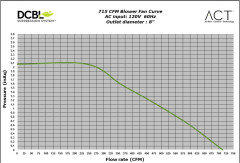
    @kaseki - here is the fan curve for the Zephyr. Any thoughts you may have is greatly appreciated. Thanks!

  • 6 years ago

    Thanks for the data.

    What we can see from this plot are the following:

    • Above about 2 inches of water column pressure "(inAq)," there is no significant flow.
    • There are no points on the useful part of the curve where there are two flow rates at the same pressure; hence, the blower is stable.
    • At zero pressure loss, i.e., hanging in air no hood, ducts, or MUA restriction, one obtains 715 CFM
    • At our example require flow rate (need to recalculate for your actual aperture) of 540 CFM, the maximum pressure loss that can be tolerated is about 0.8 inches, w.c.

    So let's go with 36 x 18, or 4.5 sq. ft. In this case, while some of the pans may not have hood over them and thus some of their plume effluent will not be captured, for 90 ft/min, 405 CFM will assure that what is captured is contained. The fan curve shows that this can be obtained at 1.4 inches, w.c.

    We don't know what the pressure loss of the baffles is vs. flow rate, but assuming some things about Wolf data I have and guessing, I would suggest we use 0.6 inches at 405 CFM for now. This allows us to allocate 1.4 - 0.6 = 0.8 inches for hood duct, MUA duct, and MUA filter.

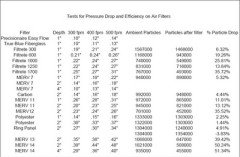
    If the dominating remaining pressure loss is the MUA filter, I can refer you to the following snippet, where various filters of different thickness (this is pleat thickness, not surface thickness) are listed vs. pressure loss at different flow rates.

    The flow rate for this case is 405 (CFM) divided by the filter area (sq. ft.). Even a mere square foot of filter should be tolerated in the MUA system based on this information. I would recommend, if space allows, a filter box (caddy) that holds a standard filter. The MUA duct would be transitioned to the filter box, which could be connected to a diffuser in the kitchen ceiling, among other possible schemes. Don't blow the air right at the hood unless it is fairly distant (a low multiple of the ceiling height).


    Remaining allowable air pressure loss can then be allocated to the ducts, wall caps, dampers, etc., which I think is conservative.

    So while we can conclude that this might work, schemes for heating the air, if required or desired may force use of an active system due to increased resistance of the duct length and of the heating scheme.

    Another conclusion from this exercise is that if you were to go to a larger hood for better capture, a more powerful blower (with a fan curve above and to the right of the one you provided) will be needed.

  • 6 years ago

    Hi @kaseki - thanks so much for the detailed answer. While I'm digesting this, I wanted to ask a slightly different question: based on the fan chart, do you think this hood is sufficient or is it better to go with a higher cfm unit (with an active MUA system)? If I understand your note correctly, it sounds like the real-world effectiveness of this unit is really 405 cfm (assuming 36"x18" aperture).

  • 6 years ago

    405 CFM is its flow rate at the specified pressure (not its effectiveness), and its effectiveness in this example is whatever 90 ft/min of aperture air velocity will achieve. (In my view what you need, and providing full containment based on my knowledge.)

    It is also my view that larger hoods will provide better capture, and in that case a larger blower flow rate at a given pressure loss will be needed. Active MUA may or may not be needed; we have to run the numbers.

    You haven't mentioned whether you are required to have heated MUA, or whether you want it anyway. (I do, in S. NH.) Also, we haven't discussed how the MUA gets to the kitchen, whether you want to do one big MUA into a heated basement and take care of everything at once (very likely active in that case).

    In other words, the entire ventilation system comprising hood subsystem and MUA subsystem need to be defined together, and retrofitting MUA is usually more difficult than retrofitting a larger hood and duct.

  • 6 years ago

    @kaseki -- ah, got it. I'm looking at several other hood options - will keep you posted once I have additional alternatives. City code does not require heated makeup air, but it does require the makeup air to be provided into the kitchen. I've been looking more at the active MUA solution, and if we go this route, we'd install it in the attic with an air inlet installed (possibly next to a passive gable vent - that's about the only location that's available to me).


    If we do go with an active MUA system, is it still necessary to add a passive MUA damper in the utility room?


  • 6 years ago

    I found another MUA system that is paired with an inline blower (of equal power) -- https://hvacquick.com/products/residential/Makeup-Air/Residential-Makeup-Air-Fans/HVACQuick-Balanced-Residential-Make-up-Air-System. Any thoughts on whether this works well? The only downside is that they do not offer a heating solution for the makeup air, but it looks like it's easier to install since we won't need to commission/ fine tune the MUA.

  • 6 years ago
    last modified: 6 years ago

    "If we do go with an active MUA system, is it still necessary to add a passive MUA damper in the utility room?"

    In principle, no. But the question that should be asked and measured by an appropriate sensor is whether, once all is working, the pressure there ever drops into back-drafting territory for your particular appliances. I will always be more comfortable if combustion appliances have their own dedicated MUA ducting.

  • 6 years ago
    last modified: 6 years ago

    HVACquick.com seems to be selling a pair of blowers, one for the hood exhaust and one for the MUA intake. These are matched, it would seem, although I didn't see enough detail to be certain of how they were going to balance the flow rates. You would have to talk with them and determine how they would keep the house negative pressure within the limits set by your particular combustion appliances. It is not immediately obvious to me how fine tuning can be avoided with any system needing to keep house pressure tightly in a safe zone. This is why I like passive appliance MUA -- to get this issue out of the way.

    It is possible that the voltage to each motor is kept the same, and some MUA restriction is set so that the MUA flow rate reasonably tracks the hood flow rate. This would have to be tested in situ. Conceptually, if the MUA filter pack has the same pressure loss vs. flow rate as the hood baffles, and everything else was the same resistance (diffuser pressure loss = hood transition pressure loss), etc., then this type of open-loop system should work. Otherwise, it is necessary to measure differential pressure (somewhere approximating outside-to-somewhere relevant inside) and try with a closed-loop controller to make that difference near zero.

    This can be done by mechanical schemes also, where some pressure controller just opens and closes a restriction. Large buildings kept in a state of positive pressure can do so by running the main building blower at constant speed, and using building pressure to regulate a damper in a duct loop "short-circuiting" the blower.