

should i repot?
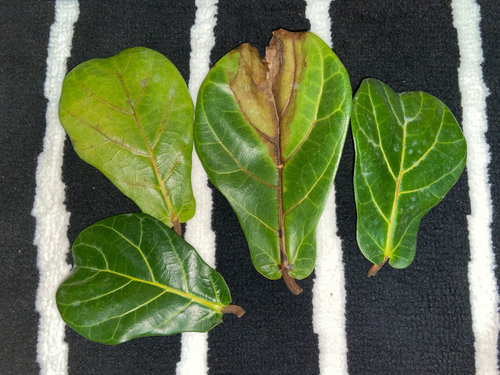
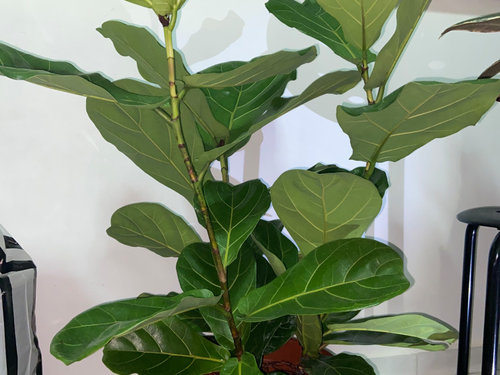
i just brought home a 1 metre ish tall fiddle leaf fig (3 separate branches) from the nursery, looks healthy and putting out new growth. its in a plastic pot with multiple drainage holes. havent watered it for 2 weeks since i got it since the soil was still quite wet. however i noticed that it was beginning to drop leaves– i wasnt worried at first bcs i know they tend to drop the older leaves when acclimating to a new environment. but what i noticed was that it was showing signs of root rot? the leaves were browning from the middle edge of the veins and inwards. my theory is that since i have lesser light at home as compared to the nursery hence the plant is using up less water for photosynthesis = more water in the soil for a prolonged time = root rot. its abt half a metre away from an east facing window so it gets about ~9h of indirect sunlight. should i put it outside (it would get about 2h of direct morning sun) or should i check the roots first and repot it if necessary? soil seems to not have any sort of extra drainage like perlite, and top 2 inches are dry. i dont want to cause any extra unnecessary stress to the plant :(
Comments (7)
huda h.
Original Author6 years agoHey Al! thank you for getting back to me!!!!
i live in singapore so its summer all year round with an average temperature of 30 degrees celcius everyday. ive repotted the fiddle and removed all the mushy roots and pruned a few of the adult roots. repotted it into coco peat, coco coir, perlite and pumice probably in the ratio 2:1:1:2. i then moved it outside my E window where it’ll get direct morning sun for ~2h and bright indirect sunlight for ~8h. this is the best light i can give it as i dont have both S/W windows and the N would be too harsh in the afternoon with indirect light thats not rly bright.
next morning the whole plant was drooping and im assuming its from transplant shock? im really unsure if i should water it bcs the substrate is moist (coco peat was freshly purchased from a nursery and was already quite moist) but its not sitting in water. with the addition of pumice and its sponge-like abilities im not too sure when to water the fiddle as i know it likes to dry from the top half first before watering deeply. right now the top is dry+moist and the bottom is moist. i wouldnt say its saturated bcs theres no excess water and i havent actually watered it at all... should i give the fiddle time to recover from the repotting and then water deeply or should i water it a little now while it adjusts to the repotting?Related Professionals
Palm Bay Landscape Architects & Landscape Designers · Redding Landscape Architects & Landscape Designers · Longview Landscape Architects & Landscape Designers · Hot Springs Landscape Contractors · Johnson City Landscape Contractors · New London Landscape Contractors · Fergus Falls Landscape Contractors · Jacksonville Interior Designers & Decorators · Zanesville Interior Designers & Decorators · Lawton Interior Designers & Decorators · Lawrenceburg Interior Designers & Decorators · Beaumont Interior Designers & Decorators · Petersburg Interior Designers & Decorators · Plainfield Interior Designers & Decorators · Hempstead Interior Designers & Decorators 6 years ago
I'm sorry, Huda. I was expecting you to come back with questions or comments before you actually undertook the repotting exercise. I would have been happy to offer guidance to make sure it goes smoothly. I would have discussed how to use ballast in the bottom of the pot (not a drainage layer) in case there was potential for the medium to be overly water-retentive. Did you perform a full repot, including bare-rooting, root pruning, and a change of growing medium? Immediately subsequent to repotting, maybe for a month or so, you'll need to keep a mental image of where the roots are in the container, and make sure the medium is moist where the roots are. You can tell what moisture levels are beyond the reach of a finger stuck in the medium by using a "tell". Info on that below.
Coco products very often have too much salt in them if they were processed with sea/ocean water, and I'm not a fan of coir or CHCs, I'll leave something at the end about that. IF it was high in salts, the salt can 'pull' water from plant cells by exactly the same mechanism curing salt pulls water from meat, which can cause an immediate collapse of the plant due to a total inability to move water into cells. The other thing I wonder is, did you keep the roots wet (not damp or moist - wet) for the entire duration of the repotting exercise?
The light sounds good, by your description.
Immediately subsequent to repotting, maybe for a month or so, you'll need to keep a mental image of where the roots are in the container, and make sure the medium is moist where the roots are. You can tell what moisture levels are beyond the reach of a finger stuck in the medium by using a "tell". Info on that below.
"Im really unsure if i should water it bcs the substrate is moist (coco peat was freshly purchased from a nursery and was already quite moist) but its not sitting in water. with the addition of pumice and its sponge-like abilities im not too sure when to water the fiddle as i know it likes to dry from the top half first before watering deeply. right now the top is dry+moist and the bottom is moist. i wouldnt say its saturated bcs theres no excess water and i havent actually watered it at all... should i give the fiddle time to recover from the repotting and then water deeply or should i water it a little now while it adjusts to the repotting?" You'll need to trust your judgement regarding whether of not you should water. My thought is yes - the weight of the water will help settle the medium so there is better contact with the roots. I think I would use a spritzer to spritz the soil so it slowly seeps down to the roots. What you would be attempting to do is add enough water to moisten the soil to the lowest point of the soil column occupied by roots. If you want to know how water-retentive your soil is, I can help you figure that out. It's not too late to depot and add ballast if your medium holds more than an inch or two of perched water. All you need is 2 clear plastic cups to do the test.
Peat vs. CoirSphagnum peat and coir have nearly identical water retention curves. They both retain about 90-95% of their volume in water at saturation and release it over approximately the same curve until they both lock water up so tightly it's unavailable for plant uptake at about 30-33% saturation. Coir actually has less loft than sphagnum peat, and therefore, less aeration. Because of this propensity, coir should be used in mixes at lower %s than peat. Because of the tendency to compact, in the greenhouse industry, coir is primarily used in containers in sub-irrigation (bottom-watering) situations. Many sources produce coir that is high in soluble salts, so this can also be an issue.
Using coir as the primary component of container media virtually eliminates lime or dolomitic lime as a possible Ca source because of coir's high pH (6+). Gypsum should be used as a Ca source, which eliminates coir's low S content. All coir products are very high in K, very low in Ca, and have a potentially high Mn content, which can interfere with the uptake of Fe. Several studies have also shown that the significant presence of phenolic allelochemicals in fresh coir can be very problematic for a high % of plants, causing poor growth and reduced yields.
I haven't tested coir thoroughly, but I have done some testing of CHCs (coconut husk chips) with some loose controls in place. After very thoroughly leaching and rinsing the chips, I made a 5:1:1 soil of pine bark:peat:perlite (which I know to be very productive) and a 5:1:1 mix of CHCs:peat:perlite. I planted 6 cuttings of snapdragon and 6 cuttings of Coleus (each from the same plant to help reduce genetic influences) in containers (same size/shape) of the different soils. I added dolomitic lime to the bark soil and gypsum to the CHC soil. After the cuttings struck, I eliminated all but the three strongest in each of the 4 containers. I watered each container with a weak solution of MG 12-4-8 with STEM added at each watering, and watered on an 'as needed basis', not on a schedule. The only difference in the fertilizer regimen was the fact that I included a small amount of MgSO4 (Epsom salts) to provide MG (the dolomitic lime in the bark soil contained the MG, while the gypsum (CaSO4) in the CHC soil did not. This difference was necessary because or the high pH of CHCs and coir.) for the CHC soil.
The results were startling. In both cases, the cuttings grown in the CHC's exhibited < 1/2 the biomass at summers end as the plants in the bark mix.
I just find it very difficult for a solid case to be made (besides "It works for me") for the use of coir or CHC's. They're more expensive and more difficult to use effectively. The fact that some believe peat is in short supply (no where near true, btw) is easily offset by the effect of the carbon footprint of coir in its trek to the US from Sri Lanka or other exotic locales.
That's the view from here. YMMV
Coir Study: https://sites.google.com/site/plantandsoildigest/usu-crop-physiology-laboratory/coconut-coir-studies
Using a 'tell'Over-watering saps vitality and is one of the most common plant assassins, so learning to avoid it is worth the small effort. Plants make and store their own energy source – photosynthate - (sugar/glucose). Functioning roots need energy to drive their metabolic processes, and in order to get it, they use oxygen to burn (oxidize) their food. From this, we can see that terrestrial plants need plenty of air (oxygen) in the soil to drive root function. Many off-the-shelf soils hold too much water and not enough air to support the kind of root health most growers would like to see; and, a healthy root system is a prerequisite to a healthy plant.
Watering in small sips leads to avoid over-watering leads to a residual build-up of dissolved solids (salts) in the soil from tapwater and fertilizer solutions, which limits a plant's ability to absorb water – so watering in sips simply moves us to the other horn of a dilemma. It creates another problem that requires resolution. Better, would be to simply adopt a soil that drains well enough to allow watering to beyond the saturation point, so we're flushing the soil of accumulating dissolved solids whenever we water; this, w/o the plant being forced to pay a tax in the form of reduced vitality, due to prolong periods of soil saturation. Sometimes, though, that's not a course we can immediately steer, which makes controlling how often we water a very important factor.
In many cases, we can judge whether or not a planting needs watering by hefting the pot. This is especially true if the pot is made from light material, like plastic, but doesn't work (as) well when the pot is made from heavier material, like clay, or when the size/weight of the pot precludes grabbing it with one hand to judge its weight and gauge the need for water.
Fingers stuck an inch or two into the soil work ok for shallow pots, but not for deep pots. Deep pots might have 3 or more inches of soil that feels totally dry, while the lower several inches of the soil is 100% saturated. Obviously, the lack of oxygen in the root zone situation can wreak havoc with root health and cause the loss of a very notable measure of your plant's potential. Inexpensive watering meters don't even measure moisture levels, they measure electrical conductivity. Clean the tip and insert it into a cup of distilled water and witness the fact it reads 'DRY'.
One of the most reliable methods of checking a planting's need for water is using a 'tell'. You can use a bamboo skewer in a pinch, but a wooden dowel rod of about 5/16” (75-85mm) would work better. They usually come 48” (120cm) long and can usually be cut in half and serve as a pair. Sharpen all 4 ends in a pencil sharpener and slightly blunt the tip so it's about the diameter of the head on a straight pin. Push the wooden tell deep into the soil. Don't worry, it won't harm the root system. If the plant is quite root-bound, you might need to try several places until you find one where you can push it all the way to the pot's bottom. Leave it a few seconds, then withdraw it and inspect the tip for moisture. For most plantings, withhold water until the tell comes out dry or nearly so. If you see signs of wilting, adjust the interval between waterings so drought stress isn't a recurring issue.
Alhuda h.
Original Author6 years agoHi Al,
yes, i did a full repot! I already prepared the potting mix beforehand so it was a quick repot maybe around 5 minutes? so i didnt see the need to keep the roots wet.... its been 2 days since repotting and the fiddle is still extremely droopy and the top stem (about 2 inches) were starting to shrivel a little bit. after feeling around the substrate i thought it could use some water so i watered it just until water drained out then i loosened the soil for more aeration. i also snipped off the shrivelled part of the stem so it can direct more energy into establishing roots(??) im so afraid of screwing up because i keep asking myself if a plant was recovering from root rot, would it still need water after repotting into a fresh medium even with more drainage???
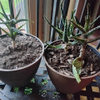
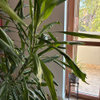
i've read up on your threads regarding the perched water table and in a feeble attempt to save the plant i stuck a small upside down plastic cup (3in height x 4in width) into the mid bottom of the medium...but now i realised i may have misunderstood? im planning to stick a piece of paper towel into 2 or 3 drainage holes so the water can drip down the towel if theres excess water. based on your experiment, should i completely stop using coco coir? and use sphagnum moss instead? is there another alternative? here in SG sphagnum moss is much more expensive than coir. i was thinking of adding in pine bark pieces into the substrate to allow even more air circulation. i shall go get some wooden dowels then, was quite apprehensive about moisture meters like u mentioned so thank you:) nutrients wise, i understand how coir can have too much of one thing and too little of another? im using slow release fertiliser granules.... right now, theres no telling if the plant will survive but maybe there could still be a chance since its not dropping leaves like crazy yet. though the leaves that have dropped have oedema, browning from the inner veins. what else can i do for the plant besides letting it recover on its own? thank you so much for your help and sharing your knowledge with noobs like me im so so grateful. heres a sad picture of my fiddle.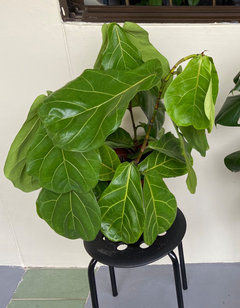
- 6 years ago
If the plant has a significantly greater volume of top mass (foliage) than roots can supply with water, the entire plant can simply collapse and die. I know it sounds scary to you, but the best thing you can do at this point is cut the stems back to 2 healthy leaves on each stem. I defoliate Ficus completely or nearly completely ALL THE TIME in summer. I've even stopped gradually trying to acclimate leaves to full sun when I bring them out of the basement grow area around May's end.
F benjamina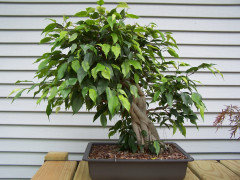
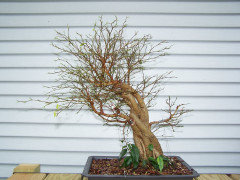
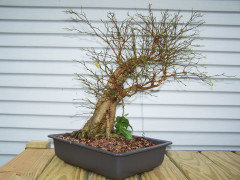 Work complete ^^
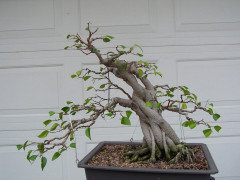
F microcarpa:Jun 12 ^^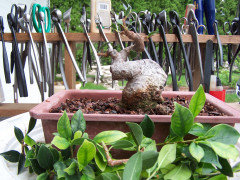 Aug 15 - same year
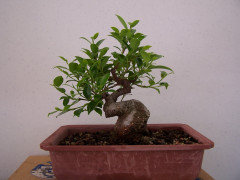 initial styling session complete
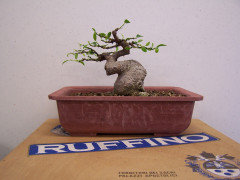
So, even if your tree loses leaves - not a big deal unless its energy reserves are too low to push a new flush of growth.
Your choices:
A) wait and hope the wilt doesn't culminate in wholesale shedding
B) Prune the stems back to 2 healthy leaves each
C) Cut the last/top leaf on each stem and remove the rest of the leaves by snipping through the leaf stem (petiole)
A would be my last choice and I know it would be your first. The plant might perk up tomorrow, or it might shed all/most leaves.
B pretty much ensures the plant won't shed all it's leaves unless the shedding process is already under way, so if that's your choice, act quickly. It also relieves pressure on roots and helps ensure the plant won't collapse
C) Is much the same as B, but what will happen is, you'll get a pristine flush of new foliage as the plant comes back on line - also relieves pressure on the root system and helps ensure the plant won't collapse
Both the cup and the wick are very good choices and will help eliminate/reduce any ill effects caused by excess water.
This is what I use for my trees:
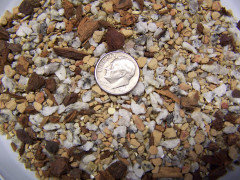
If you had pine bark there, you could easily make this:You can always work on refining the use of ballast to eliminate perched water.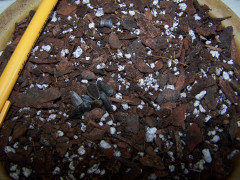
Handrek and Black wrote a book (Growing Media for Ornamental Plants) in which they confirmed essentially validated further the research I'd already done on coir. Their recommendation was that it be used as no more than 10% of a container medium for the reasons I mentioned. If you do your own research, it might be possible to put work-arrounds in place that would allow you to sidestep its issues. I haven't done that research because I have peat readily available and don't believe the idea we're depleting an important carbon sink via it's use, though I don't dispute it's over-harvested in areas where it's used as fuel.
The alternative to peat and coir would be an all mineral medium, entirely doable. If you want to explore that avenue more, I'll direct you to a thread I started in 2005 here at GW/Houzz - it's still active and discusses all types of container media at great length. Follow me.
I have other threads you might find helpful, but these might be particularly so:
An Overview of Good Growing Practices
Long Term Care of Ficus in Containers
Al huda h.
Original Author6 years agolast modified: 6 years agoHi Al,
Thank you for getting back to me 😭 ive pruned the plant down to half its height and removed some lower leaves as well. i feel that right now the medium is still quite water retentive and im afraid the roots will still continue rotting. apart from the ballast, wick and the best replication of your 5:1:1, how do i ensure from here onwards that its recovering? is there any science behind treating it with hydrogen peroxide and letting it sit in water to recover and develop new healthy roots? right now i dont have access to build a new potting medium not for the next few weeks at least.... also i understand from your threads that the size of pine barks make a difference so would you discourage using chunkier pine bark if thats all i have? Thank you:)
- 6 years ago
I don't know what more you can do, other than using the 'tell' to keep track of moisture levels deep in the pot. Do keep us posted though, please. Using H2O2 happens to be one of the documents I wrote about and saved. I read somewhere the 3% product that's nearly ubiquitous uses a stabilizer, meant to increase shelf life, that is mildly phytotoxic, so you might try on your own to find something re that.
Hydrogen PeroxideH2O2 has an extra O atom (compared to H2O) in an unstable arrangement. It's the extra atom that makes it useful in horticultural applications. Generally, we're not concerned with aerobic forms of bacteria normally occurring in container media or on roots. Since H2O2 is an unstable molecule, it breaks down easily. When it does, a single O- atom and a molecule of water is released. This O- atom is extremely reactive and will quickly attach itself to either another O- atom forming stable O2, or attack the nearest organic molecule.
Reduced O levels and high temperatures encourage both anaerobic bacteria and fungi. Many disease causing organisms and spores are killed by O, and the free O- H2O2 releases is very effective at this. Additionally, when plants growing in water-retentive media are treated with H2O2 it will break down and release O into the area around the roots. This helps stop the O from being depleted in the water filled air soil air spaces until air can get back into them. High O levels at the roots will encourage rapid healthy root growth and discourage unwanted bacteria/fungi.
I know H2O2 comes in several different strengths, the most common of which are 3% and 35% solutions. Least expensive is the 35% product (what I use) which you dilute (to an approximate 3% solution) by mixing 1:11 with water. I have used the 3% solution at 1.5 to 2 tbsp per gallon as a cutting dip/soak, and have mixed it into irrigation water for plants in extremely water retentive soils at up to 3 tbsp per gallon, both with good results and nothing adverse apparent.
H2O2 in high concentration is a powerful oxidant and quickly oxidizes almost anything it contacts, so be very careful with it if you use it. A solution that is too strong can destroy any organic molecule it contacts.
I have seen this chart posted several times as suggested strength solutions for use in watering plants. You may wish to start at a lower concentration , such as I have used, and experiment.
TO THIS AMOUNT OF WATER ADD THIS AMOUNT OF 3% HYDROGEN PEROXIDE --OR-- ADD THIS AMOUNT OF 35% HYDROGEN PEROXIDE
1 cup, add 1-1/2 teaspoons @ 35% - 7 to 10 drops
1 quart, add 2 tablespoons @ 35% - 1/2 teaspoon
1 gallon, add 1/2 cup @ 35% - 2 teaspoons
5 gallons, add 2-1/2 cups @ 35% - 3 tablespoons plus 1 teaspoon
10 gallons, add 5 cups @ 35% - 6 tablespoons plus 2 teaspoons
20 gallons, add 10 cups @ 35% - 3/4 cup plus 1 tablespoon plus 1 teaspoonAl












tapla (mid-Michigan, USDA z5b-6a)