Software
Houzz Logo Print
homeintheforest

Pool Patio- bluestone too hot? how make permeable?

6 years ago

We are wanting to install a patio around our pool and like the look of bluestone. I'm big on doing right ecologically, so would like something that would be water permeable. Also, many people have warned us that bluestone will make the area feel hot and we won't be able to walk barefoot on it. So in trying to decide whether pavers would be a better overall choice even though I prefer the natural stone aesthetically, I have few questions if anyone has the experience or knowledge to share:


1.) I saw on the Unilock website that one could choose a permeable base/bed installation instead of standard installation. Would installing bluestone (dry set with the stones touching with polymeric sand swept on top) somehow make it more permeable and better environmentally?


2.) Does anyone have experience with Techo Bloc's permeable pavers? (not wanting cobble stone look so their "Blu" model which offers larger sizes could possibly work)


3.) To address the heat issue of bluestone, I see Unilock has a simulated bluestone paver (Beacon Hill Flagstone), but it is not marketed as water permeable. Anyone have experience or feedback on whether this might be a better choice than bluestone?


Thanks for any advice or thoughts you might have!

Comments (13)

  • 6 years ago

    Thank for your input, Mystic Pools! By “environmentally friendly“, I mean water permeable rather than something that creates water runoff & sustainable (vs quarrying a mountain for). Thanks for asking.

  • PRO
    6 years ago

    With permeable pavers it's the joints that allow infiltration, not the paver itself. So doing a standard paver that's set up for tight joints and filling the joints with poly sand creates a surface that's really not much more permeable than asphalt - no matter what base you use. There are contractors who are moving to using a permeable style base for all pavers, but that comes down to efficiency, not green issues. They're finding that the #57s compact way faster and the #8s still make a good bedding layer.


    I would hesitate to do a permeable paver for a pool deck. Like I said, it's the joint that makes it permeable. The joint is filled with a #8 or #78 chip gravel, and I don't see how that's not going to end up in the pool. Additionally, depending on your soil and drainage conditions, I'd hesitate to introduce water right around the pool shell. If you have the space, I'd rather mitigate runoff via a rain garden, bioswale, etc.


    As for environmental friendliness, it takes smarter folks than me to calculate the impact of every consumer choice out there. But I do know that the concrete industry isn't known for a low carbon footprint, so I'm not sure how much "cleaner" a choice concrete pavers are vs stone that's quarried and split a couple of states away (for us, anyhow).


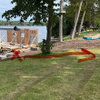
    Oh and as far as bluestone/flagstone and heat goes, we had a client who ignored warnings about the heat of the stone. They later had an irrigation company come in to install a zone to wet down the pool deck during the day just to make it walkable. There are other considerations too though. One planting client of ours just installed a pool with a pearlescent white travertine pool deck. It's super cool to the touch, but in full sun it's so blindingly reflective that I feel like I'm in that scene after Harry Potter dies (spoilers!):


    I would suggest finding a knowledgeable landscape designer to work with. You're on an interesting path, I just think someone who's been on that path before could be helpful.


  • 6 years ago

    Revolutionary Gardens: thank you so much for your extensive and thoughtful answer (with fun photo too to make the point! :))! As you noted, there are many considerations in making good environmental choices, and I appreciate your taking the time to share your knowledge and experience with me. This was incredibly helpful.

  • 6 years ago

    I suddenly got a new idea: what about wood instead of stone? Much cooler? My husband was worried about upkeep and longevity, so we dismissed this option early on. Does anyone have experience with using wood for pool patio instead?

  • 4 years ago

    We have blue stone, wood and resin. The rain is much cooler than the other two and it comes in many colours.

    homeintheforest thanked francaruso
  • 4 years ago

    Thanks, Francaruso! We went with bluestone and are happy with the results!

  • 4 years ago

    Hi homeintheforest
    I love the look of bluestone but am also worried about the heat. Did you use bluestone for the coping and deck? Is it tolerable barefoot?
    We should be finished with the pool in may, but still have time to make changes on the patio. I have bluestone for the coping.
    Would love to see pictures! Thank you

    homeintheforest thanked sandyie
  • 4 years ago

    We just finished our pool we’ve narrowed it down to bluestone, but since reading these comments I’m rethinking it. It only took me forever to make the decision of bluestone, so now its back to the drawing board..

    homeintheforest thanked HU-207338484
  • 4 years ago
    homeintheforest thanked Jean
  • 4 years ago

    I can confirm the bluestone is unbearably hot for my kids and even for adults. This is the case on 80+ degree days and any area in full sun. We researched this topic, talked to our architect and our contractor and no one really steered us away from it. Most said it was not much different than concrete or another stone. Sadly I should have trusted my gut and spent the time to go back to the drawing board and look into another material.

    homeintheforest thanked Lauren Jean
  • 4 years ago

    Patios are not environmentally friendly.

    homeintheforest thanked ShadyWillowFarm
  • 3 years ago

    Recently ripped out a heap of newly laid bluestone pavers because the heat was unbearable. Replaced with architectural white concrete, the difference was night and day.