Software
Houzz Logo Print
bonsai_citrus_and_indoor_gardening

Mulch Options For Indoor Citrus Trees

6 years ago
last modified: 6 years ago

So I've heard a lot about mulching citrus trees, there seems to be a lot of disagreement on the topic, so I thought I'd start a forum about it and pick some brains. Mulch? Don't Mulch? Best kind of mulch? I had heard about using cedar chips as a mulch on indoor trees to help keep pests at bay, (this is aside from getting a well draining medium, watering only when necessary (I personally use a moisture meter and a wooden skewer, water when both seem to indicate the soil is dry), etc.), and was intrigued by the idea. Anyone done this? Does it work? Are there better options? Benefits of mulching/not mulching?

Comments (30)

  • 6 years ago

    For indoor I would just decorative Clay pebbles or marbles, no outdoor stuff.

  • 6 years ago

    People do mulch out door in ground trees on occasion, but there is not much of a reason to mulch a container tree. Root Maker Corporation sells a pot cover for container growers, which would work as a mulch.

  • 6 years ago

    Indoor citrus normally has too much moisture and takes too long to dry out leading to root rot. I would not mulch indoor citrus. Honestly, unless your in a desert I wouldn't mulch any citrus.

  • 6 years ago

    limit the amount of water if your using clay soils wait longer between waterings

  • 6 years ago

    Thanks for the responses. I tend towards no mulch, personally, but fungus gnats are bad outdoors in my area and sometimes find their way inside, especially in the early morning hours in summer/fall if someone opens a door. Someone had suggested mulching trees to deter them from nesting in your pots, so I was curious if others share the view or if, as I was thinking, it would keep the soil too moist and potentially invite other problems. Usually I just treat them with DE and allow the pots to get more dry than usual when I find them and it kills them off in a few weeks, but this method can sometimes stress my trees, especially my big (for an indoor tree) Nagami who had a rough life before I got it.

  • 6 years ago

    To combat fungus gnats use sand. The gnats cant get thru the sand to lay their eggs and the sand drys out quickly. If you get the sand from the beach remember to rinse it well to get the salt off of it,

  • 6 years ago

    Dissolve mosquito dunks in water and then set you citrus container it the liquid for 3 or 4 minutes and that will eliminate the problem.

  • 6 years ago

    Great information, and a good explanation for why I've noticed a lot of discrepancies in opinions. I would assume that you'd want more air space and a bark that dries faster if you're looking for a mulch for indoors, (since you don't want to trap a ton of moisture lower down as evaporation rate will be lower due to lower external temperatures), likely something that would be difficult to find in the pacific northwest where I'm at where the moisture content of wood is likely higher. Have you found it beneficial in potted citrus to use a bark/is there a particular bark that you've found works best, or is it better to just mix it into your soil mix and keep the surface soil bare? Just curious.

  • 6 years ago

    my mulch is used tea leaves and used coffee grounds on top of a pot of clay soil and right now my lemon seedlings are out side

  • 6 years ago
    last modified: 6 years ago

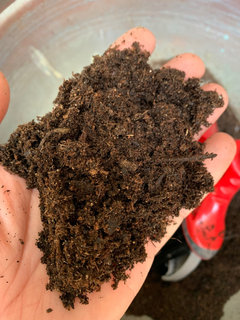
    Hi HU, I noticed the same thing. A huge cosmic discrepancy in opinion and a grand canyon discrepancy in results. When in Rome do as the Romans do. Better to use what your local greenhouses are using rather than try to buy hard to find ingredients. I use sphagnum peat moss, black earth (humus) with a maximum moisture content of 60%. The Organic matter is 25-32% and slightly enriched with traces of NPK. Some brands I use may or may not add coconut choir. I don't use any bark. The most important variable for me is the maximum water moisture content of 60%. We keep our RH 40% in the winter. I use clay pots and the watering cycles beautifully between 40-60%. I do use full spectrum LED light indoors which keeps the plant growing through the winter months. With a 40-60% humidity range it would be almost impossible to overwater. You water when the color turns milk chocolate and when the mix is moist enough the mix has the color of dark chocolate.

    Growing indoors you have to be very consistent and the nail in the coffin for bark is the all over the map wide range of water holding capacities. This is why the wildly different results. In the article with the SMALL samples they compared they found the water holding capacities of the barks ranged from 34-51 percent. The recommended guidelines for nursery substrates is 45-65 percent water holding capacities. This is why you see all these sad wilted plants bearing no fruit. From Four Winds Growers they recommend Watering before leaves show wilting, and when roots have reached about 50% dryness. If someone is using bark media which is holding only 34-51% they will have never ending water issues.

  • 6 years ago

    I'm using used coffee grounds and used tea leaves as a fertilizing mulch for my lemon seedlings are small

  • 6 years ago

    @Lemon Lime Orange Zone 6a, Thanks for the info. Right now I'm using a bagged mix that uses a mix of bark fines, compost, pumice and shell limes for PH, then add a bit of crushed lava rock, which I've found just helps it to dry a little faster. So far it's worked well as long as I keep my plants in ceramic pots, though I'd love to find an alternative to ceramic. So far haven't seen an issue except for the gnats nesting on watering day, to which one greenhouse recommended mulching, another said not to and just to dry it out when I notice them. Different parts of town, likely different experiences. Since it seems like most places around me recommend bagged mix I've been considering either amending it or mixing my own, since it takes a bit longer to dry in an indoor environment.

  • 6 years ago

    Important for everyone to use what they have locally available and use what works for them. I take issue with people that have tunnel vision and a one size fits all approach to potting soil. Good to experiment and see what works best for you. Everyone has different climates and different pots and different environmental factors to consider. The advantage of a bag mix is you have a guaranteed analysis so you know what you are dealing with. The advantage of your own mix is the fun of creating something new.

  • 6 years ago

    Received 3 mail order citrus plants yesterday and they came with a beautiful loamy soil.

  • 6 years ago

    since I'm a poor man all I could afford is locally available clay soil and I'm using no potting soil but I just keep adding used tea leaves and slowly changing the soil structure

  • 6 years ago

    Howard I am keenly waiting to hear how this works out. You should know some lemons come true to seed and others won't. Depends on the cultivar you used. You might enjoy this article. http://thecitrusguy.blogspot.com/2010/08/to-seed-or-not-to-seed.html

  • 6 years ago

    @Lemon Lime Orange Zone 6a Four winds growers? The soil my Fukushu came in was a beautiful soil like that. Climate considerations can be so different based on where you live, everyone has a different micro-climate and different needs. Experimentation is often the name of the game if you want to find something that works really well. I've just started searching for recommendations from climates similar to mine and then used that as a jumping point to decide what I want to do to build my own mix. Can be difficult and expensive though where I'm at since I don't have storage space for a lot of extra soil, so right now I've been focusing on figuring out the best way to amend the bagged mix I find in my area.


    @HOWARD Martin how have the tea leaves worked out? I had heard of adding them to a compost pile, but not directly to the soil. I'm curious.

  • 6 years ago

    Wouldn't you just love to buy that by the bag? Great info and thanks for that article. Always learning something new)

  • 6 years ago

    right now I'm just seeing how my seedlings are doing I clay soil

  • 6 years ago

    it is working for a beginning slow release fertilizer that is safe at least in clay

  • 6 years ago

    Hi Bonsai, Four Winds Growers specializes in dwarf and semi-dwarf citrus trees. They have 60 varieties of fine citrus online. These include a selection of rare and unusual citrus varieties that are hard to find at retail nurseries. With that kind of experience I like to use Four Winds Growers as a benchmark. Check out what they recommend for soil.

  • 6 years ago

    Iknow that is that way with all fruit and flowers and some times with livestock as well

  • 6 years ago
    last modified: 6 years ago

    Lemon Lime you wrote..............>You should know some lemons come true to seed and others won't.<

    I don't know of any true lemon that does not come true from seed , Could you expand on those that do not produce true? ,

  • 6 years ago

    I read the article and I agree with only part of it

  • 6 years ago

    @Lemon Lime Orange Zone 6a I've taken some of my recommendations from four winds, in fact they're one of my favorite sources for citrus related info. In their section on indoor citrus they recommend utilizing a commercial mix and amending with bark or cedar. Unfortunately they don't tell you how to make their mix only that you can make your own with compost, bark, etc. I always do my research and gather information before I try something, then fine tune. I've found some of the amendments used in bonsai soil can be added to citrus mixes to aid in drainage and moisture retention/loss in my case. Wet climate makes it so that it is really easy for moisture levels to be too much on the wet side with a low evaporation rate. (I've had mixes that will stay wet (9-10 on my moisture meter) in summer for upwards of 18 days that were supposed to be well draining, so I'm always looking for options).


    For the seeds that come polyembryonic and thus more likely to be true to seed there are a number of charts available (some you have to search for). I had heard that meyer lemons don't often come true to type, but then it's not a true lemon. Most of the charts I've found seem to be more likely to tell you which lemon types are polyembryonic than which aren't. But I guess you could always do process of elimination to know. If it's not on the chart, then it may or may not produce true to seed.

  • 6 years ago

    even those that suppose to breed true don't always come true to seed that why they're so many varieties to choose from and work with

  • 6 years ago

    Meyer lemons are not true lemons. They are a hybrid and are Monoembryonic (don’t come true). Of The 27 lemon cultivars analyzed (in the Springer study below) most could be considered slightly or moderately polyembryonic, with 25 to 43% of seeds being polyembryonic and from 1.3 to 1.6 embryos per seed.


    http://redwoodbarn.com/PDF/Whichcitrusfromseed.pdf


    https://link.springer.com/article/10.1007/s11240-008-9358-0


    https://www.gallifreypermaculture.com.au/2015/12/polyembryonic-seeds/?doing_wp_cron=1595000650.4052889347076416015625


    https://www.researchgate.net/publication/267951443_Lemons_Diversity_and_Relationships_with_Selected_Citrus_Genotypes_as_Measured_with_Nuclear_Genome_Markers


    https://thecitrusguy.blogspot.com/2010/08/to-seed-or-not-to-seed.html


    https://link.springer.com/article/10.1007%2Fs11105-010-0277-y


    https://www.sciencedirect.com/science/article/abs/pii/S0168952501024428


    In practical terms, "commercially grafted citrus trees are identical to the parent tree and fruit within two to three years. However, trees produced via seed are not carbon copies of the parent and may take five or more years to fruit, with the resulting fruit generally inferior to those of the parent. For that matter, your growing lemon tree seeds may never produce fruit, but it is a fun experiment and the resulting tree will no doubt be a lovely, living citrus specimen." Read more at Gardening Know How: Propagating Lemon Seeds: Can You Grow A Lemon Tree Seed https://www.gardeningknowhow.com/edible/fruits/lemons/propagating-lemon-seeds.htm


    I


  • 6 years ago
    last modified: 6 years ago

    The best sphagnum peat moss comes from parts of New Zealand, Peru, Canada, Ireland and Scotland. It is incredibly easy to work. The United States imports approximately 87% of Canadian peat moss production, representing 95% of America's total sphagnum peat moss imports (USGS 2019). However it does not make economic sense for some American growers to long haul Canadian peat moss when they have other forestry byproducts available for less cost. This is why it is better to use what you have locally available.

    Canada has some very rich soil we call black gold. It is some of the best soil in North America and is abundant in rich organic matter. We also have the best peat moss in the world. When you combine black gold with peat moss you have a very nice product which provides exceptional yields. My citrus nursery tells me that sometimes he buys an orange and they get a lemon because the container is packed with sand and sawdust and wood chips as filler.

    Nursery's typically hire a few brains and the rest are minimum wage kids walking around with a garden hose, watering 1000's of plants a day. Those kids are not using "tells", or moisture meters or electronic devices to know when to water. What a lot of citrus hobbyist think are "watering and potting mix issues" are really other issues like humidity, heat, fertilizer, insects, light et. The reason greenhouses can hire minimum wage people to brainlessly water their plants is because they have ideal growing conditions; greenhouse light, high humidity, gentle air, and ideal temperatures, correct hours of sunshine, healthy water supply, and slow release fertilizer.

    https://www.lambertpeatmoss.com/about-us/canadian-peat-moss-environment/

    Canadian Peat Moss and the Environment

    "Less than 0.02% of Canadian bogs are utilized for horticultural purposes, providing literally thousands of years of harvestable peat (approximately 29,000 years.) Canadian Sphagnum Peat Moss is regenerating more than 70 times faster than the current harvests. Several environmental agencies oversee all aspects of the peat bogs to insure a safe and sustainable ecosystem. Canadians are proud to share this sustainable resource to improve your soil and provide soil-less media."

    https://www.pthorticulture.com/en/training-center/what-is-sphagnum-peat-moss-and-where-does-it-come-from/

  • 6 years ago

    I'm using what I have to work with