Software
Houzz Logo Print
leivaida

Hydrangeas stems falling down

6 years ago

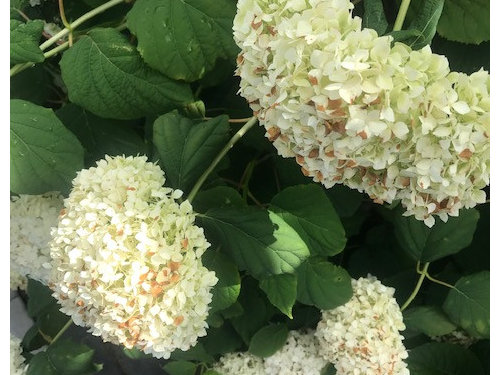
Hi there. Any recommendations on how to keep stems from my 1 year old hydrangeas from falling down? Why they are turning green or with dark spots in the flowers? Also, do you think I planted many of them together? They are all 1 year plants. Thank you. Aida


Comments (8)

  • 6 years ago

    The heads will not last forever. They’re just growing old. The plants flop because the heads are too heavy for the stems. Could be exacerbated by over feeding or light only coming from one side. If they’re only a year old they do appear to have been pushed into growth to reach that size. I don’t know what you mean by planting ‘many together’. I can only see two and they’re miles apart.

    leivaida thanked floral_uk z.8/9 SW UK
  • 6 years ago

    Bed is too narrow for plants of this stature, they are going to continue to grow across the path - hosta to the right is the kind of thing that will fit there. Likewise the Japanese maple looks like it is probably a cultivar that is going to exceed the available space by a considerable amount in time.

    leivaida thanked Embothrium
  • 6 years ago
    last modified: 6 years ago

    You appear to have a hydrangea arborescens (Annabelle, Incrediball, Invincibelle, etc.) whose stems -when young- can flop due to the weight of the blooms, weak stem DNA, windy weather, water in the blooms, etc.... As the stems become older, they will turn more woody and will be able to hold more weight but up to a point. Some varieties like Incrediball and Invincibelle can hold more weight and flop less but, despite the advertising, they not immune to the problem. They too have limits and may flop by the end of the season if the right thunderstorm passes by near the end of the season.

    Hydrangea arborescens blooms like those start green, turn white and continue through a series of color changes as they get older. I suspect that after they have been white now for a while ( month or more), it is time for the next color change, which usually adds a green tint again. Eventually, the bloom will end brown and remain attached to the stems for quite a long time. You can deadhead spent blooms at any time. see the last section at the bottom of this link titled Deadheading hydrangeas:

    https://plantaddicts.com/pruning-hydrangeas/

    Sometimes the color change goes directly from white to brown if the plant needs more water and does not get it. It can be common in the summer time. Hydrangeas tend to suffer from heat stress and may wilt as a result of temperatures above 85F, very windy conditions, lack of water, too much sunlight, etc. Maintain the soil as evenly moist as you can and with 2-4" of organic mulch (no rocks). There may be indirect sunlight hitting the plant as a result of surfaces in the area too. As the root system becomes older and more capable to absorb more water, this problem may be reduced but it tends to occur during the worst part of the summer.

    I used to use some wire fencing around my Annabelle Hydrangeas, which also displayed similar issues. I found it was best to add this during the winter as there were no leaves to block the view and I could see the internal stem "structure" of the plant and place the wire closer and in better locations. But fencing is something that can be done at any time of course. I do have a habit nowadays of taking a look at the dormant plant during winter and tweaking the wires due to new stem growth, etc.
    I like to get dark green colored wire fences that eventually get "swallowed" and hidden by all the leaves. Select a height that seems appropriate. Put it around the plant, very close to the stems and "adjust" the fence closer or further away from the stems. Like when one tightens a belt around the waist. If still flopping, move the fencing closer to the center of the stems, as if tightening the belt around your waist. Repeat until you get a look that is "acceptable" to you. I find that starting this fencing in the middle of the growing season does not look as good as when I start the fencing before leaf out time... but, that is just my opinion.
    You can also strategically cut a few blooms to help with flopping or somehow protect the blooms from getting wet or from getting too much wind but that usually requires transplanting though.
    I do not recommend completely pruning stems because they get replaced by new stems. And new stems are weaker. As the stems get older, they become more woody and can handle more weight without a lot of bending. So I prefer to keep older, woodier stems. But there are limits to that, of course; sometimes the stems will bend too much and not straighten (or break) so, I understand..., you may have to prune woody ones at times... In those cases, I get cuttings and start new plants for myself, for someone else or for a garden club sale.
    With Annabelle, I once planted a second Annabelle close to another Annabelle to see if each one would "help" the other not flop as much. In the center of the "combined" bushes, that helped but, not in the periphery.
    I have seen some people who used low fences also use a stake and green strings as a support system, tucked in close under the branches so that, as the plant leafs out and grows, the supports are hidden. Their Annabelle was also wedged in between a large rhododendron and a spirea that help prop it up, so the Annabelle looks OK even after several pounding rains and a hailstorm the prior day. Of course, just a string would be the quickest way. Buy a tall enough fence stake, pound it in the ground behind the plant with a sledge hammer or whatever; then do an inner and outer lasso. You can also lasso to a fence or structure if one exists.
    For sure, a single specimen in an "unsheltered", windy location will probably suffer more flopping. As the stems get older and woodier, this may not continue being a problem for long. They are close to the pool though so it may be necessary to prune in order to keep their size in check.

    leivaida thanked luis_pr
  • 6 years ago

    When the rain comes they will flop

    leivaida thanked hyed
  • 6 years ago

    Hi There! Thank you everyone for your answers and ideas. Indeed those are Annabelle hydrangeas. I know the space its not to big for them and I planted 4 so what you see as 1 is actually 2. Then on each side beside the second Annabelle there is one Let's dance rhythmic blue hydrangea an ornamental grass and the red dragon Japanese Mapple. Also, I have a hosta at each edge of the plant bed. That is why I asked if there where to many plants. Maybe I have to dig out the Let's dance hydrangeas and replant them in some big pots. I love seeing them form my home window. They really look amazing. I was just looking for ways to keep them more straight thinking that maybe pruning differently would've help. The suggestion about wires or fences inside the bush and setting them in winter time its a good idea. Thank you all very much.!

  • 6 years ago
    last modified: 6 years ago

    Let's Dance Hydrangeas tend to be smaller (3-4') than Annabelle so I would prefer to use them there but I am saying that without knowing the dimensions of the planting area. One warning: Annabelle & its cousins can sometimes propagate via suckers so the original planting can grow wider as new plants appear in Spring. Not all Annas do this though so, if you need to, check in Spring for suckers and prune them if you do not want them.

  • 6 years ago

    I hadn’t even spotted the pink hydrangeas. So yes, they’re way too squashed in.