Software
Houzz Logo Print
themarcanthony

Grayish Spots on Scindapsus pictus, please help!

6 years ago
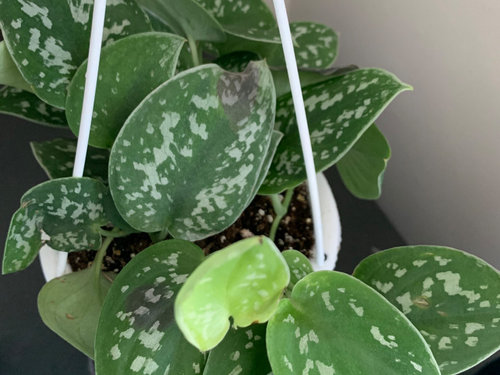
Hi everyone! This is my first post!


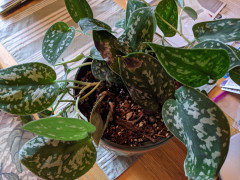
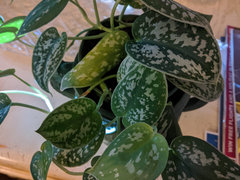
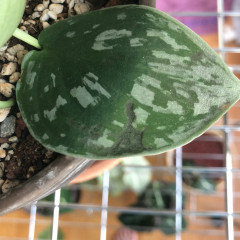
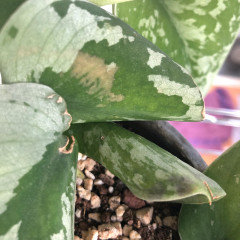
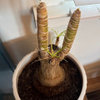
I bought this Scindapsus Pictus yesterday and this morning, I noticed these grayish/brown blotches on a bunch of the leaves. I honestly don’t recall seeing them in the plant shop, but i could have just been oblivious. Nevertheless, Does anybody have an idea what could be causing this?


Some background: I have it placed in my bedroom, which has two large, west-facing windows. I’ve been leaving my AC (in my living room) on all day, which lets the cool air Reach my room throughout the night. So, the temp in my room is between 65-70 degrees. No direct light reaches the plants, thankfully, so I doubt that is the cause.


I’m looking forward to being part of this forum, thanks everyone so much!

Comments (10)

  • 6 years ago

    I touched the spots and they are indeed soggy/soft. If that’s the case, should I assume it’s a fungal infection and exchange for another one? Or give it some time to acclimate?


    If it’s a nutrient issue, do you think worm castings would be a good way to mitigate it?


    Thanks for your help!

  • 6 years ago

    I would exchange it if you can! Fungal/ overwatering issues are much harder to treat than pests or underwatering, in my experience. If the spots are soft its almost definitely not a nutrient issue.

  • 6 years ago

    Not fungal, besides - fungal leaf lesions are dry, not wet. What we see is photo-oxidation (sunburn) and it happened VERY recently. It will soon start to turn black or dry out and turn brown, depending on how succulent the leaf tissue is. Did you allow the plant to sit in direct sun anytime between the POS (point of sale - thought I'd better clarify that) and where it's sited now?


    Al

  • 6 years ago

    Vaughn, thanks for the advice. I cut off each of the leaves with the spots. To test out the possibility of it being fungal, I'll give it a few weeks to monitor growth and such.


    Al, thank you so much for your perspective! To the best of my memory, the only time it was exposed to the direct sun was while it sat in the bag I was given while I carried it back home (about 35-40 mins). Do you think that was enough to cause these markings? If so, do you think it will be fine being placed in my bedroom (with the west-facing windows) but not in the line of direct sunlight? My view has no blockage of sunlight since I am on the Hudson River in NY.

  • 6 years ago

    To the best of my memory, the only time it was exposed to the direct sun was while it sat in the bag I was given while I carried it back home (about 35-40 mins). Do you think that was enough to cause these markings? If you were walking and the sunlight was directly on the plant - yes. If so, do you think it will be fine being placed in my bedroom (with the west-facing windows) but not in the line of direct sunlight? Should be fine there, I would think. My view has no blockage of sunlight since I am on the Hudson River in NY. Next time Sully drops in, say "HI" for me, please.

    Something I wrote about sunburn:


    Sunburn

    High light intensity levels can cause chlorophyll molecules to rise to a more excited state than normal. If light levels are high enough, the energy that is released as electrons in molecules return to their normal energy state may be sufficient to form oxygen radicals from O2. These are the same O2- radicals found in H2O2 (hydrogen peroxide) and are extremely reactive particles that readily destroy chlorophyll molecules. The entire process and technical term is photo oxidation, and we generally refer to it as sunburn.

    Many confuse over-heating with photo-oxidation (sunburn). They're different. I wouldn't put a plant in a direct sun exposure and check daily for signs of burning. If your plant is sunburned, a LOT of cells have been killed by the free oxygen O-negative radical that's generated during photo over-exposure. IOW - by the time there's a symptom, the damage has been done.

    High light intensity levels can cause chlorophyll molecules to rise to a more excited state than normal. If light levels are high enough, the energy that is released as electrons in molecules return to their normal energy state may be sufficient to form free oxygen radicals from O2. These are the same O2- radicals found in H2O2 (hydrogen peroxide) and are extremely reactive particles that readily destroy (oxidize/bleach) chlorophyll molecules. The entire process and technical term is photo oxidation, and we generally refer to it as sunburn.

    Overheating is caused by passive solar gain. Imagine how hot a dark green car gets in intense direct sun when there is no breeze to get a sense of what passive solar gain is - light energy being converted to heat. Overheating commonly occurs indoors because of a layer of still air (called the boundary layer) that surrounds the leaf. It serves to insulate the leaf so heat is trapped in the leaf and not lost to surrounding air. Most cases of overheating can be avoided by rigging a fan on a timer so it disrupts the boundary layer during periods of intense photo load.


    Al

  • 6 years ago

    I have been following this post. I just wanted to add my experience similar to yours. I have two Argyraeus silver satin pothos. The first one I got at Lowe's. I repotted it in well-draining good soil because they seem to over-water their plants. It has black spot on some leaves in random places like yours. I am planning to remove the three showing this symptom to see if any more develop. It has new active growth.

    The second one was purchased from one of my favorite small independent nurseries. I contemplated adding it to the other pot but I'm glad I never did. It never has any issues. They sit right next to each other so they get the same amount of light and same basic care. Sometimes I just think the one from Lowe's has problems I may not be able to overcome.

    This is not a solution to your issue, more I just wanted to commiserate. :-)

  • 4 years ago

    Hello, I found this while searching for the same symptoms in my skindapsus Silverian. I thought it was fungus, so I sprayed disinfectant. Has your skindapsus been healthy since then?


  • 4 years ago

    Sprayed disinfectant? That covers a lot of territory. What did you spray on your plant?

    Al

  • 4 years ago

    "I thought it was fungus, so I sprayed disinfectant."


    It would really behoove you to identify a problem before you go spraying stuff on your plant. Now, going forward we have no idea if the lesions are the original problem or something caused by the "disinfectant." A product NOT made for use on plants.

    I have seen WAY more plant damage by uninhibited use of various knee-jerk reaction "sprays" than I have insects or fungus.


    Identify your problem to a certainty before you start researching treatments- you'll save yourself a lot of grief.

Sponsored
Schlabach Woodworks
Average rating: 5 out of 5 stars21 Reviews
Franklin County's Reclaimed Wood Professionals