Software
Houzz Logo Print
jubin_kim55

Pls help! What is wrong with my Monstera??

6 years ago
last modified: 6 years ago

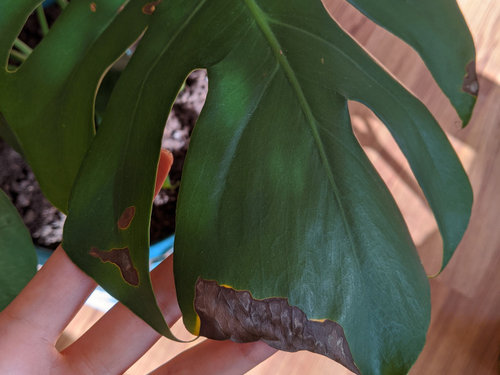
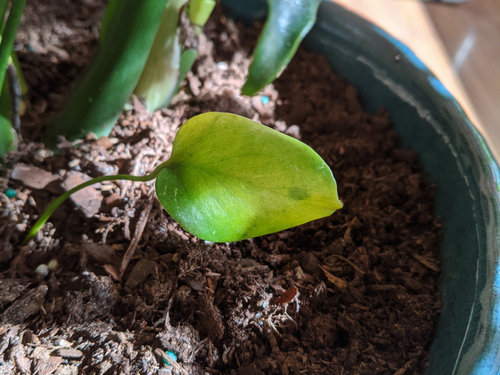
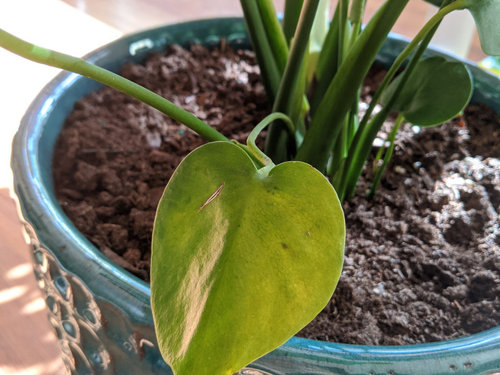
Hello!I recently got my Monstera from Home Depot about a week and a half ago and she was in a pretty rough shape. Some of her leaves were ripped, yellow, and there were brown crispy spots but I didn't really mind.

I placed her in front of an east facing window since I don't have any good north or south windows, so she's receiving pretty strong direct sunlight through a window.

When I looked online, I thought she was overwatered since she had some yellow green leaves (some of them I cut off) so I didn't water her for a week after the initial watering. But now I'm not too sure when I should water her, because she seems to have both overwatered and underwatered symptoms??

Overwatered: the yellow leaves, droopy leaves, her soil is also still not entirely dry, it is still damp on the inside.

Underwatered: brown crispy spots that are growing, crispy edges, droopy leaves

What could be the problem? There are so many factors I'm not sure what could be making the crispy spots grow and making the leaves yellow :(((Thank you so much!!


Pls ge

Comments (4)

  • 6 years ago

    I think the problem is the direct sunlight, it may be causing the brown, crispy spots, and if it gets too hot, the plant can dehydrate even though the soil is still moist. I think that might be it. Tell me if it gets better by placing the monstera a bit further from the window!

    If you wanna know more about the optimum conditions of your monstera you should really check this post: Monstera Deliciosa - How to make it love you back!

    Jubin Kim thanked The Growing Plants
  • 6 years ago

    The dead spots aren't going to fix themselves. Trim them out or cut the entire leaf off. Putting it outside for summer will do it wonders.

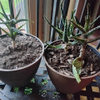
    These are the tops that have been living in this red trug since last October when they broke off taking the mother plant indoors. I do have to empty the rain water every week or two to keep mosquitoes down. This was last month.

    I don't take a lot of pictures of it (kind of plain looking) so this was back in 2016. Minimal care.

    2014 - it is still in the same pot today and I have to cut all the aerial roots that have rooted into the ground when I bring it back inside in late October.


    Jubin Kim thanked hc mcdole
  • 6 years ago

    Hi, Kim. It would be helpful if you reject commonly repeated advice to water when the top inch or two of soil is dry and start using a 'tell' to 'tell' you what's going on at the bottom of the pot in terms of moisture levels where it counts. I'll leave you with a couple of short pieces I wrote about bad watering advice and using a tell. Also, this thread that provides An Overview of Good Growing Practices might be very helpful, too.

    ************************************************************************

    Water when the top inch or two of the soil column is dry?

    Most
    growers unfamiliar with how water behaves in container media are
    prone to repeating the title mantra. But let's look at some facts. A
    saturated or partially saturated medium is limiting in a number of
    ways.


    Roots
    need an ample supply of oxygen in order that roots can function
    normally. Saturated soil surrounding roots limits oxygen required to
    drive root function, thereby impairing root efficiency and possibly
    setting the stage for any of a number of fungal pathogens that thrive
    in anaerobic (airless) conditions.


    Soil
    saturation limits gas exchange, so waste gases like methane and CO2
    in the root zone are less able to leave the soil, also limiting root
    function


    Soil
    saturation kills the fine roots that do the lion's share of work
    involving water uptake and nutrient distribution. When this occurs,
    chemical messengers tell plant central injury to the root system has
    occurred. Top growth stops immediately, because root growth always
    precedes top growth – the top will not grow if the roots cannot
    support the growth with water/nutrients. The plant is then forced to
    regenerate dead roots, using energy which otherwise would have been
    devoted to additional top growth, keeping the plant's systems
    orderly, keeping the plant wearing a 'healthy glow', and improving
    the plant's ability to defend itself. In short, the wasted energy
    would have kept the plant looking/ growing better, and healthier.


    If
    a pot is 10” deep, the top 2” can feel completely dry to the
    touch, even while the bottom 6” is 100 saturated. That means 60% of
    the medium would be fighting you tooth and nail for control over the
    plant's vitality …… and this is the point at which you should
    water again? Does that sound reasonable? We don't care even a whit if
    the top 2" of the soil are dry. Roots there are largely plumbing
    and anchorage, with essentially none of the fine almost microscopic
    roots that do the lion's share of the plant's heavy lifting.


    Ficus
    species are all good at retaining water in their roots in case of
    drought. That doesn't mean you should test them to see what they'll
    tolerate, but it does mean you can and should let the soil dry down
    so you can only detect moisture (by using a 'tell') in the bottom
    inch or two of soil. Let me know if you're unfamiliar with the term
    'tell'.


    ***********************************************


    Using a 'tell'

    Over-watering saps vitality
    and is one of the most common plant assassins, so learning to avoid
    it is worth the small effort. Plants make and store their own energy
    source – photosynthate - (sugar/glucose). Functioning roots need
    energy to drive their metabolic processes, and in order to get it,
    they use oxygen to burn (oxidize) their food. From this, we can see
    that terrestrial plants need plenty of air (oxygen) in the soil to
    drive root function. Many off-the-shelf soils hold too much water and
    not enough air to support the kind of root health most growers would
    like to see; and, a healthy root system is a prerequisite to a
    healthy plant.

    Watering in small sips leads
    to avoid over-watering leads to a residual build-up of dissolved
    solids (salts) in the soil from tapwater and fertilizer solutions,
    which limits a plant's ability to absorb water – so watering in
    sips simply moves us to the other horn of a dilemma. It creates
    another problem that requires resolution. Better, would be to simply
    adopt a soil that drains well enough to allow watering to beyond the
    saturation point, so we're flushing the soil of accumulating
    dissolved solids whenever we water; this, w/o the plant being forced
    to pay a tax in the form of reduced vitality, due to prolong periods
    of soil saturation. Sometimes, though, that's not a course we can
    immediately steer, which makes controlling how often we water a very
    important factor.

    In many cases, we can judge
    whether or not a planting needs watering by hefting the pot. This is
    especially true if the pot is made from light material, like plastic,
    but doesn't work (as) well when the pot is made from heavier
    material, like clay, or when the size/weight of the pot precludes
    grabbing it with one hand to judge its weight and gauge the need for
    water.

    Fingers stuck an inch or two
    into the soil work ok for shallow pots, but not for deep pots. Deep
    pots might have 3 or more inches of soil that feels totally dry,
    while the lower several inches of the soil is 100% saturated.
    Obviously, the lack of oxygen in the root zone situation can wreak
    havoc with root health and cause the loss of a very notable measure
    of your plant's potential. Inexpensive watering meters don't even
    measure moisture levels, they measure electrical conductivity. Clean
    the tip and insert it into a cup of distilled water and witness the
    fact it reads 'DRY'.

    One of the most reliable
    methods of checking a planting's need for water is using a 'tell'.
    You can use a bamboo skewer in a pinch, but a wooden dowel rod of
    about 5/16” (75-85mm) would work better. They usually come 48”
    (120cm) long and can usually be cut in half and serve as a pair.
    Sharpen all 4 ends in a pencil sharpener and slightly blunt the tip
    so it's about the diameter of the head on a straight pin. Push the
    wooden tell deep into the soil. Don't worry, it won't harm the root
    system. If the plant is quite root-bound, you might need to try
    several places until you find one where you can push it all the way
    to the pot's bottom. Leave it a few seconds, then withdraw it and
    inspect the tip for moisture. For most plantings, withhold water
    until the tell comes out dry or nearly so. If you see signs of
    wilting, adjust the interval between waterings so drought stress
    isn't a recurring issue.

    Al


    Jubin Kim thanked tapla (mid-Michigan, USDA z5b-6a)
  • 6 years ago

    If it came in a heavy ceramic pot, it makes it hard to feel the weight difference between "heavy after just watering" vs. "Getting very light and dry so it's time to water". It's very helpful when you can feel the difference.

    Angled early morning direct sunlight might not be too harsh if it's only a few hours and the rest of the day is indirect bright light. All day direct sunlight is too much!

    Jubin Kim thanked katrina foxworthy
Sponsored
The Creative Kitchen Company
Average rating: 5 out of 5 stars52 Reviews
Columbus Area Kitchen Remodeling and Refacing Professional