Software
Houzz Logo Print
mytemporaryacct

Fruit tree - where and how to bury compost around ?

6 years ago
last modified: 6 years ago
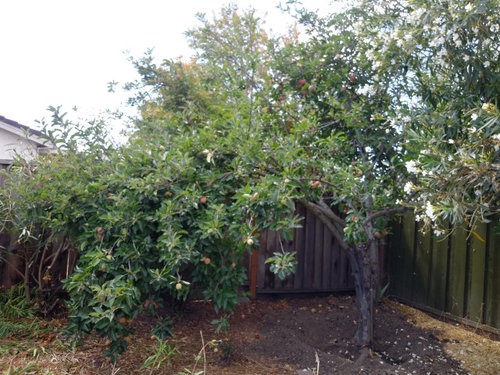
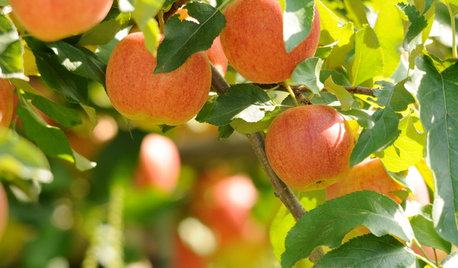
As you can see from the following image, my apple tree is in a corner of garden. It has been neglected (along with soil) for over 20 years, and received only water on occasions. Soil is 80% clay, and has not been taken care. In past couple of years, i have taken to gardening and learnt much on internet. Applying all that i learnt, and decided to improve the soil as well as feed the fruit trees in the process. This apple tree is about 13 feet tall, with branch spread of about 18 feet. I do not know what kind it is, but produces fruits that are about 2 inches in diameter.

I have two questions on my mind.

  1. I get regular kitchen waste, that i am starting to compost and bury in the garden. Had good results with trench composting it in my raised bed last year. Should i simply dig around the tree and bury the kichen waste (semi composted) OR should i install few in-soil half-buried composting towers around the tree, and feed my kitchen waste into the towers regularly ? (If composting towers, i am going to bury them to
    1 feet deep, and the PVC pipe would be atleast 6 inches diameter with 1/4 inch holes in it). I am worried that tree roots will find their way INTO the composting towers, and ruin them.
  2. How far out from the main trunk, should i dig for my trench composting process ? I have learnt from experts (like This old House show etc.) on internet that fertilizing too close to the trunk is not good. Considering that tree being in a corner, can i dig a semi-circle trench around the tree OR should i be doing a circle around the tree ? There is only about 6 feet between tree and the fence corner.

Any other suggestions are welcome, considering that i am planning to start vegetable garden soil, about 10 to 15 feet away from the trunk of this tree.


Comments (28)

  • 6 years ago

    BTW, i dug around the trunk, as suggested by experts on internet, and found the main roots. Also cut out the shoots that were trying to come up from the base of trunk. I am supposed to leave the main roots exposed to air (for about 6 inches or so, from the trunk). This would result in a dug out around trunk, which possibly would fill with water in rainy season. Mulching around the tree is to be avoided according to THIS OLD HOUSE show. Suggestions about this are also useful, to set up mulch around this tree. Thanks.

  • 6 years ago
    last modified: 6 years ago

    You can make the compost elsewhere and use it to mulch the whole bed the tree is in. Don’t dig trenches amongst the roots. Don’t pile any more soil over the root flare. How do the fruit taste? If they’re only 2” in diameter it sounds more like a crab apple. In which case no amount of care will make it much bigger or sweeter.

  • 6 years ago

    The apples are averaging 2" without any fertilizer for 3 decades, and they taste ok (since i have been watering in past couple of years, atleast for summer/ fall). If i had cared for the tree, i feel the fruits would go to 3 inches on average. They are neither bad nor real sweet (like the ones i buy at store).


    As far as composting, i don't like maggots, and once i get maggots in my container (takes about 10 days of kitchen waste), i like to bury it. Some friends suggested putting soil on top of my compost bin, in order to prevent flies from reaching into it. So, i shall try that next time and see if i can really make compost above ground (without maggots, which is absolute NO from my wife).


    Meanwhile, i still need to figure out where to fertilize the roots, and find out how far apple tree roots can spread. But, i found very little information online, other than one site that says typically the roots will go about 1.5 to 3 times the canopy of the tree. I am hoping this article will hit an expert in the field, who knows for sure the averages (since, there is each tree is different in its rooting, and the soil also factors in ). My soil has been tested and it is low in Nitrogen and Potassium, high in Phosphorous. That is where my fruit trees lived for decades, and now i am improving the soil with my trench composting.

  • 6 years ago

    If you have a tree that needs some nutrient attention, then trench composting would not be how I'd attempt to address it....far too much potential for root disruption, which could be more harmful than not, for too little benefit. I'd just use a commercial fertilizer at the appropriate time, sprinkled around at the dripline. While finished compost does provide some nutrient benefit, it is NOT a fertilizer. If you need specific nutes, then use a product that will provide what you need.

    And I'd have to question some of the advice you garnered from other online sources. I have never heard of leaving roots exposed for 6 inches. As long as the tree is planted at the proper height - and if the tree is in reasonable health after 20+ years, that is a relatively safe assumption - there is no need to dig out and expose the roots. And mulching trees is never something to be avoided! You just want to avoid piling it up against the trunk or creating mulch volcanoes. You can use your finished compost for that but unfinished or fresh/trenched material takes too long to be converted and release what small amounts of nutrients it contains.

    All trees have the majority of their roots, especially the fine feeder roots that supply oxygen, water and nutrients, spreading horizontally just below the soil surface. And for well established trees, they will extend well beyond the dripline. When/if you apply a standard granular fertilizer, start at the dripline and work outwardly from that point.

  • 6 years ago

    Literally the first time I've heard don't mulch around an apple tree. Not right up to the trunk obviously but under the canopy, go for it. If it's been neglected, the more the merrier (within reason). Mixed wood chips fine. If you can time it to cover the windfalls, free organic fertilizer and soil life. Cover whatever partially rotted stuff you don't mind having there under the mulch too. Leaves also good. You will still probably have to add fertilizer per soil test, but adding into mulch should be more effective.

    A small amount of soil work under the tree probably won't kill it, but trench composting and the like will harm the roots and hurt the tree. Seriously don't do this. I'm not a pro but in my experience mature apple trees do fine nutrition wise with lots of own organic matter (leaves and windfall left in place for example), which to me implies organic matter like mulch is not an issue at all. I think good soil life way more important.

    sam (SF bay, 10a / Sunset 16) thanked armoured
  • 6 years ago

    Ah, that is probably what happened. Since it was unattended, there was always some amount of fallen apples and leaves / branches under that tree, providing some amount of decomposed material to the soil. Since it was heavy clay, there was always retained water available too. I do see the major roots few inches below the surface, at about 6 feet from the trunk. I got educated enough (spending countless hours on youtube, watching other gardners) , and hence i was planning to be very careful not to disturb these major roots, while i dig for trench composting. But, as per consensus here, i will just mulch ( but not the 6 inches around the trunk) and buy some fertilizer spikes to feed it for a year.


    Planning to cut down the california oleyander tree next to it, since it was there only to provide foliage privacy for the fence area. That maybe taking up much of the soil nutrients away from the apple tree. This oleyander has grown to be 30 ft tall, and is becoming a useless addition to my planned vegetable gardening + fruit trees that maybe useful in 10 years or less.

  • 6 years ago

    BTW, what is that little flag that appears on the bottom right of all comments in a thread ? IS that to flag a response as problem (to the moderators ?). Just curious ....


  • 6 years ago

    "and buy some fertilizer spikes to feed it for a year."

    Don't use spikes. They are a very inefficient fertilize delivery system, designed primarily for the convenience to the gardener, not to maximize the benefit to the tree. Just use a regular granular fertilizer.

    And it is important to time the fertilizer application properly. On the west coast you can do so in fall after leaf drop or in early spring just before bud break.

    And this is just a very nit-picky aside but fertilizers are not "plant food" and applying fertilizers is not "feeding" :-) Plants feed themselves/manufacture their own food through the process of photosynthesis. All fertilizers do is supply nutrients needed for this process that may be lacking.

  • 6 years ago

    Going back to the maggot issue. That should not happen. A compost heap made of a mix of materials (kitchen waste, lawn mowings, leaves, weeds, paper, garden waste, etc ) won’t smell or attract flies. 10 days worth of kitchen waste is only the beginning of a compost heap. And a kitchen caddy usually needs emptying daily. So, if you want to continue with trench composting, which is fine, do it somewhere else, not under the apple, or any other, tree.


    The flag is for flagging comments. If you click on it you’ll see the options.

  • 6 years ago

    Actually soldier flies and their larvae (maggots) are very common in compost piles here in the US. The adult flies prefer to lay their eggs on dead or decomposed vegetative organic matter so they naturally gravitate to exposed compost. And as they are some of the most efficient decomposers of dead organic matter - raw compost - they are a desirable addition. They actually feed on the larvae/maggots of other bothersome flies, like blow flies or houseflies. They also have an ability to 'purify' or decontaminate compost by removing pollutants and pathogens like ecoli and salmonella.

    These maggots are a good thing!!😊

  • 6 years ago
    last modified: 6 years ago

    Aha. No soldier flies here.

  • 6 years ago

    chadinlg - As you correctly guessed, i never pruned the tree, up until this year, when i cleared up the central area for sunlight. Since i can not do all at once, every year, i need to prune a bit and clean up this tree. Thanks for pointing this out.


    Great suggestions , as always, from garden forum here. I will follow all the feedback i got from this. For composting, i was using a big box from HD, and closed it with lid, but somehow the fruit flies found a way in. Next time around, i will be careful and cover it with a tarp or something (since i use bokashi brans and do anaerobic composting in that box). Will close out this thread, after i a month or two, adding some comments about how my composting turned out based in this new system & suggestions here.


    Yes, i would have to close out the soil around the base of tree, since i am afraid rain water will get trapped in there, during January rains here. Will put back soil, but leave few inches free around the trunk of tree (and possibly fill that area with compost mulch).


    Gardening is so much fun, i wish i had discovered this when i was a bit younger. Oh well, wisdom dawns only with age and experience, i suppose :-)

  • 6 years ago

    I think trying to keep fruit flies out of an outdoor bin is a waste of time and effort.

    sam (SF bay, 10a / Sunset 16) thanked armoured
  • 6 years ago

    I hope your big compost box has some holes in the bottom to drain. And it will need some way for air to get to the pile which means holes in the sides or lid, and voila, fruit flies.


    With mainly kitchen waste going in, I've found the best thing to add is either dried leaves (saved from last fall) or sawdust/wood shavings. I'm fortunate to have a woodshop so I have plenty of sawdust. If you can find a woodworker or woodshop that would give you some, it's great for absorbing moisture so the pile is not too wet, and covering the pile to keep out flying insects. Also it has a bonus of absorbing nitrogen, so if the pile is giving off any ammonia or odors, it sucks those up too.

  • 6 years ago

    Gardengal,


    Just to clarify on one of your posts.....


    The suggestion in "This old House" youtube clip was to leave some inches of root flare exposed (partially) to the air. From that video it looked like about 4 to 6 inches of flare was left exposed, but we can not be sure, since it is a 2 dimensional video clip. I saw the top part of the root flare exposed, but the bottom half or so was going into the ground. But, as per chatinlg in this thread, i will not worry much about air exposure & moisure issues, since we have a pretty good air and soil quality here in SF bay area. It feels like it is more important than i do not leave a dug out structure around the trunk (as currently in the picture).

  • 6 years ago

    Got it :-) However, that advice - which is indeed very sound - applies to newly planted trees. You cannot go back 20 or more years after the fact to correct!! If your tree had been planted too deeply originally, the issues that this would raise would long ago have been realized.

    It is often difficult to get a proper sense of how and why for certain gardening practices from just a video clip, even from sources that typically offer accurate horticultural knowledge. The point TOH was trying to make is that trees should be planted initially with the root flare at or slightly above the soil surface. This is to prevent the root ball being buried too deeply, depriving the root system of necessary oxygen, which can hamper establishment or even kill the tree. As I mentioned, had this been an issue, it is unlikely the tree would have survived so long....failure usually occurs in just a few years, if not sooner. As time goes on, mulch, debris, soil migration and all sort of other factors can bury or disguise the root flare clearly from view but since the roots have already established themselves, there is no adverse effect.

  • 6 years ago

    I was taught that flies are one of the signs that your compost is nitrogen heavy and wet. Adding carbon is the solution. It sounds like your compost has little to no carbon if it’s just kitchen scraps. Can you add newspaper or cardboard?

  • 6 years ago

    Yes kltasel2, I also remembered that, and today added lot of shredded brown bags and some white paper and tossed it. There was wetness from the all the fruits of summer time,
    and that will be absorbed now.


    Fortunately, the maggots have vanished, to my happiness. It must have been the other tip i got from internet (ie. sprinkling in a few tablespoons of turmeric powder over the 10 gallons of compost i had in the box). Unlike last year, i noticed the maggots soon (when there were less than 30 of them), and it has been controlled now. I also squeezed some lime juice (since i have lots of rotting lemon available), which is the other tip i got from someone.

  • 6 years ago

    There seems to be mention of two types of flies. I was referring to fruit flies, whose offspring will usually be too small to notice. I find them nothing more than a mild annoyance when dumping stuff in and outdoors not worth worrying about. If there are other types of flies with large writhing maggots, perhaps a different story. A thick layer of paper or sawdust will reduce fruit flies but they'll be back. But they don't bite and a cover usually keeps them reasonably contained,so why worry. In my bin dont have much overlap between fruit flies and other types, but perhaps different climate.

  • 6 years ago

    Earlier in the thread you mentioned bokashi and a volume of 10 gallons. This is a very different method from a normal outdoor compost heap. The latter is much more straightforward to manage but 10 gallons would be too small a volume. So are you doing indoor bokashi or outdoor traditional?

  • 6 years ago

    Regarding the flies..... Last year i had seen the big maggots (which i actually saw turn into black soldier flies, and fly away ). This is how i came to the conclusion that the popular and widespread notion on the internet that maggots are not harmful in a composting process is "quite likely wrong idea". WHY ? Because, any nutrient that the maggot consumes (to become a fly), is actually nutrient that literally flies away from the nutrient content of a compost pile. When i saw 30% of my compost last year to be maggots, i realized i had lost 30 percent of nutrient content - this is why i decided to bury them all before they all flew away.


    This year, i covered up the bin with a something, and was careful not to expose the bin to flies for long time. But the fruit flies found their way in,and the maggots were about 1 cm long, before i extinguished them with turmeric powder. This is a debatable topic, hence i kept my theories to myself before. I am sure there are many here, who will disagree with this theory.

  • 6 years ago

    Floral,

    currently, the composting is going well. Though i keep my compost outside in a bin, it is mostly anaerobic in a large container with a lid on it. I don't turn it more than twice a week or so,and the bokashi bran speeds up the composting process ( this is my anecdotal observation in limited time ). I was not adding an "browns" before, but fixed that issue with recent paper shredded additions. It is not an authentic bokashi process, but i simply add the brans because it helps a bit. Friends of mine who have compost tumbler also report maggots, so i never got a tumbler, and opted for the bin instead. The bin also keeps the smell contained, because i tend to go overboard with the kitchen waste and often forget the "browns".

  • 6 years ago

    You’re wise not to get a tumbler. They’re expensive and by most reports we see here they rarely work well. A simple aerobic pile of about a cubic yard, contained in something like a wire mesh enclosure, pallet bin or just a free standing heap is the easiest method and least likely to go anaerobic (= smelly) or to attract flies. Does your bin have the necessary air holes?

  • 6 years ago

    Bokashi is of course anaerobic so I understand your keeping it closed. But I think if you gave it some drainage holes for the excess moisture, things might be better. Bokashi is not supposed to smell, so I think it is not quite compost but not quite Bokashi either.

  • 6 years ago

    :-) True toxcrusadr. Its neither aerobic nor anaerobic, but is getting decomposed. The juice that is forming at the bottom is getting absorbed by the shredded paper that i added. I plan to continue adding paper shredded, cause it is heavy on nitrogen, and hence the smell. Not much air gets in or out, but there is a bit of air when i close the lid, which gets used for couple of days, before i turn the pile. Intention is to bury this anyways, when i find time and accumulate enough partially decomposed material. It will take less time to fully decompose once within the soil.

  • 6 years ago

    Sounds like a plan. Like we always say, "observe and adjust," and find what works for you.

  • 5 years ago

    I am about to cover up the 2 feet radius around the root of this tree. As you can see in the picture, there is a drop of 1 ft from ground level, where the major root branches are going under the ground. Therefore, Ideally, the ground around this tree should be 1 feet below what it is right now, for proper breathing by the root system there. I gathered this information by watching multiple experts on the internet.


    So, now the question is how should i mulch and cover this u shaped bowl for upcoming winter ? Leveling the ground around it will take too much work that i can not put in before the rains start. The two options i am considering are

    1. Put fine wood mulch (pine bark) around the root system (2 feet wide bowl, 1 feet deep). This will create breathing space for the root system. Then cover the whole circle there with weed fabric and cover the weed fabric with a small layer of soil.
    2. Cover the whole thing with soil + mulch combination (which is what this tree had for 3 decades) and just don't worry about further care.


    Separately, i am also wondering how to deal with the small trees that are trying to crop up from the back side (not seen in picture) of the tree, where i notice that the root system has grown into ground level. I am having to constantly cut out the saplings that are trying to come up from that area of the root, trying to develop into further trees). I have root kill liquid, but afraid to use it even in minor dilution onto this area of the root.


    Thanks for your comments.