Software
Houzz Logo Print
lecarter83

Geothermal cooling and heating

5 years ago
We are considering the purchase of a 1935 2-story brick home that has geothermal heating and cooling, installed ~2002. (Florida) The units are in a 9x9 partial basement. The in-ground "loops" are under the driveway. I imagine it is a closed loop system but no one seems to know at this point. Getting information has not been easy. The current owners have lived there for 12 years and tell a story of no problems with the house. We love the house and have been looking for a long time, but we want to make sure we aren't walking into some expensive issues. (Or at least offer an amount that will account for some major expenses in the next few years. )


1.) We found it odd that the homeowner has a dehumidifier running all of the time in the partial basement that houses the electrical panel, water heater, and the heat pump. There is also an oscillating fan running at all times in the crawl space next to this area. Is this something that signals a red flag?


2.) The unit in the basement seems undersized for the square footage. It is 2.5 tons for 2400 sqft. Is it a big deal to just put in a larger unit?


2.) The unit in the main house basement and the smaller unit in the detached apartment are both very noisy. Is that OK? (I have read that they are supposedly quiet.)


3.) The electric bills for the current owner seem pretty high given the fact that geothermal is supposed to be so efficient. We've been to the house 3 times and it is never actually cool inside. Is this a sign that the unit is not working properly?


Has anyone had to replace their in-ground loops? What questions should I be asking?


My husband thinks we would be better off converting to traditional air conditioning, but I don't know enough about geothermal to know what to think.


Our agent says to get the house under contract and then have people look at it... then we can always renegotiate or back out of the deal. We prefer to have a clearer understanding of things before making the offer.


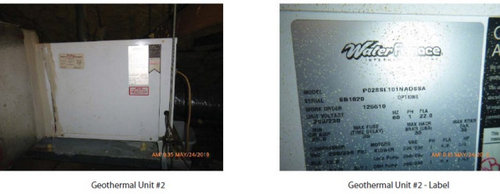
This is the unit in the partial basement in the main house:


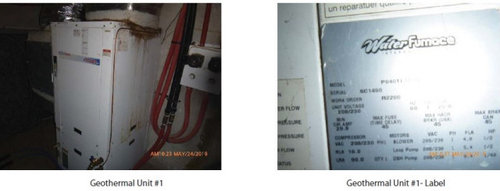
This is the unit in the detached apartment:


Any information, suggestions, advice will be appreciated!


~Lesley


Comments (4)

  • 5 years ago

    You need to call out an HVAC company familiar with this equipment to give you an assessment. Advice on an internet forum from anonymous people, whether in or not in the business, isn't going to answer the good questions you have.

    Lesley C thanked Elmer J Fudd
  • 5 years ago

    Water Furnace is a known name in these units. I'm not surprised running a dehumidifier constantly in Florida. If the ground loop doesn't leak, leave it alone. The ground loop and inside unit are sized to match. You won't be able to greatly change the unit size. You'll have to get an HVAC contractor to give you an opinion on noise and function. Maybe the current owners like it warmer than you do. 2 1/2 tons seems low. Is the system also adding heat to domestic hot water?

    Lesley C thanked Seabornman
  • 5 years ago
    last modified: 5 years ago

    Unfortunately your pictures are very low-res, poorly exposed & very incomplete.

    Unit 1 looks like a nominal 3.5 ton HP and in very rough shape. I would want to know why it’s so rusted out. That’s not normal!

    Unit 2 looks like it might be supported from above in an attic. It looks like a nominally 2-ton HP.

    You did not mentioned where this house is located and as a result it’s not possible to determine much more about capacity that is dependant on average annual ground temperature that varies even within the state.

    It’s just a guess but I would estimate that there is about 500-feet total (I would hope minimum) of vertical borehole if the ground loops are vertical.

    This is the rest of the data that was retrievable from the pictures.

    Unit 1 is incomplete due to the poor image but likely also has a ‘Cupronickel’ Heat Exchanger as well - that is a higher quality heat exchanger and a very good thing for a higher resistance to corrosion.

    EWT would be the average Entering Water Temperature that is unknown as I don’t know the city it’s in.

    Unit 2 - Model: 028

    27,500btu at 86˚F EWT 15.7EER

    28,600btu at 77˚F EWT 16.9EER

    No Desuperheater (DHW generator)

    ECM Blower

    Cupronickel Heat Exchanger

    No Sound Kit

    1-inch pleated disposable filter

    Unit 1 - Model: 040

    39,700btu at 86˚F EWT 16.7EER

    41,000btu at 77˚F EWT 18.0EER

    Now for some possible good news, even if both these units are toast as I expect they might be - the ground loops are not. They can be flushed and reused with modern, more efficient geothermal heat pumps. You would not need antifreeze in your ground loops as there is virtually a zero percent chance of freezing in Florida - unless Hell freezes over. The ground loops might have the capacity to support 5-tons of cooling, perhaps even more.

    If this were my house I would definitely be reusing those ground loops once they could be verified as still serviceable. You could install a pair of Waterfurnace Series 5 HP that would likely be able to supply all your air-conditioning, heating (if required) and most of your domestic hot water at an operating price lower than anything else that provides active heating and cooling.

    If you buy the house try to get a reduction in price due to the HVAC system ‘unknowns’ and age. This looks like either a poorly installed or poorly maintained system - or both! The most important element is the size and condition of the ground loops. Call a Waterfurnace dealer to see what can be done. There might be tax credits or rebates even on geothermal replacement units.

    “1.) We found it odd that the homeowner has a dehumidifier running all of the time in the partial basement that houses the electrical panel, water heater, and the heat pump. There is also an oscillating fan running at all times in the crawl space next to this area. Is this something that signals a red flag?”

    Not necessarily odd if this is an ‘unconditioned’ part of the house.

    “2.) The unit in the basement seems undersized for the square footage. It is 2.5 tons for 2400 sqft. Is it a big deal to just put in a larger unit?”

    Yet to be determined.

    “2.) The unit in the main house basement and the smaller unit in the detached apartment are both very noisy. Is that OK? (I have read that they are supposedly quiet.)”

    Specs indicate , ‘No Sound Kit’.

    “3.) The electric bills for the current owner seem pretty high given the fact that geothermal is supposed to be so efficient. We've been to the house 3 times and it is never actually cool inside. Is this a sign that the unit is not working properly?”

    Yes, it might be!

    “Has anyone had to replace their in-ground loops? What questions should I be asking?”

    Ask for any & all documentation pertaining to the purchase, design, commissioning of and maintenance records for this system.

    Ground loops would have to be flushed and pressure tested. If the pressure held, the loops are good. Measuring the volume of water removed once loops are confirmed completely filled should reveal the size of the loops.

    “My husband thinks we would be better off converting to traditional air conditioning, but I don't know enough about geothermal to know what to think.”

    If the loops can be salvaged, I would say no to traditional air-source HPs.

    “Our agent says to get the house under contract and then have people look at it... then we can always renegotiate or back out of the deal. We prefer to have a clearer understanding of things before making the offer.”

    Agreed - but hire a geothermal expert for the geothermal evaluation - not just a knowledgable accredited House Inspector or general HVAC contractor - This requires a very special expertise! You will likely get the purchase price reduced enough to more than cover the inspection costs.

    Waterfurnace Series -5

    IMPO

    SR

    Lesley C thanked fsq4cw
  • 5 years ago

    You can enjoy all these benefits by installing a geothermal heating and cooling system in your home.

    https://wwwductless-mini-split-air-conditioner.org/


    Green

    Geothermal heating and cooling system is environmentally friendly. In fact, it was recognized by the U.S. Environmental Protection Agency as the most environmentally-safe heating and cooling system. It consumes very little electricity to move heat energy into your home. It doesn’t burn fossil fuels either.


    Lower utility bills

    As compared to traditional heating systems, geothermal heat pump simply moves heat from one place to another. It also requires a lot less energy to cool your home since the temperatures underground remain a relatively constant 50 degrees F year-round.


    For those who are looking for ways to reduce their energy cost, a geothermal system would be a great option for you. In fact, it allows you to save 20-50% on your cooling cost and 30-60% on you heating cost. However, you also need to consider the upfront cost. A geothermal system is quite expensive. Depending on the site accessibility, system configuration, plot size, and soil conditions, it costs about $10,000 to $30,000. This is why a lot of homeowners are hesitant to install it in their home.


    Longevity

    The average lifespan of the HVAC system is between 13 and 15 years. Geothermal systems, on the other hand, usually last for about 24 years. If properly maintained, it can even last for up to 50 years. As compared to ordinary systems, it only requires periodic checks and very little maintenance. This system may be more expensive upfront, but you’ll get more bang for your buck with the extended service life.


    Safety

    Unlike traditional heating systems, geothermal system does not rely on fossil fuel energy. Rather, it uses free, renewable energy sourced from under the ground. That means, there is no risk for explosion, carbon monoxide poisoning or toxic fumes, and no combustion gases. The safety of your home increases by using geothermal HVAC system.


    There are three common sounds you hear from an air conditioner while it’s working: the hum of the fans, the whir of the compressor, and the drip of water moisture. The dripping water comes from the evaporator coil of the indoor unit; as warm air crosses the cold coil, water vapor condenses on the coil as it absorbs the heat. This excess moisture then drips down into a shallow pan, where a pump draws it down a drain and into the wastewater system of the plumbing.


    If your air conditioning is working as it should, you won’t encounter trouble from the moisture in the system: the condensate drainage system will take care of it. But trouble can develop—algae blocking the drain, broken or loose drain line, burnt-out pump—leading to issues like water overflowing the pan or dripping out the bottom. This could even stop the AC from turning on. Should you notice water leaking from your AC, call for repair technicians right away to investigate and remedy it before you incur costs to repair water damage in your house.


    Lesley C thanked Mini-Split Warehouse