Software
Houzz Logo Print
b_cz10

Feeding soil through winter

5 years ago
last modified: 5 years ago

Was thinking about all of the tips for cold zone rose growers to stop fertilizing in September or so, to let the roses get ready for winter. I was wondering if using organic fertilizers like Rosetone or Neptunes Harvest, until hard, constant freezes (Nov/Dec) would actually strengthen the plants, either to get ready for winter this fall, or to have your soil in great condition for Spring, when the roses wake up? Or both? Wouldn't these fertilizers that apparently "feed soil" be good to use up until winter? Help the roses get as much 'food' as possible to be strong and make it through winter, and whatever is left is in the soil for spring.

I've noticed since I stopped fertilizing with rosetone and neptunes about a month, or month and half ago, the roses have less growth, more yellow leaves, and some with yellow leaves/black spots (mostly toward the bottom of the plants). Can't help but think they'd like some 'food' to help them. The mulch has also depleted on top of my beds, so I am adding the rest of my leftover tree bark mulch pile today and then will get more mulch for winter protection.

This is still my first season with roses, so maybe I'm completely wrong. Any thoughts?

Comments (17)

  • 5 years ago

    My thoughts exactly. When the temps finally get out of the 90s, and the spot diseases slow down and the Japanese beetles are finished, my roses finally have a chance to grow some leaves to feed them for winter storage. (I don't spray or use any fungicide/insecticide.) They quickly use up whatever is left in the soil and then the leaves and fall flush of flowers get smaller and smaller. Even though I try to space out my fertilizer schedule it always seems I get delayed by rain or drought or ghastly high temps so I never get that end of August last fertilizing. Technically our first frost date is supposed to be the first week of October but they've pushed that to the middle of the month now. I have been tempted to do a fish/kelp drench later than the end of August but I do see a flush of growth immediately after using fish/kelp so that foliage would be very tender to early frosts and might cause the plant to try and push out more growth from the damage which could weaken the base plant. It's a quandary I have not resolved in 40 years.

  • 5 years ago
    last modified: 5 years ago

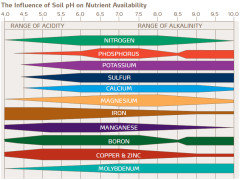
    Brendan: what's your rainfall in Sept, Oct. and Nov.? pH of rain is 4.5 and low pH is enough to make nutrients less available, see below chart. Nutrients are still there, but they are not available with drop in pH due to tons of acidic rain. Remember the gorgeous spring flush of Khalid's roses in Pakistan (like over 100 blooms per Austin rose) .. when the monsoon (all-month-rain) of July came, all his roses lost 1/2 of leaves, smaller leaves & smaller blooms and less-petals blooms, also yellow & pale leaves due to sulfur less available. Then he fertilized his roses, and they quickly recuperated. Yes to fertilize with HIGH CALCIUM and potassium .. these are the 1st one to get leached out with acidic rain. Sulfur is also leached out, and that is supplied through organic matter. But NO to fertilize with nitrogen, that causes green-growth which will get killed by frost. Potassium & calcium will thicken canes and roots for better winter-survival in zone 5. I don't use granular fertilizer with nitrogen like Rose tone, and I don't use soluble with nitrogen during cold fall, but I use composted horse manure (rich in calcium & potassium & phosphorus and trace elements, but no nitrogen).


    Bc _zone10b thanked strawchicago z5
  • 5 years ago

    Straw, I read that it’s good to add some nitrogen to leaf piles in bed to help them decompose. Do you disagree?

  • 5 years ago
    last modified: 5 years ago

    @strawchicago z5 Great points, thanks! I was reading what might have high calcium/potass without nitrogen and came upon azomite. Maybe I should try sprinkling that around all my rose beds. Still have a big bag of it in my garage, here's what I found:

    "Most conventional fertilizers contain mainly Nitrogen (N), Phosphorus (P) and Potassium (K), which are called macronutrients. Plants require macronutrients in large amounts. NPK are only three of the essential nutrients required by plants. When choosing a fertility program, growers often neglect trace minerals and focus primarily on NPK. For plants to complete their life cycle and produce at full potential, a wide range of trace minerals is necessary. AZOMITE is a naturally-occurring source for nutrients that does not harm the environment and is OMRI-Listed for use in organic production."


    "Can too much AZOMITE BE TOXIC


    No. AZOMITE is 100% naturally-derived and completely free from fillers. It is not chemically altered and its natural, nontoxic composition will not harm plants or the environment."


    This is all from Azomite.com website of course....so I have to read more for gardeners finds with it-

  • 5 years ago

    @lkayetwvz5 -I'm not sure too. I don't really think that feeding something like fish/kelp would lead to an unnatural excess of nitrogen/new growth to die from winter. But maybe it dos. I wouldn't really expect any new growth to survive anyways tho, so as long as we feed and promote strong new growth like Straw is saying, it should be fine. Plus I feel like the soil in new beds especially, can use all the help it can get

  • 5 years ago

    Thanks Seil! I think I actually have some of your helpful comments about feeding the soil saved. This all makes sense and goes with what I was thinking, that getting the roses as strong and high-fed before winter will help them getting started in the spring. Appreciate it

  • 5 years ago

    Curious what people think of using coffee grounds on top of soil over fall/winter. I know there is an NPK element to them, so I don't want to push the roses too much. Thing is, I've been saving all of my coffee grounds and have a big container of it. It's getting moldy so I'm either going to dump it in the garbage or spread around the rose beds. Maybe it will help the soil and worms? Any thoughts?

  • 5 years ago

    I sprinkle coffee and tea all winter. I figure the worms like it

  • 5 years ago

    Intetesting thoughts on Azomite

    I have never heard of it before

    Is this something available at a place like the Grange ?

  • 5 years ago

    @oursteelers 8B PNW wonder if I can throw it on the beds even with mold forming. Maybe this moldy batch will go to garbage and I'll recycle the next batch


    @Kristine LeGault 8a pnw - Azomite was at my local Agway in a decent size bag. I plan on trying it a bit more next year, this year I was a little hesitant since all of my roses were new. There are some youtube vids on it

  • 5 years ago

    Thank you I will check it out. I have tons of babies this year.

  • 5 years ago

    I do it even with mold, don‘t know if that‘s good or bad

  • 5 years ago

    In zone 5b I'm guessing your temperatures are starting to drop? The cold will probably kill off the mold in not too long if you put it outside.

  • 5 years ago

    Also, for what it's worth, I keep feeding and fertilizing until the snow is deep and the ground is frozen, because I never know how and when winter is going to hit. I haven't been at it very long, only 6 years, but I've only lost 2 roses to winterkill in that time, so I'm calling it a success to keep feeding them.

  • 5 years ago

    The mold is fine put it on your beds. I wouldn't worry about the pH either. By the time it's composted its essentially neutral. A pot of it isn't that much.

  • 5 years ago

    @joeywyomingzone4 - Thanks for the info. I noticed this month when I didn't put down rose tone or feed the plants, they're all starting to deal with yellow leaves or blackspot. I know those are weather related too, but I think I will try feeding them until the snow is covering like you said. Can't tell what the best idea is yet, but having them strong and ready for winter is my goal......


    @Vaporvac Z6-OhioRiverValley Thanks, I'll throw some around. Just didn't want to deal with nitrogen levels going up randomly. DIdn't realize it had so little effect on the soil, makes sense. Also the coffee seems to help keep the small critters away